Powerhouse B2B Lead Generation Landing Page Template
Pipeline is a sidebar companion landing page template built for B2B marketing agencies that specialize in demand generation for mid-market SaaS companies. It pairs a press-ticker header, a twelve-question frequently asked question-driven scroll, and a persistent sidebar call to action into one restrained, editorial layout that earns trust before it ever asks for a meeting.
by Rocket studio
Quick summary
Pipeline is a single landing page template designed for B2B demand generation agencies serving mid-market SaaS clients. The layout uses a sidebar companion structure: a scroll-linked table of contents on the left, a rich frequently asked question-driven content column in the center, and a persistent playbook download call to action pinned throughout. The entire page speaks directly to VP Marketing hires, Revenue Operations leads, and SaaS CEOs who need answers fast.
Who this template is for
This template is built for a specific kind of agency. It works best when your firm already knows its target audience well and needs a landing page that reflects that clarity back to prospective customers the moment they arrive.
- B2B marketing agencies that run demand generation programs for mid-market SaaS companies and need a landing page that communicates depth without a bloated pitch deck.
- Demand generation strategists and agency principals who want a resource-rich, frequently asked question-driven format that generates qualified leads through education rather than pressure.
- Boutique strategy shops positioning against both scrappy freelancers and large holding companies, who need a landing page that signals enterprise-level thinking without enterprise-level overhead.
What problem this template solves
A generic agency landing page does not work for sophisticated B2B buyers. Decision makers evaluating a demand generation partner are calculating buyers. They are weighing multiple options, reading between the lines of every claim, and looking for proof that an agency actually understands their situation. Most agency landing pages fail this test because they lead with credentials instead of clarity.
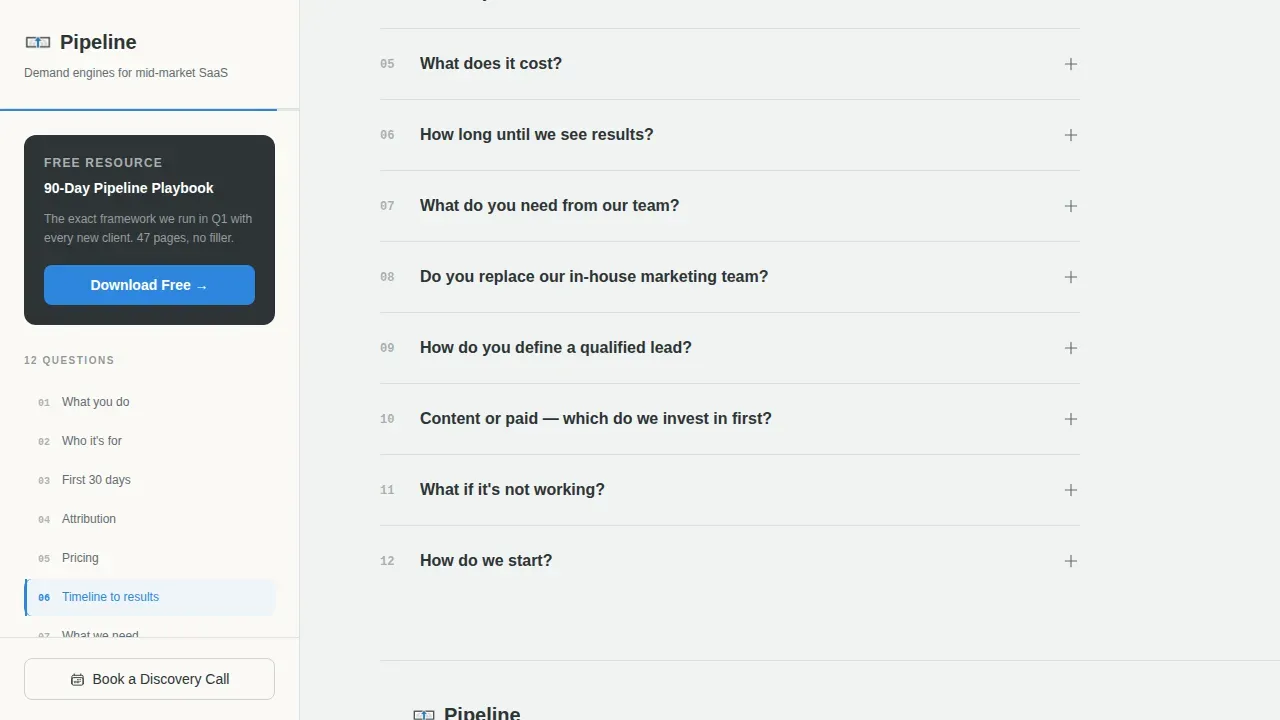
The Pipeline template solves this by restructuring the entire page around the twelve questions every VP Marketing asks during a first call. Instead of a traditional hero image and services grid, the landing page becomes a conversation. Each question is a section header. Each answer delivers enough value to make the next question feel safe to ask. The result is a landing page that earns trust by giving insight before asking for anything in return.
- Eliminates the cold sales pitch dynamic by replacing it with an honest, question-led format that speaks directly to each visitor's real pain point.
- Reduces friction for high-intent visitors by letting them jump straight to the question burning hottest in their mind, rather than forcing them to read the entire page from top to bottom.
- Converts passive browsers into playbook downloaders by embedding contextual secondary calls to action inside every frequently asked question answer, so capturing leads happens naturally throughout the scroll.
What you get with this template
This template gives you a fully structured landing page with every major section pre-built and ready to customize. The layout is opinionated by design. It makes specific choices about hierarchy, spacing, and flow so you do not have to start from scratch.
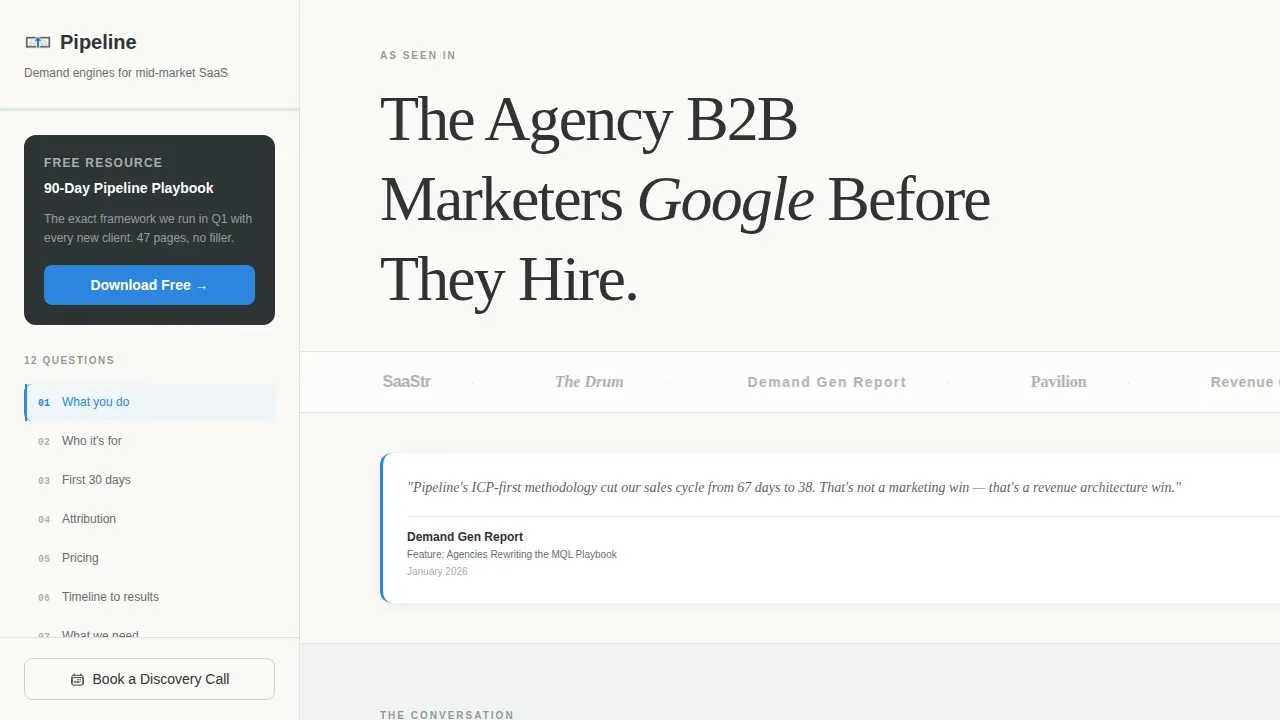
- Press ticker header with a scrolling logo bar, an editorial serif headline, and three dated pull-quote cards that function as prominently displayed trust signals from the first scroll position.
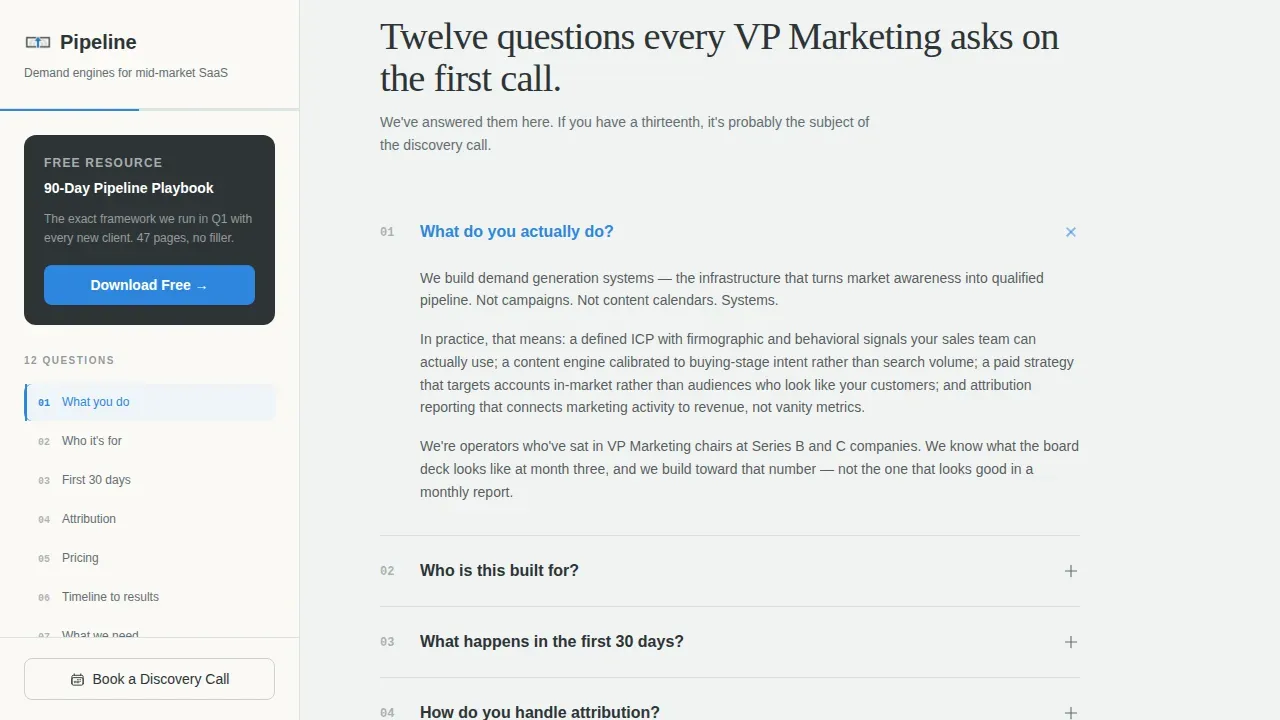
- Twelve-section frequently asked question content column where each question becomes a rich answer block, complete with placeholder space for timeline graphics, downloadable framework links, and contextual secondary call to action placements.
- Persistent sidebar holding a scroll-linked table of contents, a pinned primary call to action for the 90-Day Pipeline Playbook download, and resource thumbnail slots for related content.
Feature list
This section describes the core capabilities built into the Pipeline template. Every feature described here is present in the template as delivered.
Press Ticker with Editorial Header
The header section replaces a traditional hero image with a horizontally scrolling publication logo bar rendered in charcoal monochrome. Below the ticker, a single serif headline sets the editorial tone, followed by three pull-quote cards on linen-white backgrounds. Each card includes a publication name and date, grounding social proof in specificity. This structure gives the landing page instant authority without relying on a photograph or a generic tagline. The press ticker creates recognizable client logos-level credibility from the very first visible section of the web page.
frequently asked question-Driven Content Column
The main content column is structured as twelve question-and-answer sections. Each question functions as a heading. Each answer opens into a rich block of copy, graphic placeholders, and secondary call to action links. The rhythm mimics a real client conversation, building trust incrementally so that every answer makes the next question feel natural. This format is ideal for longer sales cycles, where decision makers need more than a headline and a button before they are willing to share their work email.
Scroll-Linked Sidebar Navigation
The sidebar holds a persistent table of contents that tracks progress as the visitor scrolls. Each frequently asked question section is listed by question title. Active state highlighting shows visitors where they are on the page. This design lets high-intent visitors jump straight to their most pressing concern without scrolling through irrelevant sections. The sidebar nav is a practical tool for busy decision makers reading between meetings on a laptop.
Pinned Playbook Download Call to Action
The primary call to action, "Download the 90-Day Pipeline Playbook," is pinned in the sidebar throughout the entire scroll. The form requires only a work email and company name, limiting form length to reduce friction. This concise lead form approach keeps the conversion goal clear and avoids overly complex forms that discourage submission. The download call to action is always immediately visible, no matter how deep a visitor scrolls into the frequently asked question content.
Contextual Secondary calls to action Inside frequently asked question Answers
Every frequently asked question answer section contains a secondary call to action. These link to a related template, benchmark report, or recorded teardown. This transforms the landing page into a resource library structured as a conversation. Each secondary call to action is relevant to the answer it follows, so it feels like a natural next step rather than an interruption. This approach keeps website visitors engaged and supports generating qualified leads across multiple intent levels.
Cloud Canvas Color System and Executive Suite Typography
The visual identity uses four colors: boardroom charcoal (#2D3436), pressed-linen white (#FAF9F6), soft cloud gray (#DFE6E9), and a single decisive blue (#2E86DE) reserved exclusively for links, active states, and the primary call to action. The sidebar sits on linen white. The main column breathes on cloud gray. Typography pairs Fraunces serif headlines with DM Sans body text, creating a matte, editorial feel that signals confidence without visual noise.
Page sections overview
| Section | Purpose |
|---|---|
| Press Ticker Header | Scrolling publication logos plus editorial headline establish instant authority |
| Pull-Quote Cards | Three dated press quotes function as prominently displayed social proof |
| frequently asked question Section Block | Twelve question-and-answer sections deliver demand generation insight and capture interest |
| Sidebar Table of Contents | Scroll-linked nav lets visitors track progress and jump to any question |
| Pinned Download call to action | Persistent playbook offer in sidebar keeps the conversion goal always visible |
| Secondary call to action Links | Contextual resource links inside each frequently asked question answer support lead generation throughout scroll |
| Footer Row | Linear single-row footer closes the page cleanly without overwhelming visitors |
Design & branding system
The Pipeline template uses what the design brief calls an Executive Suite theme. The visual language is intentionally restrained. Nothing competes for attention. The palette and typography work together to feel like a freshly printed strategy document on heavyweight stock.
- Color system: Boardroom charcoal (#2D3436) for text and monochrome logos, pressed-linen white (#FAF9F6) for the sidebar and card backgrounds, soft cloud gray (#DFE6E9) for the main content column, and decisive blue (#2E86DE) used only for interactive elements and the primary call to action. This restraint prevents visual clutter and keeps design strategies focused on conversion.
- Typography: Fraunces serif for all editorial headlines, DM Sans for body copy and interface labels. The pairing feels authoritative and readable without being formal to the point of coldness.
- Spacing and layout: Generous margins in the content column signal confidence. The sidebar is visually separated but always present, creating a dual-column layout that rewards desktop readers while remaining navigable on mobile devices.
Mobile & speed optimization
The Pipeline template is built desktop-first, reflecting the real behavior of its target audience. A VP Marketing reading this landing page is almost certainly on a laptop. That said, the layout is built to remain fully usable on mobile devices for visitors browsing on the go.
- Responsive column stacking: The two-column sidebar-plus-content layout collapses gracefully on smaller screens. The sidebar table of contents moves to a sticky top bar or collapsible menu, keeping navigation accessible without overwhelming visitors on narrow screens.
- Static-first architecture: frequently asked question content sections use a static-first rendering approach with client-side interactivity reserved for the sidebar and accordion expand-collapse behavior. This keeps the core landing page content load fast, supporting the technical performance needs of a B2B landing page without sacrificing interactivity.
- Minimal animation footprint: Ticker scroll, frequently asked question accordion expansion, and sidebar progress tracking are the only animated elements. Each animation serves a functional purpose. None add decorative weight that would slow down the page or distract from the conversion goal.
How this template helps you convert
A well designed landing page does not convert by being loud. It converts by being useful at exactly the right moment. The Pipeline template is built around a clear conversion architecture that serves both the playbook download goal and the longer-term discovery call pipeline.
- Trust is built before the ask. The press ticker and pull-quote cards establish social proof and trust signals above the fold. A visitor who arrives skeptical sees recognizable credibility signals before they read a single word of body copy. By the time they reach the first frequently asked question answer, they are already leaning in. This is how a high-converting B2B landing page builds credibility with decision makers and enterprise clients without relying on a hard sales pitch.
- The scroll rewards attention. Each frequently asked question answer delivers real, actionable insight. Demand generation is not just mentioned, it is demonstrated. The content itself is the value proposition. By the time a visitor has read three answers, they have already received more practical guidance than most agencies put in a proposal. This makes the playbook download feel like an obvious next step rather than a transaction, and supports generating qualified leads who are already pre-sold on the agency's thinking.
- Every section has a conversion path. The pinned sidebar call to action is always there for visitors who are ready to act. The secondary call to action links inside each frequently asked question answer serve visitors who need one more piece of evidence. The linear single-row footer closes the page without distraction. This layered call to action structure respects the buyer's journey while keeping every section of the landing page pointed toward the same conversion goal.
Other information about this template
The Pipeline template fits a specific intersection of creative direction, layout style, and audience intent. Here is additional context that may help you decide if this is the right starting point for your own landing page.
- Creative direction: The frequently asked question-Driven format is particularly well suited to B2B demand generation agencies because the target buyers for these services are sophisticated readers. They do not respond to bold claims without evidence. A question-led scroll format speaks directly to how they already think, turning the landing page into a mirror of their own internal decision process.
- Content and resource delivery: The landing page direction here is Content/Resource, meaning the page is designed to deliver valuable resources as the primary mechanism for capturing leads. This differs from a pure lead capture landing page. The page functions as a resource library that happens to have a download gate. The playbook earns the click because the surrounding content has already proven the agency's thinking is worth acting on.
- Demand generation alignment: The Pipeline template reflects a clear gen strategy for agencies that need to create demand among buyers who do not yet know they need a new partner. Many mid-market SaaS companies do not initially recognize that their current approach to demand generation activities is producing vanity metrics rather than leading indicators of revenue. This landing page does market research-level education work before the first call.
- Audience and positioning: The template is designed for agencies targeting enterprise level clients and decision makers at mid-market tech companies who have outgrown their first agency. It is not for generalist freelancers or volume-play lead generation shops. The restraint of the design and the depth of the frequently asked question content signal that Pipeline works with a small number of target accounts at a time, not a high-volume pipeline.
- Lead form design: The pinned download form uses a concise lead form approach, limited to work email and company name. This reduces friction, avoids overly complex forms, and keeps the form length appropriate for a cold-to-warm conversion on a single landing page. Multi step forms are intentionally avoided here because the frequently asked question content itself does the qualification work.
- Social proof placement: Client testimonials and client logos in the press ticker section work differently here than on a standard landing page. Because they appear before the body content rather than after a pitch, they function as trust signals that prime the reader rather than seals that validate a decision already made. This is a deliberate design choice that supports higher conversion rates for skeptical decision makers.
- Reference templates and benchmarks: Well-known B2B landing page examples that use similar design strategies include pages from companies like Webflow Enterprise, which leads with a clear value proposition and minimal visual clutter, and ActiveCampaign, which uses client testimonials and social proof throughout the scroll. Monday.com uses storytelling around its project management software to highlight key benefits rather than listing features. These examples share Pipeline's approach: lead with usefulness, gate only when the value is already proven.
- Audience segmentation: The sidebar table of contents allows creating tailored experiences within a single landing page by letting each visitor segment navigate to the section most relevant to their role. A Revenue Operations lead focused on unqualified MQLs will jump to the attribution question. A VP Marketing worried about board reporting will go straight to the 30-day timeline. A SaaS CEO evaluating agency fit will look at the pricing model section first. The same landing page serves all three without overwhelming visitors with content meant for someone else.
- Sales cycle context: Because B2B demand generation agency engagements involve longer sales cycles, the landing page is built to nurture rather than close. The goal is not to convert every website visitor into a signed contract on the first visit. The conversion goal is a playbook download that begins a relationship. From there, the agency's sales outreach and discovery call process can take over with a warm, pre-educated lead rather than a cold prospect.
- Define leading indicators: One of the most common pain points for VP Marketing hires in new roles is that they need to define leading indicators of pipeline health for their board deck. The frequently asked question content in this template is designed to address exactly that need, giving visitors a step by step process for thinking about demand generation strategy before they ever book a call. This is just what a data-driven agency landing page should do: demonstrate the thinking before selling the engagement.
- B2B companies and landing page volume: Research shows that B2B companies with 30 or more landing pages generate seven times more leads than those with fewer than 10. The Pipeline template is built to be one high-performing node in a broader demand generation campaign strategy. Agencies can use it as the anchor landing page for targeted campaigns, with supporting landing pages for specific target accounts, verticals, or use cases.
- Conversion rate context: The average landing page conversion rate is 26%, significantly higher than the 2-5% conversion rate for social media. A well designed landing page with clear trust signals, a specific value proposition, and a low-friction call to action consistently outperforms social-only demand generation campaigns. The Pipeline template is built around these principles throughout its entire page design.
- Own landing page customization: When you build your own landing page using this template, the frequently asked question questions, pull-quote cards, sidebar resources, and secondary call to action links are all editable. You are not locked into the placeholder questions. Agencies serving different verticals, for example enterprise clients in fintech versus mid-market tech companies in DevOps, can adapt each question section to reflect the specific pain points their target audience actually asks about.
- Boost awareness through the press ticker: The scrolling press mentions section is designed to boost awareness of the agency's thought leadership before a visitor has read a single paragraph. Even visitors who spend only ten seconds on the page will register that this agency has been featured in recognizable publications, establishing instant authority without a single written claim.

Theme
Executive Suite
Creative direction
FAQ-Driven
Color system
Cloud Canvas
Style
Sidebar Companion
Direction
Content/Resource
Page Sections
Press Ticker Header with Pull-quote Cards
Twelve-section Frequently Asked Question Content Column
Scroll-linked Sidebar Table of Contents
Pinned Playbook Download Call to Action
Contextual Secondary Ctas in Every Answer
Cloud Canvas Executive Suite Visual System
Related questions
What type of agency is this landing page template designed for?
How does the frequently asked question-driven format help with lead generation?
Can I customize the frequently asked question questions for my own target audience?
Does the sidebar call to action remain accessible on mobile devices?
What makes this different from a standard B2B agency landing page?