DEI & Inclusion Specialist Professional Website Template
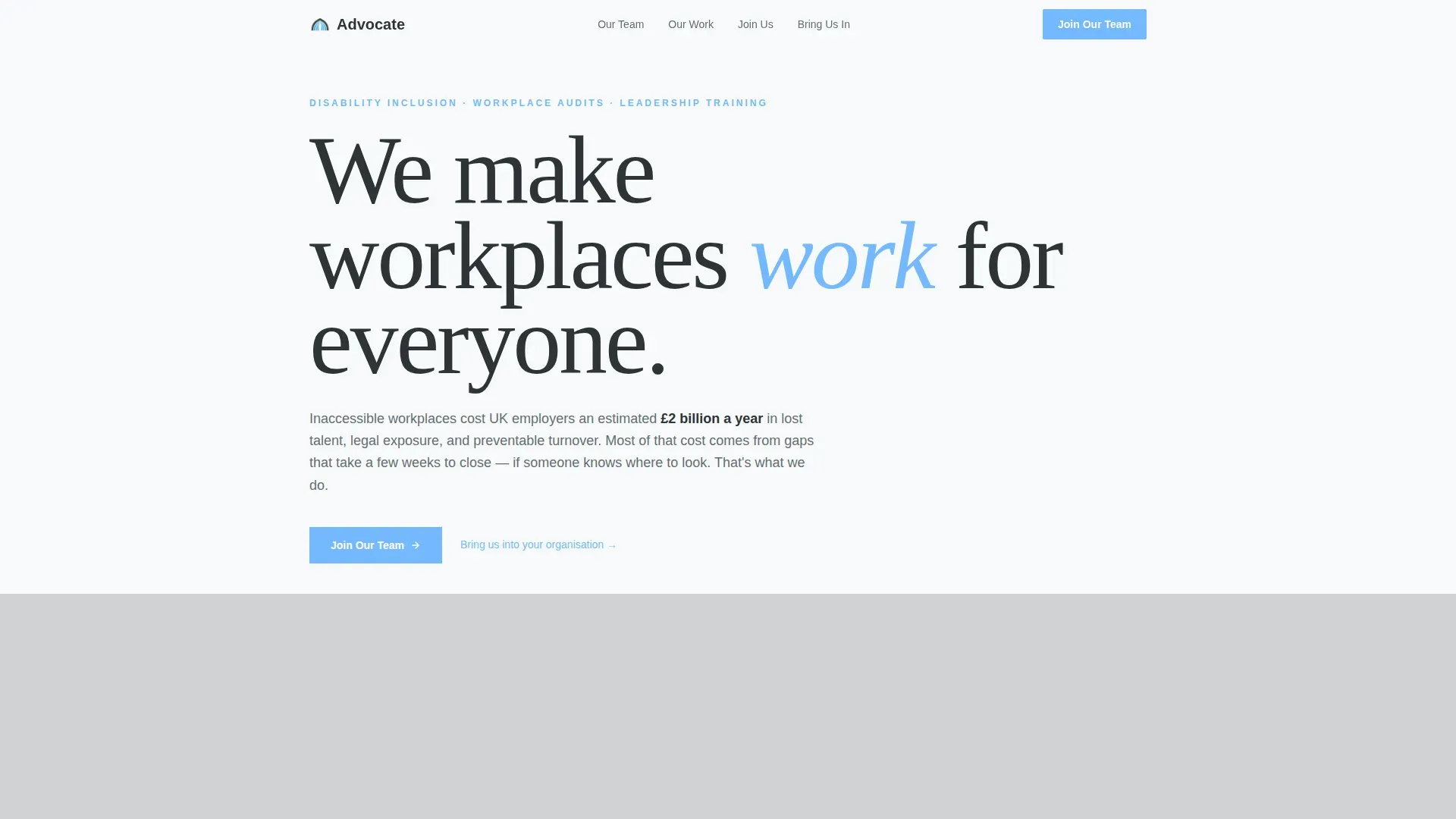
The Advocate disability inclusion consulting landing page template is a single-column flow layout built for consultancies that remove workplace barriers for people with disabilities. It leads with a logo trust bar and a bold headline, then builds credibility through team profiles, proof snippets, and a recruitment-focused application form. The design is calm, people-forward, and professionally purposeful.
by Rocket studio
Quick summary
The Advocate template gives a disability inclusion consultancy a professional, people-first landing page that works equally well for recruiting new consultants and reaching prospective employer clients. It opens with a trust bar of partner logos, introduces the team through generous profile cards, and closes with a focused application form. Every section is designed to communicate confidence, warmth, and real capability.
Who this template is for
This template is purpose-built for consultancies operating at the intersection of disability inclusion and organisational change. It speaks directly to the people doing this work and the organisations that need it.
- Disability inclusion consultancies seeking to grow their team of workplace auditors, assistive technology specialists, neurodivergent coaches, and policy drafters
- HR directors, DEI leads at large businesses, and public-sector heads of people who need to understand the consultancy's scope before making contact
- Advocacy groups, accessibility consultants, and independent practitioners who want a credible, accessible website to represent their services
What problem this template solves
Many consultancies working on disabilities and workplace inclusion struggle to communicate their value clearly online. A generic website fails to reflect the depth of the work or earn the trust of a cautious audience. This template solves that problem directly.
- It replaces abstract promises with faces, quotes, and concrete outcomes, so visitors feel they have already met the team before they apply or make contact
- It gives employer clients a secondary path to get in touch without competing with the recruitment focus
- It presents a clear and concise value proposition that explains how the consultancy fosters inclusion, satisfying the expectations of HR professionals who need evidence before they act
What you get with this template
You get a complete, single-column flow landing page developed to serve both a recruitment goal and a client conversion goal without compromising either. The layout is structured so visitors move naturally from curiosity to confidence to action.
- A hero section with a display headline, partner logo bar, and a plain-language problem statement
- A team section that alternates consultant profile cards with proof snippets, metrics, and case study moments
- A dual-path call-to-action section featuring a primary "Join Our Team" application form and a secondary "Bring Us Into Your Organization" contact link
Feature list
This template includes a focused set of features developed specifically for professional services consultancies in the disability inclusion space. Each feature supports the page's goal of building trust through people and proof.
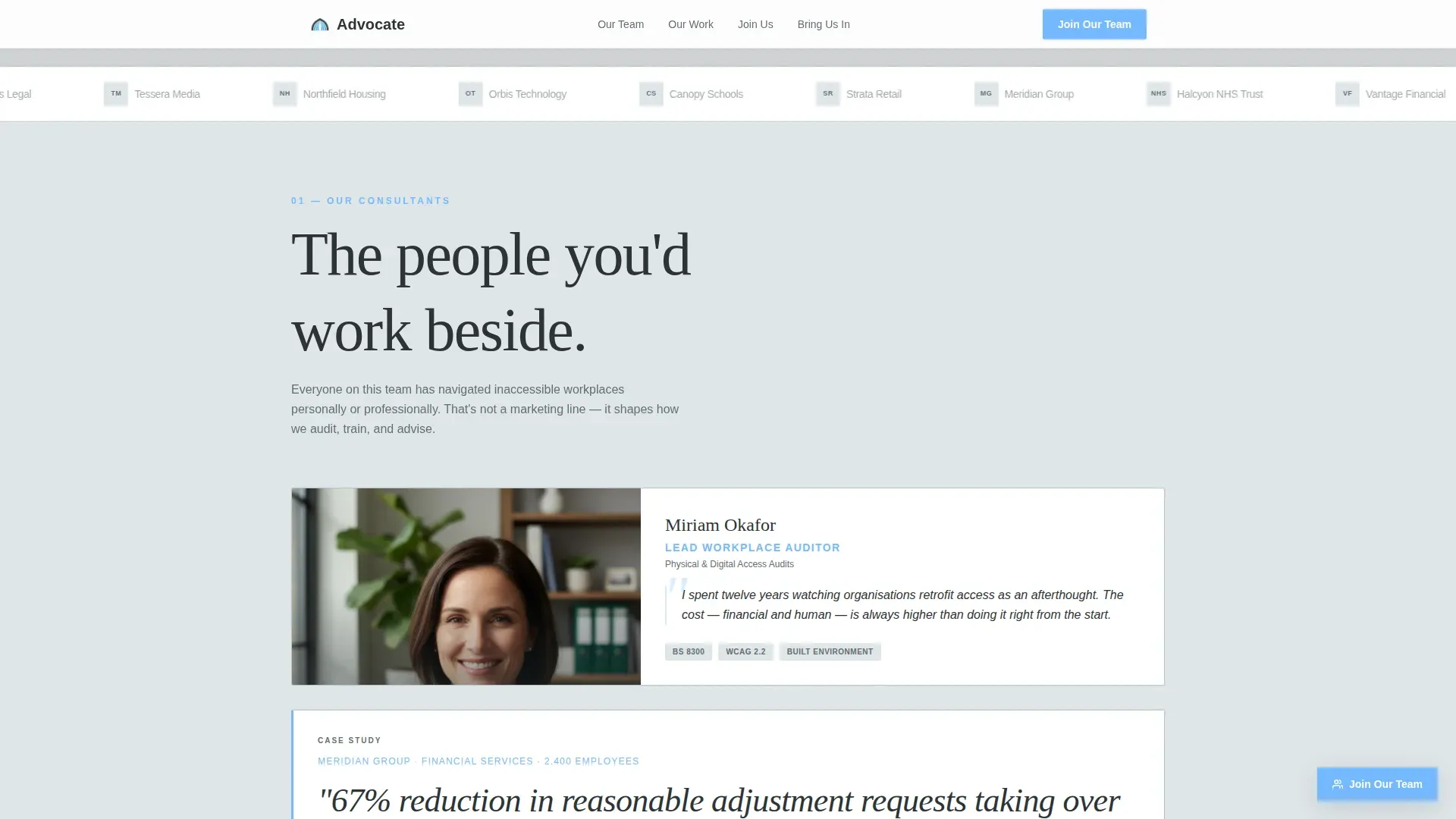
Logo Trust Bar with Partner Display
The header opens with a horizontal strip of client and partner organisation logos rendered in desaturated slate. The strip can be configured as a gentle scroll or a static row, giving visitors immediate social proof before they read a single line of copy. This is one of the most effective design elements for communicating credibility to employer clients and prospective consultants alike.
Consultant Profile Cards with Specialisms
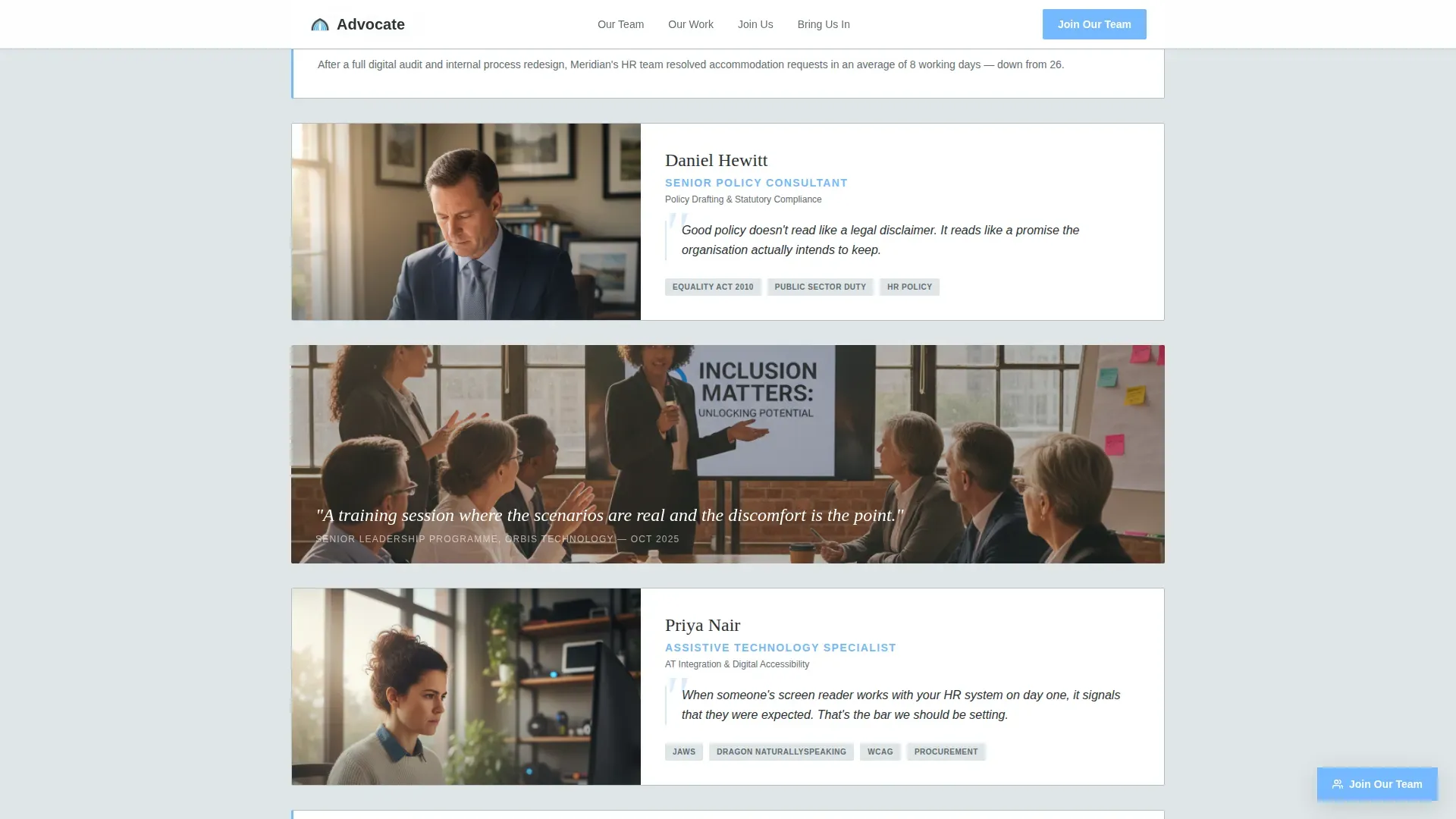
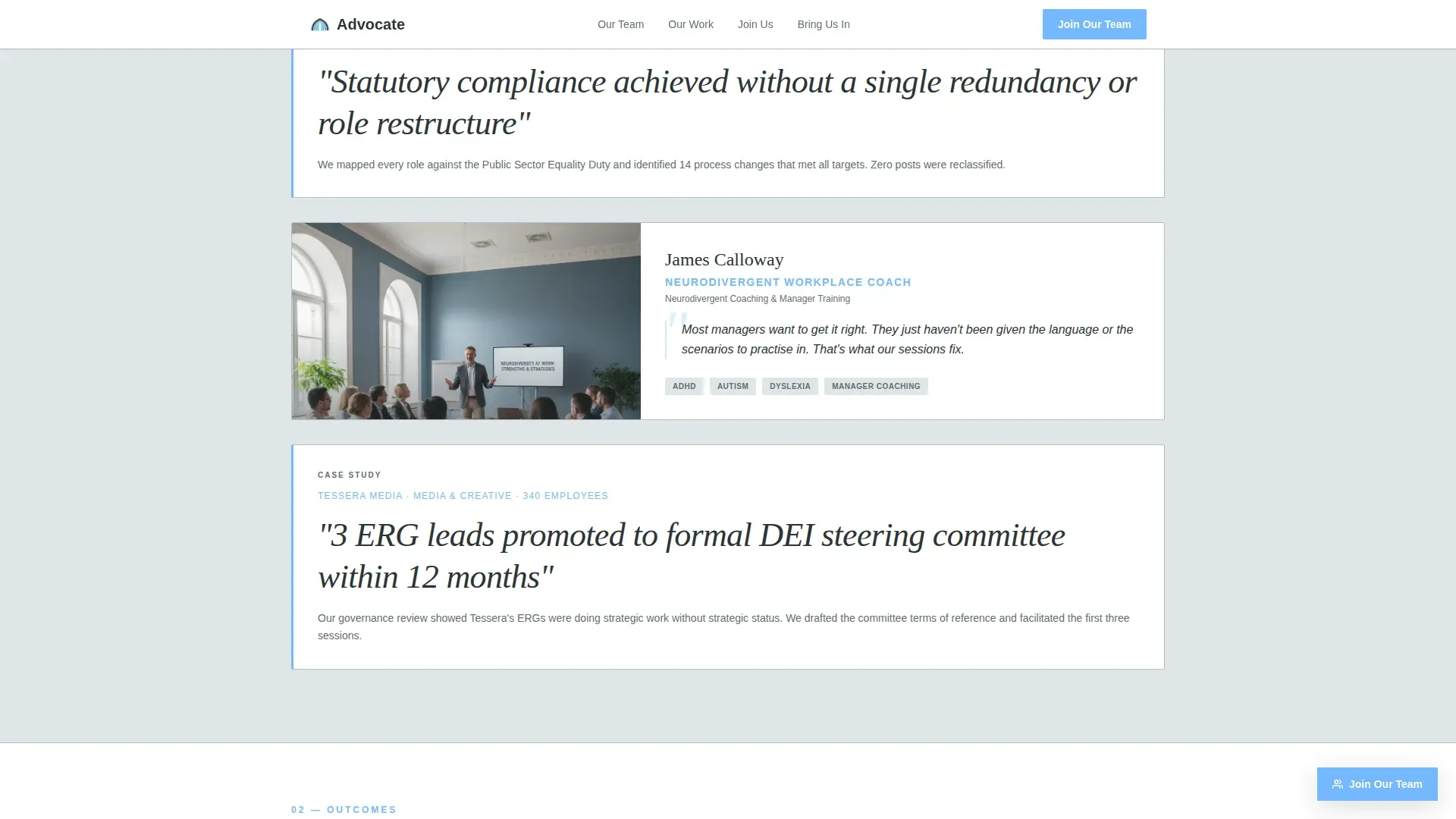
Each consultant gets a generous card showing a real photograph, their area of specialism, and a direct quote about why this work matters to them. The cards are laid out in a single-column flow that alternates with proof snippets. Inclusive imagery depicts people with disabilities in professional settings, showing their agency and independence.
Metrics and Proof Bar
A dedicated section surfaces concrete outcome statistics between the team cards and the call-to-action section. These figures give HR directors and DEI leads the data-driven evidence they need to trust the consultancy's track record and move toward making contact. Highlighting success stories with metrics is essential for any disability consultancy landing page.
Dual-Path Conversion Section
The page closes with two clearly separated conversion paths. The primary path is a "Join Our Team" application form with fields for name, email, an area-of-expertise dropdown, and an open text field asking candidates what inclusion means in their own words. The secondary path is a "Bring Us Into Your Organization" text link that routes prospective employer clients to a short contact form.
Floating Recruitment Call-to-Action Button
A subtle floating "Join Our Team" button follows the visitor down the page. It stays visible without interrupting the reading experience. This persistent prompt ensures that any person ready to apply can act at any moment without scrolling back to the form.
Testimonial and Case Study Slider
A slider component surfaces client voices alongside specific outcomes. Each slide pairs a named organisation or role with a tangible result. This format helps visitors understand the real-world impact of the consultancy's training, audit, and policy work.
Page sections overview
| Section | Purpose |
|---|---|
| Header logo bar | Establish trust through partner and client logos |
| Hero headline block | State the core value proposition clearly |
| Problem statement paragraph | Name the operational cost of exclusion plainly |
| Consultant profile cards | Introduce the team through faces and real quotes |
| Proof and metrics strip | Provide concrete outcome data between team cards |
| Case study slider | Surface client voices and specific results |
| Join Our Team form | Capture consultant applications with four fields |
| Bring Us In link | Route employer clients to a short contact form |
| Footer row | Provide navigation and contact reference |
Design & branding system
The visual identity follows a Directory and Discovery theme that feels like a clear morning seen through an office window. It is professional without being sterile and calm without being passive. The colour system is built around four values that each carry a specific role.
- Deep charcoal slate (#2D3436) for primary text, mid-tone warm gray (#636E72) for secondary copy, open sky blue (#74B9FF) for every clickable element and highlighted name, and pale cloud white (#DFE6E9) washing the backgrounds between sections
- Display type is set in Fraunces, a serif that feels unhurried and editorial; body and interface text uses DM Sans for clarity and legibility at all sizes
- Accessible design principles are built into the colour choices: the contrast between text and background aids users with visual impairments, including those who are colourblind, supporting the broader commitment to disability inclusion that the consultancy itself practises
Mobile & speed optimization
The template is built desktop-first to match how HR directors typically review consultancy websites, with full responsiveness for mobile visitors. Many prospective consultant candidates arrive on mobile, so the layout adapts cleanly across screen sizes.
- The hero fade, scroll-reveal stagger animations, and floating call-to-action button are all designed to work smoothly on mobile without affecting the reading experience
- The application form, testimonial slider, and floating button are handled as interactive client components, while static sections use server-rendered output to keep the page load experience predictable
How this template helps you convert
The page is structured to build trust progressively, so visitors are already invested in the consultancy before they reach any call to action. This approach is particularly effective for recruiting specialists in disability inclusion work, where candidates want to know who they would work beside before they apply.
- The logo bar and problem paragraph establish credibility and context in the first few seconds, so both prospective consultants and employer clients feel they have landed in the right place
- The alternating rhythm of consultant cards and proof snippets creates a scroll experience that feels like meeting the team in person, reducing the friction that typically separates a curious visitor from a completed application
Other information about this template
This section covers additional context about the template's scope and the broader ecosystem of resources and platforms relevant to disability inclusion consulting websites.
- The template is the Advocate disability inclusion consulting landing page template, a single-page layout in the HR and Hiring category under the DEI and Inclusion subcategory
- Disability websites built for consultancy purposes benefit from following accessibility standards such as the Web Content Accessibility Guidelines (WCAG). The four principles of accessibility, known as Perceivable, Operable, Understandable, and Robust (POUR), provide a useful framework for evaluating how well any website serves users with disabilities
- For screen readers to interpret the site correctly, every image should include descriptive alt text. Alt text for images helps relay visual content to users who rely on screen readers to browse. Keyboard navigation support is equally important: keyboard-friendly navigation ensures users who cannot use a mouse can still move through the entire website without hindrance
- Videos embedded in a disability inclusion website should include closed captions and transcripts to support users with hearing impairments and to assist non-native speakers in understanding video content
- Organisations looking for free templates to create disability websites quickly may find platforms like Weblium useful. Weblium offers free templates for building disability websites, featuring a drag-and-drop builder and professional design. Weblium templates include specific blocks and features necessary for disability websites
- Platforms such as Inclusively are developed to facilitate employment services and connect candidates with disabilities to inclusive employers. Inclusively allows job seekers to specify their accommodation needs in their profiles and has a network of over 950 advocacy organisations that support job seekers with disabilities. Inclusively also provides unlimited job postings for employers, a free platform for job seekers, and a community portal for sharing resources around disability inclusion
- Government agencies, educational institutions, and advocacy groups face distinct compliance requirements under legal frameworks such as the Equality Act and the Americans with Disabilities Act (ADA). A consultancy landing page that clearly communicates its services helps these organisations find the right support to meet statutory inclusion targets without reducing people to compliance checkboxes
- Other things to consider when building or customising this template include adding an accessibility statement to communicate the site's commitment to access, and ensuring that all design elements, including images, support the accessible design principles the consultancy champions
Theme
Directory & Discovery
Creative direction
Team & People
Color system
Slate & Sky
Style
Single Column Flow
Direction
Recruitment/Hiring
Page Sections
Logo Trust Bar with Partner Display
Consultant Profile Cards with Quotes
Metrics and Outcomes Proof Bar
Dual-path Conversion Section
Floating Recruitment Button
Testimonial and Case Study Slider
Related questions
Who is the primary audience for this landing page?
Can this template support both recruitment and client enquiries at the same time?
How does the template build trust with visitors before asking them to act?
Is this template suitable for consultancies working with government agencies and large businesses?
What does the application form collect from prospective consultants?