Employment & Labor Law Reviews Website Template
Advocate is a sidebar companion landing page built for ADA and disability rights law firms. It pairs a press-driven credibility header with a scrolling testimonial mosaic and a persistent sidebar screener. The result is a trust-first intake experience that converts visitors into qualified leads through a Rights Guide download and a three-question case screener, all without requiring a phone call.
by Rocket studio
Quick summary
Advocate is a single-page, sidebar companion landing page template designed for ADA and disability rights legal practices. It opens with earned press credibility, builds trust through a mosaic of real case outcomes, then offers two low-friction intake paths: a Rights Guide download and an embedded case screener. The layout prioritizes visitors who may have communication disabilities.
Who this template is for
This template was built for disability rights attorneys and ADA litigation practices that need a high-trust digital presence. It suits firms whose clients arrive scared, skeptical, or uncertain whether they even have a case worth pursuing.
- ADA and disability rights law firms serving individuals with physical, sensory, or developmental disabilities
- Attorneys handling employment accommodation denials, public access violations, housing barriers, and school district disputes
- Practices looking to replace phone-first intake with a frictionless, content-led conversion flow
What problem this template solves
Most legal landing pages ask visitors to trust the firm before giving them any reason to. Advocate flips that order. It leads with press recognition and specific case outcomes, then invites action only after trust has been built through evidence.
- Visitors with ADA violations often do not know whether their situation qualifies as a legal matter, so the case screener addresses that uncertainty directly
- Phone-first intake creates friction for visitors who are deaf, hard of hearing, or otherwise communication-disabled
- Generic law firm pages fail to reflect the specific situations of wheelchair users, deaf employees, or parents fighting school districts
What you get with this template
Advocate delivers a complete, conversion-ready landing page structured around social proof and guided intake. Every section has a defined role in moving a hesitant visitor toward a confident next step.
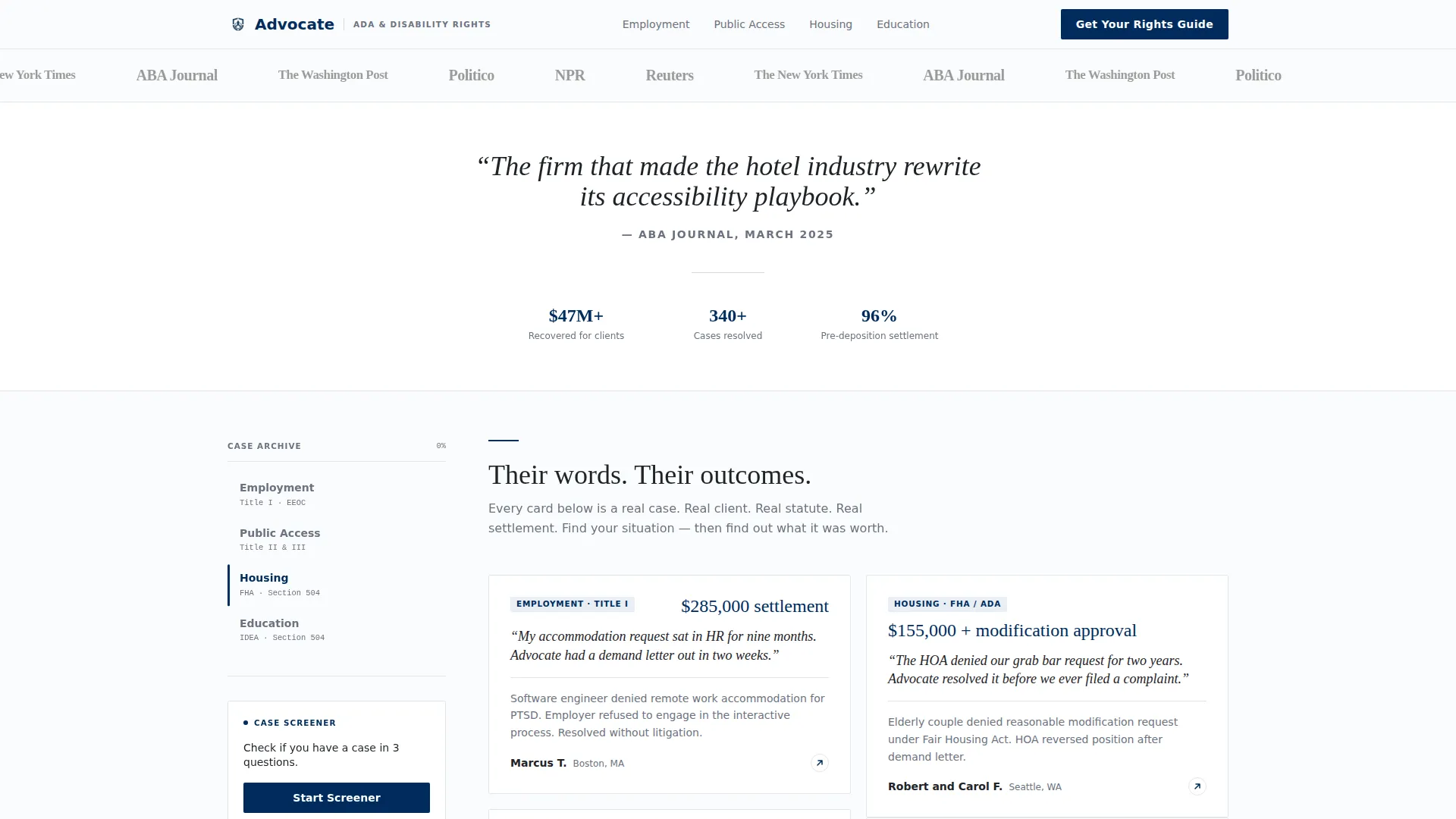
- A press mentions header band featuring grayscale media logos and an oversized serif pull-quote
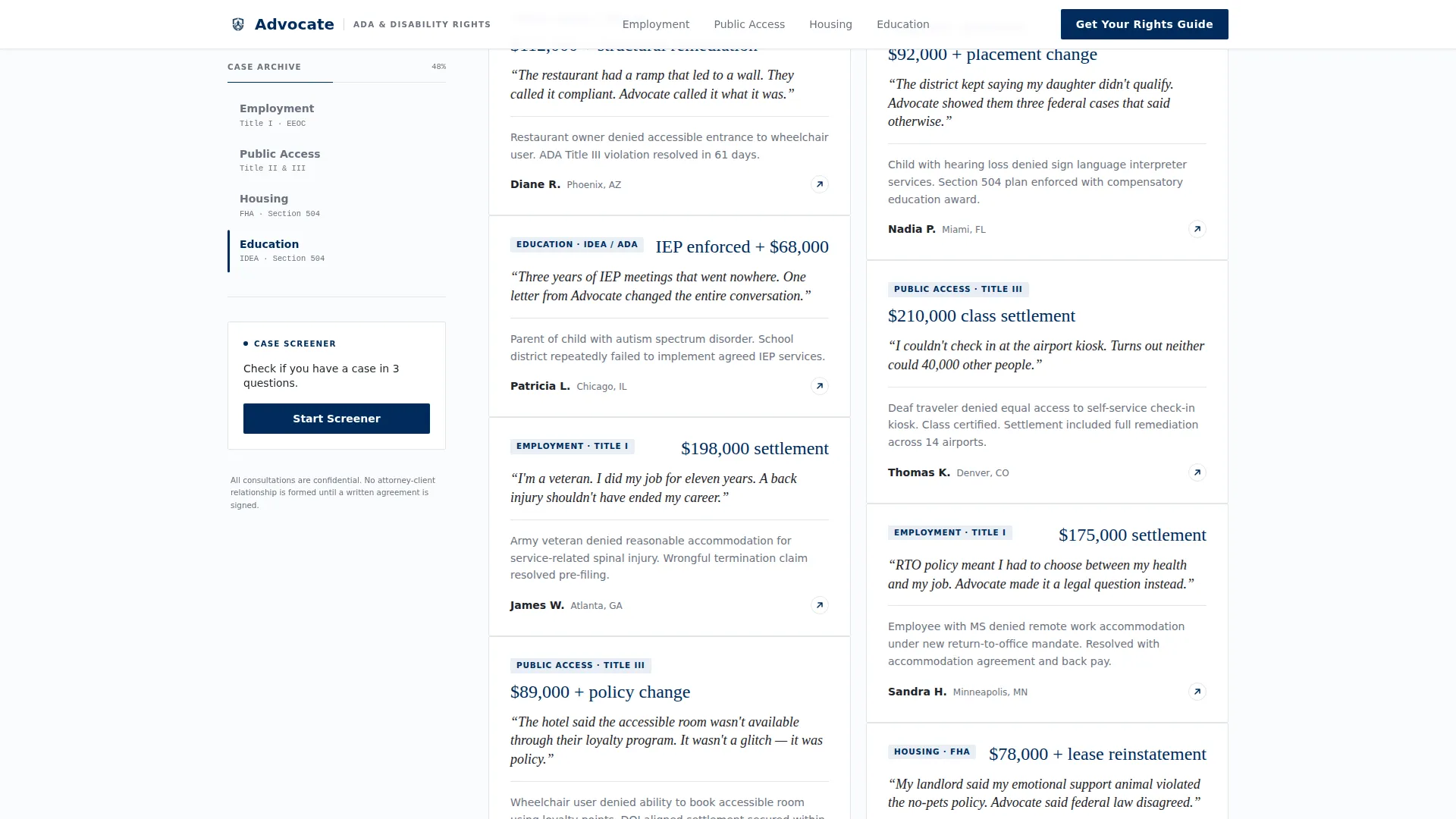
- A staggered testimonial mosaic with case type tags, settlement outcomes, and client quotes
- A persistent sidebar with scroll tracking, jump-links by case category, and a three-question case screener
Feature list
This template packages several purpose-built components, each designed to serve the specific trust and intake needs of an ADA law firm.
Press Mentions Header Band
A horizontal band of grayscale media logos sits above the fold, paired with a centered serif pull-quote from a named publication. No stock photography, no decorative imagery. Just earned recognition doing the work before the visitor scrolls.
Staggered Testimonial Mosaic
Client stories tile across the main content column in cards of varying heights. Each card carries a case type tag, a geographic detail, a settlement outcome, and a two-sentence client quote. The mosaic grows denser as visitors scroll, letting cumulative evidence build the argument.
Persistent Sidebar with Scroll Tracker
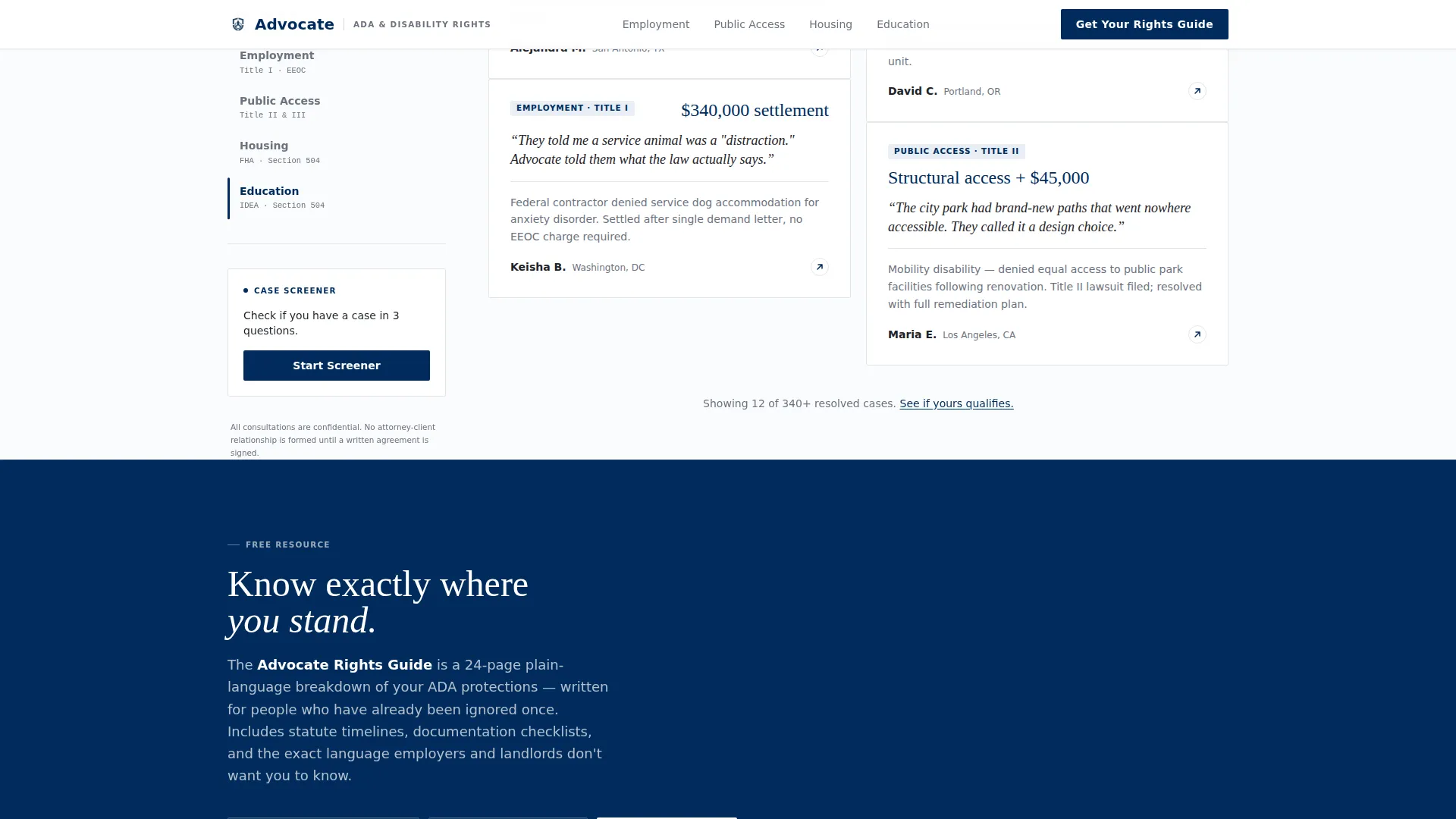
The sidebar stays fixed while the main column scrolls. It displays jump-links organized by case category (employment, public accommodation, housing, education) and updates its active indicator as the visitor moves through the page.
Embedded Three-Question Case Screener
The sidebar hosts an interactive screener that asks about barrier type, when it occurred, and whether a complaint was filed. It feeds into the intake flow without requiring a call, reducing friction for visitors with communication disabilities.
Rights Guide Email Capture
Positioned after the first cluster of testimonials, the Rights Guide download uses a single email field and an issue-type dropdown. It is the primary conversion object, placed where trust is highest in the scroll sequence.
Practice Areas Bento Grid
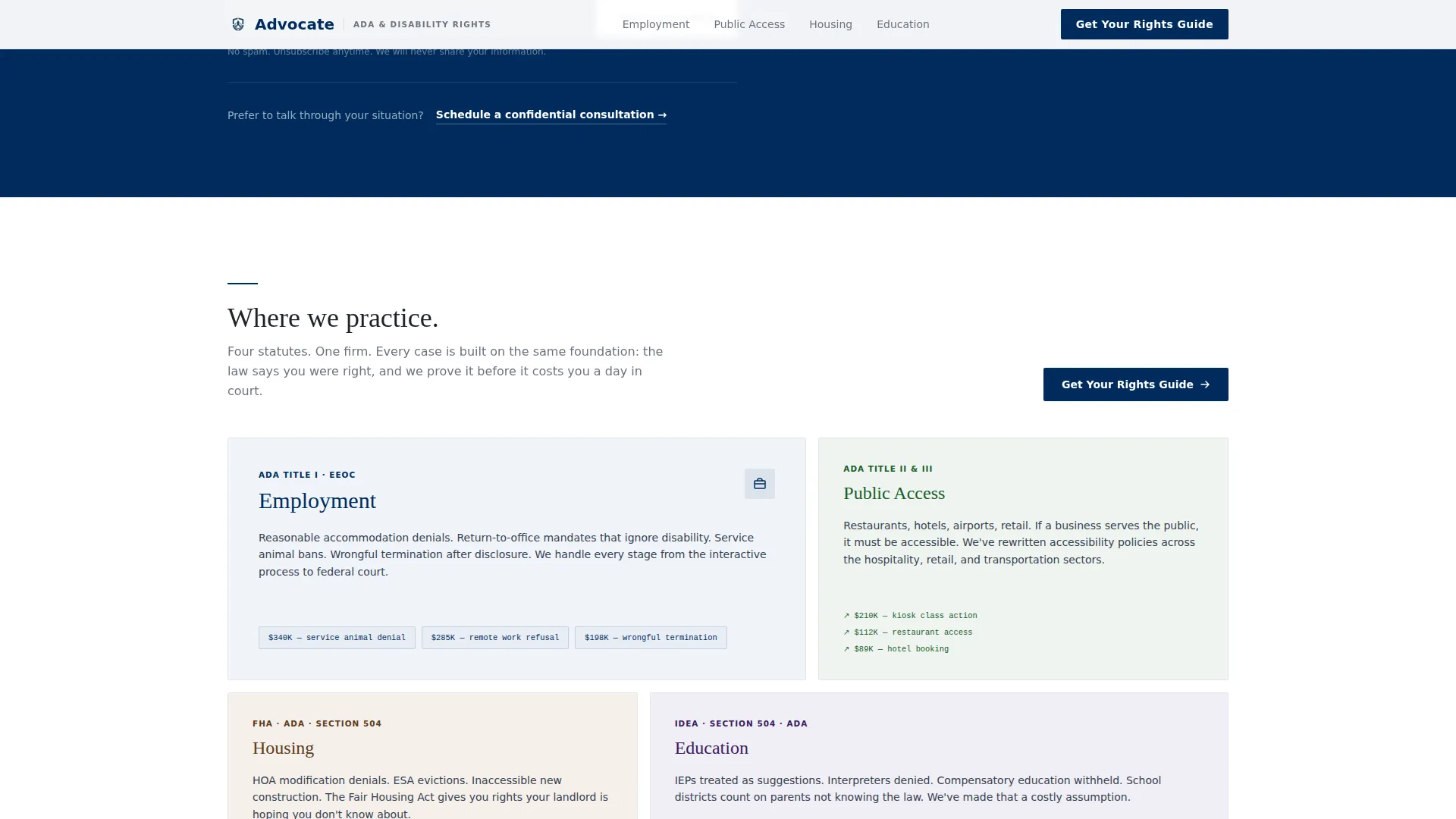
An asymmetric bento grid presents the firm's four practice areas: employment, public access, housing, and education. Each tile is visually distinct and links directly to the corresponding testimonial cluster via the sidebar jump-links.
Page sections overview
| Section | Purpose |
|---|---|
| Press Mentions Band | Opens with media logos and a publication pull-quote to establish credibility before any scroll |
| Testimonial Mosaic | Staggered client story cards with case tags, outcomes, and quotes that build trust through evidence |
| Rights Guide Capture | Email and dropdown form positioned at peak trust to convert readers into intake leads |
| Practice Areas Grid | Asymmetric bento grid covering employment, public access, housing, and education |
| Sidebar Case Screener | Three-question interactive embedded in the fixed sidebar to qualify leads without a phone call |
| Footer Row | Single-row linear footer with firm contact and navigation links |
Design & branding system
The visual identity follows an Executive Suite theme built around an Arctic White color system. The palette is clinical and authoritative, designed to signal serious legal competence without visual noise.
- Background uses clinical white (#FAFBFC) and polished platinum (#D4D7DD); text is set in deep charcoal wool (#1E2328)
- Federal blue (#002B5C) appears exclusively on links, active sidebar indicators, and interactive states, giving authority a precise and restrained accent
- Typography pairs Fraunces serif for headlines with DM Sans for body text and interface elements, creating a contrast between gravitas and clarity
Mobile & speed optimization
The template is built desktop-first to serve its sidebar companion layout, with a defined responsive collapse behavior for smaller screens. The technical approach favors static rendering and minimal scripting.
- The sidebar companion collapses responsively on mobile, keeping the case screener and jump-links accessible without the fixed two-column structure
- Scroll-linked sidebar tracking and staggered card reveals use IntersectionObserver for lightweight, non-blocking animation
- The page follows a static-first build approach with minimal JavaScript, keeping the interactive components lean and fast to render
How this template helps you convert
Advocate is designed around a specific insight: disability rights clients need evidence before they need a call to action. The template sequences trust and conversion in a deliberate order.
- The press band and testimonial mosaic establish credibility early, so visitors arrive at the conversion points already convinced the firm delivers results
- The Rights Guide download offers immediate value with minimal commitment, capturing an email and issue type before any deeper engagement is required
- The sidebar screener runs in parallel as a secondary path, qualifying visitors who prefer self-service intake over form submissions
Other information about this template
Advocate is a strong fit for ADA and disability rights legal practices that operate in a high-stakes, high-trust niche where the wrong first impression costs the firm qualified leads. A few additional points are worth noting.
- The template uses American legal terminology and federal statute framing throughout, making it suitable for United States-based ADA litigation practices
- Animation intensity is set to medium: scroll-linked sidebar behavior, staggered card reveals, and spotlight hover effects add life without overwhelming the clinical aesthetic
- The interactivity level is high relative to most legal landing page templates, with three distinct interactive components (scroll tracker, case screener, email capture) built into the layout
- The footer follows a Pattern 1 linear single-row format, keeping the exit experience clean and consistent with the page's restrained visual system
- Social proof is geographic and specific: named clients, real cities, defined case types, and stated settlement outcomes are the foundation of the mosaic, not generic endorsements
Theme
Executive Suite
Creative direction
Testimonial Mosaic
Color system
Arctic White
Style
Sidebar Companion
Direction
Content/Resource
Page Sections
Press Mentions Header Band
Staggered Testimonial Mosaic
Persistent Sidebar with Scroll Tracker
Embedded Three-question Case Screener
Rights Guide Email Capture
Practice Areas Bento Grid
Related questions
Who is this template designed for?
Does this template support a no-phone intake flow?
What sections are included in this landing page?
Is this template suited to desktop or mobile audiences?
Can the sidebar case categories be updated to match a firm's practice?