Specialist Foot Care Landing Page Template
Straighten is a single-page landing page template built for bunion and hammertoe specialists. It combines an interactive severity slider, a side-by-side treatment comparison table, and a seven-question diagnostic quiz to guide patients from first symptom to booked consultation. The design uses a cool Alpine Fresh palette and clinical typography to earn trust through specificity rather than reassurance.
by Rocket studio
Quick summary
Straighten is a focused, high-interactivity landing page template for podiatric and orthopedic specialists treating bunions and hammer toe deformity. An illustrated severity slider opens the page, a comparison table drives the diagnostic conversation downward, and a seven-question quiz closes with a personalized treatment path. Every section is built to move a hesitant patient closer to booking.
Who this template is for
This template is designed for foot and ankle specialists who need to convert researching patients into scheduled consultations. It suits clinics where surgery, conservative treatments, and patient education all share equal weight on the same page.
- Podiatrists and orthopedic surgeons treating bunion deformity and hammer toe conditions
- Foot and ankle clinics offering both non-surgical and surgical pathways to patients
- Specialists who want an interactive, quiz-driven intake experience before the first call
What problem this template solves
Most patients spend months ignoring pain in their toes before they search for help. When they finally do search, they land on pages full of vague reassurance and stock photos. They leave without understanding their condition or trusting the provider. This template replaces that experience with clinical specificity.
- Patients with swelling, corns, calluses, and toe discomfort cannot easily tell whether they require surgery or conservative care
- Generic clinic pages fail to explain what the bone is actually doing, so patients delay treatment further
- Booking drop-off is high when patients must repeat their symptoms on every form they fill out
What you get with this template
You get a fully structured, single-page layout that takes a patient from a rough self-assessment all the way to a pre-filled intake form. The template is built around three interactive moments: the severity slider, the comparison table, and the diagnostic quiz.
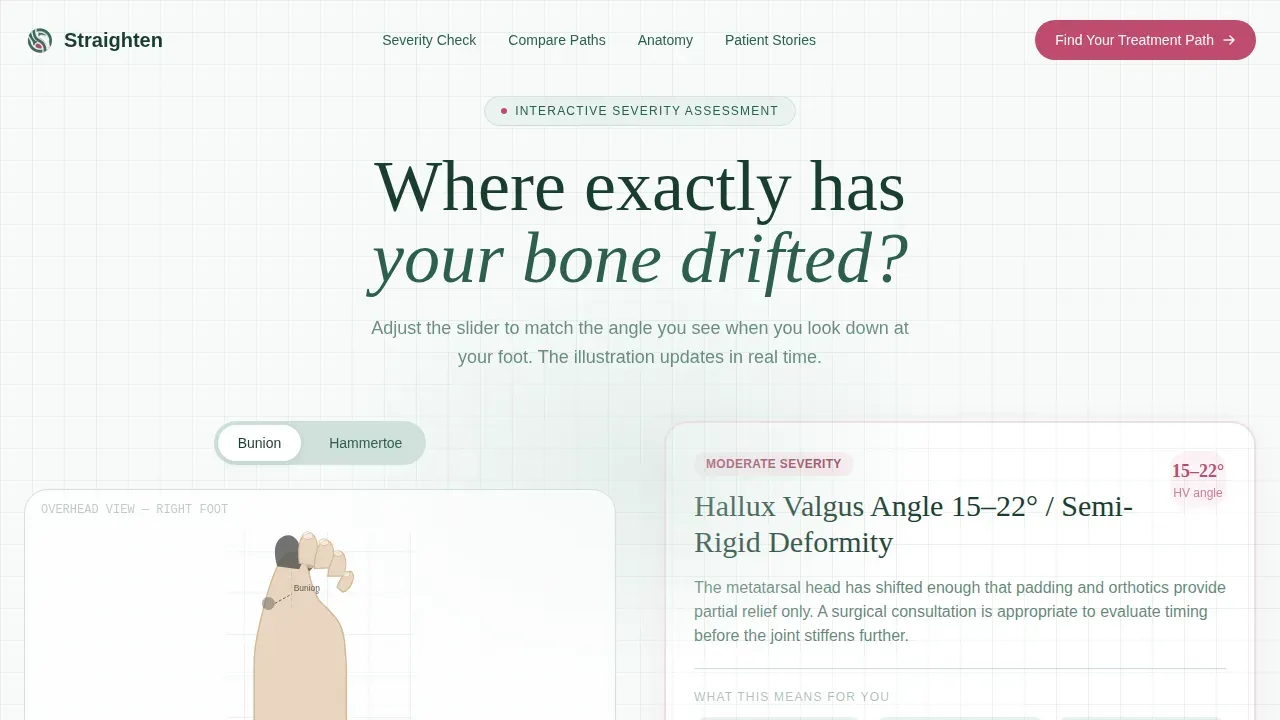
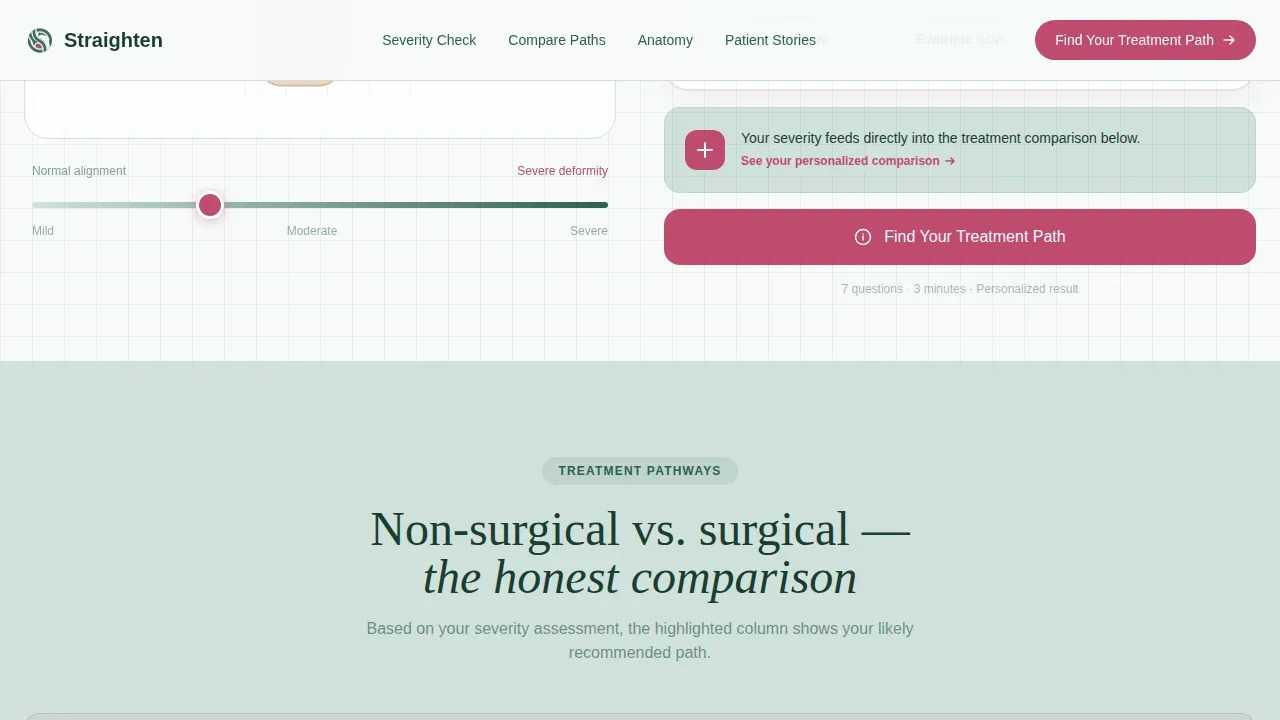
- Interactive overhead foot illustration with a severity slider that updates a dynamic severity classification in real time
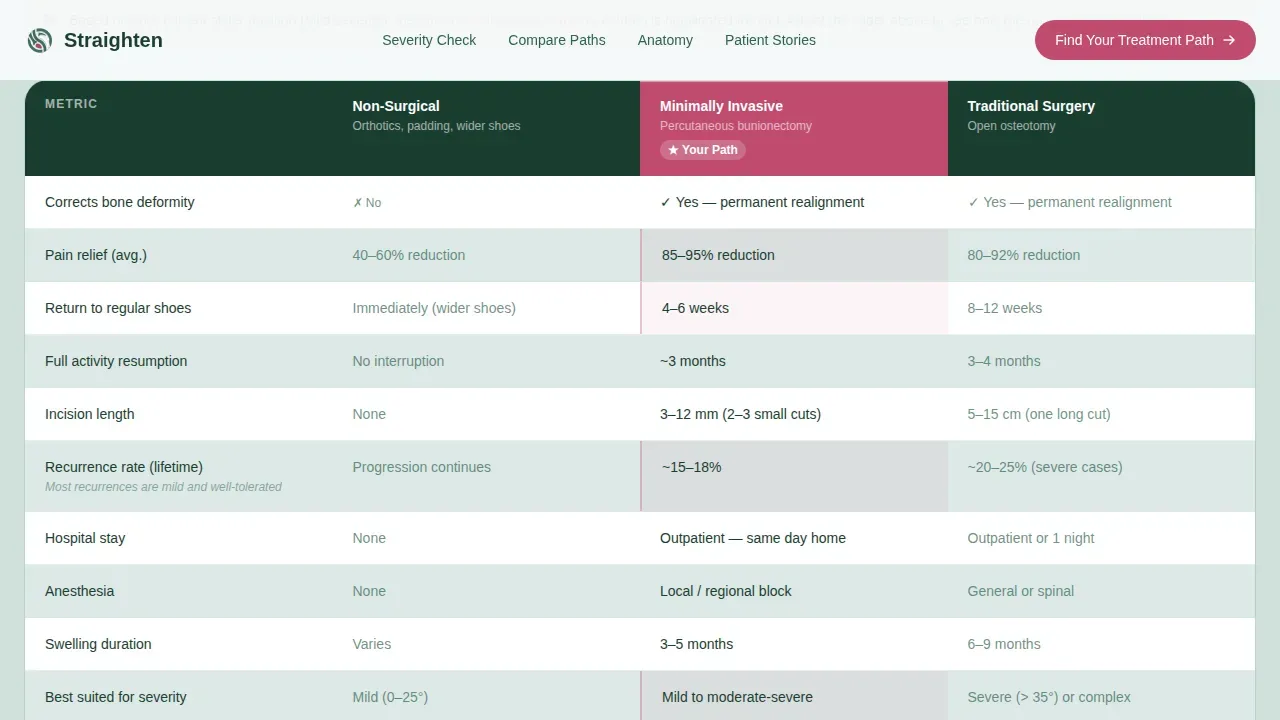
- Side-by-side comparison table showing non-surgical versus surgical pathways with recovery timelines, pain reduction data, and severity highlighting
- Seven-question diagnostic quiz that delivers a personalized treatment recommendation and pre-fills the consultation booking form with the patient's answers
Feature list
This template includes six purpose-built components. Each one is grounded in the clinical and conversion goals described in the source brief.
Interactive Severity Slider
The header presents an illustrated overhead view of two bare feet on a clinical measurement grid. As the visitor moves the slider, the illustrated bunion or hammer toe deformity progresses visually from mild to severe. A dynamic text block updates with a preliminary severity classification, giving patients their first honest look at what their toes are doing.
Treatment Comparison Table
A structured side-by-side table maps non-surgical versus surgical pathways. Each column shows recovery timelines, pain reduction data, and recurrence information. The row matching the visitor's severity level is highlighted in alpine berry, making the personalized recommendation impossible to miss.
Anatomy Deep Dive Bento Grid
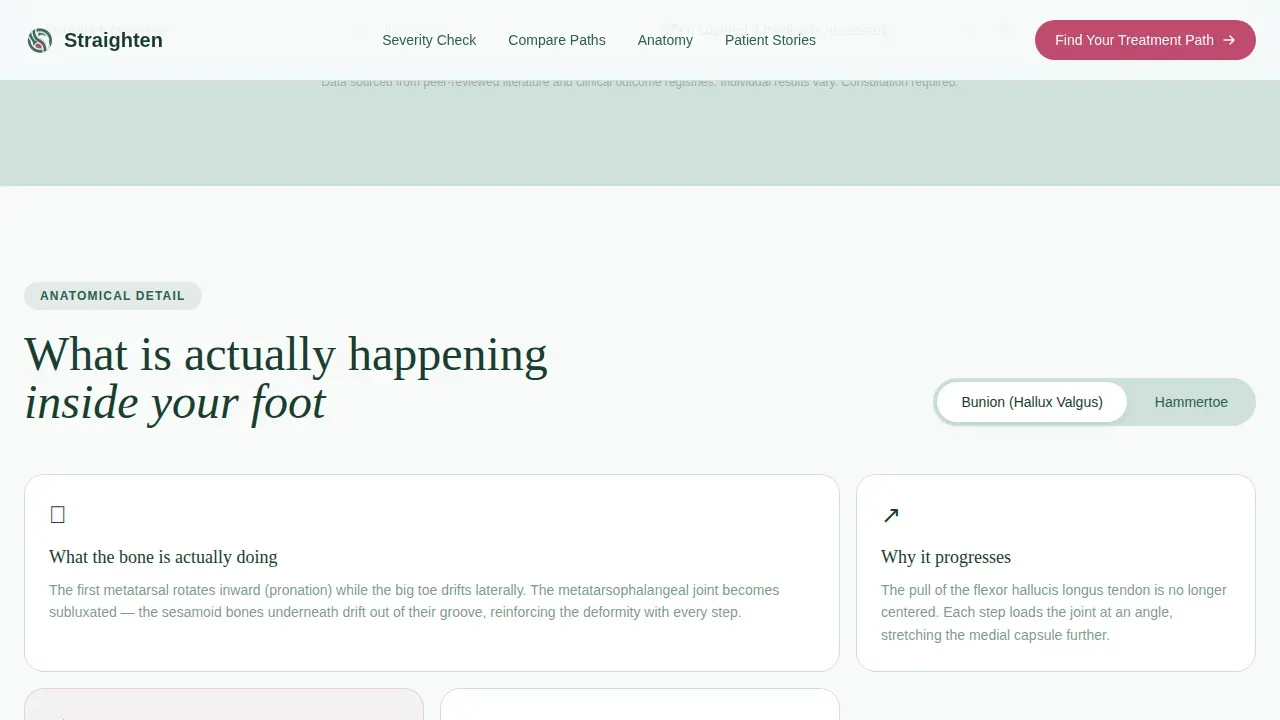
A bento-style anatomical section explains what the bone is actually doing in both bunion and hammer toe conditions. It covers how tendons and muscles fall out of balance, why the toe joint drifts or locks in a bent position, and what accelerates deformity over time. Specificity here builds more trust than any testimonial could.
Seven-Question Diagnostic Quiz
The primary call to action launches a modal quiz covering pain frequency, shoe limitations, toe flexibility, family history, failed home remedies, activity goals, and insurance type. Each answer narrows the recommendation. The result page delivers a personalized severity score alongside a treatment comparison tailored to that patient.
Pre-Filled Intake Form Integration
When a patient taps the secondary call to action, "Book Your Imaging Consultation," the intake form arrives pre-filled with all quiz answers. The patient never repeats themselves. This single detail removes the most common friction point between quiz completion and booked appointment.
Patient Outcome Social Proof Section
A dedicated section presents specific patient outcomes tied to procedure types. Recovery timelines, pain reduction percentages, and procedure counts give prospective patients concrete benchmarks. Outcome-specific testimonials are more persuasive than general satisfaction statements because they answer the question every patient is actually asking.
Page sections overview
| Section | Purpose |
|---|---|
| Hero Severity Slider | Lets visitors self-assess toe deformity angle interactively |
| Treatment Comparison Table | Compares non-surgical and surgical pathways side by side |
| Anatomy Deep Dive | Explains bone, tendon, and muscle mechanics per condition |
| Patient Outcome Proof | Shares specific recovery data and procedure-linked results |
| Quiz Call to Action | Launches seven-question diagnostic and treatment path quiz |
| Footer Linear Row | Displays contact, scheduling, and practice information |
Design & branding system
The visual identity follows an Educational Guide theme using the Alpine Fresh color system. Every color choice has a functional role: backgrounds clarify, text anchors, and the berry accent activates.
- Glacier white (#F7FAFA) and snow shadow (#D0E1DC) alternate as section backgrounds for calm visual rhythm
- Evergreen depth (#2D5F4E) carries all body text, headings, and structural elements for legibility and authority
- Alpine berry (#C04B6F) appears exclusively on primary buttons, quiz triggers, and the severity-highlighted table row
Typography pairs Fraunces serif headlines for medical gravitas with DM Sans body text for clean, comfortable reading at any size.
Mobile & speed optimization
The template is built desktop-first to match how patients research carefully at home, with a strong mobile fallback for on-the-go searches. Interactive components use client-side rendering while static sections use server components to keep load behavior efficient.
- Slider-driven SVG illustration and scroll reveal animations are scoped to client components so static content loads without waiting
- The quiz modal is designed to function cleanly on small screens, keeping form fields readable and tap targets accessible
- Section backgrounds alternate between glacier white and snow shadow to maintain visual structure without heavy image assets
How this template helps you convert
The page is structured as a diagnostic conversation that earns each scroll. Visitors are not asked to book an appointment before they understand their condition. By the time they reach the quiz call to action, they have already self-classified their severity, compared their treatment options, and read the anatomy behind their symptoms.
- The severity slider creates immediate personal relevance. Patients see their own toes in the illustration, not a stock image, which makes the page feel like the start of a real consultation rather than a marketing page.
- The comparison table removes the biggest obstacle to booking: uncertainty about whether surgery is necessary. Patients who can see recovery timelines and recurrence rates side by side are better prepared to commit to a next step.
- The pre-filled intake form eliminates repetition. When quiz answers carry forward automatically, the path from "find my treatment path" to "book imaging consultation" has zero friction.
Other information about this template
The Straighten expert bunion and hammertoe specialist landing page template is designed to address several clinical realities that generic medical templates ignore entirely.
- Bunions develop over time from wearing narrow-toed shoes or high heels, and the most prominent symptom is a bony bump at the base of the big toe pointing toward the second toe; bunions do not resolve without professional treatment
- Hammer toe occurs when one or more toes bend abnormally at the middle joint; most hammertoes start as flexible deformities, and early evaluation can prevent them from becoming rigid and painful
- Left untreated, both conditions progress: the toe joint stiffens, corns and calluses form where shoes put pressure on exposed bone, and swelling around a fluid filled sac near the big toe joint makes wearing shoes increasingly difficult
- Foot and ankle surgery has advanced significantly; minimally invasive techniques now allow ankle surgeons to address bunion deformity and hammer toe correction with less disruption to surrounding tendons and foot muscles, and most patients are walking within days after procedures like corrective bunion surgery
- Conservative treatments including wider toe box shoes, arch support, and padding can reduce pain and slow progression for flexible deformities; severe cases with decreased movement or rigid toes may require surgery to restore proper alignment
- The recovery process after foot and ankle surgery varies by procedure; following bunion surgery or hammertoe correction, most patients begin walking with support within six weeks and return to comfortable shoes as healing progresses
- Wearing high heels regularly, having high arches, or having long toes are among several factors that contribute to how quickly a deformity can develop and worsen
- Shoe wear habits matter throughout recovery; patients are typically advised to avoid narrow shoes or any style that puts pressure on the toe box while the foot continues to heal
Theme
Educational Guide
Creative direction
Problem→Solution Arc
Color system
Alpine Fresh
Style
Comparison Table
Direction
Quiz/Assessment
Page Sections
Interactive Foot Severity Slider
Side-by-side Treatment Comparison Table
Anatomical Bento Grid Deep Dive
Seven-question Diagnostic Quiz Modal
Pre-filled Consultation Booking Form
Patient Outcome Social Proof Section
Related questions
What conditions does this landing page template target?
Does the quiz really pre-fill the intake form?
Can I use this template if I offer only conservative treatments?
How does the severity slider work?
Is this template suitable for a clinic that also performs ankle surgery?