Allergen — Safe Bites Landing Page Template
The Allergenfree - Safe Bites Tasting Event landing page template is built for allergen-free food brands hosting live tasting tours. It combines warm sensory storytelling with rigorous food safety communication, driving event registrations through a single-column scroll flow, a UGC photo-wall hero, and a form that collects dietary needs before guests ever arrive at the table.
by Rocket studio
Quick summary
This template gives allergen-free food brands a complete single-column landing page for live tasting event registrations. It opens with a community photo wall, moves through sensory food moments, communicates food safety with clarity, and closes on a communal table scene paired with a sticky registration bar. Every section is purpose-built to turn cautious visitors into committed attendees.
Who this template is for
Food businesses running allergen-free tasting events need more than a pretty page. They need a format that earns trust fast, communicates dietary needs clearly, and converts a nervous visitor into a registered guest. This template was designed precisely for that moment.
- Allergen-free food brands planning live tasting tours across multiple locations, with audiences managing food allergies affecting the whole family
- School nutritionists and event organizers who need to collect attendee dietary preferences in advance and present clear allergen information at every station
- Adults diagnosed late in life with food allergies or severe allergies, looking for a safe environment where they can enjoy food without constant vigilance about cross contamination
What problem this template solves
People managing food allergies face a real problem at food events: they cannot assume safety. They double check every label. They ask the same questions at every table. They leave events early because the allergen information was vague or absent. A landing page that fails to address this upfront will lose them before they even consider registering.
- It solves the trust gap by making food allergy safety visible and specific from the very first scroll, rather than burying it in fine print
- It solves the friction problem by combining a sticky bottom call-to-action bar with a short registration form that collects dietary needs without overwhelming the visitor
- It solves the credibility gap by using real community-submitted photos and sensory-led copy that prove the food is genuinely delicious, not just technically allergen free
What you get with this template
You get a fully structured single-column landing page with five distinct content sections, a sticky registration bar, and a warm visual system built for food brands that take both taste and food safety seriously. Every component ships ready to customize.
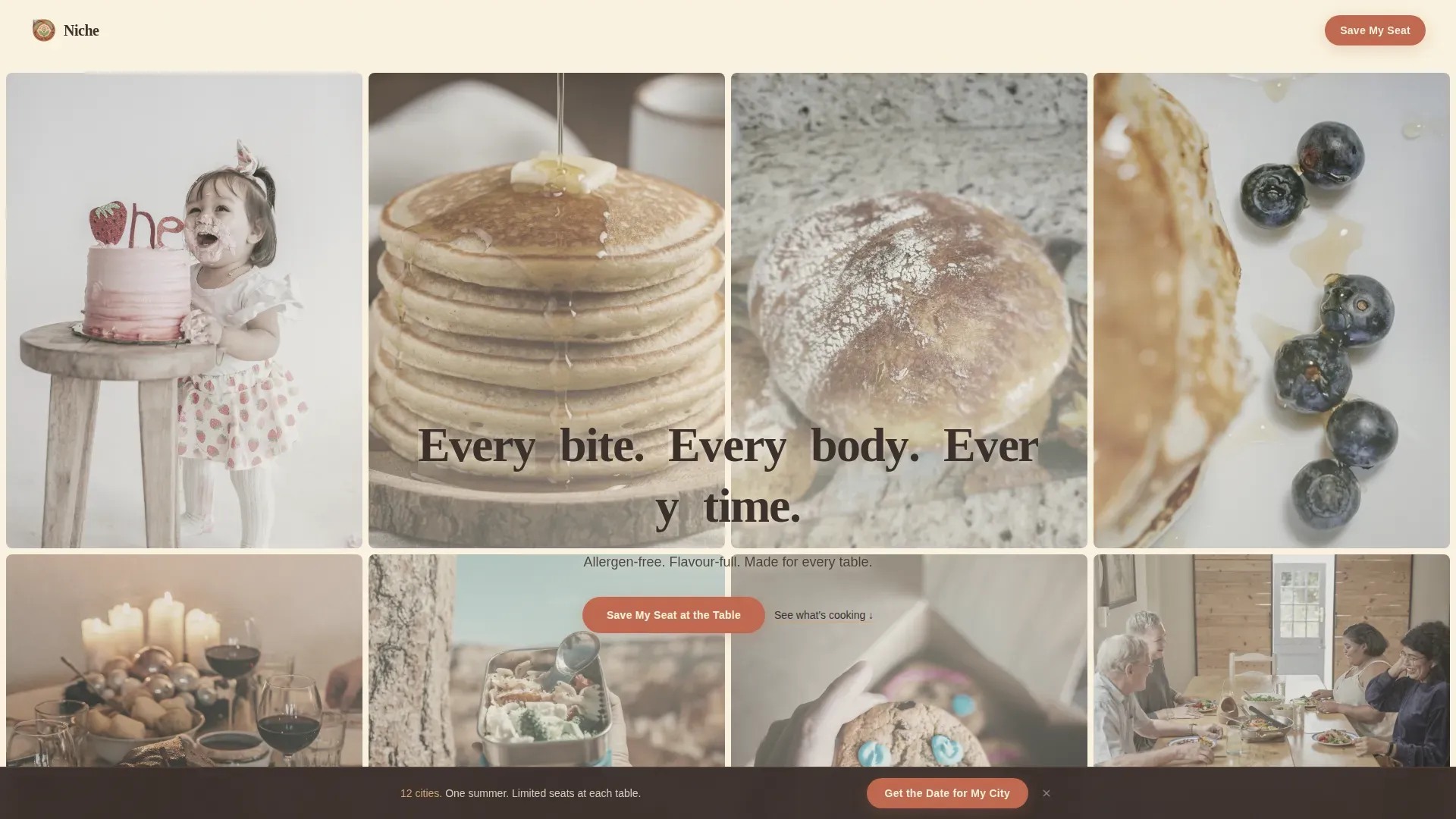
- A masonry UGC photo wall hero with floating headline, a sensory food showcase section, an allergen trust section with sage-colored ingredient callouts, a communal table celebration scene, and a registration form section
- A registration form collecting first name, email, nearest city via dropdown of tour stops, and a single community-minded checkbox
- A sticky bottom bar that appears after fifty percent scroll with a secondary call-to-action, reducing friction for visitors who are not yet ready to commit but want to be notified about their city's date
Feature list
This template ships with six core features drawn directly from the design and functional brief. Each one plays a specific role in converting a visitor who manages food allergies into a registered tasting event guest.
UGC Photo Wall Hero with Floating Headline
The header opens on a masonry grid of real family photos submitted by actual community members: a toddler with frosting on both cheeks, a Thanksgiving table where every dish is safe for everyone, a lunchbox opened on a park bench. Images are warm and slightly imperfect, shot on phones in natural light. A single line of hand-set type floats over the mosaic: "Every bite. Every body. Every time." This format builds instant social proof and tells visitors with food allergies that this community already exists and already trusts the brand.
Sensory Showcase Section
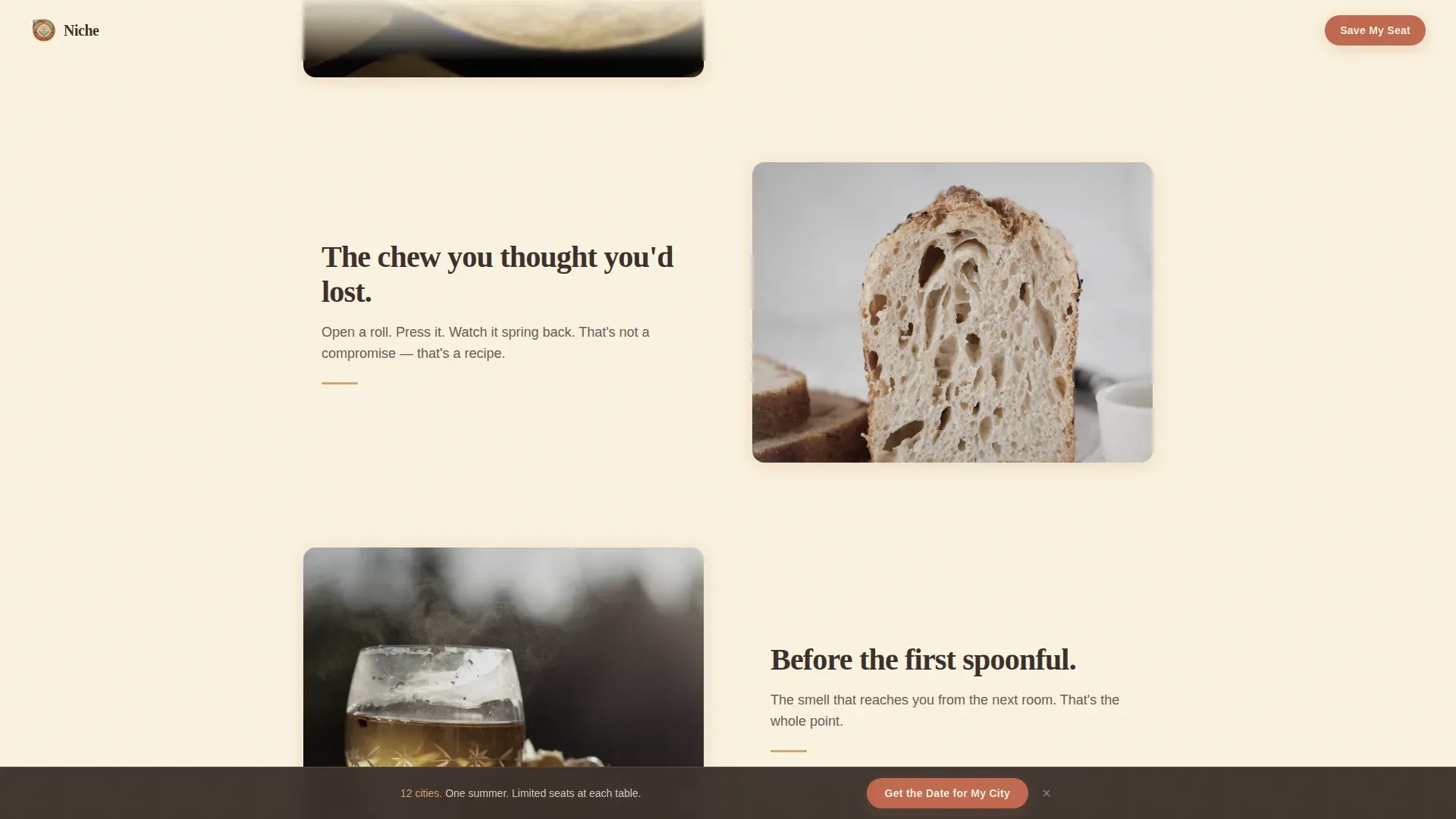
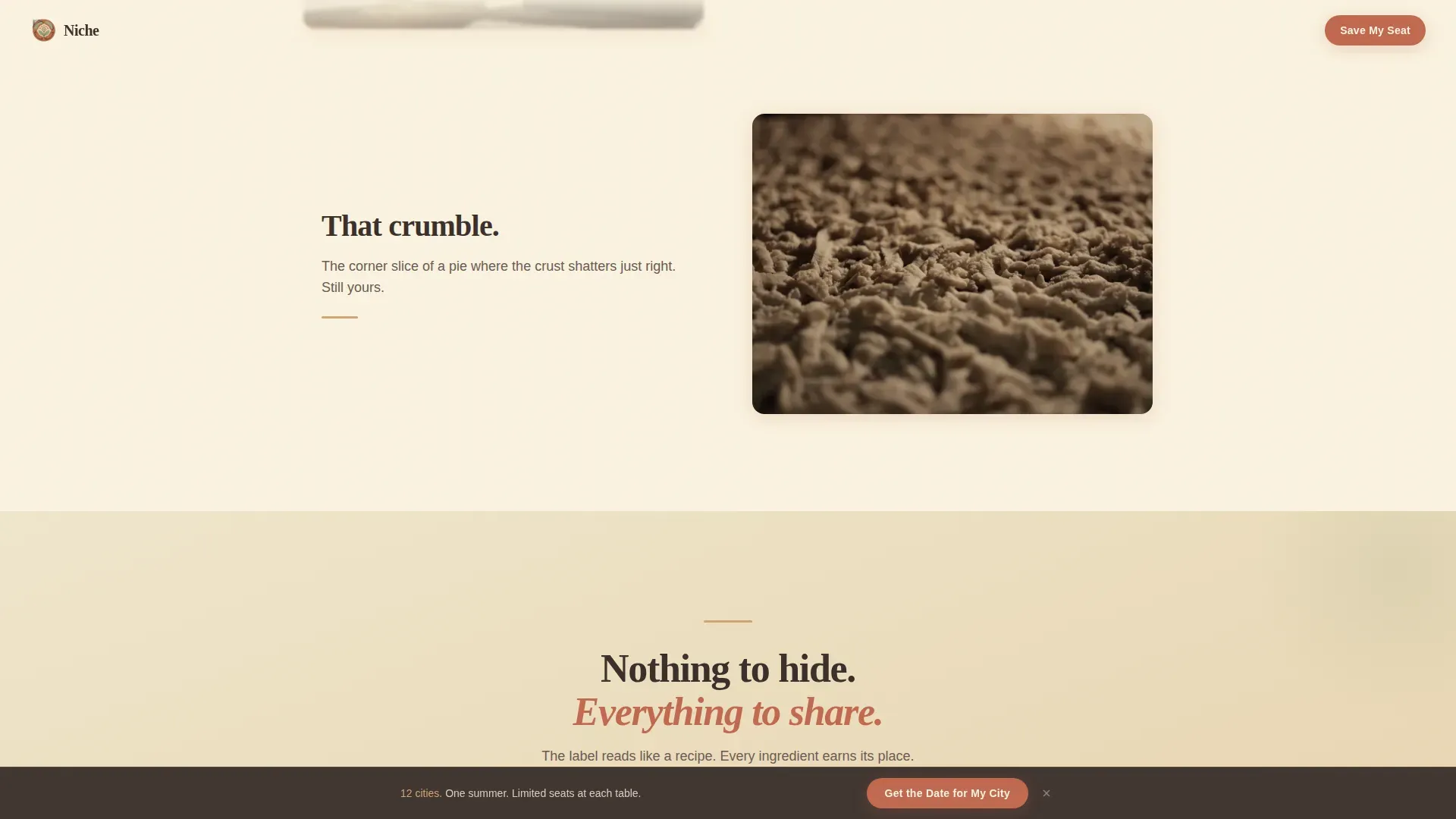
Each subsection isolates one sensory moment. A slow-motion pour of golden batter hitting a hot pan. A macro shot of air pockets inside fresh gluten free bread. A steaming bowl releasing visible wisps. Copy is written in short, warm fragments that read like someone describing a smell from memory. This approach makes food allergies feel like an irrelevant background detail, because the food in front of you is already safe and already extraordinary.
Allergen Trust Section with Ingredient Callouts
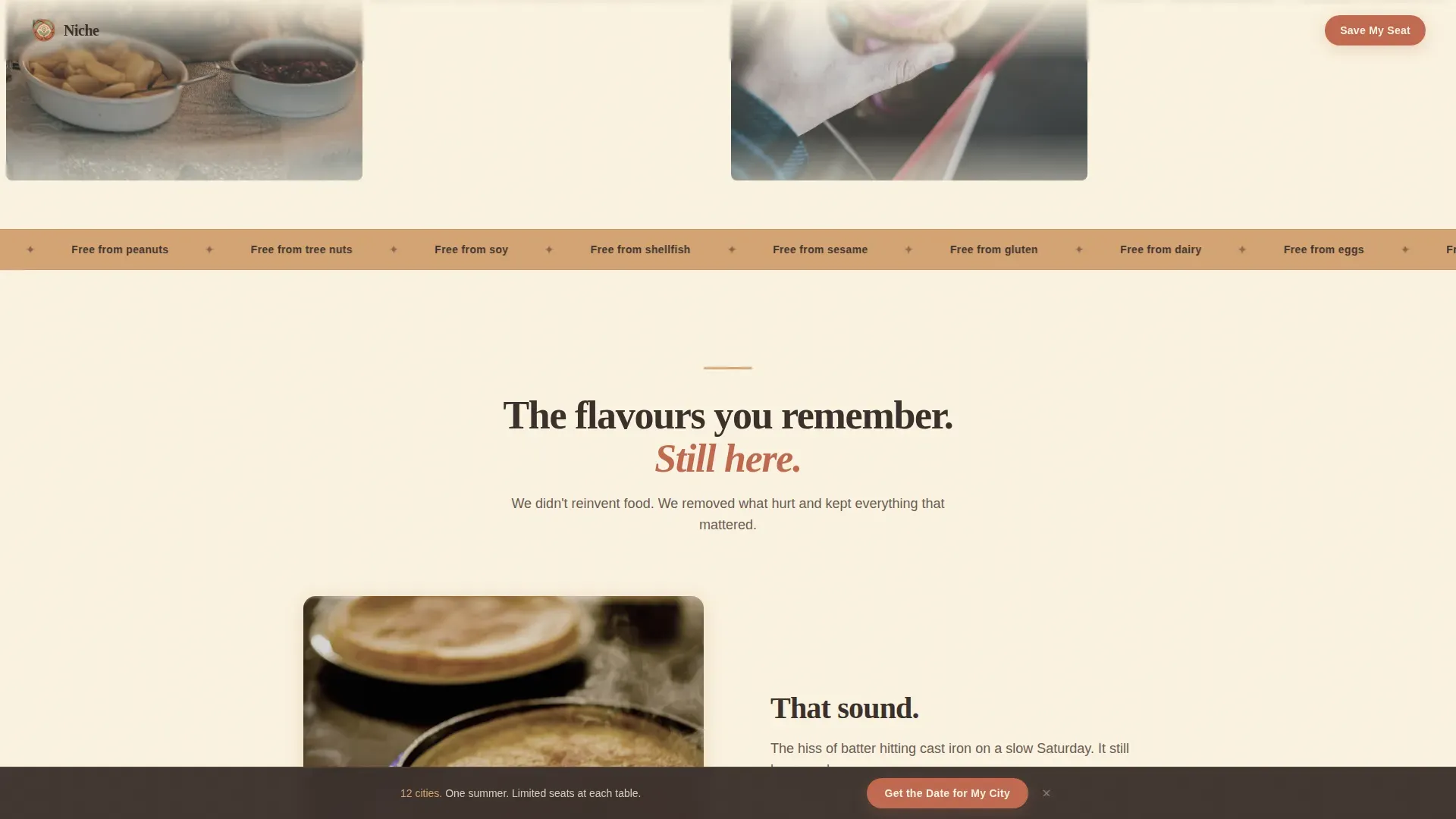
This section displays all eight major allergens removed, using sage-colored trust badges and ingredient callouts. It tells visitors exactly which common food allergens are absent: peanuts, tree nuts, dairy, wheat, eggs, soy, shellfish, and sesame. Understanding food allergies means understanding what is not in the food. This section does that work so visitors do not have to ask. Food businesses can customize the callout badges to match their specific product lineup and event menu options.
Event Registration Form with Dietary Intake
The registration form collects first name, email, nearest city from a dropdown of tour stops, and one checkbox: "I'm bringing someone who also deserves this." The form is designed to gather attendee dietary needs before the event, consistent with best practices for planning allergy-friendly events. Collecting this information in advance helps food businesses prepare separate prep areas, dedicated utensils, and appropriate menu options for every registered guest.
Sticky Bottom Call-to-Action Bar
A secondary call-to-action bar reading "Get the Date for My City" appears after fifty percent scroll. It stays anchored to the bottom of the viewport as the visitor reads. This reduces friction for users who are interested but not yet ready to commit. It is especially useful for mobile visitors, who may be browsing quickly in a grocery aisle while managing food allergies and comparing options on the go.
Communal Table Celebration Scene
The final content section before the registration form features a long communal table scene. It is the emotional crescendo of the page. Momentum builds from comfort to celebration. The copy and imagery work together to communicate that allergen free food is not a compromise. It is a gathering point. This scene is positioned to land emotionally before the primary call-to-action "Save My Seat at the Table" appears, making the registration feel like a natural next step rather than a hard sell.
Page sections overview
| Section | Purpose |
|---|---|
| Hero Photo Wall | Opens with UGC masonry grid and floating brand headline to establish community trust instantly |
| Sensory Showcase | Triggers hunger through macro food photography and warm sensory copy fragments |
| Allergen Trust Badges | Displays all eight removed allergens with sage-colored ingredient callouts for credibility |
| Communal Table Scene | Delivers emotional crescendo through a celebration image before the primary call to action |
| Event Registration Form | Collects name, email, city, and dietary checkbox to register attendees for a tour stop |
| Sticky call to action Bar | Appears at fifty percent scroll with a secondary prompt to reduce commitment friction |
| Footer | Linear single-row footer with essential links and contact information |
Design & branding system
The visual identity follows a Pastoral Calm theme built around the Sunset Mesa color system. The palette feels like a desert kitchen at golden hour: clay bowls on a wooden table, dried herbs hanging from a beam, the last band of copper light crossing a flour-dusted countertop. Every color plays a specific role in guiding attention and communicating food safety trust.
- Cream linen (#FAF3E0) carries the background, sandstone (#D4A373) warms the section dividers, sage (#A3B18A) marks trust badges and ingredient callouts, terracotta (#C1694F) fires all call-to-action buttons, and mesa shadow (#3A2F2B) anchors body text
- Typography pairs Fraunces, a warm serif display face, with DM Sans for body copy, creating a combination that feels both trustworthy and appetizing
- High-quality, appetizing food photography is central to the visual system, with an emphasis on macro shots, natural light, and real-family imagery rather than studio polish
Mobile & speed optimization
The template is built mobile-first, which matters deeply for this audience. Mothers managing food allergies are often on their phones in grocery store aisles, reading labels and researching safe options at the same time. A mobile-friendly design ensures the landing page is accessible and readable on every device without forcing the visitor to pinch and zoom.
- GSAP ScrollTrigger powers scroll-based animations including character reveals, section parallax, and sticky bar appearance, all handled through client components to keep static content fast
- The sticky call-to-action bar is optimized for thumb reach on mobile, appearing precisely at fifty percent scroll so it does not interrupt early reading but stays available for quick action
- Server components handle all static content rendering, keeping the page responsive even on slower connections common to mobile browsing
How this template helps you convert
An effective landing page for allergy-friendly events must balance trust, clarity, and appetite appeal in equal measure. This template sequences those three elements deliberately. Visitors do not encounter the registration form until the page has already earned their emotional investment through community proof, sensory storytelling, and transparent allergen information.
- The UGC photo wall builds immediate trust by showing real families who have already engaged with the brand, reducing skepticism for visitors with severe allergies or past experiences of accidental exposure at food events
- The allergen trust section and registration form work together: the trust section resolves safety concerns, and the form then captures dietary needs including severity levels and city preferences, so food businesses can prepare dedicated preparation areas and allergen-appropriate menu options for every attendee
- The sticky call-to-action bar ensures that visitors who are warming up but not yet ready to register still have a low-commitment path to stay connected, which keeps them in the funnel and reduces drop-off before they reach the primary form
Other information about this template
This template is purpose-built for the intersection of allergen-free food brand marketing and live event registration. It reflects best practices from multiple disciplines: food safety communication, event planning, sensory marketing, and mobile-first web design. The notes below cover additional context that food businesses and event organizers will find useful when deploying this template.
- Understanding food allergies is foundational to the copy direction. Food allergies are a serious public health concern, with some reactions being life threatening. Common food allergens including peanuts, tree nuts, dairy, wheat, soy, shellfish, eggs, and sesame can trigger severe reactions ranging from mild symptoms like tingling in the mouth and hives to anaphylaxis, which can cause difficulty breathing and swelling of the throat and vocal cords. The template's allergen trust section is designed to address these concerns directly.
- Food businesses must inform customers if any food they provide contains allergens contained within the recognized major allergens list. Food labeling and allergen information requirements vary by jurisdiction, but best practices for food businesses include visible allergen warnings, pre packaged foods with clearly emphasized allergenic ingredients on food packaging, and separate allergen information for every buffet item rather than a blanket statement for the buffet as a whole.
- Cross contamination is one of the most serious risks for people with food allergies. Cross contamination risks arise when allergen free foods share surfaces, utensils, or shared equipment with allergen-containing foods. The registration form and event planning sections of this template encourage food businesses to use separate prep areas, apply rigorous hygiene practices, and communicate cross contact prevention to staff before every event.
- The registration form is structured to support best practices for gathering dietary needs. It should be treated as a starting point. Event organizers are encouraged to expand it into a full dietary questionnaire that collects known allergies, severity levels, and whether dedicated preparation areas are required. A mandatory dietary questionnaire of this kind helps food businesses avoid cross contaminated outcomes and ensures every guest can identify safe foods at every station.
- An emergency action plan is an important component of any allergy-friendly event. Food businesses hosting this type of tasting experience should ensure that on-site staff are trained in allergy awareness, that an epinephrine auto injector is available on-site, and that emergency contact information and emergency services access are part of the event safety plan. Guests with severe allergies should be made aware of this emergency action plan before they arrive.
- The template supports color-coded food stations as a design pattern. Event organizers can adapt the sage trust badge system from the landing page into physical event signage, using standardized symbols such as GF (Gluten-Free) and NF (Nut-Free) next to each dish. This approach helps attendees quickly identify safe foods and make informed choices without needing to ask restaurant staff at every turn.
- The market for allergy-friendly products has expanded dramatically. Navigating the grocery store aisles still requires a keen eye and careful label reading, but this template can support allergen-free food brands in communicating their value clearly, helping families identify safe choices before they even arrive at the event. Homemade-style baked goods like allergen free rolls, gluten free pancakes, dairy free cookies with chocolate chips, and nut free baked goods made without wheat flour are all strong candidates for the event menu and for visual showcasing on the landing page.
- This template supports event organizers who want to encourage attendees to inform staff about their dietary restrictions before and during the event. Clear allergen information at the point of service helps prevent accidental exposure and allergic reactions. Encouraging customers to share their food allergies at check-in is a simple step that food businesses should build into their event flow as standard procedure.
- The allergen-free safe bites tasting event landing page template is also well-suited for food businesses operating across multiple locations or planning a city-by-city touring tasting event, as the city dropdown in the registration form supports this multi-stop structure natively. Event spaces vary in their allergen management capabilities, so training event-specific staff on allergy protocols and conducting a walkthrough of the catering setup at each stop are critical steps to ensure safety at every venue.
- Trust indicators built into this template, such as UGC testimonials and community-submitted photos, reflect the kind of social proof that builds confidence for visitors with severe allergies. Testimonials from past attendees who have managed food allergies and felt genuinely safe at the event are among the most effective trust signals available to food businesses. Organizers should encourage attendees from past events to contribute photos and short testimonials to populate the UGC hero grid at each new tour stop.
- From a public health perspective, allergen management at food events requires constant vigilance. Food businesses must protect customers by applying extra effort at every stage: from food preparation and food handling through to food service and event cleanup. Best practices include staff training on allergy awareness, clear allergen warnings at every station, separate prep areas with dedicated utensils, and a policy to avoid cross contact from shared equipment throughout the event. Potential cross contamination risks do not disappear after doors open. They require active management at every point in the food service chain.
- Brazil nuts and other tree nuts fall under the broader peanuts tree nuts category that must be disclosed in allergen information. Common allergens like these can trigger life threatening immune system responses even in small quantities, which is why this template places the allergen trust section prominently in the page flow rather than relegating it to a footer disclaimer. Allergen warnings should be specific, visible, and written in plain language so that visitors can make informed choices with confidence.
Theme
Pastoral Calm
Creative direction
Taste & Aroma
Color system
Sunset Mesa
Style
Single Column Flow
Direction
Event Registration
Page Sections
UGC Photo Wall Hero with Community Proof
Sensory Showcase with Macro Food Photography
Allergen Trust Section with Sage Callout Badges
Event Registration Form with Dietary Intake Fields
Sticky Bottom Call-to-action Bar
Communal Table Celebration Scene
Related questions
Does this template include a registration form with dietary fields?
Can this template support a tasting event running across multiple cities?
How does this template communicate food safety to visitors with severe food allergies?
Is the sticky call-to-action bar included in this template?
What makes this different from a standard event registration template?