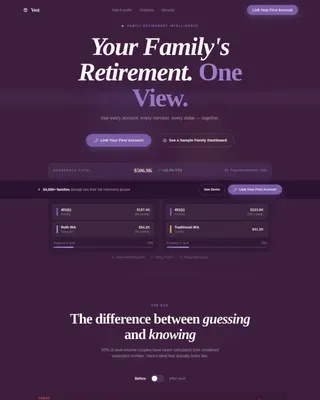
Precision Coverage Audit Landing Page Template
The Safeguard smart coverage gap assessment landing page template is built for pre-retiree home insurance advisors. It combines a live Coverage Gap Calculator with a confessional Problem-Solution zigzag layout and a seven-question progressive assessment. The result is a structured, dashboard-styled landing page that turns a visitor's quiet suspicion about overpaying into a confident request for a personalized coverage review.
by Rocket studio
Quick summary
Safeguard is a single-page home insurance advisory template designed for pre-retirees aged 55 to 67. It opens with a live Coverage Gap Calculator, guides visitors through a problem-resolution zigzag, and converts them via a seven-question assessment. The design feels like a financial advisor's desk after hours: authoritative, warm, and quietly urgent.
Who this template is for
This template was designed with a very specific visitor in mind. That visitor is a homeowner in their late fifties or early sixties, sitting with a policy that was written when the mortgage was new, the kids were young, and income protection was the primary concern. Life has changed. The policy has not. Safeguard speaks directly to that gap between the current state and where coverage actually needs to be.
- Homeowners aged 55 to 67 with policies unchanged since the early 2000s
- Early retirees shifting focus from income protection to asset preservation
- Insurance advisors and brokers serving the pre-retiree market who need a high-converting lead generation landing page
What problem this template solves
Most home insurance landing pages pitch products. Safeguard does something different. It identifies the specific mistakes pre-retirees make and shows, in real time, what those mistakes cost. The gap between current performance and the desired future state is not abstract here. It shows up as a dollar amount in an amber output panel before a visitor has typed a single word into a form.
The core problem this template addresses is structural. Advisors serving pre-retiree homeowners need a landing page that does the analytical work upfront. Visitors arrive skeptical. A thorough gap analysis of their coverage situation, conducted interactively through sliders and a seven-question assessment, replaces skepticism with recognition. The page earns trust before it asks for anything.
- Over-insured homeowners are paying for riders, replacement-cost clauses, and coverage levels that no longer match their current situation or desired outcome
- Advisors lack a structured way to demonstrate overpayment without a face-to-face meeting
- Generic insurance landing pages fail to reflect the specific risks and weaknesses of a pre-retiree policy portfolio
What you get with this template
Safeguard delivers a complete, ready-to-customize landing page built around interactive tools, a confessional narrative arc, and a multi-step conversion flow. The template is built on a Dashboard Pro theme using the Teal Catalyst color system. Every section has a defined role in the gap analysis process, moving the visitor from awareness to action in a single scroll.
The template gives you a focused set of components, each doing specific conversion work:
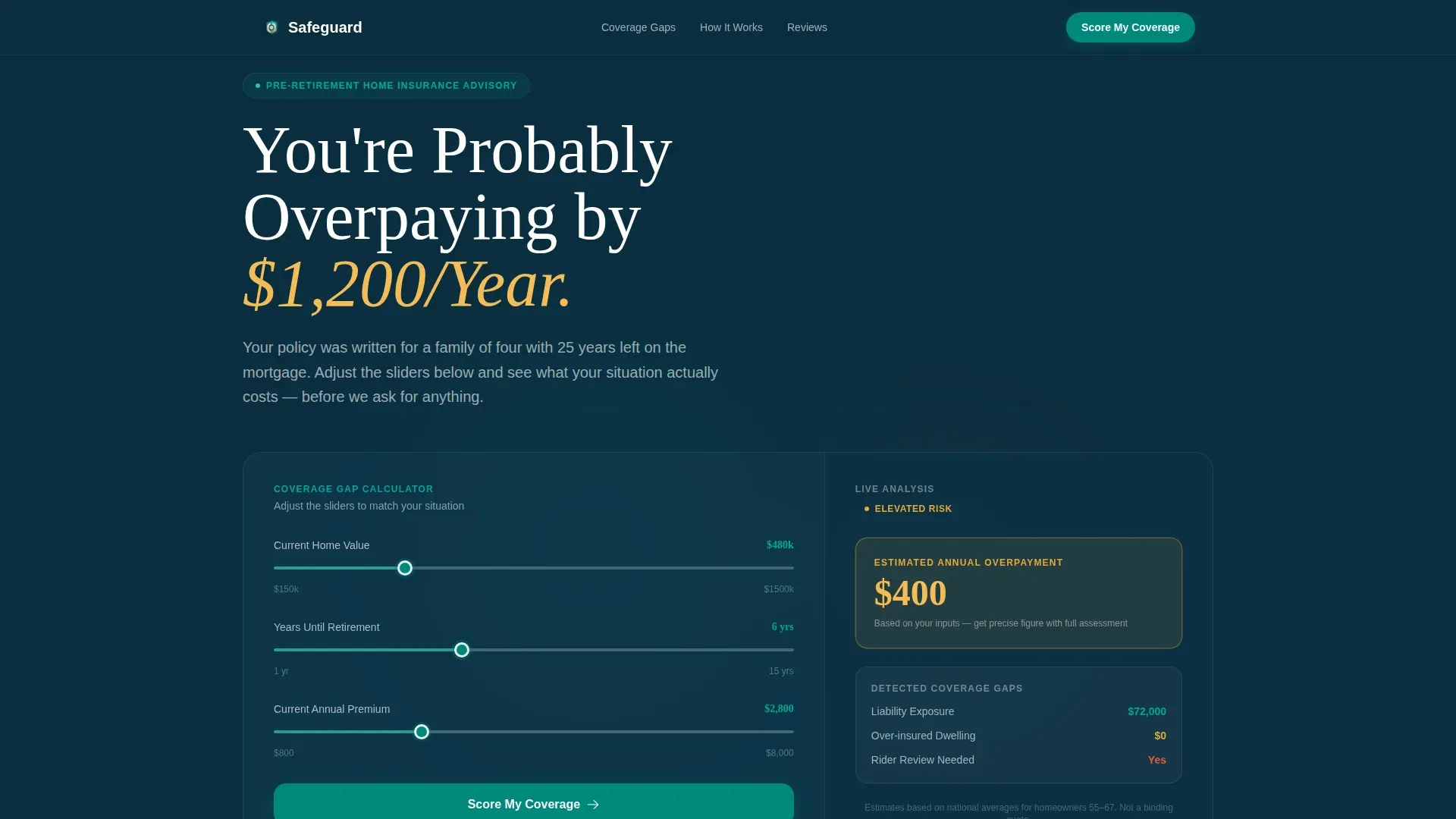
- A hero section with a live Coverage Gap Calculator featuring three interactive sliders and an amber real-time output panel
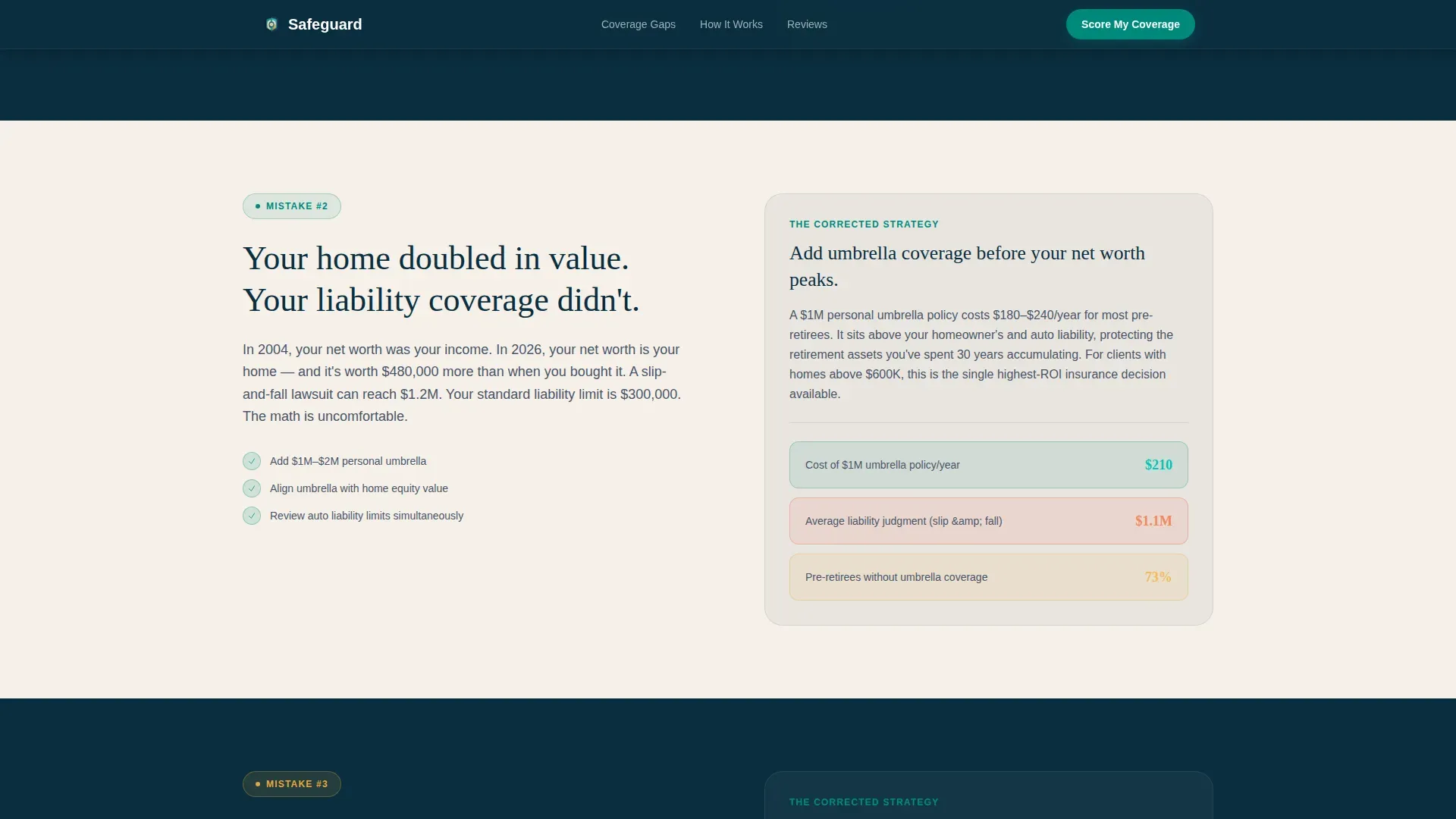
- A zigzag Problem-Solution arc with three alternating navy and parchment panels, each naming a specific pre-retiree insurance mistake alongside its corrected strategy
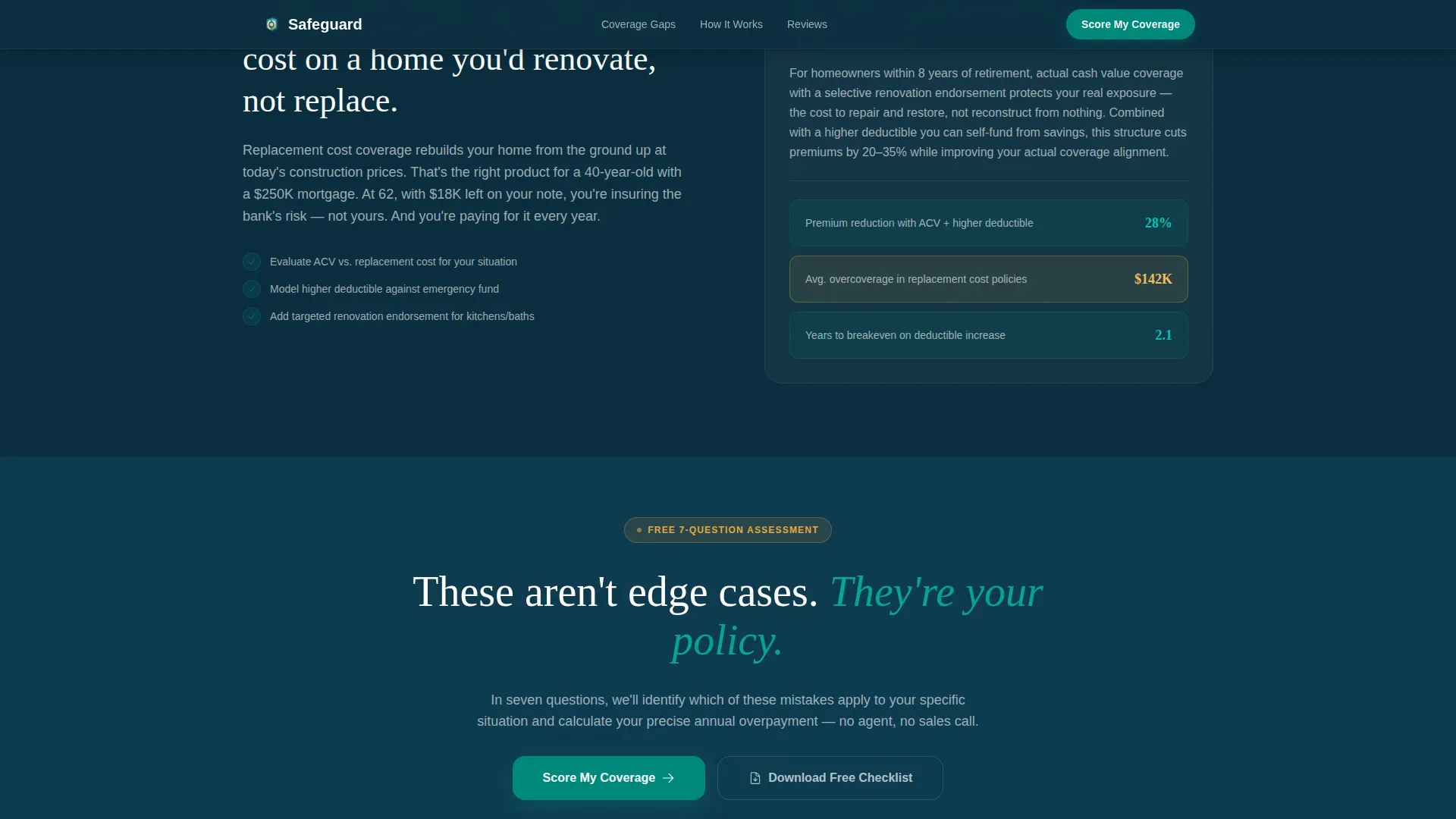
- A seven-question progressive assessment modal, a credibility section with stats and testimonials, a secondary checklist download path, and a single-row footer
Feature list
This gap analysis template includes purpose-built components that work together to conduct a thorough gap analysis of a visitor's coverage situation. Each feature below reflects what is explicitly described in the source brief.
Live Coverage Gap Calculator
The hero section opens with a dashboard-styled estimator on a deep navy background. Three input sliders let visitors set their current home value, years until retirement, and estimated annual premium. As each slider moves, the right-side output panel recalculates potential annual savings and flags specific coverage gaps in amber. The numbers move in real time, giving visitors a concrete reason to keep reading before any form is shown.
Seven-Question Progressive Assessment
The primary conversion path is a modal-based assessment that opens when a visitor clicks "Score My Coverage." Each of the seven questions occupies its own screen with a teal progress bar tracking completion. Questions cover home ownership status, dwelling value, current annual premium, whether coverage has been updated in the last five years, retirement timeline, primary concern (cost versus gaps versus both), and email for the personalized report. This structured approach mirrors the gap analysis process used by professional advisors to identify gaps between current and future states.
Zigzag Problem-Solution Panels
Three alternating sections, set on navy and warm parchment backgrounds, name specific pre-retiree insurance mistakes on the left and present the corrected strategy on the right using teal-highlighted data cards. The rhythm escalates from "you're wasting money" to "you're exposed at the worst possible time." This structure helps the visitor conduct a self-directed gap analysis, comparing their current situation against the desired state with increasing urgency and clarity.
Credibility and Social Proof Section
A stats grid and three pre-retiree testimonials with word-animation styling are positioned after the midpoint call to action. This section provides the trust signals that a high-converting landing page requires. Specific names, ages, and savings metrics make the findings feel real rather than generic. Social proof at this stage reinforces the gap analysis findings already surfaced by the calculator.
Secondary Checklist Download Path
For visitors not ready to complete the full assessment, parchment sections include a static "Download the Pre-Retirement Coverage Checklist" link that captures just an email address. This secondary path ensures that visitors who identify gaps but are not ready to commit still enter the lead funnel. It provides a low-effort action plan entry point that keeps the conversion process open.
Scroll-Reveal Animation System
The template uses GSAP-powered scroll reveals throughout. Zigzag section transitions, quiz step animations, and word-blur testimonial effects create a sense of deliberate pacing. The page feels like it is being revealed rather than loaded, which reinforces the "advisor walking you through your policy" experience the brief describes.
Page sections overview
| Section | Purpose |
|---|---|
| Hero Calculator | Opens with live gap estimator and amber savings output |
| Problem-Solution Zigzag | Three panels naming specific pre-retiree coverage mistakes |
| Call to Action Break | Teal "Score My Coverage" section repeated after third panel |
| Credibility Stats | Stats grid with three animated pre-retiree testimonials |
| Assessment Modal | Seven-question progressive quiz with teal progress bar |
| Checklist Download | Secondary email capture for visitors not yet ready to assess |
| Single-Row Footer | Linear footer closing the page with minimal distraction |
Design & branding system
The visual identity is built on the Teal Catalyst color system applied through a Dashboard Pro theme. The palette was chosen to feel like a financial advisor's desk after hours: the lamp still on, the numbers finally making sense. Every color has a defined role, and nothing appears decoratively.
- Deep policy navy (#0B2E3F) grounds all primary backgrounds with quiet authority; active teal (#00897B) covers every interactive element and progress indicator to guide attention without pressure
- Warm parchment (#F5F0E8) softens alternating content panels, reducing data density and giving the eye a place to rest between problem statements
- Alert amber (#E8A838) appears only on savings callouts and assessment result highlights, reserving its visual weight for the moments when the page has something genuinely worth flagging
Typography pairs Fraunces serif headlines for authority with DM Sans body and data label text for clarity. Together they strike a balance between the gravitas of a financial document and the readability of a well-designed dashboard.
Mobile & speed optimization
The landing page is designed desktop-first, reflecting the demographic reality that pre-retiree homeowners aged 55 to 67 tend to engage with financial content on larger screens. The layout prioritizes wide-format slider interactions and side-by-side zigzag panels. Full responsiveness is built in, ensuring the assessment form and calculator remain fully functional on tablet and mobile devices.
The assessment form follows a breadcrumb-style step structure, which is also thumb-friendly on smaller screens. Fast loading is a priority for any gap analysis tool, and the template separates server-rendered static sections from client-side components for the calculator and quiz.
- Static content sections use server components for fast initial rendering; the calculator and assessment modal run as client components to keep interactivity smooth without blocking the page
- The assessment form is structured to be fully responsive and usable on any screen size, with each question occupying its own screen to reduce cognitive load on mobile
How this template helps you convert
Gap analysis is vital in strategic planning for insurance advisors, and the conversion architecture of this template reflects that. Rather than asking for contact information immediately, Safeguard proves its value with the calculator first. By the time a visitor reaches the primary call to action, they already have a gap estimate in hand. The ask feels like a logical next step, not a cold pitch.
- The live calculator delivers a personalized savings estimate before any form appears, making the "Score My Coverage" call to action feel like a natural continuation of a process already underway rather than an interruption
- The zigzag problem-solution arc names real pre-retiree weaknesses in plain language, creating a confessional recognition that turns passive readers into engaged prospects who want to know their full score
- The secondary checklist download captures visitors who identify gaps but need more time, ensuring a lower-commitment path into the lead funnel without sacrificing the primary assessment flow
Other information about this template
Safeguard is positioned within a broader category of gap analysis template options built for financial services and insurance contexts. Understanding how this template relates to the wider landscape of gap analysis tools and methodologies helps advisors make an informed decision about whether it fits their business process.
A gap analysis identifies the difference between the current state and the desired future state of a business or client situation. The gap analysis process involves defining the current situation, mapping the desired outcome, and building an action plan to close the space between them. This template applies that framework to home insurance coverage, translating a process usually reserved for corporate strategic planning into a direct consumer experience.
The gap analysis template includes three structural layers that mirror the classic gap analysis approach: the current state (what the visitor's policy covers today), the desired future state (what coverage should look like in retirement), and the specific gaps in between. This structure is consistent with how other gap analysis tools present findings, whether the context is a business process review, a product gap analysis, a market gap analysis, or a competitive gap analysis.
In a business context, gap analysis focuses on comparing current performance against future goals across areas like human resources, training, supply chain, and data security. In this template, the same structured approach is adapted for home insurance, where the analysis focuses on identifying coverage weaknesses, unnecessary riders, and liability exposure rather than operational metrics. The desired state for a pre-retiree is clear: asset preservation, reduced premium waste, and confidence that coverage reflects today's life, not 2004's.
For advisors who conduct thorough gap analysis work across multiple client profiles, the template provides a reusable framework. Teams can customize the sliders, questions, and parchment-panel problem statements to reflect the specific gaps most common in their client base. The action plan outputs from the seven-question assessment can be tailored to reflect regional market conditions, policy types, and retirement timelines relevant to a particular advisory practice.
The broader gap analysis landscape includes tools and methodologies used across industries. A swot analysis, for example, helps organizations assess internal strengths and weaknesses alongside external opportunities and risks. Performance gap analysis evaluates current performance metrics against expected benchmarks. A thorough gap analysis of any kind requires a robust framework that surfaces findings clearly and assigns ownership to each identified gap. This template applies those same principles to a consumer insurance context, making the gap analysis process accessible and actionable for a non-technical audience.
Organizations that conduct a thorough gap analysis of their cyber insurance coverage, for example, often discover missing controls, unclear policy terms around data breaches, or gaps in incident response coverage. The Cyber Insurance Coverage Gap Analysis process identifies gaps in an organization's cyber insurance policy, helping risk managers assess the adequacy of their current coverage and understand their vulnerabilities. A company may discover that its policy does not cover ransomware attacks or data breaches involving third-party vendors during this analysis. Similar logic applies here: pre-retiree homeowners often carry the same gaps and missing controls in their home policies that have gone unexamined for years.
The template also draws on conversion principles applicable to any gap assessment landing page. Action-oriented language in calls to action increases effectiveness. Compelling headlines communicate the benefits of the assessment immediately. The page acts as a virtual handshake, providing immediate clarity on securing assets and eliminating coverage deficiencies. These principles apply whether the organization is an insurance advisory firm, a financial planning practice, or an independent broker developing a lead-generation strategy.
A gap analysis can boost performance and help organizations make informed decisions by providing a clear picture of current processes relative to future goals. This template is designed to do exactly that, in the most human and direct way possible.
- This template can support any insurance advisory business focused on the pre-retiree market, whether a solo advisor or a regional firm developing a dedicated landing page for this demographic
- The template's own template structure is fully customizable: slider ranges, question sets, problem panel content, and checklist content can all be adjusted to reflect a specific advisory firm's positioning and target market
- The executive summary-style output from the seven-question assessment is designed to be delivered as a personalized report, giving the advisor a warm lead and the visitor a tangible deliverable
- Tools referenced in the broader gap analysis category, including options like those used for SEO gap analysis or seo gap analysis workflows, operate on the same compare-current-to-desired logic that this template applies to insurance coverage
- Advisors looking to track progress on lead generation across multiple campaigns can use this template as a repeatable asset, cloning and adjusting it for different segments of the pre-retiree market

Theme
Dashboard Pro
Creative direction
Problem→Solution Arc
Color system
Teal Catalyst
Style
Zigzag/Alternating
Direction
Quiz/Assessment
Page Sections
Live Coverage Gap Calculator
Seven-question Progressive Assessment
Zigzag Problem-solution Arc
Credibility and Social Proof Section
Secondary Checklist Download Path
GSAP Scroll-reveal Animation System
Related questions
What sections are included in this landing page template?
Who is this template designed for?
Can I customize the calculator sliders and assessment questions?
How does the template capture leads from visitors not ready to complete the assessment?
What design system does this template use?