Addiction Recovery Caregiver Support Landing Page
Anchor is a split-screen landing page template built for addiction and recovery caregiver support services. It uses a Problem→Solution Arc structure to validate the caregiver's exact situation before presenting a navigator-based solution. The Medical Clarity design and Stacked Type Tower header create immediate emotional impact, guiding exhausted families toward an intake consultation booking.
by Rocket studio
Quick summary
Anchor is a single-page, split-screen landing page template designed for caregiver-facing addiction recovery support services. It pairs raw problem statements with named service responses across scrollable sections, using a clinical alpine aesthetic to build trust fast. The goal is one clear action: move a family member in crisis toward booking an intake consultation.
Who this template is for
This template is built for healthcare and addiction recovery service providers who work directly with family caregivers. If your service involves trained navigators, care coordinators, or family support specialists, this page was designed around your offer.
- Recovery support services that serve spouses, parents, or adult children of people in active addiction
- Healthcare practices or nonprofits offering family-facing intake consultation programs
- Social workers or therapists who refer caregivers to structured navigator support services
What problem this template solves
Family caregivers in addiction crises do not need another generic healthcare page. They need to feel recognized within the first five seconds. Most service pages lead with credentials; this template leads with the caregiver's own situation, spoken back to them precisely.
- Caregivers arrive exhausted and skeptical, having already tried multiple facilities or been denied by insurance
- Standard service pages fail to validate the caregiver's specific pain before asking them to act
- Without a clear Problem→Solution structure, visitors leave before they reach the call to action
What you get with this template
You get a fully structured, single-page split-screen layout with every section pre-wired to follow the Problem→Solution Arc from first scroll to final call to action. Each section is production-ready and mapped to a specific stage of the caregiver's decision journey.
- A Stacked Type Tower hero with a headline that commands attention and a primary call-to-action button beneath it
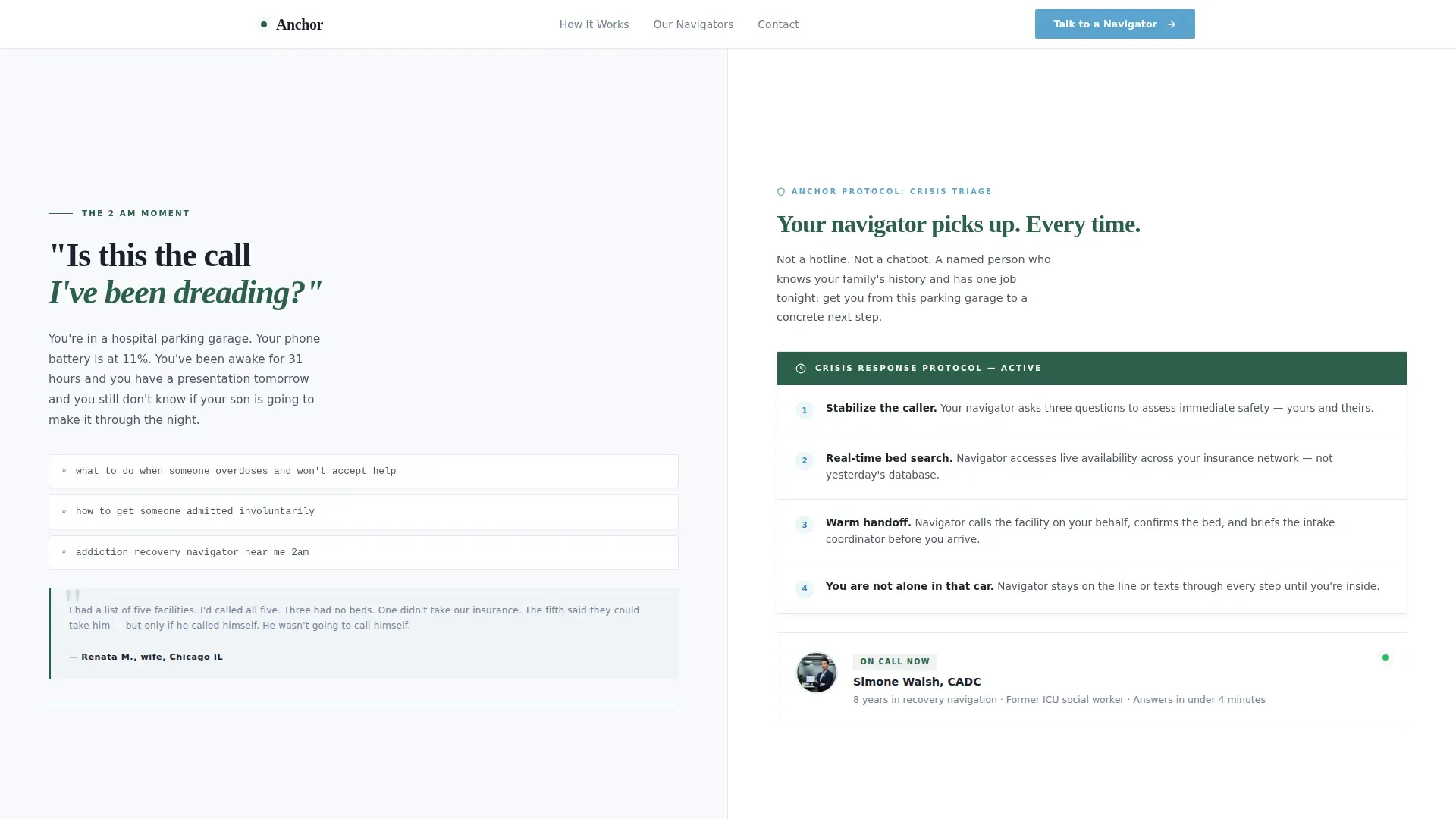
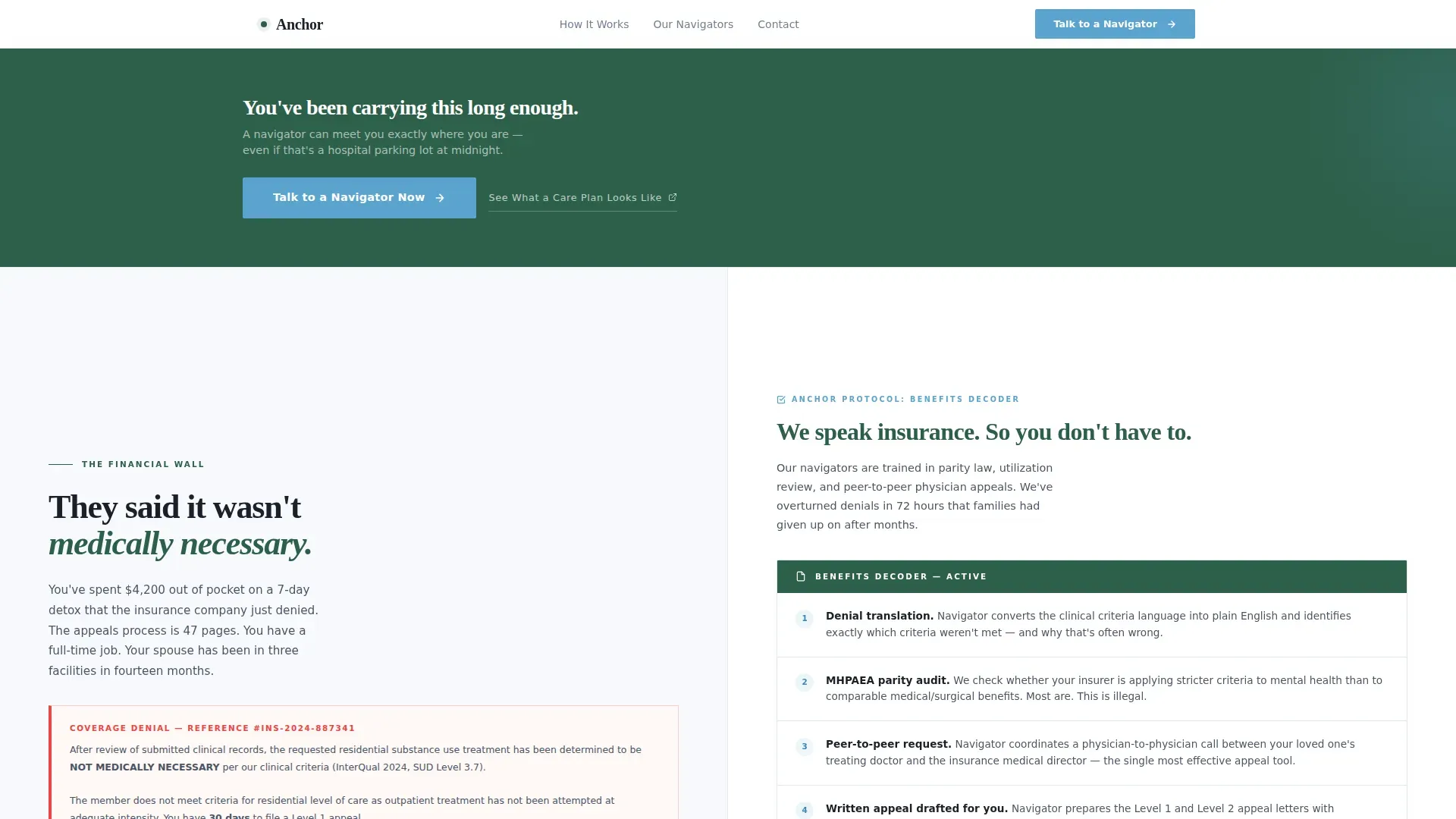
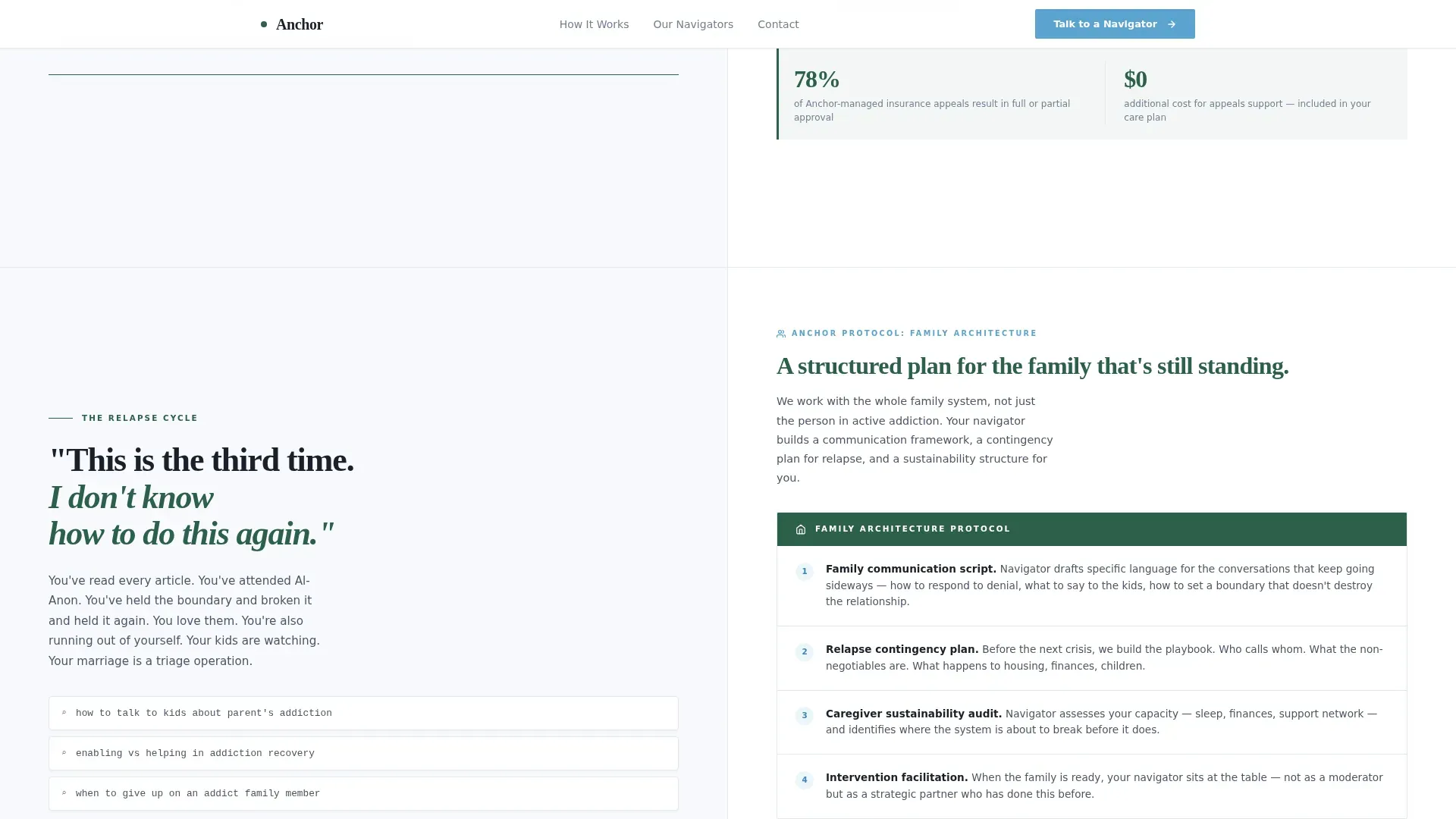
- Three split-screen problem and solution sections covering the 2 a.m. crisis, insurance denial, and relapse cycle scenarios
- A trust section with named navigator profiles and caregiver voice quotes, plus a footer using a minimal clean pattern
Feature list
This template includes purpose-built components tied directly to the caregiver support service use case. Every feature listed here is grounded in the source design brief.
Stacked Type Tower Hero
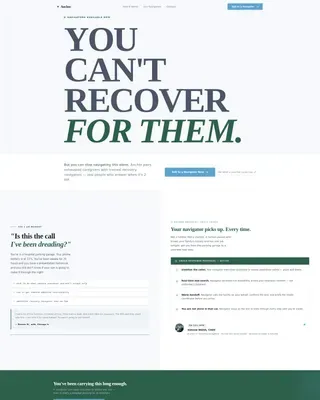
The hero uses massively scaled, vertically stacked sans-serif typography to fill the viewport with the headline "YOU / CAN'T / RECOVER / FOR THEM." No images distract. The type itself carries the emotional weight, and a single evergreen sentence below reframes the visitor's situation before the first scroll.
Split-Screen Problem and Solution Panels
Each scroll section divides the viewport 50/50. The left panel holds the caregiver's problem in their own language, rendered as raw quotes, search queries, or insurance rejection artifacts. The right panel presents the corresponding service response, such as a navigator's action plan or a family communication script.
Repeating Clear-Sky Call-to-Action Blocks
The primary call-to-action button, "Talk to a Navigator Now," appears first below the hero and repeats after every second split section. It is always rendered in clear-sky blue with white text, reserved exclusively for action moments so the eye is never desensitized.
Inline Sample Care Plan Preview
A secondary quiet link, "See What a Care Plan Looks Like," triggers an inline PDF preview for visitors who are not yet ready to call. This gives hesitant caregivers a low-commitment next step that keeps them on the page.
Named Navigator Profiles and Caregiver Quotes
The trust section features named navigator profiles alongside specific outcome statements and raw caregiver voice quotes. Social proof is presented as human evidence, not statistics, which fits the emotional register of the audience.
Scroll-Reveal and Sticky Split Animations
Sections use scroll-reveal transitions, word stagger animations, and sticky split panel behavior. These animations deepen the stakes progressively as the visitor scrolls, matching the emotional arc of the content without overwhelming the clinical aesthetic.
Page sections overview
| Section | Purpose |
|---|---|
| Hero Stack | Deliver the blunt headline and primary call to action |
| 2 AM Crisis | Pair midnight crisis problem with Navigator Protocol response |
| First call to action Repeat | Reintroduce action button after the crisis section |
| Insurance Denial | Contrast denial artifact with Benefits Decoder solution |
| Relapse Cycle | Show relapse pattern problem against Family Communication Script |
| Trust and Profiles | Build credibility with named navigators and caregiver quotes |
| Final call to action Block | Close with primary call to action and secondary care plan link |
| Minimal Footer | Provide clean site footer using Pattern 4 minimal layout |
Design & branding system
The template follows a Medical Clarity visual theme built on the Alpine Fresh color system. The aesthetic is intentionally clinical enough to signal competence and natural enough to feel safe, like a pristine clinic with wide mountain-view windows.
- Snow white (#F7F9FC) dominates all backgrounds to signal transparency and reduce visual noise
- Evergreen (#2D5F4A) anchors headlines and section dividers, acting as the visual handrail across the page
- Granite (#4A5568) carries all body text for zero-strain readability, and clear-sky blue (#5BA4CF) is reserved exclusively for calls to action and progress indicators
- Typography pairs Fraunces serif for emotional display weight with DM Sans for clean body clarity
Mobile & speed optimization
This template is designed mobile-first. The target audience, family caregivers in crisis, are most often on their phones in parking lots, waiting rooms, and hospital corridors.
- The split-screen layout adapts to a stacked single-column flow on smaller screens, keeping content readable without horizontal scrolling
- Server Components handle all static content sections, keeping JavaScript minimal and load impact low
- Scroll-linked transitions and animations are built with performance restraint so the page stays responsive on mid-range mobile devices
How this template helps you convert
This template earns the click before it asks for it. The structure is deliberately built so that by the time the primary call to action reappears, the visitor feels directed rather than sold to.
- The hero names the caregiver's exact situation in the first viewport, creating immediate recognition that lowers defensiveness before any service claim is made.
- Each split section deepens the emotional stakes and then resolves them with a named protocol, so the service feels specific and credible rather than generic by the time the call to action appears again.
- The inline care plan PDF preview gives undecided visitors a low-friction next step, keeping them engaged with the page rather than bouncing before they are ready to book.
Other information about this template
This template is built specifically for the addiction and recovery caregiver support niche within the broader Health and Medical category. It is optimized for a click-through landing page goal, meaning every design decision points toward one outcome: the intake consultation booking.
- The page is localized for English-language, United States-based audiences and is priced in USD where applicable
- The footer uses Pattern 4, a Superhuman Extreme Minimal layout, which keeps the close of the page clean and distraction-free
- The FAQ expand interaction is included as a built-in interactive component for any on-page questions a service provider wants to address
- This template suits any caregiver-facing service in the addiction recovery space, including family intervention support programs and recovery navigator practices
Theme
Medical Clarity
Creative direction
Problem→Solution Arc
Color system
Alpine Fresh
Style
Split Screen (50/50)
Direction
Click-Through
Page Sections
Stacked Type Tower Hero
50/50 Split-screen Sections
Repeating Navigator Call-to-action
Inline Care Plan PDF Preview
Named Navigator Trust Section
Scroll-reveal and Sticky Panel Animations
Related questions
Can I use this template for a different healthcare service, not just addiction recovery?
Does the template include the inline PDF preview functionality?
Is this a single page or a multi-page website template?
How does the call-to-action placement work across the page?
Can the typography and color system be customized to match an existing brand?