PTSD Support Group Landing Page Template
Anchor is a trauma-informed landing page template for peer-led PTSD support groups. Built as a 50/50 split-screen layout, it guides anxious visitors through real fears before asking for anything. The FAQ-driven structure, warm Cloud Canvas palette, and gentle typography create a page that feels like a safe room, not a clinical form.
by Rocket studio
Quick summary
Anchor is a single-page landing page template designed for peer-led PTSD support groups. Its FAQ-driven layout answers every visitor fear before presenting the RSVP form. The split-screen structure, soft Cloud Canvas color system, and serif-led typography work together to create a calm, pressure-free experience that earns trust at every scroll.
Who this template is for
This template is built for people and organizations running peer support groups in the mental health and trauma care space. It speaks directly to the late-night searcher who is not yet ready to call anyone.
- Peer support facilitators and community mental health organizers running PTSD support circles for veterans, survivors, or first responders
- Therapists and counselors looking to refer clients to a structured group resource with a clear, low-pressure landing page
- Partners or family members searching for help on behalf of a loved one who is living with post-traumatic stress
What problem this template solves
Most mental health landing pages ask for something before they give anything. For someone living with post-traumatic stress disorder (PTSD), that exchange feels unsafe. Anchor flips that order entirely.
- Visitors arrive scared and unsure; the page answers their real questions first, then offers the RSVP form only after trust is established
- The standard clinical design language found on most health pages feels cold and alienating to trauma survivors; this template uses warmth, whitespace, and literary tone instead
- Groups without a dedicated web designer need a ready-to-use layout that already communicates safety and structure without requiring copy from scratch
What you get with this template
You get a complete, ready-to-customize landing page built around the emotional journey of a first-time visitor. Every section has a clear job, and no section asks more than the visitor is ready to give.
- A five-section split-screen layout covering the hero, four FAQ-style answer panels, and a dual-path conversion section
- A pre-built RSVP form collecting first name, preferred contact method, and one optional open field, paired with a secondary PDF download call to action
- A fully defined visual system including color variables, Fraunces serif headlines, and DM Sans body text, all ready to apply
Feature list
A single paragraph introduces the feature set: every feature below comes directly from the template's planned structure and design system. Nothing here is speculative.
FAQ-Driven Split-Screen Layout
Each scroll step places one real visitor question on one side of the screen and its calm, honest answer on the other. The rhythm of question, space, and answer models the structure of the group itself, giving visitors a felt sense of safety before they ever read the RSVP form.
Dual-Path Conversion Section
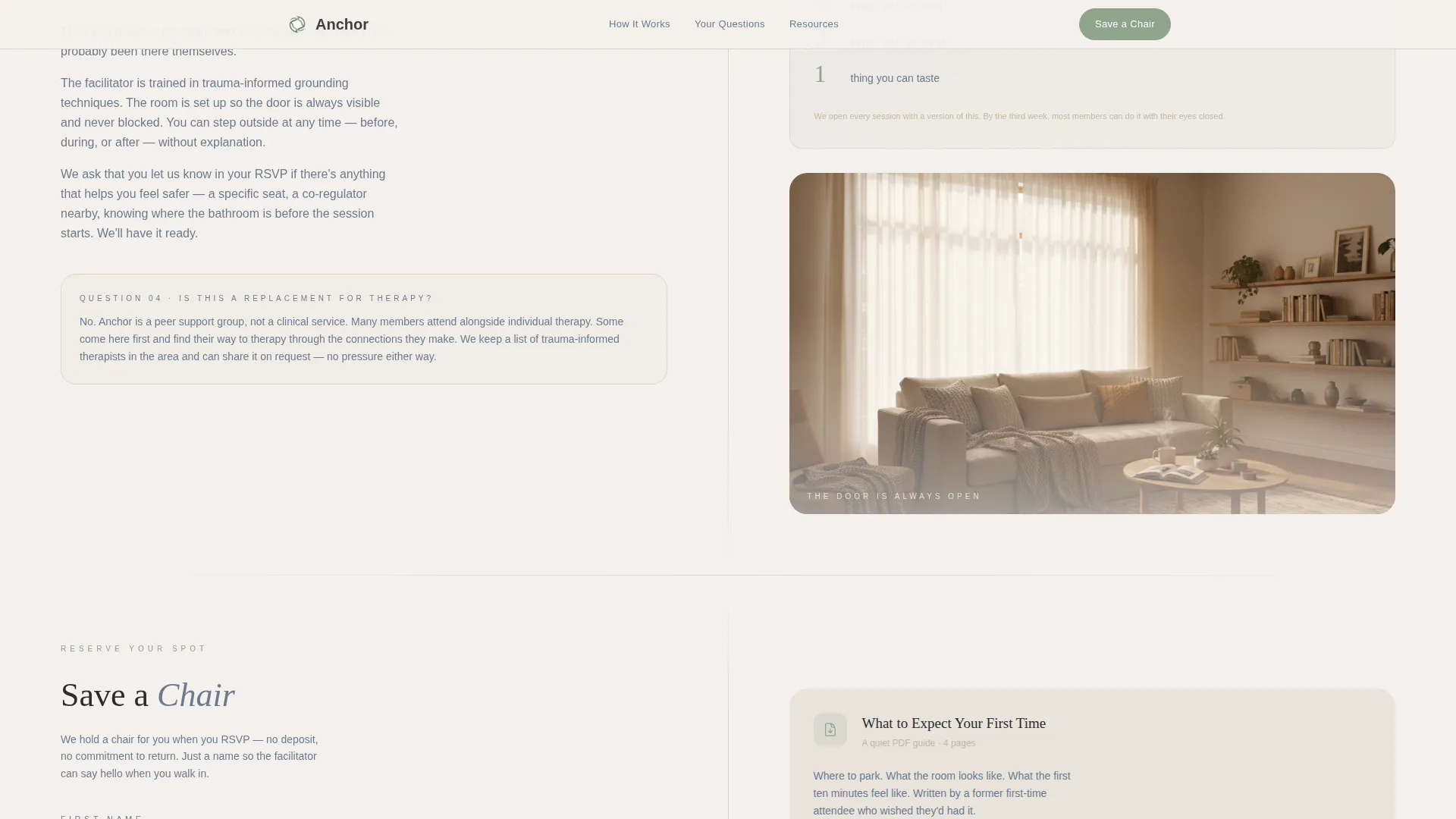
The conversion section offers two low-barrier entry points at once. Visitors can submit the "Save a Chair" RSVP form with just a first name and a preferred contact method, or they can download the "What to Expect Your First Time" PDF guide using only an email address. Neither path demands more than the visitor is ready to share.
Anonymized Peer Quote Blocks
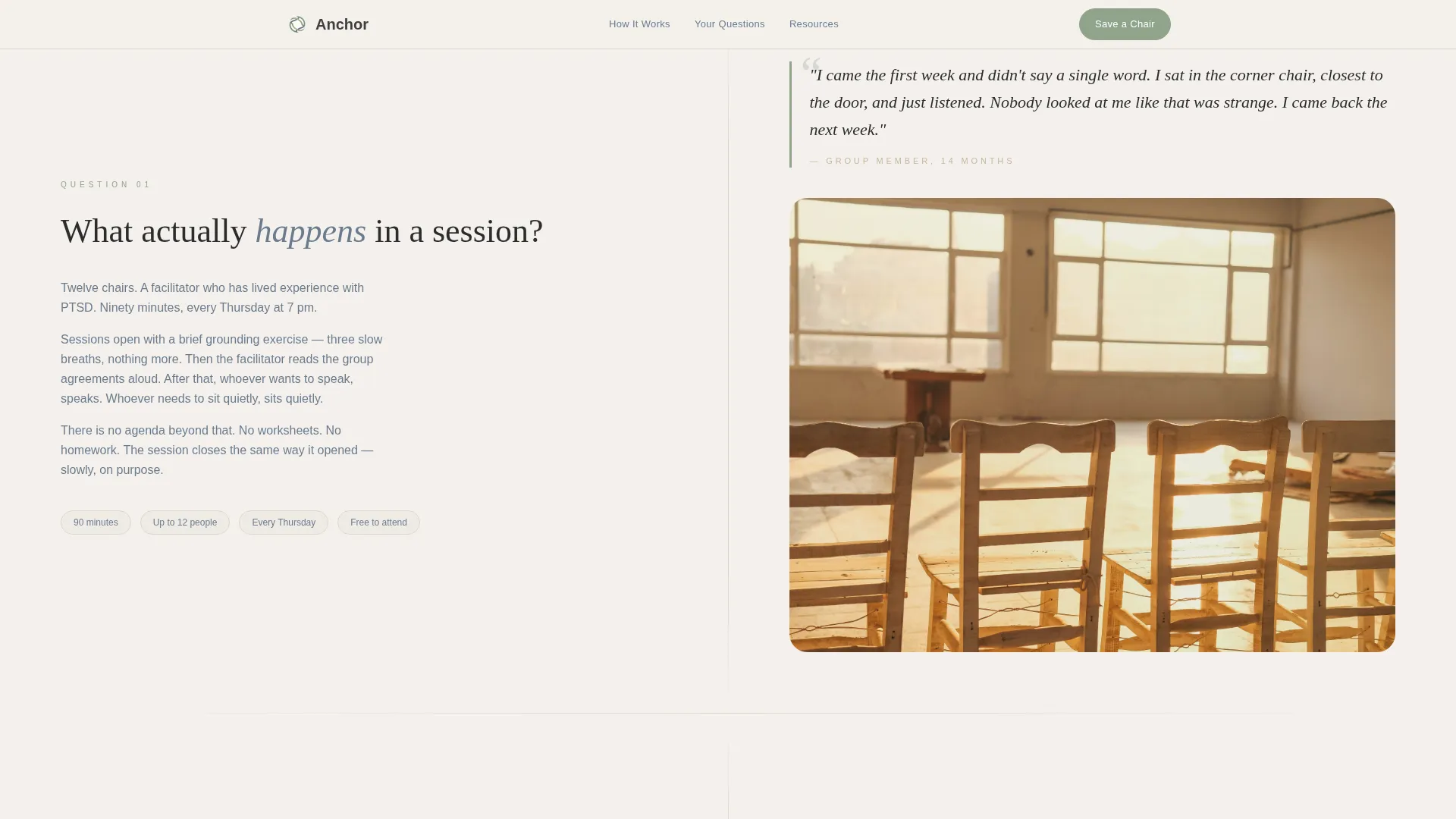
Each FAQ panel pairs its answer with a single, anonymized quote from a group member or a quiet supporting illustration. These social proof elements are kept understated and human, adding credibility without pressure or performance.
Grounding Technique Card
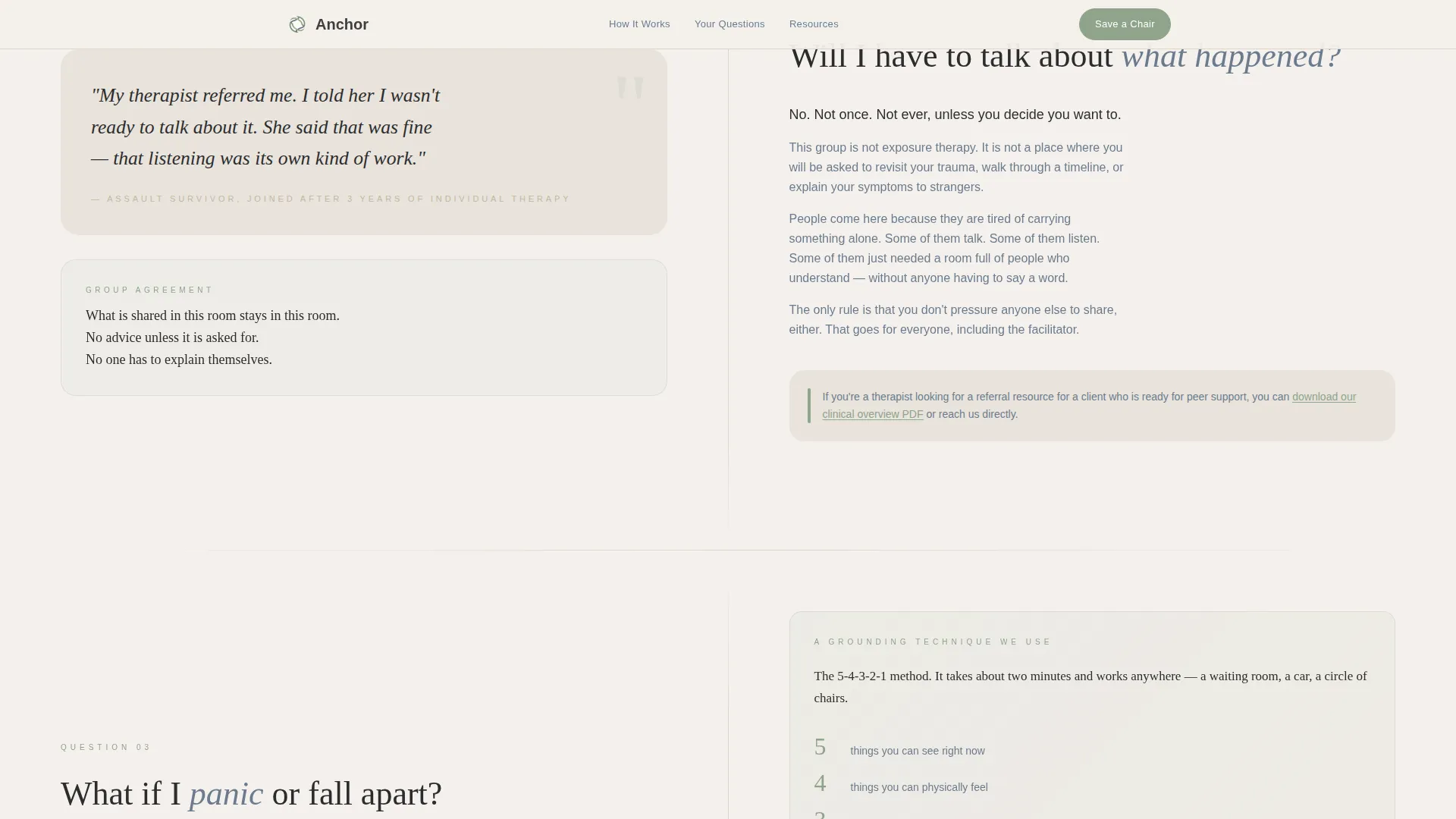
The "What if I panic?" section includes a dedicated grounding technique card alongside the written answer. This gives the template a concrete, practical resource that goes beyond reassurance and models the group's trauma-informed approach directly on the page.
Warm Healing-Space Visual System
The template ships with a complete Cloud Canvas color system: fog white (#F4F1ED) backgrounds, washed linen (#DDD5C7) panels, quiet slate (#6B7B8D) body text, and muted sage (#8FA38B) on buttons and pull-quotes. Typography pairs Fraunces serif for headlines with DM Sans for body copy.
Gentle Animation and Scroll Behavior
Section reveals use low-to-medium intensity fade-ins and scroll-triggered transitions. Jarring motion is explicitly avoided. The animation pacing reinforces the page's calm, unhurried tone and respects visitors who may be sensitive to sudden visual movement.
Page sections overview
| Section | Purpose |
|---|---|
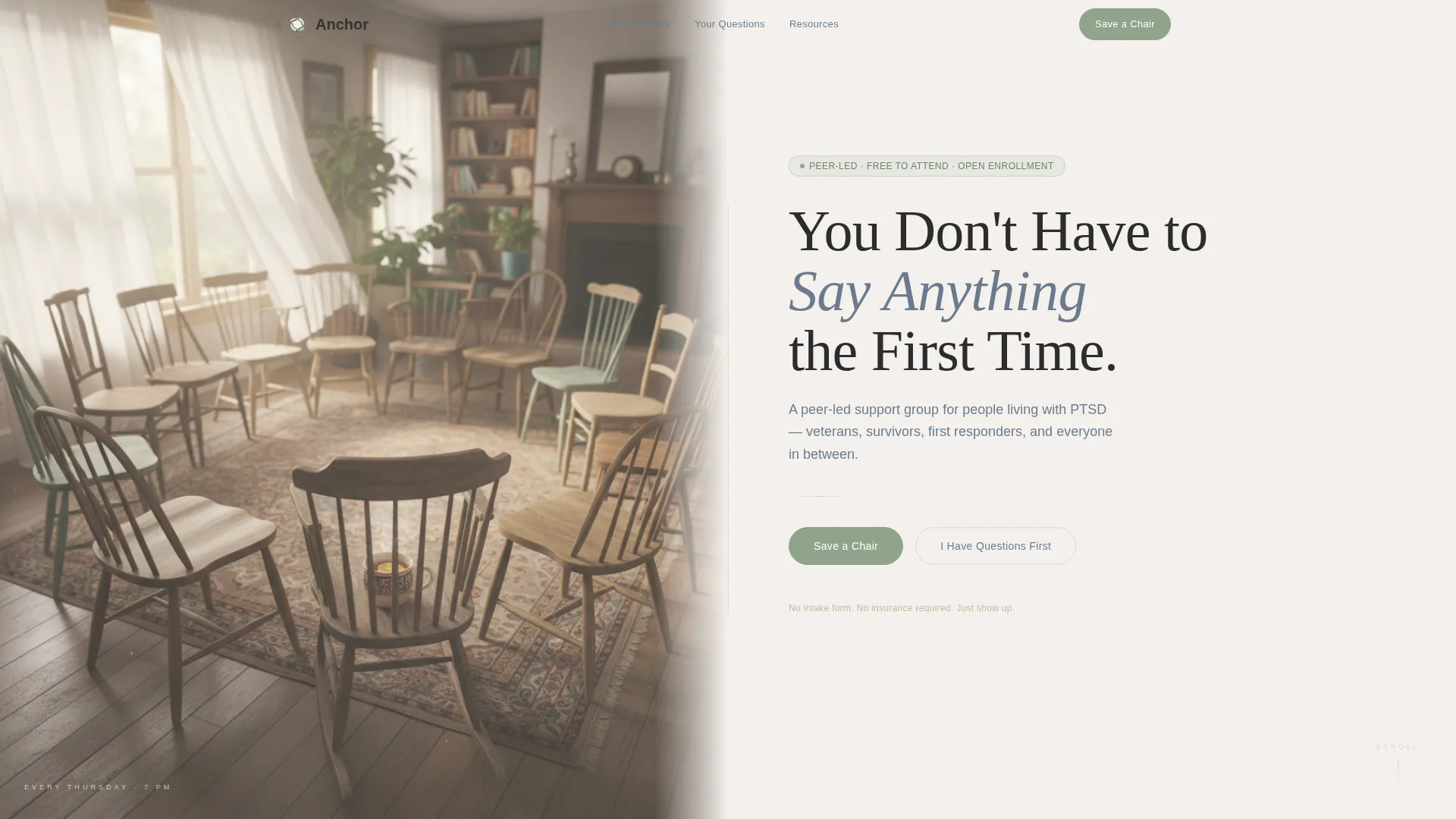
| Hero Split Panel | Introduces the group with a warm photo and headline that removes pressure immediately |
| Session Structure FAQ | Answers "What happens in a session?" with a split layout and anonymized peer quote |
| Talking Requirement FAQ | Answers "Will I have to talk about what happened?" with a quiet illustration |
| Panic Response FAQ | Answers "What if I panic?" with a grounding technique card |
| Save a Chair | Presents the RSVP form and PDF download as two equal, low-barrier paths |
| Footer | Closes with horizontal flow pattern for contact and supplementary links |
Design & branding system
The visual identity follows a Healing Space theme. Every color and type choice prioritizes warmth and calm over clinical polish, making the design feel like a room prepared for you rather than a product pitched at you.
- Color system uses four values: fog white (#F4F1ED) as the base background, washed linen (#DDD5C7) for panel fills, quiet slate (#6B7B8D) for body text, and muted sage (#8FA38B) as the single accent on buttons and pull-quotes
- Typography pairs Fraunces, a literary serif, for all headlines and the muted sage accent lines, with DM Sans as the clean, readable body font throughout
Mobile & speed optimization
The template is built with equal priority for desktop and mobile viewing. Desktop serves partners and family members doing late-night research. Mobile serves individuals searching privately in the middle of the night.
- The 50/50 split-screen layout adapts gracefully for smaller screens, stacking content vertically while preserving the question-and-answer rhythm of each section
- Static content sections use server components to minimize JavaScript load, keeping the page responsive even on slower mobile connections
How this template helps you convert
Anchor is designed so the page itself does the hardest work before the form ever appears. Conversion happens because trust has already been built, not because a button was optimized.
- The FAQ-driven scroll sequence answers every common fear in order, so visitors arrive at the RSVP form having already decided the group feels safe enough to try
- Two parallel conversion paths lower the barrier further: visitors who are not ready to RSVP can still engage by downloading the PDF guide, giving the group a way to follow up gently
Other information about this template
This template is built specifically for the PTSD care niche within the broader Health and Medical category. It is designed around trauma-informed content principles rather than standard lead-generation patterns.
- The template style is a Split Screen (50/50) layout, a format that creates visual balance and gives equal weight to the visitor's question and the group's answer
- The header concept is a Half-Page Photo and Text split, using a warm-toned photograph of an empty circle of chairs rather than stock imagery of hands or clinical settings
- The creative direction is FAQ-Driven, meaning each page section is built around one real question a scared visitor is already asking
- The landing page direction is Content and Resource, prioritizing information delivery and trust-building over aggressive lead capture
- The template avoids crisis language, stock medical imagery, and clipboard-style form design throughout
Theme
Healing Space
Creative direction
FAQ-Driven
Color system
Cloud Canvas
Style
Split Screen (50/50)
Direction
Content/Resource
Page Sections
Faq-driven Split-screen Layout
Dual-path Conversion Section
Grounding Technique Card
Anonymized Peer Quote Blocks
Cloud Canvas Visual System
Gentle Scroll Animations
Related questions
Can I customize the colors and fonts in this template?
Does this template include a working RSVP form?
Is the PDF download section included and ready to customize?
Can a therapist use this template to promote a peer referral group?
What kind of support group is this template designed for?