Depression Support Group Landing Page Template
Anchor is a depression support group landing page built around a gentle, trust-first experience. A multi-step conversational form opens the journey. Anchor nav sections guide visitors from naming their experience to choosing a group format. Three session options, facilitator bios, and anonymized participant voices carry someone from quiet recognition to a single, unhurried next step.
by Rocket studio
Quick summary
Anchor is a depression support group landing page designed to meet people exactly where they are. A multi-step conversational form opens the page by mirroring the visitor's inner experience. Anchor nav links guide the scroll through four focused sections. The goal is one gentle action: finding the right group.
Who this template is for
This template is built for mental health practitioners, peer support facilitators, and wellness organizations running structured depression support groups. It works for small practices and community programs alike, wherever the priority is earning trust before asking for commitment.
- Therapists or facilitators launching a new group program and needing a warm, non-clinical entry point
- Community mental health organizations offering peer-led depression support sessions
- Family members searching for group options on behalf of someone they love
What problem this template solves
People experiencing depression rarely search for help in a clinical frame. They arrive at a page mid-exhaustion, mid-doubt, already skeptical. A standard sign-up form or pushy call-to-action can feel like one more thing demanding something they don't have. This template removes that friction entirely.
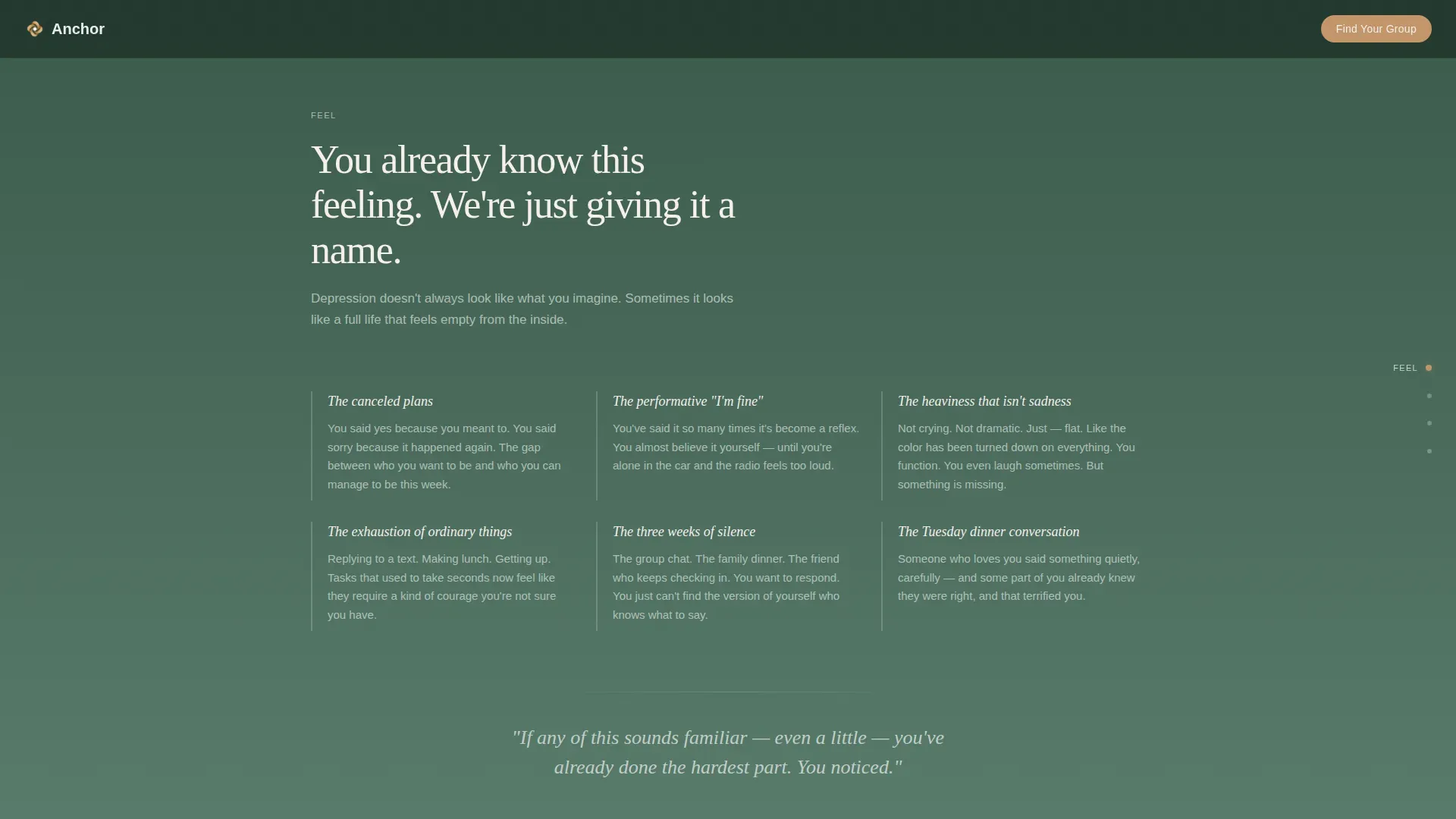
- It names the specific, lived textures of depression without using diagnostic language that creates distance
- It replaces form pressure with a paced, conversational flow that builds trust before making any ask
- It offers multiple group formats so visitors can find a fit without feeling forced into one path
What you get with this template
This template delivers a complete, single-page hub and spoke layout structured around four anchor-navigated sections. Every design choice, from the gradient backgrounds to the amber accent, is intentional and pre-built.
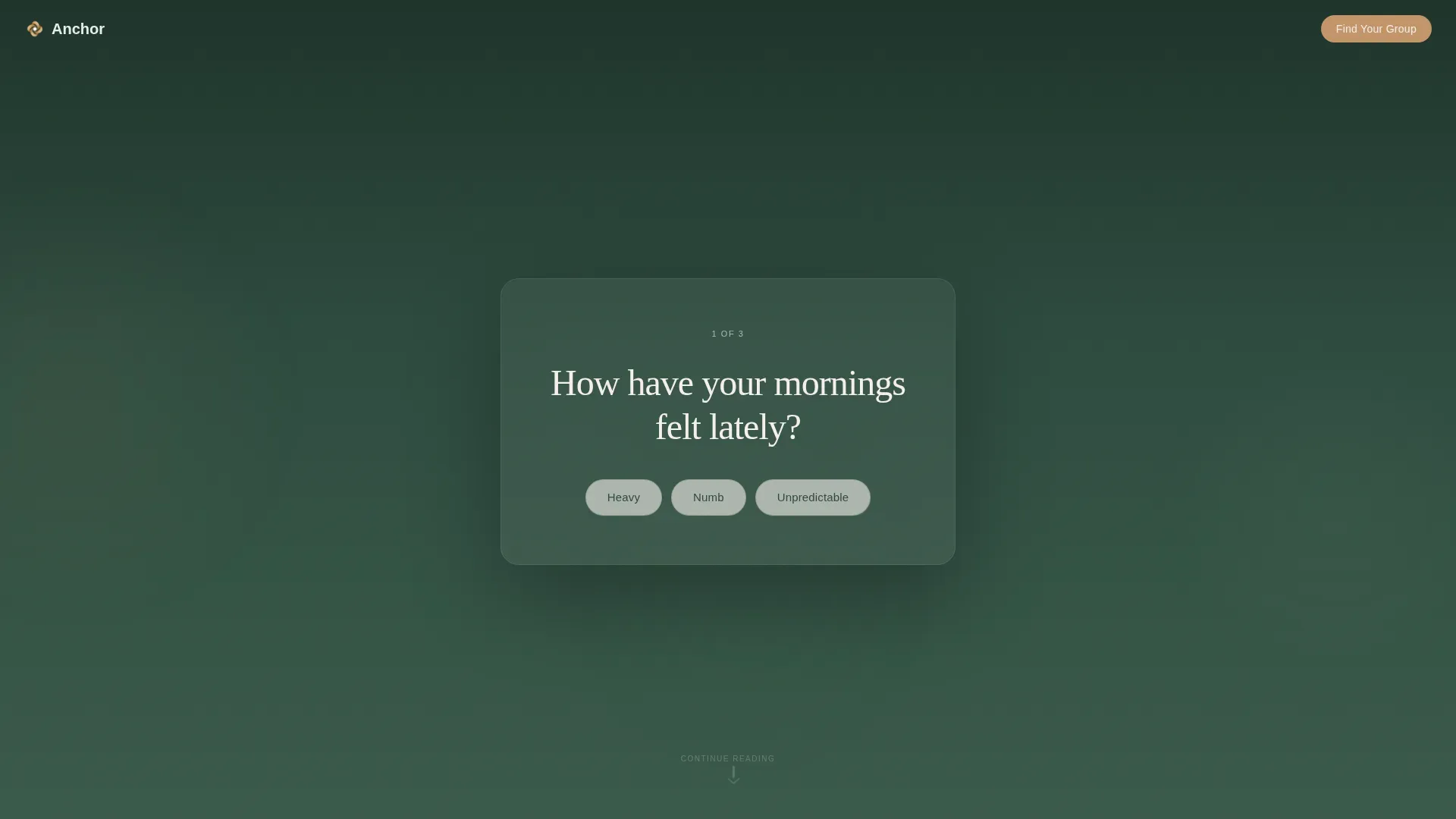
- A multi-step conversational header form with soft pill-shaped answer options and slow fade transitions
- Three expanding spoke cards covering weeknight, Saturday morning, and asynchronous text-based group formats
- A fixed anchor navigation bar with single-word labels: Feel, Understand, Join, and Begin
- Primary and secondary call-to-action placements throughout, including a low-pressure facilitator contact path
- An ultra-minimal footer following a horizontal layout pattern
Feature list
This template is built around five deliberate components that work together to carry a visitor from quiet recognition to confident enrollment.
Multi-Step Conversational Form
The header opens with a single centered question in large Fraunces serif type. Three soft pill-shaped options appear below it. Selecting one transitions gently to the next question using slow fade animations. The sequence builds emotional resonance before any action is requested.
Anchor Navigation Bar
A fixed, minimal navigation bar becomes visible just below the header. It uses four single-word labels to orient the visitor throughout the scroll. The amber accent color highlights the active section, functioning like a lantern marking each resting point along the journey.
Expanding Spoke Cards
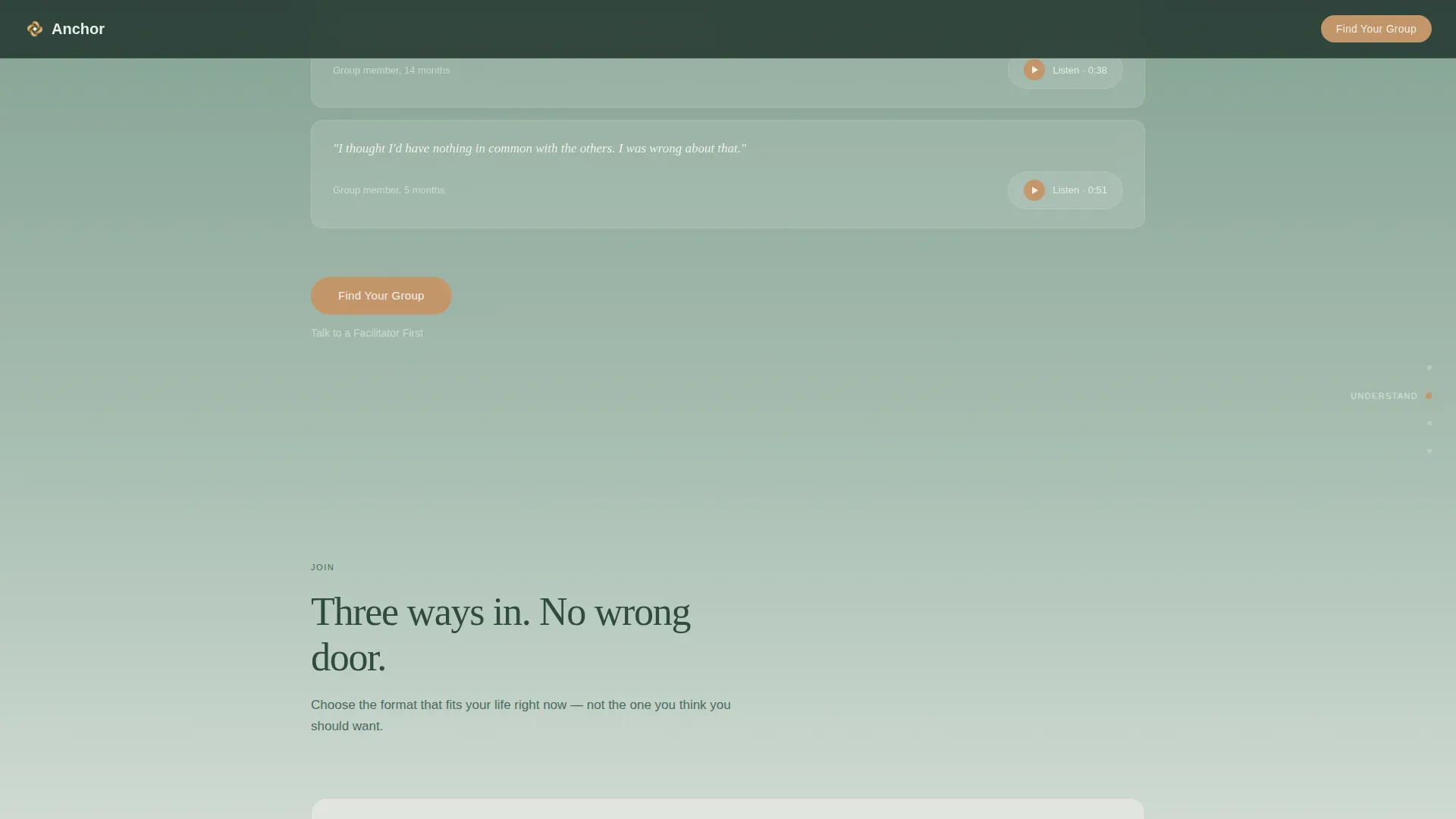
The Join section presents three group format cards. Each card expands on click to reveal session schedules, group size details, and facilitator bios. The expansion behavior keeps the page uncluttered while surfacing the right detail at the right moment.
Scroll-Linked Gradient Backgrounds
Background gradients shift section by section as the visitor scrolls downward. The page moves from deep moss tones at the top toward lighter fog and birch shades lower down. This visual arc mirrors the emotional arc of the content itself.
Dual Call-to-Action Architecture
The primary call to action, "Find Your Group," appears at the end of the header form and again at the base of each spoke section. A secondary text link, "Talk to a Facilitator First," sits beneath every primary button for visitors who need more time before committing.
Page sections overview
| Section | Purpose |
|---|---|
| Hero Conversation Form | Opens with a paced multi-step question sequence to build immediate emotional resonance |
| Feel Named Experience | Names specific lived textures of depression without clinical language or labels |
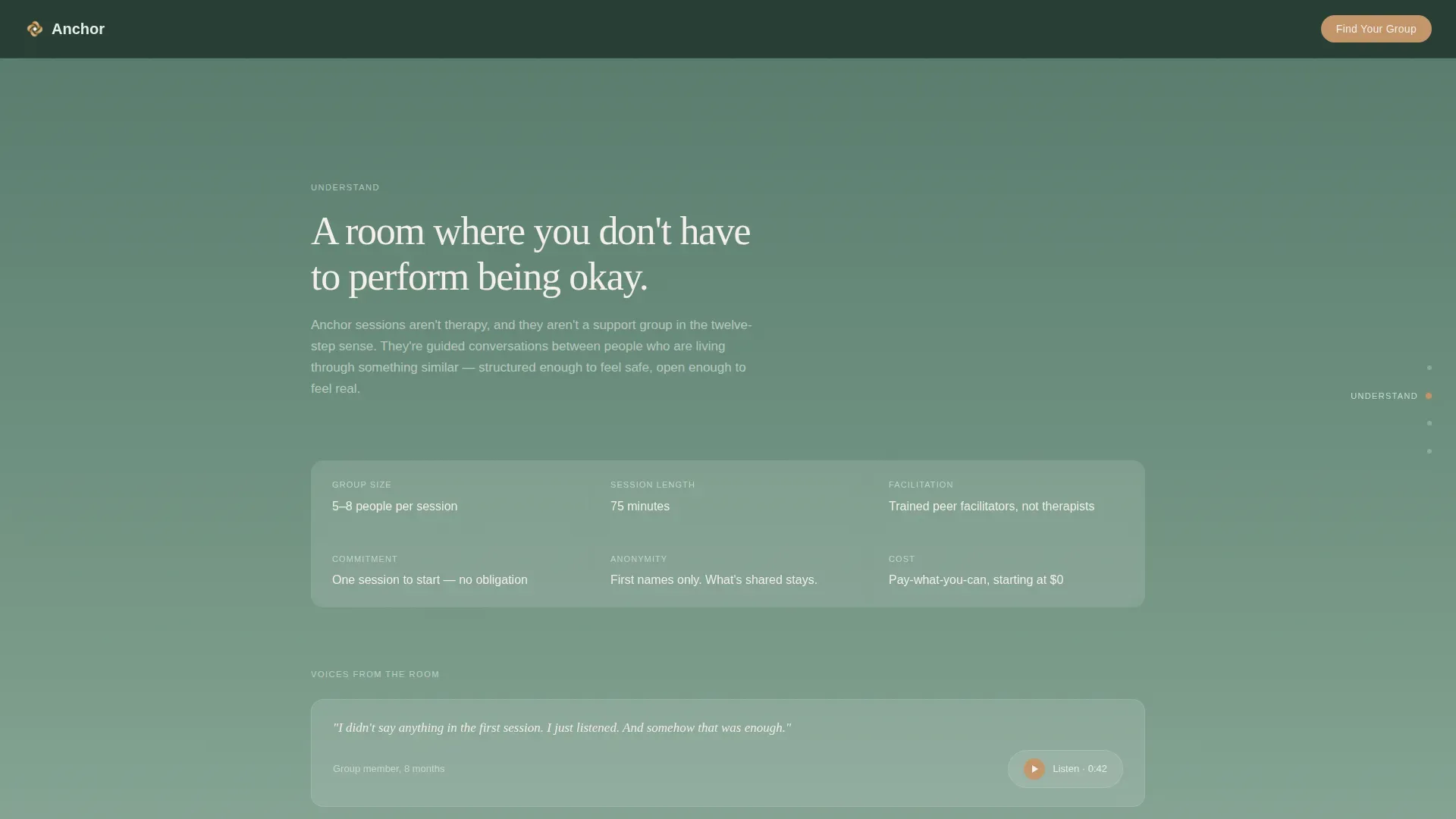
| Understand Group Model | Explains session structure, facilitator roles, and anonymized participant voices |
| Join Format Cards | Presents three group formats as expanding spoke cards with schedules and bios |
| Begin Gentle call to action | Closes the scroll with the primary enrollment action and secondary facilitator path |
| Footer Minimal Bar | Ultra-minimal horizontal footer with essential links only |
Design & branding system
The visual identity uses a Forest Trust color system built to feel like a forest trail just after rain. Every color has an assigned role, and none are used arbitrarily.
- Deep moss (#2D4A3E) carries all primary text and structural elements; morning fog (#E8EDE9) and birch bark (#F5F0EB) serve as background surfaces that keep the page airy and calm
- Gentle amber (#C4956A) appears only on interactive elements such as buttons, selected anchor nav states, and progress indicators, so it always signals a place to act
- Fraunces serif handles headings and emotionally weighted type; DM Sans handles body copy for clarity and ease of reading
Mobile & speed optimization
This template is built mobile-first because the person most likely to find this page is already holding their phone. Every layout decision prioritizes small-screen readability and one-thumb navigation.
- The multi-step form, anchor nav, and spoke cards are all designed to feel natural on a phone screen without requiring pinch or zoom
- Animations rely on CSS-driven transitions and slow fades rather than heavy JavaScript, keeping the experience smooth on mid-range devices
- The minimal footer and lean component structure reduce visual noise and unnecessary load on the page
How this template helps you convert
This template converts by demonstrating patience. It never rushes the visitor and never asks for something before offering something first. That restraint is the persuasion strategy.
- The multi-step form opens by reflecting the visitor's own experience back to them, creating a sense of being understood before any group information appears, which lowers resistance to reading further.
- The scroll-linked gradient arc moves the page from darkness toward light, so the visitor feels the emotional shift in their body as they move through the content, arriving at the call to action already oriented toward action.
- The dual call-to-action structure ensures that both ready and hesitant visitors have a clear next step, with the secondary facilitator path catching anyone not yet ready to commit to a group.
Other information about this template
This template sits within the Health and Medical category under Depression Care, and it was designed with the specific niche of depression support groups in mind. A few additional details are worth noting for anyone evaluating it.
- The template uses a Hub and Spoke layout with anchor navigation, meaning all content lives on one scrollable page with the anchor bar providing orientation
- The click-through direction means the primary action leads to a dedicated enrollment page, keeping the landing page itself free of form fields and data collection
- The Problem to Solution Arc creative direction is built into the page structure itself, with each section designed to deepen trust before the next one asks for more
- Anonymized participant quotes and facilitator bios are included as social proof components within the Understand and Join sections
- The page is localized for English (US) with no currency references, making it straightforward to adapt for any US-based group program
Theme
Soft Gradient
Creative direction
Problem→Solution Arc
Color system
Forest Trust
Style
Hub & Spoke (Anchor Nav)
Direction
Click-Through
Page Sections
Multi-step Conversational Header Form
Fixed Anchor Navigation Bar
Expanding Group Format Spoke Cards
Scroll-linked Gradient Arc
Dual Call-to-action Placement
Anonymized Social Proof Components
Related questions
What kind of organization is this template designed for?
Does this template include the enrollment page it links to?
Can the three group format cards be updated to reflect different session types?
Is the multi-step form connected to a database or email system?
What option exists for visitors who are not ready to join a group?