Gourmet Food Truck Landing Page Template
Pachamanca is a masonry-layout landing page template built for an authentic Peruvian food truck. It combines a scrapbook-style hero, a neighborhood route grid, event use-case cards, handwritten testimonials, and a booking form with a guest-count slider. The design runs on an earthy Warm Stone palette that tastes like slow-roasted tradition pulled straight from the soil.
by Rocket studio
Quick summary
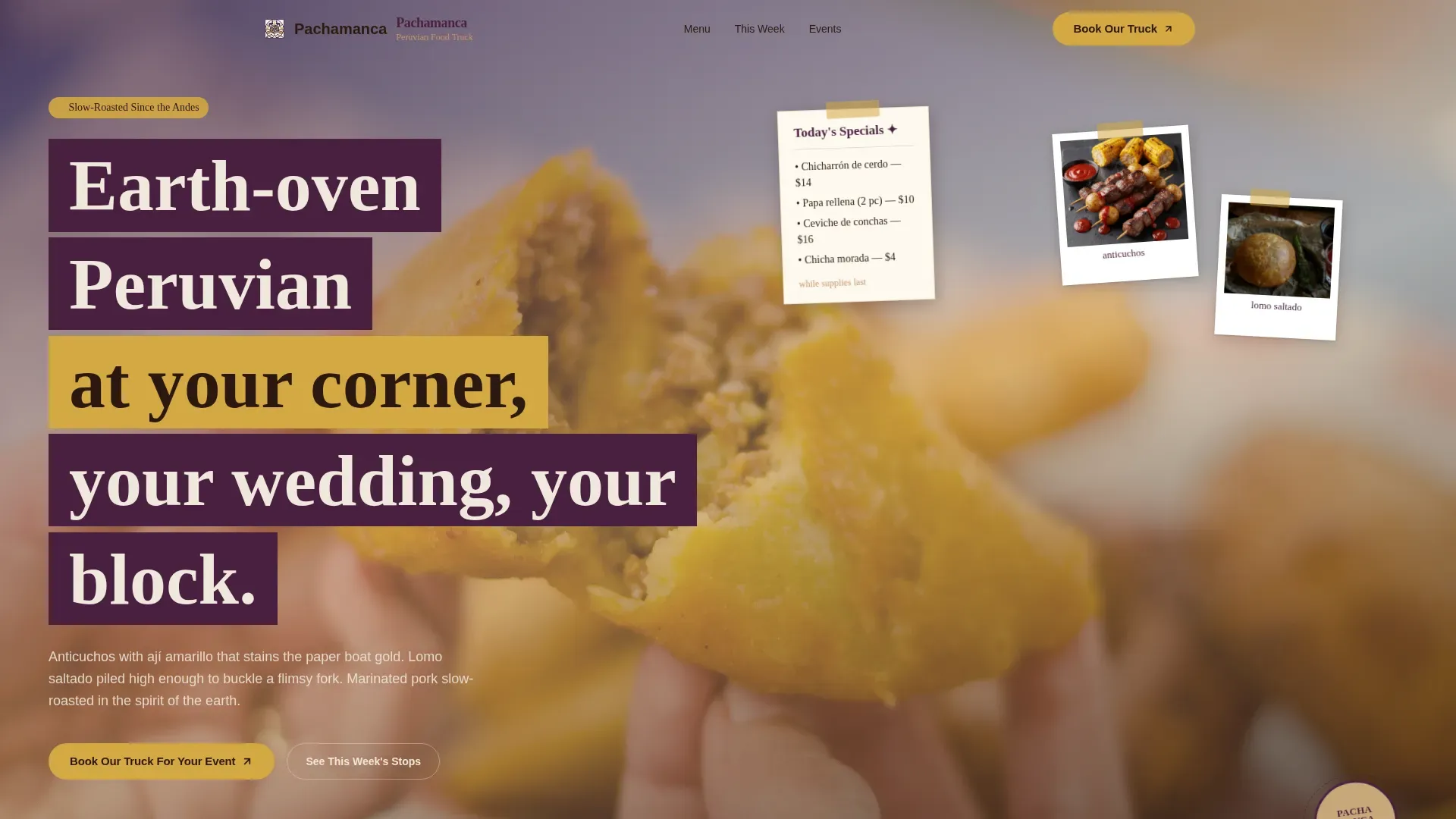
Pachamanca is a single-page booking and discovery template for a Peruvian food truck. It opens with a collage hero layered with Polaroid food photos, a handwritten specials card, and a kraft-stamped logo. A masonry grid then maps the truck's neighborhood route, followed by event use-case cards, scrolling testimonials, and a structured booking form. The whole page is built mobile-first and designed to convert walk-up customers and event planners alike.
Who this template is for
This template is built for food truck owners who serve peruvian food and need a page that handles both daily foot traffic and group event bookings at the same time. It works especially well when your menu centers on a traditional peruvian dish with a real backstory, the kind of peruvian cuisine that earns loyal regulars and repeat event clients.
- Office managers and corporate teams booking Friday group lunches for 20 or more guests
- Wedding couples and event planners who want a late-night peruvian food catering window
- Block party organizers who need a reliable anchor vendor with a clear booking path
What problem this template solves
Most food truck websites try to do too much. They dump a full PDF menu online, bury the location schedule three scrolls deep, and offer no clear path for event inquiries. Customers who want lunch tomorrow and clients who want to book for 200 guests both leave without finding what they need.
This template solves that problem by separating the two journeys cleanly. Walk-up customers find the weekly neighborhood route immediately. Event clients find a structured booking form without scrolling past irrelevant content. Every section is built to answer one specific question before asking the visitor to act.
- No more burying the location schedule where hungry customers cannot find it
- No more losing event leads because the booking process feels unclear or unfinished
What you get with this template
You get a fully designed, section-led landing page that reflects the warmth and depth of peruvian food culture. The layout is dense where it should be and spacious where it counts. Every component is built around the booking and discovery needs of a food truck that serves a traditional peruvian dish to real neighborhoods on a real schedule.
- A collage hero with layered Polaroid-style photo slots, a handwritten daily specials card, a torn map fragment, and a kraft-paper logo stamp
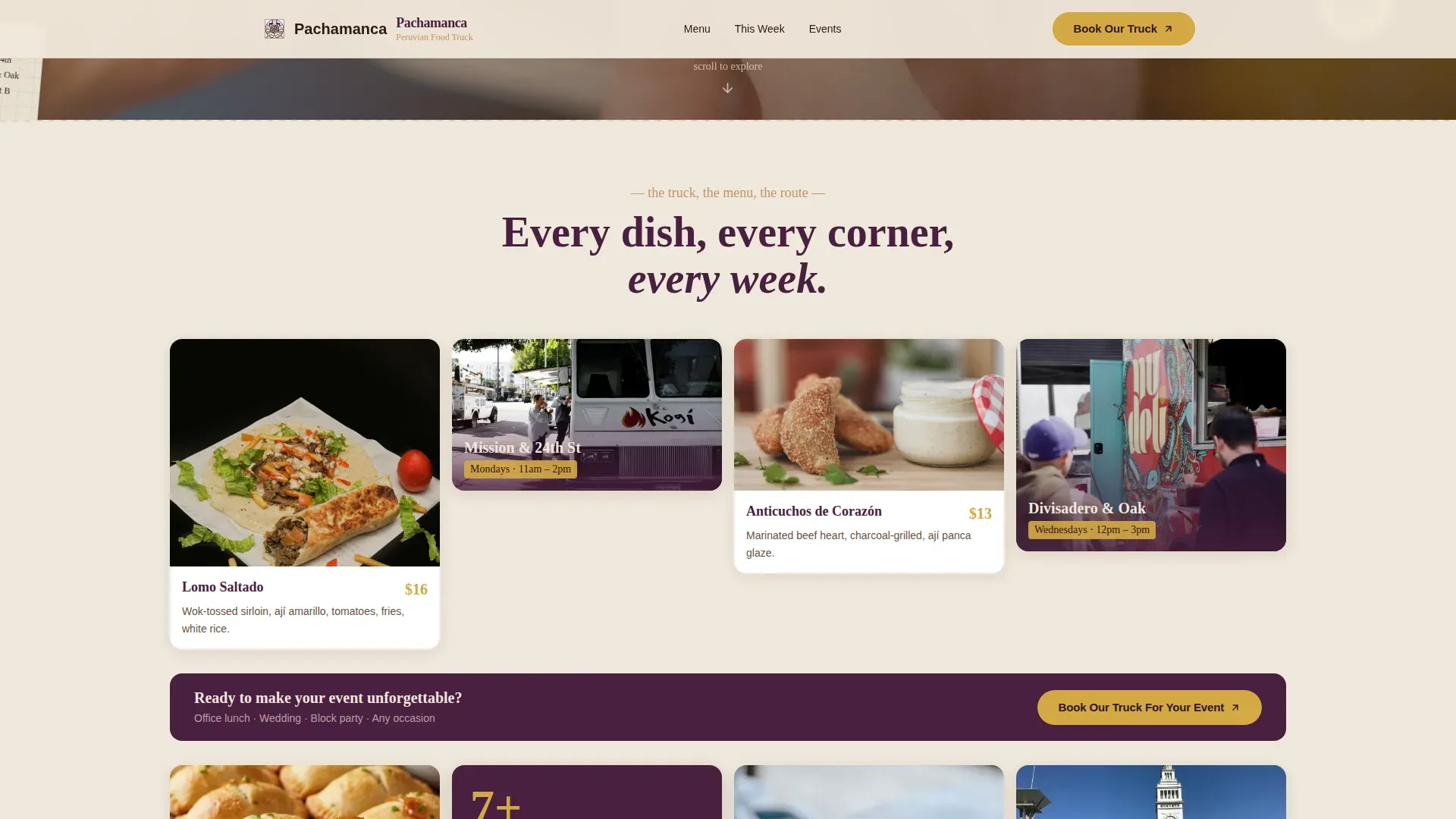
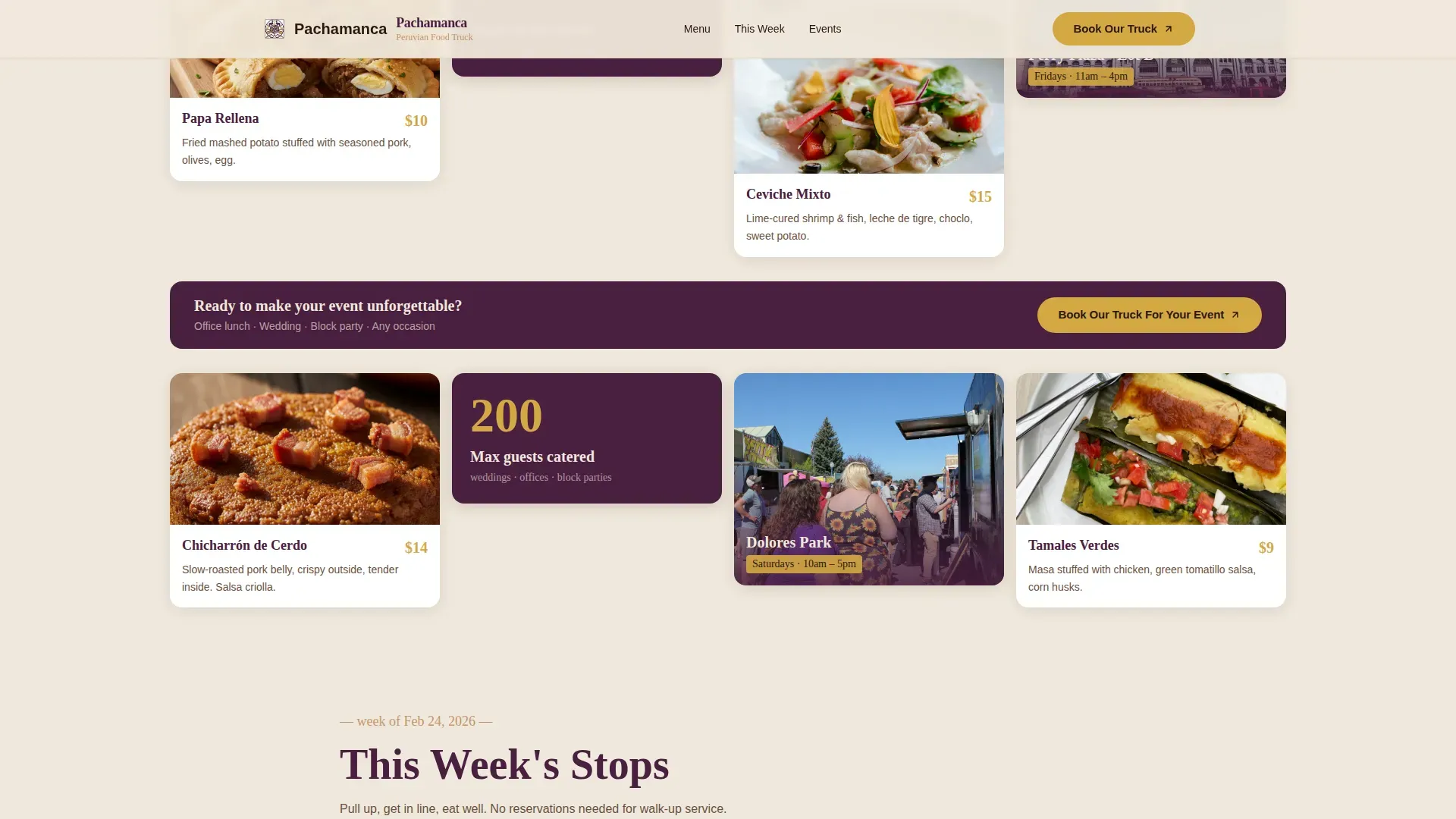
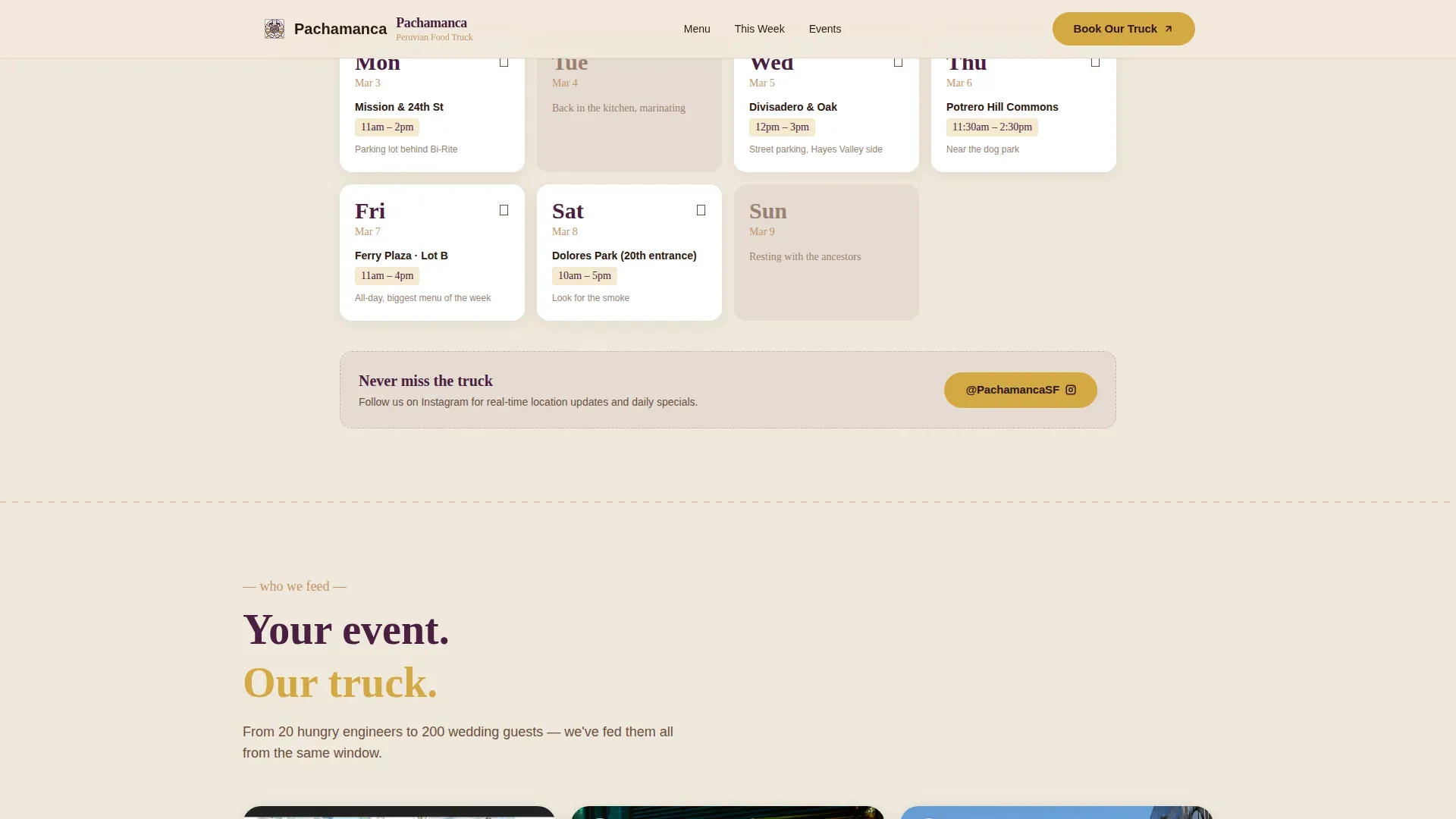
- A masonry neighborhood route grid where each card shows a truck location, cross streets, and a weekly schedule printed like a community flyer
- An event use-case section with asymmetric bento cards for office, wedding, and block party categories, a scrolling handwritten testimonial marquee, a booking form with date input, guest-count slider (20 to 200), event type selector, and address field, and a split-layout footer with logo and tagline on the left and navigation links on the right
Feature list
The template packs a specific set of visual and functional components. Each one is tied directly to the needs of a peruvian food truck operating across multiple neighborhood stops and booking categories.
Collage Scrapbook Hero
The header is built as a layered collage, not a flat banner. Polaroid-style food photo slots overlap at casual angles against a chalky highland white ground. A handwritten specials card sits slightly crooked with simulated tape. A torn map fragment shows three neighborhood stop areas. The dominant image shows hands tearing open a foil-wrapped papa rellena, steam escaping, the filling golden and visible. The kraft-paper logo stamp completes the composition. This header communicates texture, warmth, and authenticity before a single word is read.
Masonry Neighborhood Route Grid
The scroll experience is structured like a walking tour of the truck's weekly route. Each masonry card represents one neighborhood stop. It carries a photo of the truck at a specific corner, the cross streets named clearly, and the weekly schedule laid out like a printed community flyer. Between neighborhood clusters, testimonial cards from regulars appear in a handwritten notebook-paper style. The grid density increases as you scroll, building the feeling that this peruvian food truck is woven into the fabric of real streets and real lunch hours.
Event Use-Case Cards
Three asymmetric bento-style cards present the three booking categories: office events, weddings, and block parties. Each card is tailored to the language and concerns of that specific client type. Office managers can view group-size information. Wedding couples can read about late-night service windows. Block party organizers can find anchor-vendor details. This section helps each visitor self-identify and move toward the booking form with confidence.
Booking Form with Guest Slider
The booking form is built for clarity. It asks for the event date first, then uses a range slider to set guest count between 20 and 200. The visitor then selects an event type from four options: wedding, office, block party, or private. Finally, they enter a street address. The primary call-to-action button reads "Book Our Truck For Your Event" in quinoa gold on choclo purple. On mobile, this button is pinned to the bottom of the viewport. On desktop, it repeats after every third masonry row so it is always within reach.
Scrolling Handwritten Testimonial Marquee
Social proof is presented as a horizontally scrolling marquee of testimonial cards. Each card is styled to look handwritten on lined notebook paper. The format is intentional: it feels personal and unpolished in the best sense, matching the handmade character of the overall design. Testimonials reference specific dishes and neighborhood stops, which builds credibility in a way that generic star ratings cannot.
Secondary Navigation Path
A secondary call-to-action labeled "See This Week's Stops" scrolls visitors back up to the neighborhood route map. This path is designed specifically for walk-up customers who are not planning an event but want to find the truck for lunch. It keeps both visitor types on the same page without confusion and reduces the risk of losing a daily customer to a dead end.
Page sections overview
| Section | Purpose |
|---|---|
| Hero Collage Header | Establish warmth, authenticity, and brand identity through a layered scrapbook composition |
| Masonry Route Grid | Show the truck's weekly neighborhood stops with location, schedule, and food photos |
| Event Use-Case Cards | Present three booking categories so each visitor can self-identify quickly |
| Testimonial Marquee | Build trust through scrolling handwritten social proof tied to specific dishes |
| Booking Form | Capture event date, guest count, event type, and address through a structured input flow |
| Split Footer | Display logo, tagline, and navigation links in a clean two-column layout |
Design & branding system
The visual identity is built on an Agrarian Root theme expressed through the Warm Stone color system. The palette is grounded in earthy, handmade pigments that feel sun-dried and deeply considered. Fraunces serif handles all headlines, giving the type a warm literary weight. DM Sans carries body copy with clean readability. Together they produce a voice that feels both rooted in history and easy to read on a phone screen.
- Sun-dried adobe (#C4956A) and chalky highland white (#F0E8DC) dominate backgrounds and card surfaces, giving the page a terracotta warmth
- Rich choclo purple (#4A2040) anchors navigation and headlines, while quinoa-field gold (#D4A843) activates buttons, price callouts, and hover states
Mobile & speed optimization
Over 50 percent of web traffic is mobile, so this template is built mobile-first. The sticky booking call-to-action remains pinned at the bottom of the viewport on mobile so that event inquiries are never more than one tap away. The masonry grid adapts its column density for smaller screens without losing the neighborhood-scrapbook character. Float animations and scroll reveals are implemented with GPU-accelerated CSS so that visual richness does not come at the expense of smooth performance.
- Lazy-loaded images keep the initial page load feeling responsive even with a photo-dense layout
- The guest-count slider and booking form inputs are sized and spaced for comfortable use on touch screens
How this template helps you convert
The template is built around two distinct visitor journeys, and it resolves both without forcing either group to wade through content meant for the other. Walk-up customers find the route map fast. Event clients find the booking form structured and approachable. Every design decision is made to reduce hesitation and move visitors toward action.
- The sticky mobile call-to-action and desktop row-repeat placement mean that "Book Our Truck For Your Event" is always visible, so event leads are captured at the moment of intent rather than after the visitor loses momentum
- The secondary "See This Week's Stops" path keeps daily customers engaged without pulling them into an event booking flow they do not need, which reduces bounce and builds the habit of checking the page each week
Other information about this template
Peruvian cuisine has gained recognition worldwide as one of the most diverse and rich culinary traditions in the world. That recognition holds genuine cultural, social, and financial importance for Peru and for every food business that represents it. Peruvian cuisine is considered a social and cultural treasure, shaped throughout history and intertwined with the biodiversity of Peru's regions. The culinary diversity found within Peru's various regions forms an integral part of the cultural heritage of their respective societies. Peruvian food has positioned itself in the world due to its excellence, variety, colors, flavors, and textures.
Pachamanca is a traditional Andean dish that involves cooking meat and vegetables underground using heated stones. The term comes from the Quechua language, meaning "earth pot." The main ingredients of pachamanca are tubers and meat, often accompanied by local sauces, spices, salads, and occasionally chicken or other protein sources. Tubers such as potatoes hold a central place in the preparation, as potatoes have been cultivated in the Andean soil for thousands of years and remain a defining ingredient across peruvian food culture. Potatoes appear in many traditional forms across Peru, and their role in pachamanca reflects the deep agricultural practices of Andean civilization.
The preparation of pachamanca is an ancestral rite. It is commonly cooked during festive occasions and social gatherings in places like Cusco and across the highland regions. The dish is produced in a pit dug into the ground, lined with heated stones, then layered with marinated meat, potatoes, and other vegetables. Once cooked, the feast is accompanied by salads, sauces made from local spices and ají amarillo, and sometimes seafood in coastal variations. Peruvian food scholars, food content produced in both english and spanish, and books published on Andean gastronomy all state that pachamanca represents a living connection to an ancient civilization and its relationship with the land.
From a dissemination standpoint, this template helps share that story with new audiences efficiently. Food truck owners can use it as a starting site without requiring technical skills. No-code platforms make it accessible so that owners can focus on their food rather than on development processes. A subscription-based platform often provides a free trial, which means you can review the template in a working state before committing. The page is designed to work as a published, production-ready item from the first day it goes live.
- The pachamanca authentic peruvian food truck landing page template is designed specifically for Peruvian food truck businesses that need both a route-discovery tool and an event booking system on a single page
- Content categories covered by this template include neighborhood route mapping, event booking, social proof, and food storytelling, making it a comprehensive field tool for food truck operators
- The template's content is fully reviewed and ready to customize, so minimum setup time is required before the page can go live
- Users can find the booking form, route map, and event use-case cards all within a single scrolling view, with access to each section clearly shown through the navigation and secondary scroll path
- Books, articles, and published research on peruvian food and Andean history can inform the custom copy you add to fill in menu descriptions and neighborhood stop details
Theme
Agrarian Root
Creative direction
Local & Neighborhood
Color system
Warm Stone
Style
Masonry/Pinterest
Direction
Booking/Scheduling
Page Sections
Collage Scrapbook Hero Header
Masonry Neighborhood Route Grid
Event Use-case Bento Cards
Booking Form with Guest-count Slider
Scrolling Testimonial Marquee
Dual Visitor Navigation Paths
Related questions
Can I use this template without any coding knowledge?
What event types does the booking form support?
Is this template designed for mobile users?
Can walk-up customers find the truck's weekly schedule easily?
How does the testimonial section help build credibility?