The Anodize aerospace surface treatment finishing landing page template is a dashboard-style, data-driven layout built for Nadcap-accredited finishing facilities. It front-loads compliance credentials, process qualifications, and capacity data so procurement engineers and quality leads can verify vendor fit before ever contacting sales. Every section reads like a vendor qualification packet, not a brochure.
by Rocket studio
Loading preview…
Quick summary
This template gives an aerospace surface treatment facility a commanding digital presence. It presents anodizing process data, compliance badges, and capacity metrics as a structured command-center interface. The design speaks directly to procurement engineers who need verifiable facts, not marketing language, before shortlisting a vendor.
Who this template is for
This landing page is built for B2B industrial facilities where precision and certification are non-negotiable. It serves teams that sell finishing services to tier-one aerostructure manufacturers and defense primes.
MAS&R directors and procurement engineers at engine OEMs sourcing Nadcap-accredited vendors
Quality leads at defense primes who require full AS9100-certified documentation trails
Tier-one aerostructure manufacturers in active vendor-screening phases
What problem this template solves
Procurement engineers in the aerospace industry spend hours chasing vendor qualification data across phone calls and email threads. That friction kills conversions. This template solves that problem by placing every key data point on-screen before a visitor ever reaches the contact form.
Engineers cannot verify corrosion resistance specs, process qualifications, or capacity without a first call
Facilities lose qualified leads who move on to vendors with clearer digital documentation
Compliance proof is scattered and hard to trust without a structured, data-forward presentation
What you get with this template
You get a fully structured, single-page dashboard layout that presents aluminum anodizing qualifications, process coverage, and lead-generation tools in one scrollable session. The template is organized to mirror the way a procurement engineer reads a vendor qualification packet.
A hero section with live-styled data tiles showing Nadcap status, active specs, throughput, and on-time delivery percentage
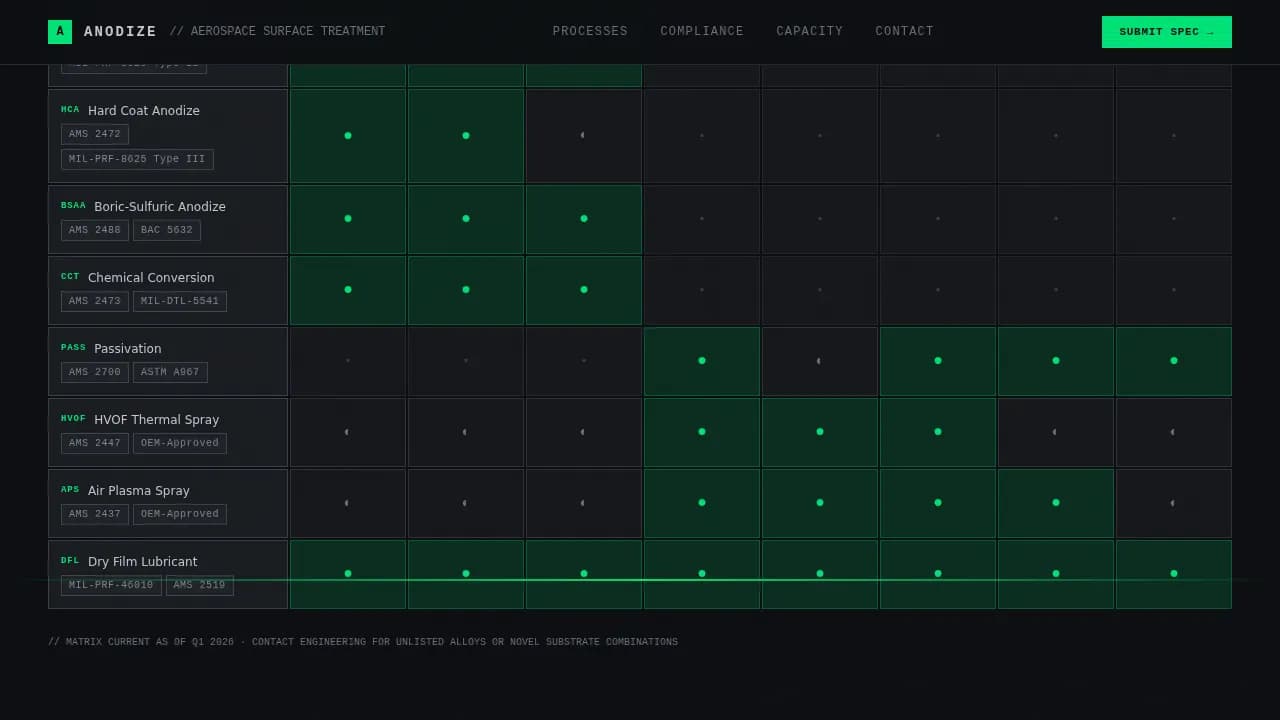
A clickable process matrix grid mapping treatment families against substrate alloys, with spec-pass indicators
Theme
Data Command
Creative direction
Industry Report
Color system
Carbon Fiber
Direction
Lead Generation
Page Sections
Live-styled Hero Data Tiles
Interactive Process Qualification Matrix
Compliance Depth Dashboard
Capacity Gantt Lead-time View
Dual-path Lead Capture Section
Data Command Visual System
Related questions
What types of anodizing processes does this template support showcasing?
Who is the primary audience for this landing page template?
Does the template include a way to collect engineering drawing files?
Can this template serve facilities that also work in non-aerospace markets?
Why is the layout designed desktop-first rather than mobile-first?
A compliance depth section with audit scores, rejection-rate trend charts, and rolling quarter data
A capacity Gantt-style block displaying current lead times by process type
A dual-path lead capture section with a full spec-submission form and a gated capability matrix download
Feature list
This template includes purpose-built components that reflect the real workflow of aerospace vendor evaluation.
Live-Styled Hero Data Tiles
The header section overlays animated data tiles onto a processing-line visual. Tiles reveal one by one in a control-room style, displaying Nadcap accreditation status, active specifications such as AMS 2470, AMS 2488, and MIL-PRF-8625, monthly throughput volume, and on-time delivery percentage. This gives the anodizing process immediate credibility before any copy is read.
Interactive Process Qualification Matrix
A clickable data grid maps treatment families, including anodize, passivation, high-velocity oxygen fuel (HVOF) coating, dry film lubrication, and chemical conversion, against substrate alloys. Each cell lights up where the facility holds active qualification. Engineers can instantly see whether their specific aluminium alloy or metal surface is covered, removing a common early-stage qualification bottleneck.
Compliance Depth Dashboard
This section presents Nadcap merit status badges, customer audit scores, and rejection-rate trend lines charted over rolling quarters. The data does the persuading that copywriting cannot. It shows durability of process control and enhancing reliability over time, which is what the aerospace sector demands from any finishing vendor.
Capacity Gantt View
A visual lead-time block chart shows current turnaround capacity by process type. Procurement teams can assess whether aluminum components or other parts can be scheduled within their program timelines without a single phone call, improving efficiency on both sides.
Dual-Path Lead Capture
The primary conversion form captures part name, alloy, applicable AMS or MIL specification from a searchable dropdown, annual volume estimate, and a drag-and-drop drawing upload field. A secondary gated path offers a downloadable capability matrix in exchange for company name and email, reaching visitors still in early vendor-screening.
Data Command Visual System
Typography runs in a monospaced face that echoes inspection reports and certificate stamps. All layout elements use 1-pixel aluminium-tone borders on dark backgrounds. Spec-pass green is reserved exclusively for compliance badges, live capacity indicators, and call-to-action elements, so every green pixel carries functional meaning.
Page sections overview
Section
Purpose
Hero Processing Line
Introduce facility with live-styled compliance and throughput data tiles
Process Matrix Grid
Map treatment families against qualified substrate alloys interactively
Compliance Depth Panel
Display Nadcap status, audit scores, and rejection-rate trend lines
Capacity Gantt Chart
Show current lead times by process type for scheduling decisions
Spec Submission Form
Capture part details, alloy, spec, volume, and drawing upload
Capability Matrix Download
Gate a PDF for visitors still in vendor-screening phase
Minimal Footer
Copyright, essential links, and live status indicator
Design & branding system
The visual identity follows a Data Command theme. Every design choice reflects the precision of a coordinate measuring machine readout, not a marketing brochure. Backgrounds hold in the black-to-graphite range, and the palette creates a surface that feels like the interface of industrial inspection software.
Deep composite black (#0D0F12) and woven graphite (#2A2D34) form all background layers, with machined aluminium (#C5C9D1) for borders and data labels
Spec-pass green (#00E676) appears only on compliance badges, capacity indicators, and call-to-action buttons, giving it functional visual weight
Typography uses a monospaced or semi-monospaced face for all data readouts, enhancing the appearance of technical authority throughout
Mobile & speed optimization
This template is designed desktop-first, matching the primary context in which procurement engineers review vendor packets at workstations. The layout prioritizes data density and readability at full-screen widths.
Static sections use server-side rendering for fast initial load, while interactive components such as the process matrix, trend charts, and form load as client components
Staggered tile reveals, scroll-linked transitions, and scan-line animation effects are scoped to avoid blocking the main layout thread
The drag-and-drop drawing upload and searchable specification dropdown are built as isolated interactive zones that do not affect surrounding content performance
How this template helps you convert
The template earns the lead by front-loading every data point a procurement engineer would normally ask about in a first call. By the time a visitor reaches the form, the facility has already answered the standard qualification questions on screen.
The hero tiles and process matrix establish anodizing process credentials immediately, reducing the need for follow-up verification and shortening the vendor evaluation cycle
The compliance depth section and Gantt capacity view address the two most common conversion blockers, certification proof and scheduling feasibility, before any call-to-action appears
The dual-path form captures both ready-to-quote leads and early-stage researchers with a single page, maximizing the conversion surface without adding friction
Other information about this template
This template is a strong fit for facilities operating across different industries where aluminium anodizing standards overlap, including automotive and aviation alongside aerospace applications. The process matrix can reflect qualifications for aluminum alloys where anodizing works well, such as those with copper, magnesium, or silicon content, while transparently noting where certain alloys may not be suitable.
Anodizing is an electrolytic passivation process. It submerges aluminum in an electrolyte and passes an electric current through it, building a controlled oxide layer from the base metal itself rather than depositing a foreign material
The full anodizing process sequence covers pre-cleaning, etching, anodizing, and sealing. Proper sealing of the anodized layer dramatically improves corrosion resistance and chemical stability, extending longevity across extreme environments
Type I chromic acid anodizing creates a thinner oxide layer suited for tight-tolerance flight-critical parts and aids paint adhesion. Type II sulfuric acid anodizing produces a thicker oxide layer enhancing surface hardness and corrosion resistance. Type III hard coat anodizing delivers maximum wear resistance and durability for high-wear aerospace components
Anodized aluminum used in defense aircraft and aviation platforms must withstand extreme temperatures and harsh environmental conditions over decades of service. The anodized layer forms a metallurgically bonded surface that cannot peel or flake, giving it a corrosion resistant finish that traditional plating or paint methods cannot match
Anodizing utilizes less harmful chemicals and produces fewer volatile organic compounds compared to many traditional metal finishing techniques, aligning with modern sustainability and regulatory goals
Commonly anodized parts across the aerospace sector include fuel tanks, wing skins, engine parts, landing gear components, and cabin interior structures. Anodizing is also used on titanium parts specifically to prevent galling between mating components
High-resolution imagery showcasing finished aerospace parts alongside performance statistics creates visual appeal that supports trust for procurement audiences still evaluating vendor credentials