Local Agricultural Equipment Manufacturing Professional Website Template
Anodize is a single-column B2B landing page template built for agricultural equipment anodizing services. It leads with a before/after slider showing real field corrosion data, walks buyers through three escalating case studies, and closes with a specification intake form. The dark Data Command aesthetic signals industrial precision from the first scroll.
by Rocket studio
Quick summary
Anodize is a B2B landing page template designed for aluminum component finishing services targeting the agricultural equipment sector. It opens with an interactive before/after corrosion slider, builds credibility through three field-proven case studies, and converts qualified buyers with a part specification form. The visual style mirrors a combine cab instrument panel at dusk.
Who this template is for
This template is built for finishing operations that need to speak the language of engineers, fleet managers, and dealers. It addresses industrial buyers who require data before they commit to a coating partner.
- OEM engineers specifying corrosion-resistant coatings for combine headers and hydraulic housings
- Fleet maintenance directors evaluating component life extension across large equipment pools
- Regional implement dealers looking to reduce warranty claims on aluminum harvester parts
What problem this template solves
Selling anodizing services to industrial buyers means competing on proof, not promises. Most service pages lead with process descriptions that engineers and maintenance directors have already read. Buyers need field numbers, test certifications, and a frictionless path to submit a part specification.
- Generic service pages fail to front-load the measurable field data that industrial buyers require before inquiring
- No structured intake path means qualified prospects leave without submitting alloy specs or engineering drawings
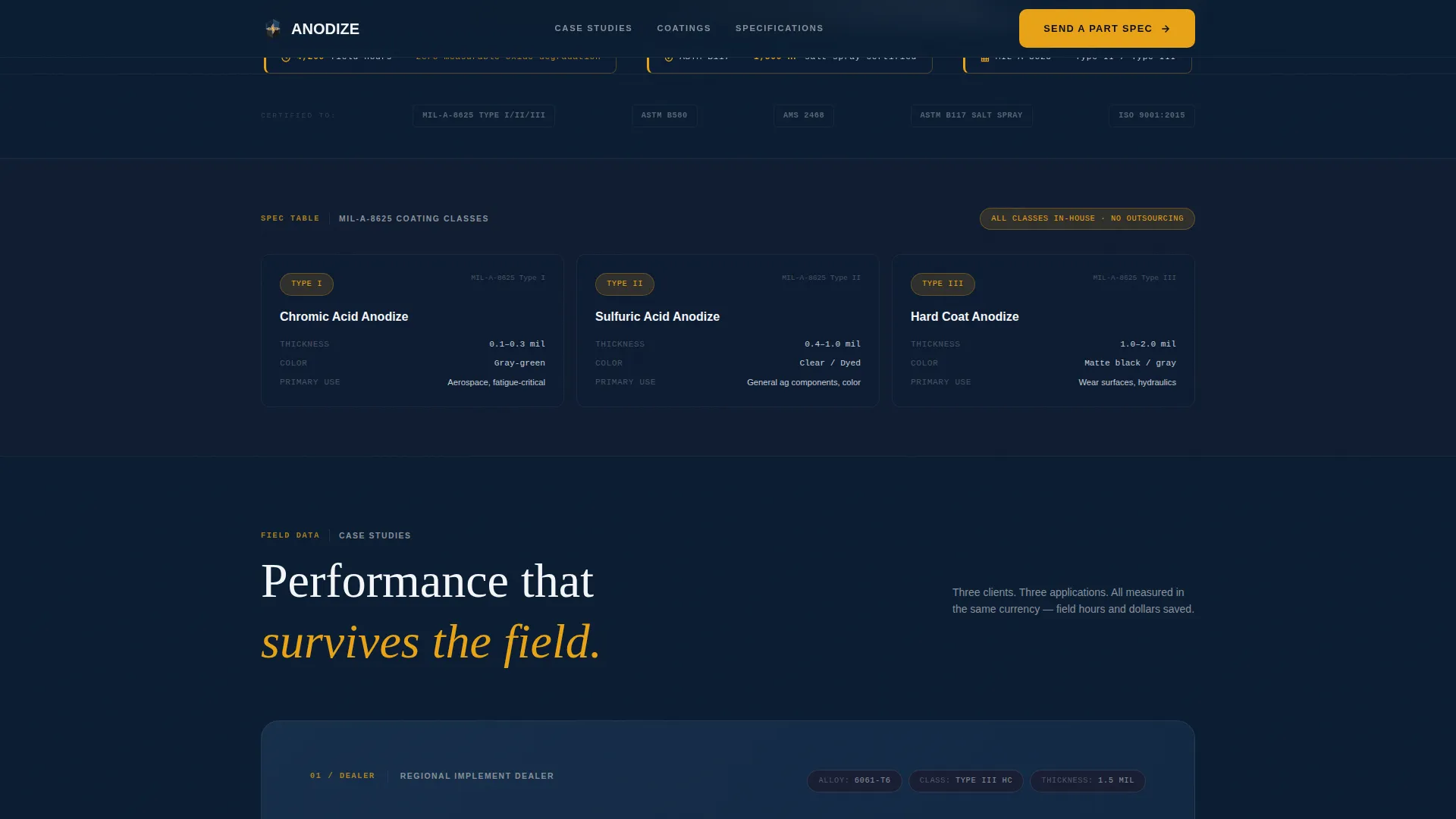
- Vague coating descriptions do not differentiate Type II, Type III, and chromic anodize options for spec-sensitive engineers
What you get with this template
You get a complete, conversion-focused single-column landing page built around three escalating case study narratives. Every section is designed to present hard performance data before asking for a commitment.
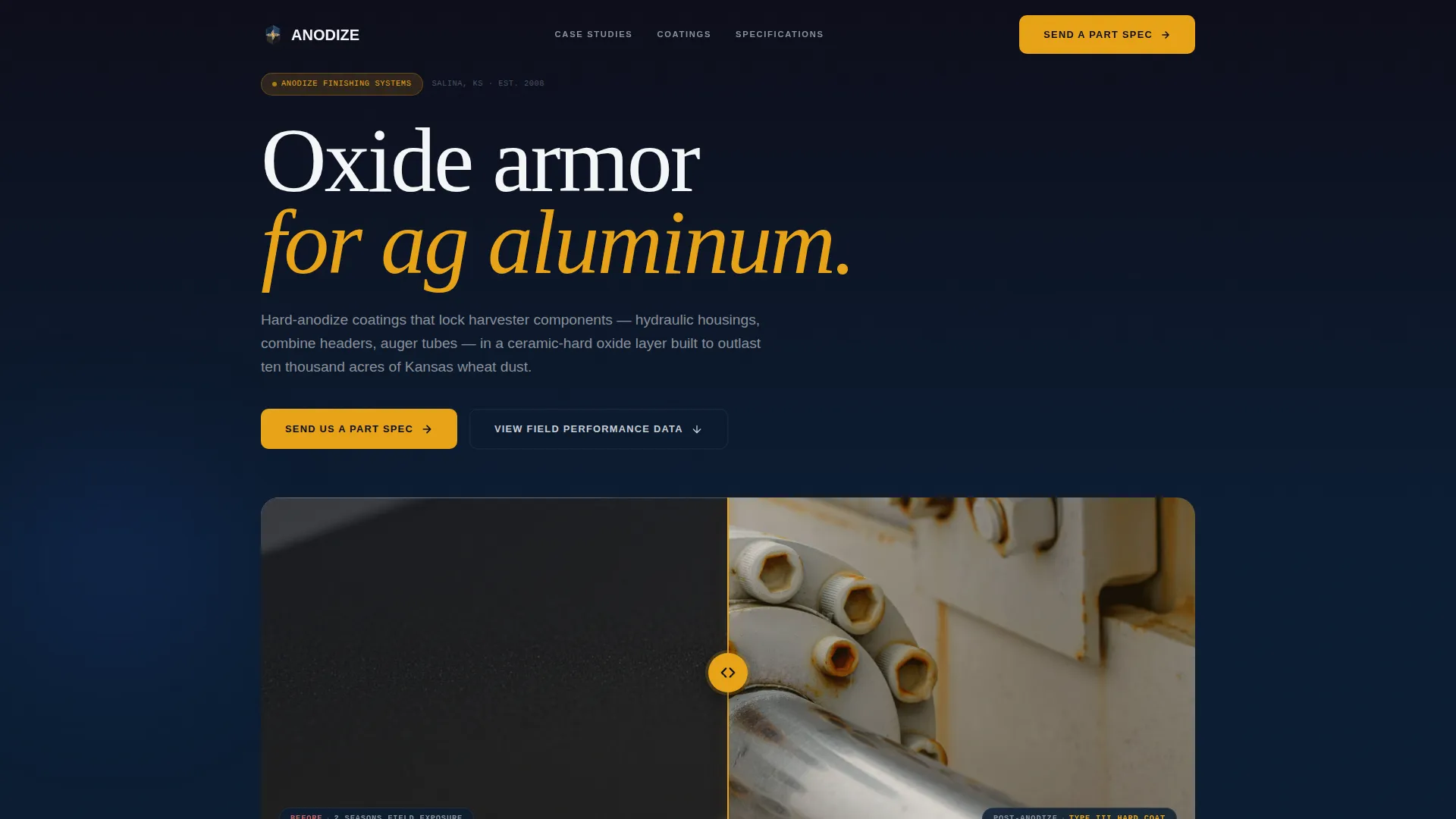
- A full-width interactive before/after slider showing a corroded aluminum manifold alongside its post-anodize state, overlaid with a 4,200 field-hours data point
- Three structured case study sections, each moving from client problem to coating specification to hard performance outcome
- A dual-path partnership call-to-action section with a part specification form and a secondary test coupon request path
Feature list
This template delivers a focused set of purpose-built components. Each one is grounded in the specific conversion flow described in the brief.
Interactive Before/After Corrosion Slider
The hero opens with a full-width drag slider. The left panel shows a pitted, chalky aluminum hydraulic manifold after two seasons of field exposure. The right panel shows the same part post-anodize with mil-spec thickness stamps visible. A single amber data overlay reads "4,200 field hours, zero measurable oxide degradation," setting the credibility benchmark before the first scroll.
Escalating Case Study Narrative Flow
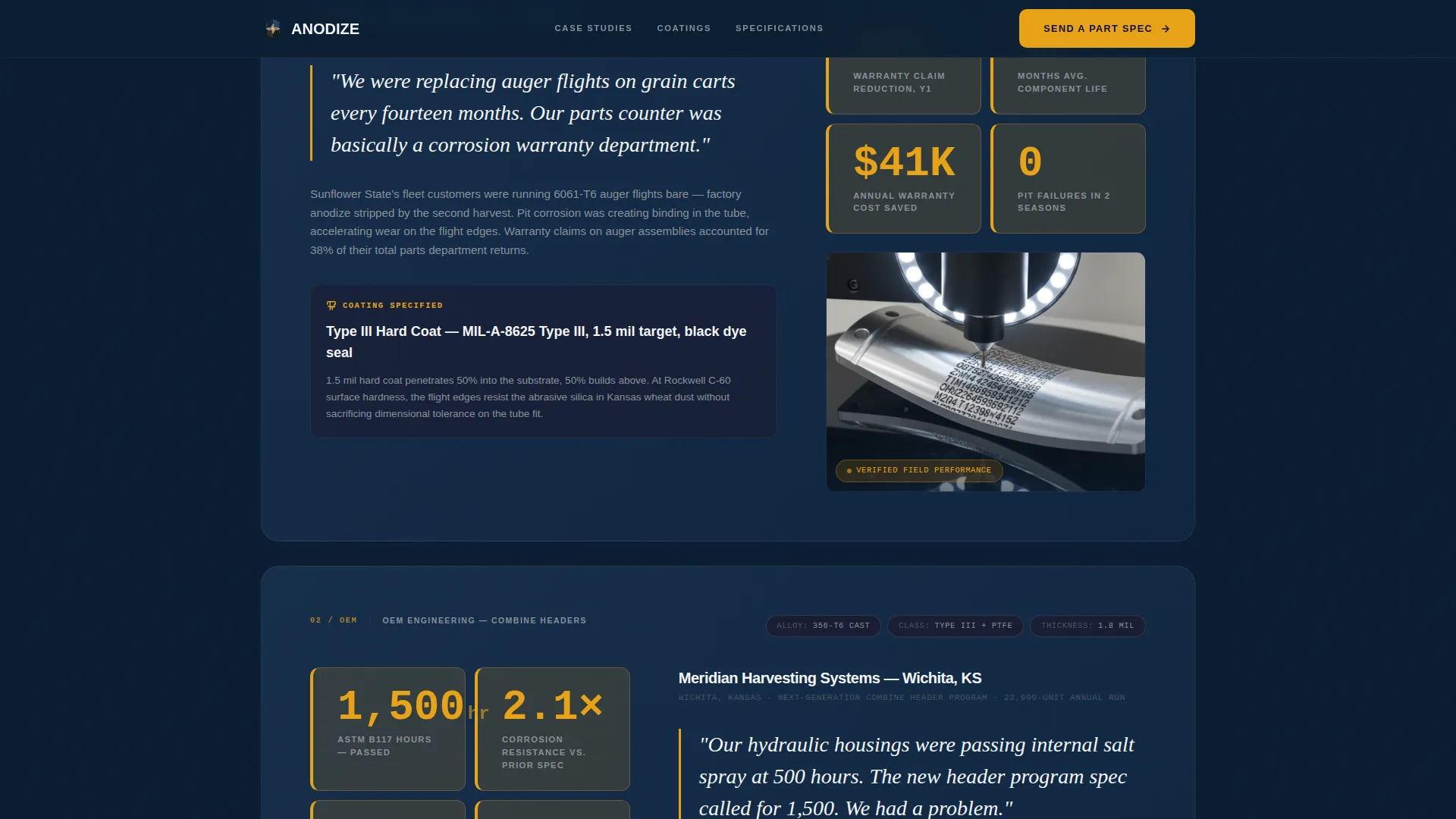
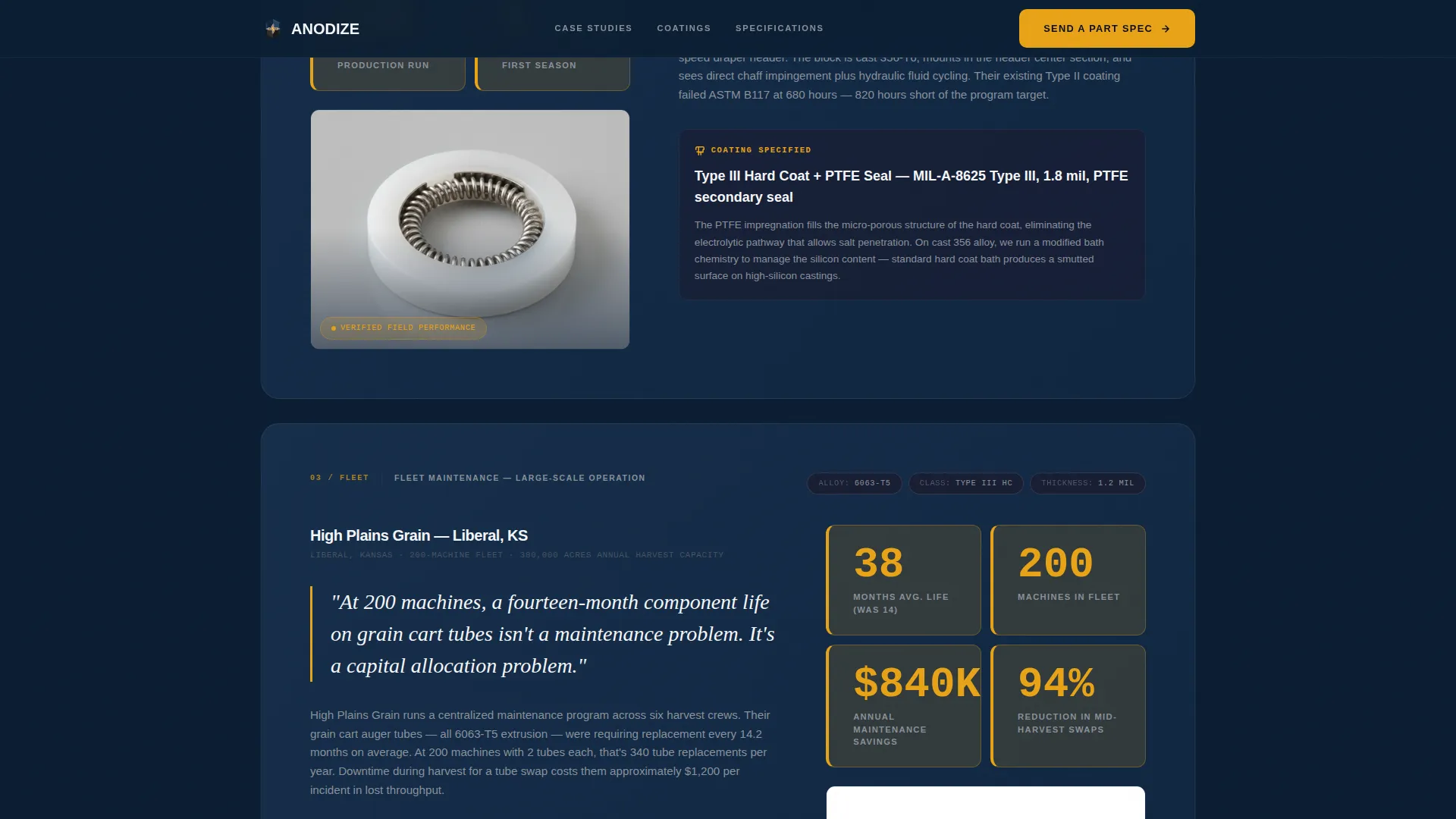
Three sequential scroll sections each tell a complete client story. The first covers a dealer who cut warranty claims 60% on auger flights. The second documents an OEM that passed ASTM B117 (American Society for Testing and Materials standard B117) salt spray testing at 1,500 hours. The third shows a fleet operation extending component life across 200 machines. Each section opens with a client problem quote, reveals the anodizing specification applied, and closes with amber-highlighted performance data blocks.
Amber Callout Data Blocks
Performance numbers appear in diagnostic amber (#E8A317) callout blocks throughout the case studies. This keeps critical proof points visually separated from body text and immediately readable on the dark instrument panel background, ensuring field hours, test results, and warranty reduction figures are never buried.
Part Specification Intake Form
The primary call-to-action form collects substrate alloy type, annual volume estimate, and coating class selection via a dropdown covering Type II, Type III, and chromic anodize options. A file upload field accepts engineering drawings, giving OEM engineers a direct path to submit technical documentation alongside their inquiry.
Test Coupon Request Path
A secondary conversion path lets engineers request a physical test coupon before committing to a production run. This reduces the friction for buyers who need tactile, measurable proof of coating quality before they can get internal approval.
Scroll-Triggered Animation System
Section reveals, staggered stat counters, and parallax depth layers fire on scroll to reinforce the engineering report pacing of the case study narrative. Hover states on case study cards and the interactive slider are handled as client components, while static sections use server components for performance.
Page sections overview
| Section | Purpose |
|---|---|
| Hero slider section | Establishes corrosion proof with interactive before/after and 4,200-hour data overlay |
| Case Study One | Dealer warranty claim reduction story with 60% improvement callout |
| Case Study Two | OEM ASTM B117 salt spray pass at 1,500 hours with spec detail |
| Case Study Three | Fleet life extension proof across 200 machines at scale |
| Partnership call to action form | Collects alloy type, volume, coating class, and engineering drawing upload |
| Test coupon path | Secondary call to action for engineers needing physical coating samples |
| Minimal footer | Horizontal flow footer with essential links and contact anchors |
Design & branding system
The visual identity follows a Data Command theme. The palette and typography are calibrated to feel like a modern combine cab instrument panel at dusk, dark and precise with amber backlight reserved for data that matters.
- Color system uses command-deck navy (#0B1D33) as the primary surface, hard-anodize black (#1A1A2E) for depth layers, machined aluminum silver (#C8CED6) for body text and surface details, and diagnostic amber (#E8A317) strictly for callout data points and call-to-action elements
- Typography pairs DM Sans for body text and user interface elements with Fraunces serif display type for case study headlines, creating a readable contrast between data clarity and editorial weight
Mobile & speed optimization
The template is desktop-first, built for OEM engineers reviewing technical specifications on workstations. It is fully responsive to tablet and mobile viewports so fleet managers and dealers can review data in the field.
- Static content sections use server components to reduce initial load time, while the before/after slider and specification form run as client components
- Scroll-triggered animation layers and parallax depth effects are scoped to enhance desktop performance without blocking mobile rendering
How this template helps you convert
The conversion architecture works by making the business case before the form appears. By the time a maintenance director reaches the call-to-action, the corrosion numbers have already done the persuasion.
- The hero slider and 4,200 field-hours data overlay establish measurable proof within seconds of the first impression, qualifying serious buyers immediately
- Three escalating case studies build cumulative trust, moving from dealer warranty savings to OEM certification to fleet-scale life extension, so each buyer persona finds their own proof point before the ask
- The dual-path call to action captures both ready-to-spec buyers via the part specification form and evaluation-stage engineers via the test coupon request, maximizing inquiry volume across buyer readiness levels
Other information about this template
This template is part of the Manufacturing and Industrial category, under the Agricultural Equipment Manufacturing subcategory. It is designed specifically for the agricultural equipment anodizing service niche, with an intersection match score of 13.
- Template style is Single Column Flow, optimized for the focused, sequential reading pattern of technical B2B buyers
- Localization is set for the United States market using USD pricing references, imperial measurements, and Midwest agricultural context including Kansas wheat farming operations
- The template supports Type II anodize, Type III hard anodize, and chromic anodize coating classes as dropdown options in the specification form
- Creative direction follows a Case Study Narrative pattern, with the header concept built around a Case Study Before/After treatment
Theme
Data Command
Creative direction
Case Study Narrative
Color system
Navy Authority
Style
Single Column Flow
Direction
Partnership/B2B
Page Sections
Interactive Before/after Corrosion Slider
Three Escalating Case Study Sections
Amber Performance Data Callouts
Part Specification Intake Form
Test Coupon Secondary Path
Scroll-triggered Animation System
Related questions
Who is this landing page template built for?
What coating classes does the specification form support?
Can engineers request a physical sample before committing to a production run?
What performance data does the template reference in its case studies?
Is this template optimized for desktop or mobile viewing?