Expert Metalsmith Portfolio Landing Page Template
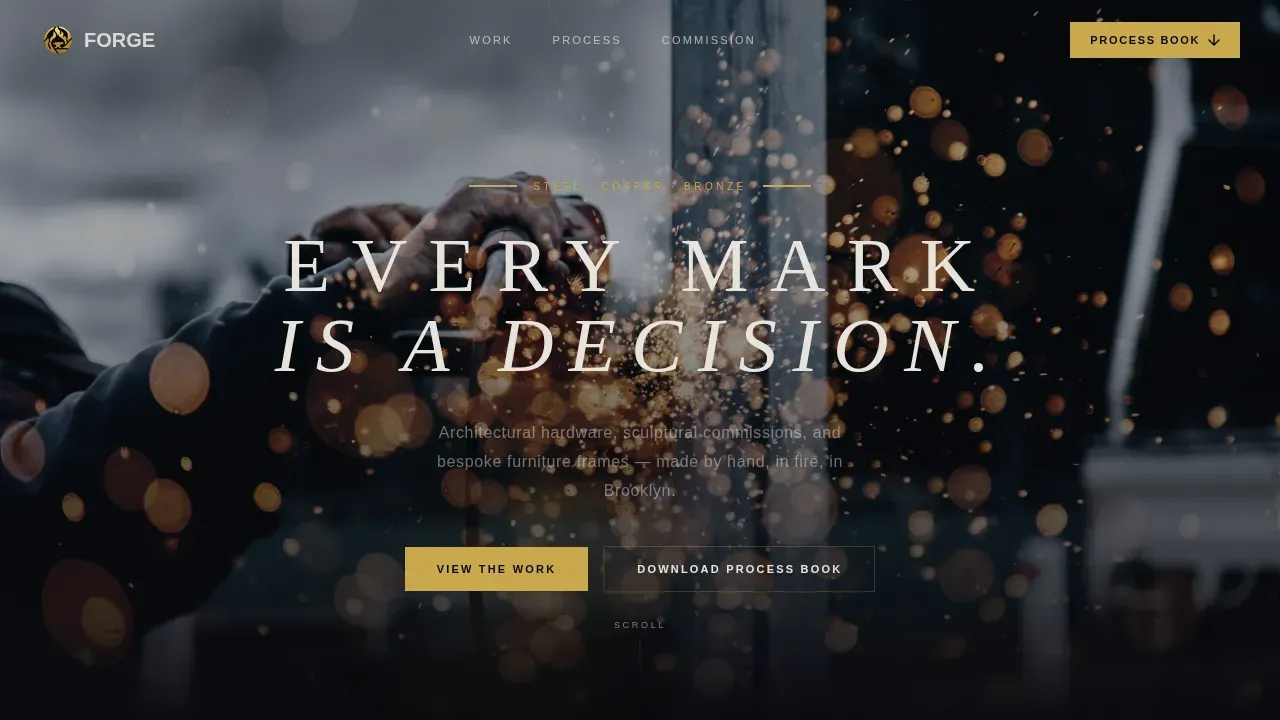
Forge is a dark immersive metalsmith case study portfolio landing page built for artisan studios that work in steel, copper, and bronze. It uses an asymmetric 60/40 grid to present process-rich project narratives, a cinematic full-screen video hero, and a dual-conversion layout that captures email leads through a gated Process Book download while opening commission conversations through a short inquiry form.
by Rocket studio
Quick summary
Forge is a single-page portfolio template built for professional metalsmith studios. It pairs a cinematic full-screen video hero with an asymmetric 60/40 case study grid, letting each project tell its full story across photography, material notes, and written narrative. The page closes with two conversion paths: a gated Process Book download and a commission inquiry form.
Who this template is for
This template is built for independent metalsmith studios and bespoke fabrication workshops that serve high-end clients. It is especially well suited for makers whose work lives at the intersection of art and architecture, where the process is as compelling as the finished piece.
The visitors you want to attract are professionals who will spend time reading a case study before they ever send an inquiry. They need to see your thinking, not just your output. This template gives them both.
- Independent metalsmith studios producing architectural hardware, sculptural commissions, and bespoke furniture frames for interior architects, luxury developers, and gallery directors.
- Craft-focused creative professionals whose portfolio needs to communicate both artistic mastery and technical problem-solving reliability to discerning B2B clients.
- Artisan makers transitioning to larger commissions who need a credible, editorial-quality landing page that earns trust before a client ever picks up the phone.
What problem this template solves
Most portfolio templates are built for visual creatives who want a fast, image-forward grid. They work well for photographers and graphic designers. They do not work well for metalsmiths, fabricators, or studio craft professionals whose clients need to understand the process behind the object before committing to a commission.
The core problem this template addresses is the gap between a beautiful object and a credible studio narrative. Clients commissioning large-scale architectural installations or bespoke hardware want to know the why and how behind the metalwork, including the problem solved and the technical challenges faced. A generic portfolio page cannot carry that weight.
- No narrative structure. Standard portfolio grids present images without context. Forge is built around a case study format that moves each project through a clear beginning, a process-heavy middle, and a result that demonstrates both craft skill and client service.
- No conversion path for high-value leads. A typical portfolio has no mechanism for capturing qualified interest. Forge solves this with a gated Process Book download paired with a short commission inquiry form, so every serious visitor has a clear next step.
- No visual atmosphere that matches the work. A bright, minimal template undersells the drama of metalwork. The dark immersive design system creates the right emotional register from the first frame.
What you get with this template
This template delivers a complete single-page portfolio experience designed for studios that sell on process, credibility, and craft. Every section has been developed to serve the specific needs of artisan metalsmith practices operating in the luxury and architecture market.
The layout follows a proven case study narrative structure. Each project is presented across a 60/40 asymmetric grid: the wider column holds immersive process photography while the narrower column carries the written story. That rhythm is intimate and expansive in turns, pulling the visitor deeper the way a documentary intercuts workshop and gallery footage. The page is also built to support dual conversion, meaning it does not ask every visitor to do the same thing. Architects browsing on a large desktop screen can download a detailed process book; developers ready to talk can jump straight to the commission form.
- A full-page layout with six defined sections: cinematic video hero, two case study blocks in the 60/40 grid, a full-bleed detail shot between stories, a dual-conversion block with Process Book download and commission inquiry form, and a linear single-row footer.
- A dark immersive design system built on volcanic black, anthracite charcoal, molten gold accents, and forge-white body text, with Fraunces display type and DM Sans for body copy.
- Built-in conversion mechanics including an email-gated PDF download with an optional audience dropdown and a short-form commission inquiry with fields for project type, material preference, and timeline.
Feature list
This template was developed around a specific set of features that serve the metalsmith portfolio use case. Each feature reflects a deliberate design and content decision grounded in how high-end craft professionals attract and convert serious clients.
Cinematic Full-Screen Video Hero
The hero section opens with a slow, cinematic video loop shot in available workshop light. The footage shows a gloved hand drawing a white-hot steel bar from the forge, sparks showering in real time, the camera racking focus from the molten tip to the smith's face. The grade is deep and contrasty, with crushed blacks and preserved highlights only where fire touches steel. A single line of forge-white text fades in after four seconds, letterspaced wide. This kind of high-impact hero section grabs attention immediately and sets the emotional register for every case study that follows. It aims to make the visitor feel present in the workshop before they read a single word.
Asymmetric 60/40 Case Study Grid
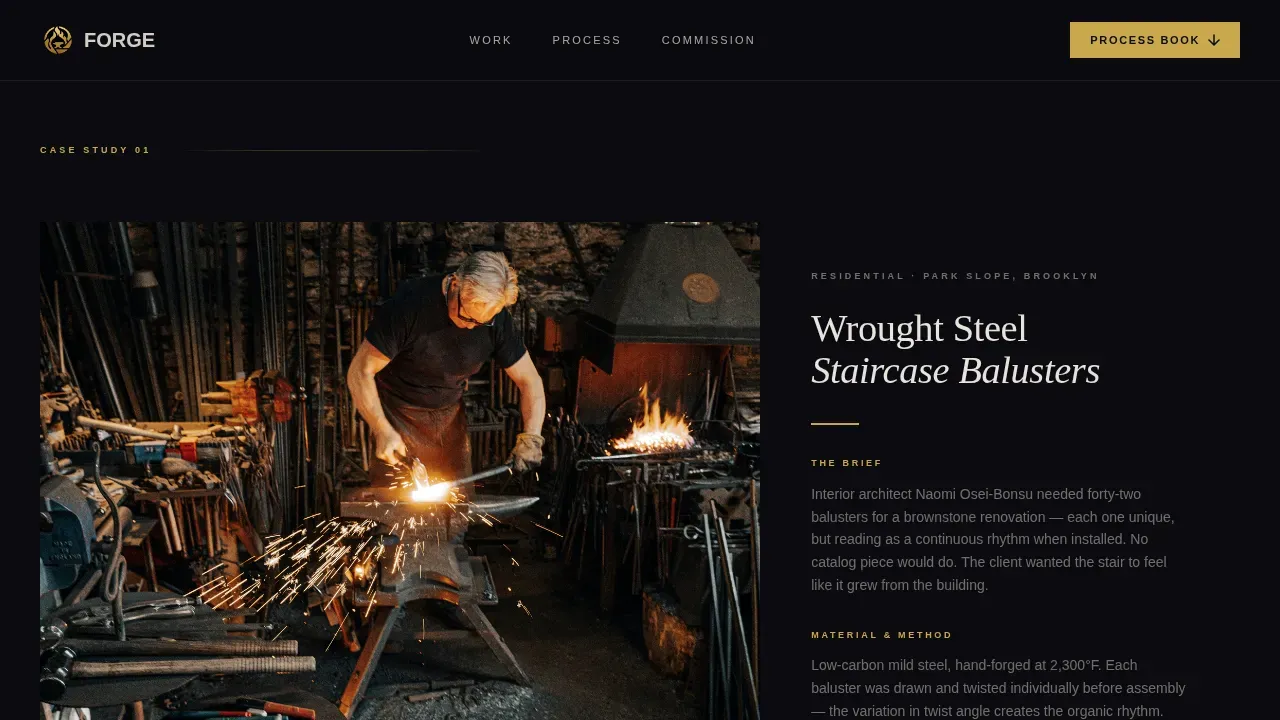
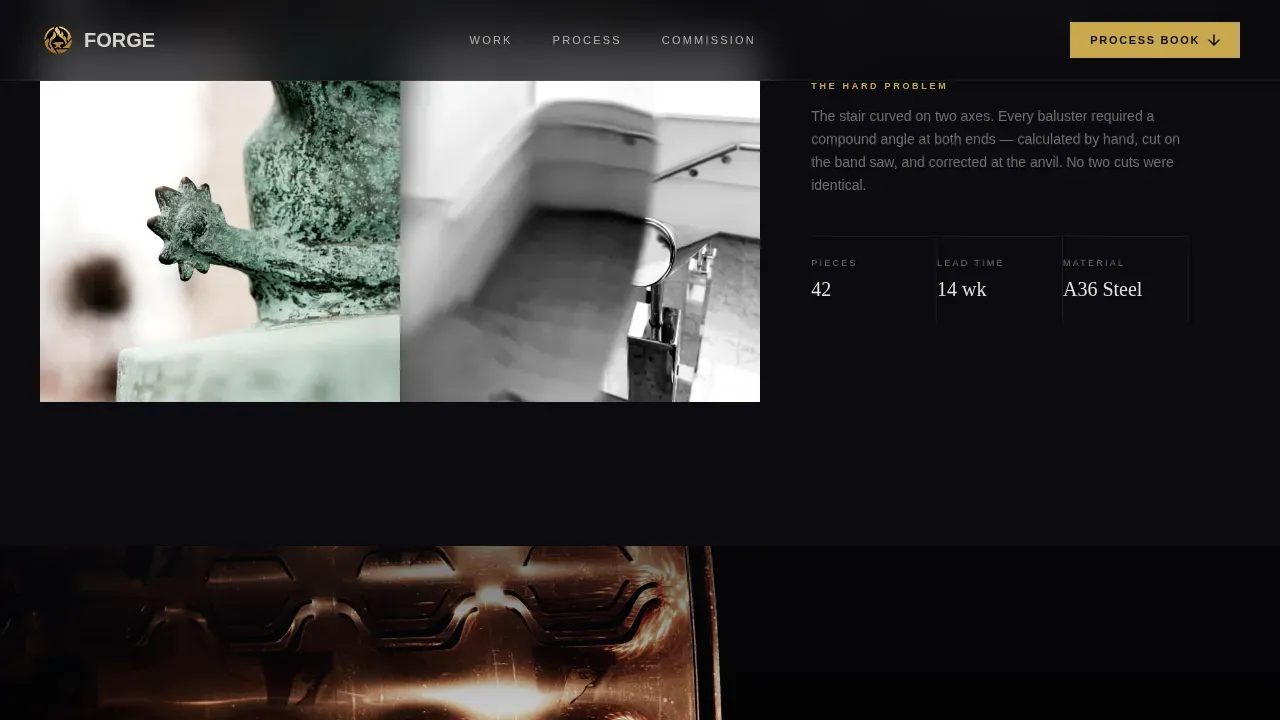
The page structure is built around a 60/40 asymmetric grid that gives each case study space to breathe and develop. The wider 60 percent column holds immersive process photography: raw stock shots, mid-fabrication close-ups, and installed final pieces. The narrower 40 percent column carries the written narrative, covering the client's brief, the material selected and why, and the technique that solved the hardest problem. This layout supports the full storytelling structure each project needs, with a clear beginning that frames the commission, a middle that emphasizes the process and struggle, and an end that showcases the result. Using macro photography in this grid is especially effective for showing quality details such as solder joints, metal finishes, and surface patination that demonstrate craft at close range.
Full-Bleed Detail Shot Dividers
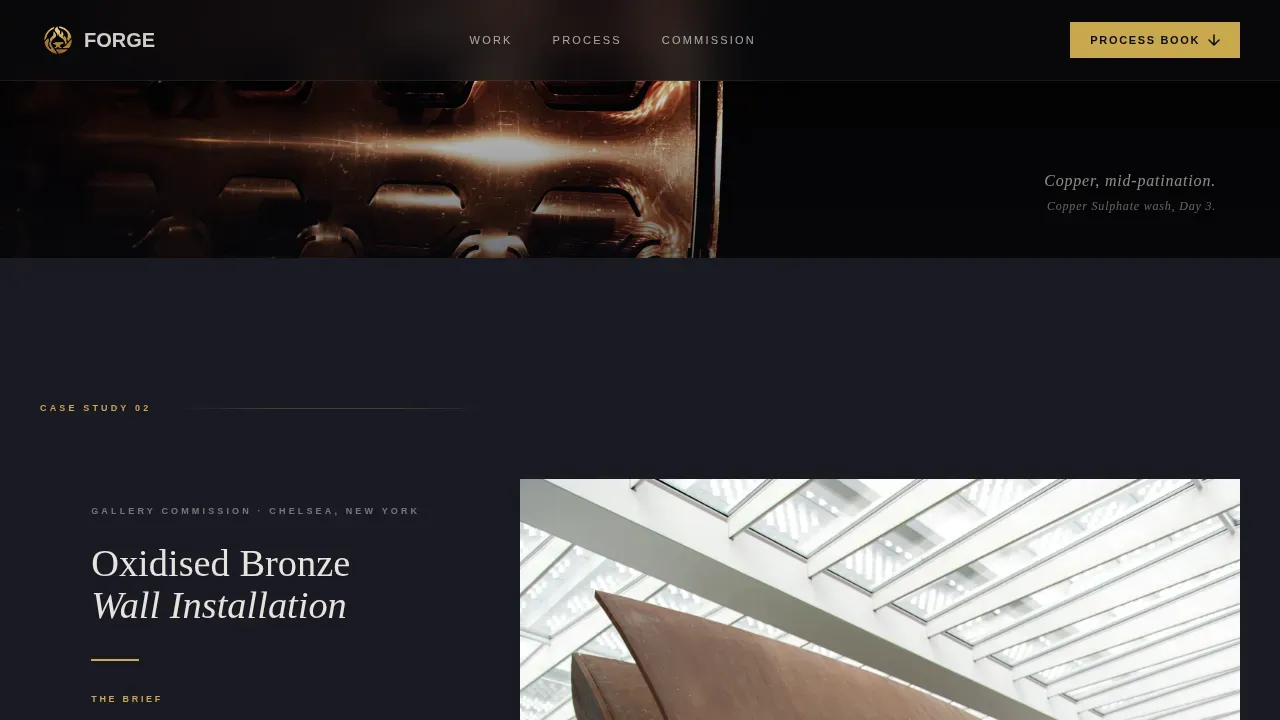
Between each case study block, a single detail shot bleeds full-width across the page. This functions as a visual breath, giving the visitor a moment to absorb what they have just read before the next project story begins. The rhythm it creates is intimate then expansive, intimate then expansive. It also reinforces the idea that each piece in your collection is worth individual attention. These full-bleed images are among the most powerful examples of how the template uses space to communicate value without words.
Gated Process Book Download
The primary conversion path is a forty-page PDF download gated behind a single email field. An optional dropdown lets the visitor identify themselves as an architect, developer, collector, or press contact. The Process Book teases one spread per case study inline on the page, so the full download feels like a natural next step rather than a transaction. This approach earns the click by showing the visitor exactly what they will receive before they give their email address. The concept of earned trust is central to how this gate is designed: the tease is generous, and the ask is minimal.
Short-Form Commission Inquiry
The secondary conversion path is a compact inquiry form designed for visitors who are ready to start a conversation. The form includes fields for project type, material preference, and rough timeline. It does not ask for everything at once. That restraint is intentional: a client commissioning architectural metalwork for a luxury development project is a professional. They will respond better to a focused form than an exhaustive one. The form sits alongside the Process Book download in the same conversion block, so both paths are always visible without competing.
Staggered Scroll Animations and Gold Accent System
The template uses high-animation scroll reveals throughout. Content staggered into view as the visitor scrolls creates a sense of progressive discovery that mirrors the act of watching something being made. Molten gold accents at hex value C9A84C appear on hover states, progress indicators, and section dividers. These details are used sparingly and deliberately. Gold appears only where it earns its place, which gives every gold element a sense of occasion. The animation and accent system together create an experience that resonates on multiple sensory levels, which is the core aim of immersive product design applied to a portfolio context.
Page sections overview
| Section | Purpose |
|---|---|
| Full-Screen Hero | Opens with cinematic video, delayed text reveal establishes tone |
| Case Study One | 60/40 grid presents staircase baluster project with process narrative |
| Full-Bleed Detail | Single image divider provides visual breath between project stories |
| Case Study Two | 60/40 reversed grid presents sculptural installation commission |
| Dual Conversion Block | Process Book download email gate plus commission inquiry form |
| Linear Footer | Single-row footer closes the page cleanly |
Design & branding system
The design system for this template was developed to feel like a jeweler's velvet tray laid inside a blacksmith's shop. Opulent details emerge from deliberate darkness. Every color decision, type choice, and spacing rule serves one goal: making the visitor feel that your studio operates at a level of craft and intention that justifies the cost of a commission.
Visual design elements like typography and color schemes play a crucial role in attracting and retaining visitors. This template uses a carefully controlled palette and type pairing to do exactly that, without relying on decoration that distracts from the work itself.
- Color system: Volcanic black at hex 0B0B0F as the dominant background. Anthracite charcoal at hex 1A1A24 for card surfaces and secondary panels. Molten gold at hex C9A84C reserved exclusively for hover states, progress indicators, and section dividers. Forge-white at hex E8E4DD for body text, warm enough to feel like parchment held near a flame.
- Typography: Fraunces serif display type for headings and the hero text reveal. DM Sans for all body copy, form labels, and navigation. The pairing balances editorial weight with functional clarity, which is the right register for a studio selling to architecture and design professionals.
- Spacing and layout language: The asymmetric 60/40 grid, full-bleed photography, and deliberately wide letter spacing in the hero create a spatial generosity that signals confidence. Nothing is crowded. Every element has room to be read.
Mobile & speed optimization
This template is designed desktop-first, which reflects how its primary audience, interior architects and luxury developers, typically reviews portfolio work on large screens during the course of a working day. That said, the layout is built to be responsive to tablet viewports, ensuring the case study grid and conversion block remain legible and functional on smaller displays.
Performance decisions are built into the template's structure. The video hero is lazy-loaded so it does not block the initial page render. Images are set up for optimization. CSS scroll-behavior native is used for animation rather than heavy JavaScript libraries, which keeps the scroll reveal experience smooth without adding unnecessary weight.
- Desktop-first layout with responsive tablet support, reflecting the real device habits of architecture and design professionals who review portfolios during site visits or studio meetings.
- Lazy-loaded video hero that defers the cinematic background footage until the page is ready, preventing the visual centerpiece from becoming a performance bottleneck.
- CSS-native scroll behavior used for staggered reveal animations, keeping the motion system lightweight and consistent across browsers without library dependencies.
How this template helps you convert
Conversion for a high-value artisan studio does not look like an e-commerce checkout. It looks like a qualified lead who has already spent fifteen minutes with your work, understands your process, and arrives at your form with a specific project in mind. This template is built to create exactly that kind of visitor journey. The design of the page reflects the studio's identity at every scroll point, so trust develops gradually before any ask is made.
A prominent call-to-action is placed at both the top and bottom of the page to facilitate engagement, and the dual-conversion block ensures that visitors at different stages of readiness both have a clear path forward.
- The Process Book gate earns qualified email leads. By teasing one spread per case study inline, the template makes the full forty-page download feel like the obvious next step. The optional audience dropdown segments your list from the moment of signup, giving you context on who is downloading before you follow up.
- The commission inquiry form captures ready buyers. The short-form structure with project type, material preference, and rough timeline fields is designed for professionals who already know what they want. It removes friction without removing qualification. A visitor who completes this form has self-identified as a serious prospect.
- The case study narrative builds trust that the form cannot. Every project story presented in the 60/40 grid demonstrates problem-solving, material knowledge, and craft depth. By the time a visitor reaches the conversion block, the work has already made the argument. The form is just the handshake.
Other information about this template
This section covers additional context about the template's craft philosophy, educational value, and broader design lineage. It is intended to help anyone exploring this template gain a fuller picture of what makes it distinctive in the portfolio and agency category.
The template draws on a long tradition of presenting skilled making as both art and discipline. Metalsmithing has a history stretching from ancient greece through the roman world to contemporary art studios operating today. The objects a metalsmith produces sit at the intersection of visual arts, material culture, and functional architecture. A portfolio that presents that work well must honor all three of those dimensions at once.
The case study format used here has its roots in how students learn to think about creative work. In art history courses and visual arts programs, students discover the importance of context, process, and critical reflection alongside the finished object. The best case study portfolios apply that same intellectual rigor to professional practice. They do not just show what was made; they explain why every decision was made, from the choice of material to the resolution of a structural challenge.
Immersive product design focuses on creating engaging experiences that resonate on multiple sensory levels. This template applies that principle to the portfolio context by using video, close-range photography, gold accent animation, and a dark atmospheric palette to create an experience that feels like entering the workshop itself. The process of building this kind of immersive experience involves understanding the user's needs and preferences to create something tailored rather than generic. In metalsmithing specifically, immersive product design can enhance the emotional connection between a piece and its future owner or commissioner, which is exactly the work this template does before a single form field is filled in.
The design of a portfolio page should reflect the studio's identity and values. This template's Obsidian and Gold color system, its editorial use of space, and its emphasis on narrative depth over image quantity all communicate the same thing: this is a studio that thinks carefully about everything it makes. The landing page should provide direct, to-the-point information that leads visitors to a solution for their problem, and every section of this template does exactly that.
The template's case study philosophy aligns with what students learn in rigorous art history and studio practice courses: that original works gain meaning from the conditions of their making. An immersive portfolio should focus on quality, recommending the display of only the best three to five projects rather than a large number of similar pieces. This template enforces that discipline through its structure. Two deep case studies are better than twelve shallow ones.
Professionals in architecture, interior design, and the visual arts gain insight from seeing how a maker approaches a problem, not just the solution. Site visits to fabrication studios are a normal part of the procurement process for large commissions. This template can serve as a virtual site visit, letting a client explore your workshop and your thinking before they commit to a physical meeting. Students discover this approach in foundation art courses and carry it into professional practice. The template supports that professional standard.
The storytelling structure built into the template covers what professionals in user experience design call the Problem, Actions, and Result arc. Effective user experience design requires a clear problem statement to guide the process, and a well-structured case study can effectively communicate the designer's thought process and outcomes to stakeholders. The same principle applies here: each case study in this template is structured to demonstrate the challenge faced, the process followed, and the result delivered. Clients gain insight and confidence from that transparency.
Templates can help create a powerful portfolio and present case studies effectively. Using a template to streamline the process of developing a professional portfolio does not compromise individuality; it provides a structural foundation that lets the work take center stage. A well-structured portfolio can significantly enhance a studio's standing with the kind of discerning clients this template is built to attract.
The template was also developed with an awareness of how visual culture, material culture, and artistic production intersect in contemporary practice. The work of a metalsmith sits within a broader art history that includes craft traditions from ancient greece to the roman world to modern china to the neo dada artists who made industrial materials central to contemporary art. That context gives the work presented in this template a depth that connects it to the wider world of visual arts and artistic practice. Students learn this kind of contextual thinking in art history class, and it is the same thinking that makes a case study portfolio more than a slideshow. Every case study here is an argument about why this studio's work matters in the contemporary world.
The concept of drawing from material culture, cultural contexts, and the everyday life of the workshop is central to what makes metalsmith portfolios compelling. The best examples in this genre do not separate art from life or technique from idea. This template creates the space for that integration to be visible on screen.
- Category and subcategory: Portfolio and Agency, Metal Smith Portfolio niche.
- Sections included: Video hero, two case study blocks, full-bleed detail divider, dual-conversion block, linear footer.
- Primary conversion: Gated Process Book download with email capture and audience segmentation dropdown.
- Secondary conversion: Short-form commission inquiry with project type, material preference, and timeline fields.
- Design system name: Obsidian and Gold.
- Typography pairing: Fraunces display serif and DM Sans body.
- Animation level: High, including video background, staggered scroll reveals, gold line progress dividers, and hover states.
- Device priority: Desktop-first, responsive to tablet.
- Template style: Asymmetric Grid, 60/40 column split.
- Creative direction: Case Study Narrative.
- Header concept: Full-Screen Video Background.
- Landing page direction: Content and Resource destination.
- Fact note: No-code tools and AI-powered platforms can streamline the process of adapting and deploying this template without requiring extensive programming knowledge, making the development process more accessible for studio owners who want to focus on their craft rather than code.
Theme
Dark Immersive
Creative direction
Case Study Narrative
Color system
Obsidian & Gold
Style
Asymmetric Grid (60/40)
Direction
Content/Resource
Page Sections
Cinematic Full-screen Video Hero
Asymmetric 60/40 Case Study Grid
Full-bleed Detail Dividers
Gated Process Book Conversion Block
Short-form Commission Inquiry
Gold Accent Animation System
Related questions
Who is the ideal client for this template?
What does the Process Book download section include?
Can I adapt the case study sections to my own projects?
Is this template only suitable for metalworking studios?
What animation and interaction features are included?