Advocacy Legal Landing Page Template | Precision Law
The Appellate Precision Advocacy Legal Landing Page Template is a hub-and-spoke, anchor-nav landing page built for appellate law firms targeting trial lawyers and in-house counsel after adverse verdicts. It leads with a manifesto header, then walks visitors through every anxious question before delivering a single high-intent call to action: Request a Case Evaluation.
by Rocket studio
Quick summary
This template is a single-page hub-and-spoke landing page designed for a premium appellate law firm. It opens with a full-screen manifesto header and flows through five frequently asked question-driven spoke sections, each answering one question that appellate clients actually think in. Every section builds authority, eliminates uncertainty, and moves visitors toward one action: requesting a case evaluation.
Who this template is for
This template serves legal professionals who need to convert high-stakes, time-pressured clients quickly. The design assumes your visitors already understand the gravity of an adverse ruling. They do not need education. They need confidence that your firm can find the reversible error and argue it effectively before appellate courts.
- Trial attorneys who just received an adverse verdict and need appellate specialists immediately
- In-house counsel facing rulings that threaten company policy or ongoing operations
- Criminal defense attorneys whose clients are running out of appellate options in their jurisdiction
What problem this template solves
A general law firm landing page cannot carry the weight of an appellate engagement. Clients arriving after a trial loss are anxious, time-constrained, and professionally cautious. They will not fill out a generic contact form. They need a page that projects authority, answers their specific fears, and earns the click before it asks for it.
- Standard legal pages bury the call to action and fail to address deadline urgency or fee transparency
- Visitors leave when they cannot quickly find answers to questions like cost, timeline, and whether an appeal is even viable
- Generic design undercuts credibility with judges, co-counsel, and sophisticated in-house legal teams who review services carefully
What you get with this template
You get a fully structured, section-led appellate landing page built on a hub-and-spoke architecture. The anchor navigation acts as the hub. Each spoke scrolls to a self-contained section that answers one question with precision. The page earns the conversion by eliminating every uncertainty before the final call to action appears.
- A typographic manifesto header with a word-by-word GSAP animation reveal and a burnished gold call-to-action button
- Five frequently asked question-driven spoke sections covering reversibility, deadlines, process differences, cost, and recent wins
- A fixed anchor navigation bar with active-section highlighting and a persistent "Request a Case Evaluation" button
Feature list
This template was built around one core principle: precision matters. Every feature serves the goal of delivering clear appellate advocacy arguments in a format that judges, co-counsel, and senior clients will respect.
Manifesto Header with Typographic Reveal
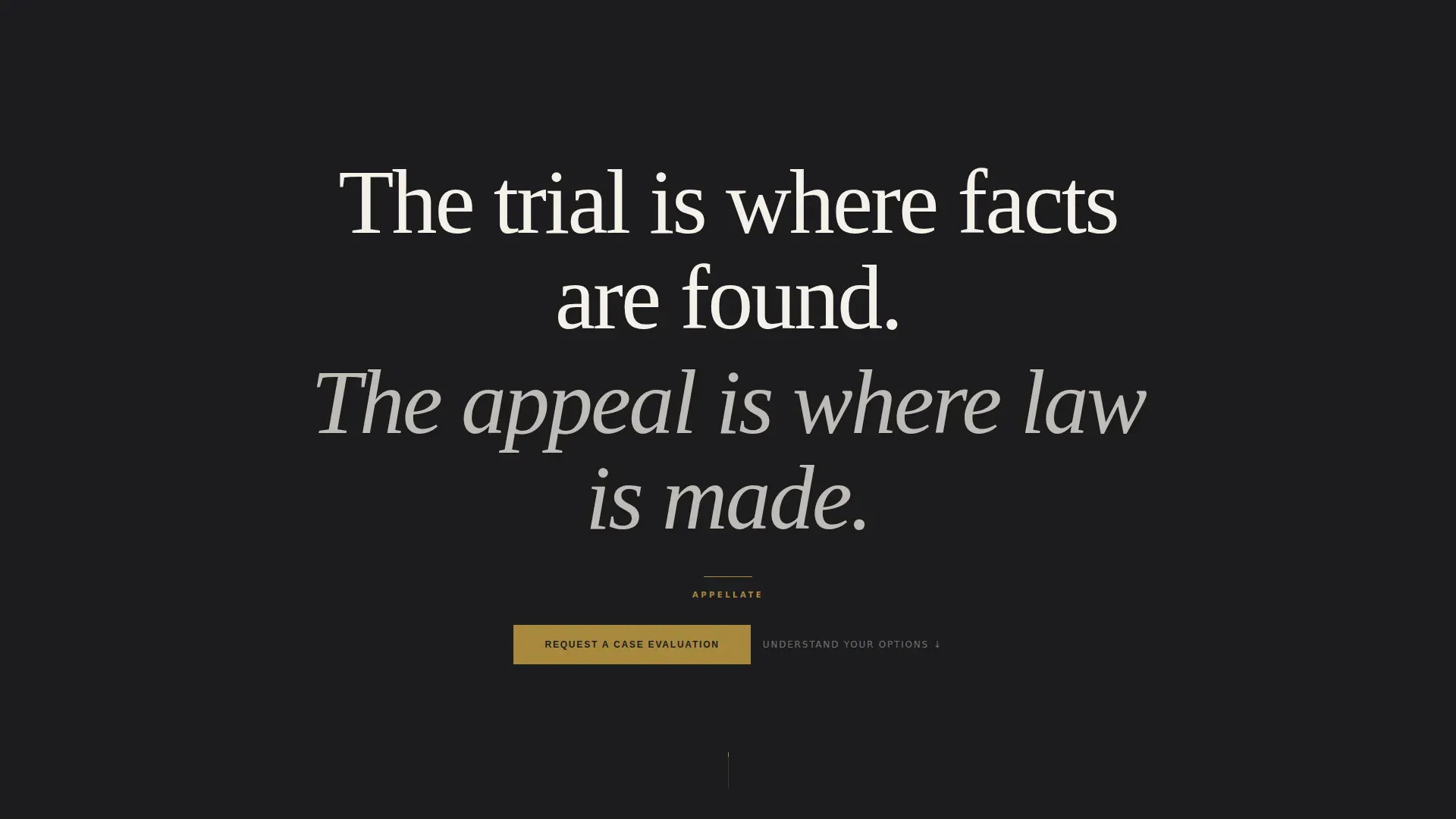
The header opens on an iron-black screen with a single serif statement set at enormous scale. Each word appears in sequence using a GSAP stagger animation, deliberate as oral argument. Below the statement sits the firm name in small gold caps and a burnished gold call-to-action button above the fold, so the primary action is visible the moment the animation concludes. This design choice accurately represents the firm's authority before a single section loads.
Hub-and-Spoke Anchor Navigation
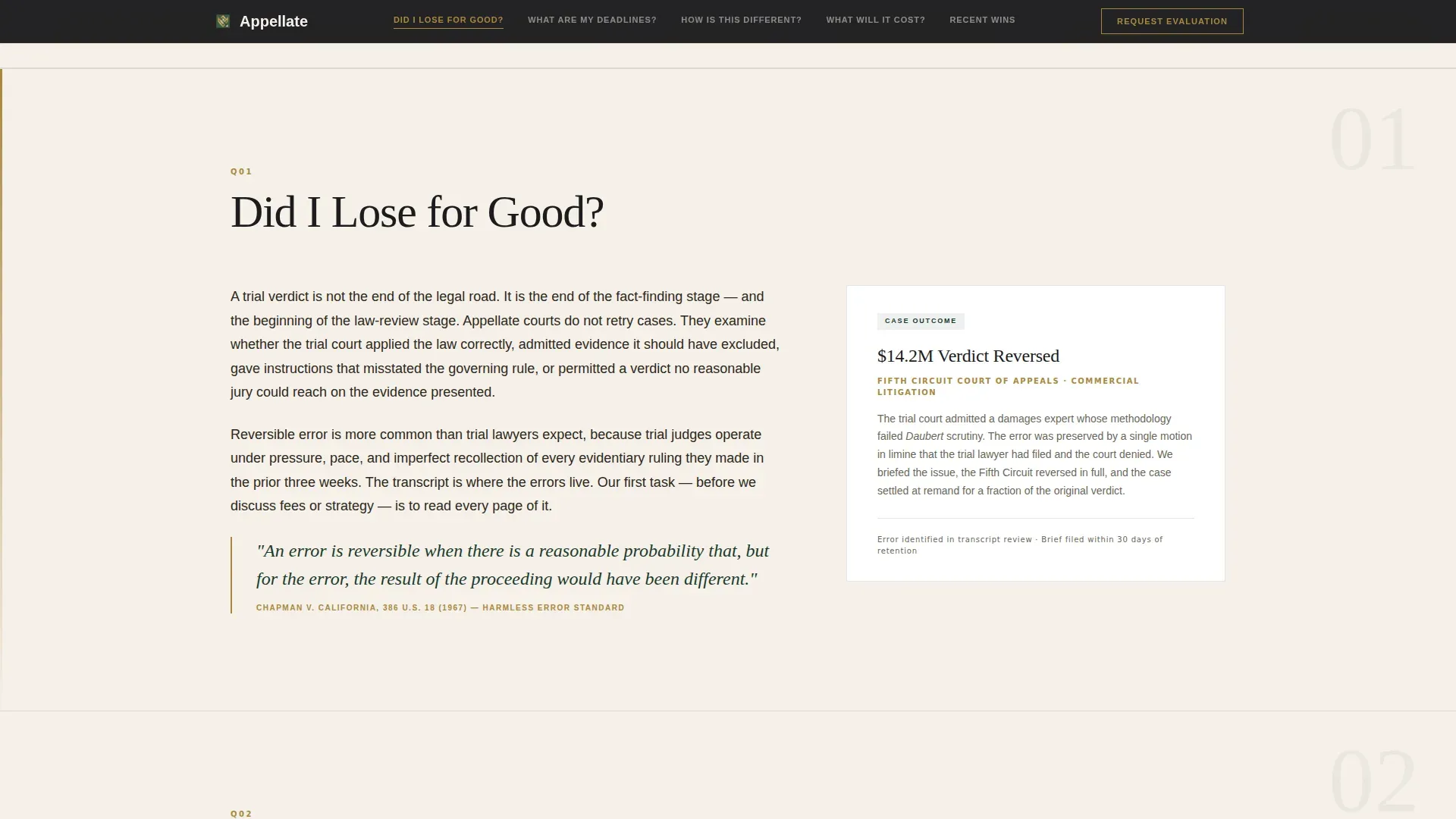
The anchor nav materializes across the top of the screen after the header animation completes. Each link in the nav uses the language appellate clients actually think in: "Did I Lose for Good?", "What Are My Deadlines?", "How Is This Different from Trial?", "What Will It Cost?". Active-section highlighting keeps visitors oriented as they scroll. The "Request a Case Evaluation" button stays fixed in the nav bar, so the call to action is always accessible as a link at every scroll position.
frequently asked question-Driven Spoke Sections
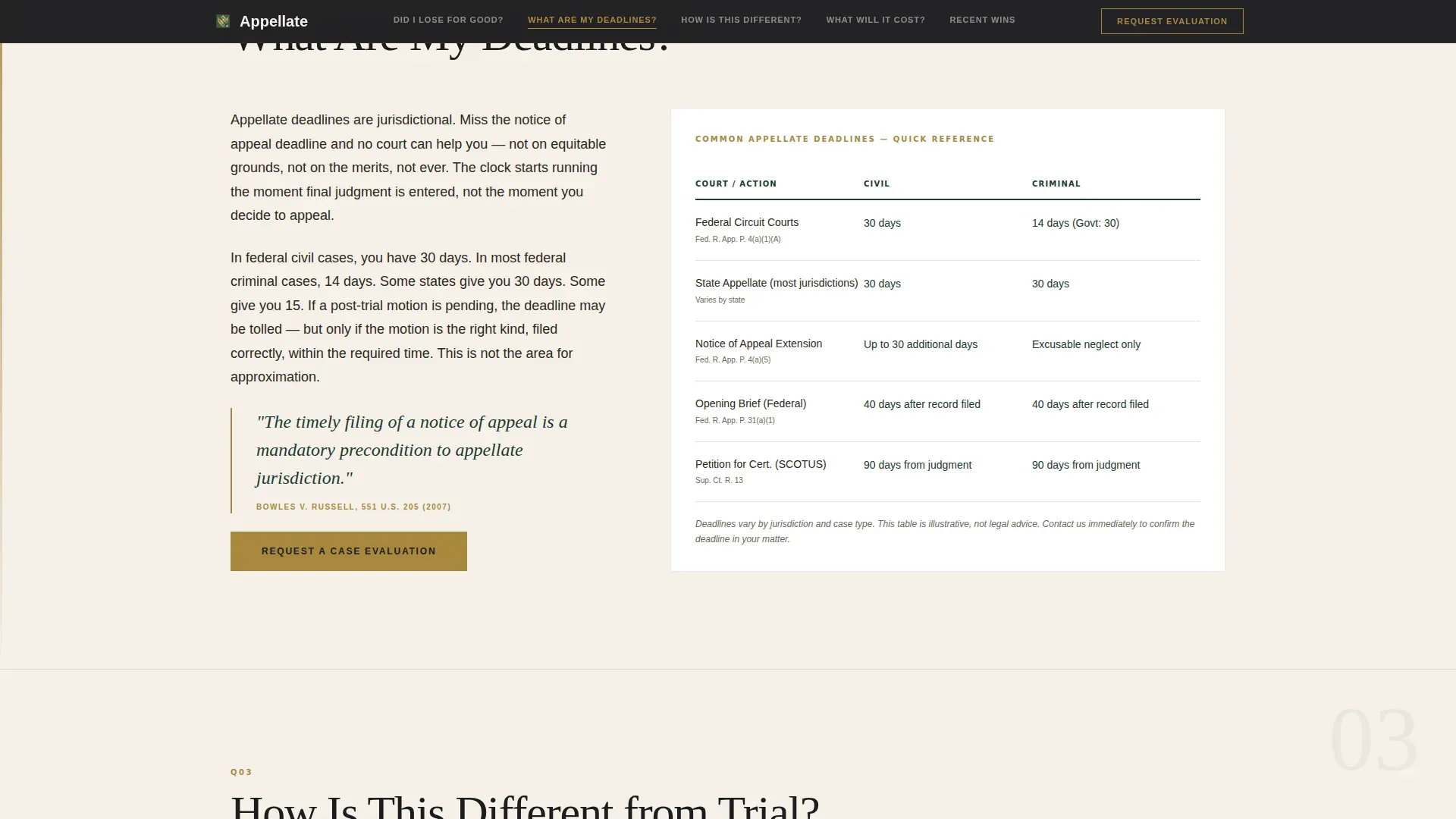
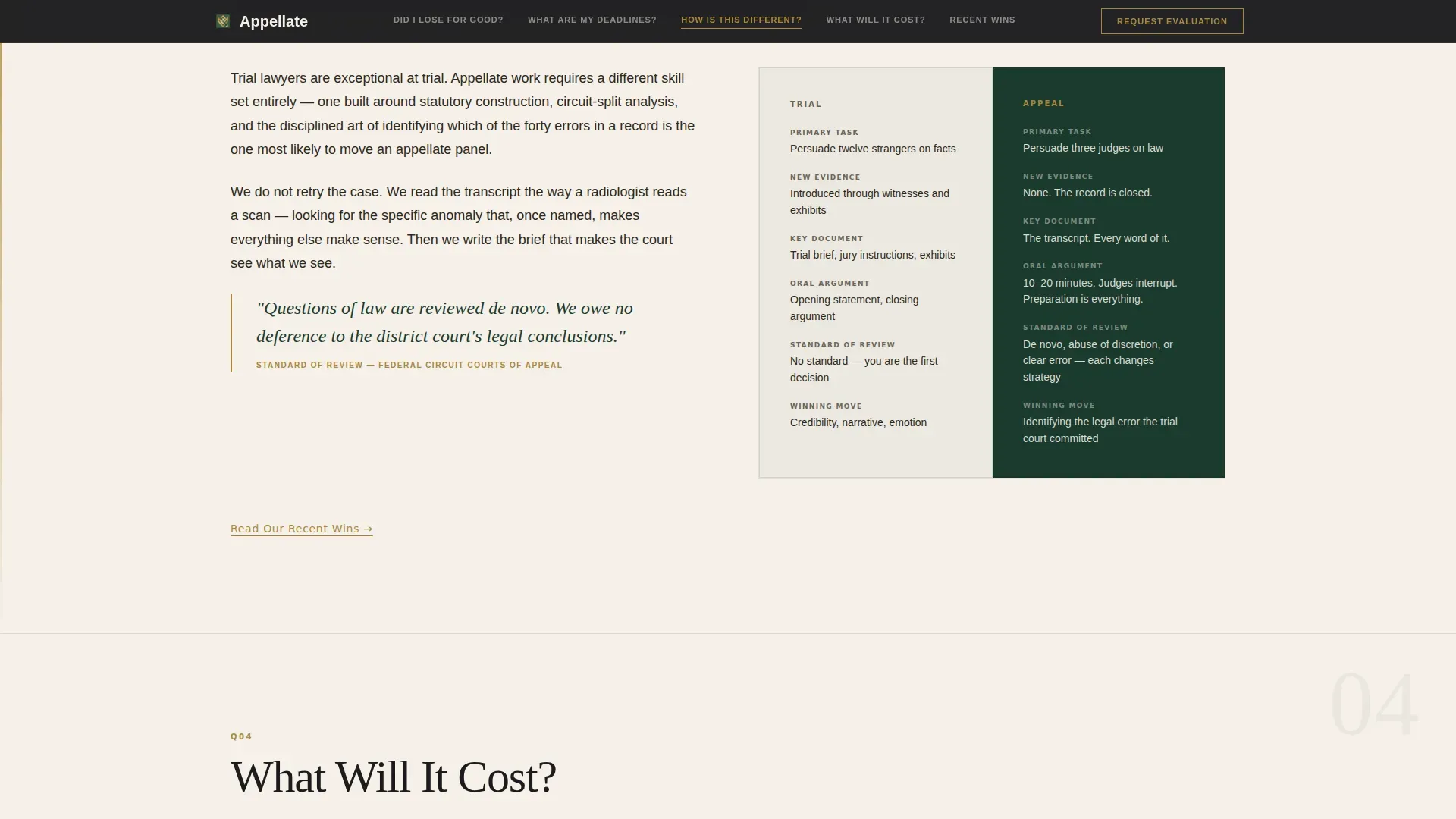
Each spoke section is a self-contained unit. It provides a short plain-language explanation, a pull quote from a relevant standard of review, and a concrete case outcome. This structure mirrors the logic of an effective appellate brief: frame the legal issue, cite the applicable standard, then demonstrate the result. Judges read briefs to decide cases, and this page follows the same reasoning structure that persuades them.
Secondary Social Proof and Wins Section
After the deadlines spoke, a text link reads "Read Our Recent Wins." Clicking scrolls to a section displaying three concrete case outcome cards, each showing the court, the issue argued, and the result obtained. Client testimonials and case results validate expertise. This section builds confidence before the final full-width call-to-action block, so visitors arrive at the close already persuaded.
Final Full-Width Call-to-Action Block
The page concludes with a full-width conversion block. By this point, visitors have read the answer to every anxious question. The block does not need to oversell. It simply restates the offer: Request a Case Evaluation. The burnished gold border frames the button, consistent with the Forest Trust palette used throughout, reinforcing a sense of professional continuity and authority.
Page sections overview
| Section | Purpose |
|---|---|
| Manifesto Hero Header | Establishes judicial authority and presents the primary call to action above the fold |
| Anchor Navigation Hub | Links all frequently asked question spokes and keeps the evaluation call to action fixed as visitors scroll |
| Did I Lose for Good? | Explains reversible error doctrine with a standard of review pull quote and a case outcome |
| What Are My Deadlines? | Presents jurisdiction deadline context, urgency framing, and an evaluation call to action |
| Read Our Recent Wins | Secondary text link leading into three case outcome cards |
| How Is This Different? | Compares trial and appellate process; explains the firm's appellate method |
| What Will It Cost? | Covers fee transparency and flat-fee evaluation framing |
| Final call to action Block | Full-width conversion close after all uncertainty has been eliminated |
Design & branding system
The visual identity follows a Corporate Precision theme. It feels like a mahogany law library at dusk: dark, serious, and controlled, with one warm point of focus that draws the eye to what matters most.
- Forest Trust color system: deep judicial evergreen (#1B3A2D) for primary structure, aged parchment cream (#F5F0E8) for body sections, iron gavel black (#1C1C1E) for the hero, and burnished gold (#A8893E) reserved for anchor nav highlights and call-to-action borders
- Typography: Fraunces, a sharp judicial serif, for all headlines and manifesto text; DM Sans for precise body copy that supports clarity without competing with the headings
- The gold accent appears sparingly, which gives it authority; overusing it would dilute the professional sense of restraint the template is built on
Mobile & speed optimization
The template is built desktop-first, reflecting how attorneys and in-house counsel review professional services: on a large screen, with time to read. Full mobile support is included so visitors on any device can access every spoke section and call to action without friction.
- Responsive design ensures the anchor navigation, spoke sections, and call-to-action blocks function smoothly on mobile devices and tablets
- Mobile-first design principles apply to loading behavior, ensuring fast load times and seamless functionality on smartphones
- GSAP animations are handled by a dedicated Client Component, keeping static content rendered efficiently and the page responsive across devices
How this template helps you convert
This template is built on the Problem, Agitation, Solution structure. It acknowledges that losing a trial is difficult, surfaces every fear a potential client carries, and then systematically eliminates each one before asking for the engagement. By the time a visitor reaches the final call-to-action block, the only remaining unknown is whether the firm will take the case.
- The manifesto header establishes immediate authority and places the primary call to action above the fold, so high-intent visitors can act right away without scrolling
- The five frequently asked question-driven spokes answer every anxious question in plain language, building credibility section by section and removing every reason to leave before the close
- The fixed anchor navigation keeps the "Request a Case Evaluation" button visible at all times, so the conversion path is never more than one click away regardless of where a visitor is on the page
Other information about this template
This template draws on well-established principles for high-performing law firm landing pages. It is designed to drive one specific action, and every design and copy decision supports that single objective. The following points summarize additional context useful for legal teams, firm administrators, and marketing professionals evaluating this template.
- A well-targeted law firm landing page can reach conversion rates of 8.33%, compared to the average of 5.81%, when it uses direct calls to action and surfaces client results as social proof
- Social proof elements, including testimonials and case outcome cards, can increase conversions by up to 34%, which is why the wins section is positioned before the final close
- No-code landing page builders allow law firms to launch and customize this template without coding skills; the drag-and-drop editor simplifies every edit from headline copy to color tokens
- A short contact form on the intake page linked from the call to action reduces friction and increases submissions by requesting only essential information
- Trust signals, including court outcomes, standards of review pull quotes, and professional headshots, strengthen authority and reinforce legitimacy throughout the page
- Appellate advocacy articles and secondary sources cited within spoke sections can add further depth for firms that want to demonstrate intellectual range to visiting co-counsel or law students reviewing the practice
- Oral advocacy is deeply connected to brief quality; a well-crafted brief empowers the oral argument by giving advocates confidence, flexibility, and control at the podium
- Effective appellate advocacy involves disciplined adherence to court rules and a thorough understanding of how appellate judges read, conduct deliberations, and decide cases
- This template supports the appellate precision advocacy legal landing page template use case across federal and state appellate courts, including intermediate courts and courts of last resort
- Moot court training and real case outcomes are both appropriate resources to feature in the wins section, giving law students and junior associates a view into the firm's professional standards
- The template is specifically suited for law practice areas that depend on written arguments and oral argument performance, where clarity, authority, and persuasion must work together across every client touchpoint
- Using best practices from high-performing law firm landing page examples, this template is supported by design decisions that align with how appellate advocates need to present their services to sophisticated legal buyers
Theme
Corporate Precision
Creative direction
FAQ-Driven
Color system
Forest Trust
Style
Hub & Spoke (Anchor Nav)
Direction
Click-Through
Page Sections
Word-by-word Manifesto Header Animation
Hub-and-spoke Anchor Navigation
Faq-driven Spoke Sections
Case Outcome Social Proof Cards
Full-width Final Conversion Block
Related questions
Can I edit the spoke section questions to match my firm's focus?
Does the fixed anchor navigation work on mobile devices?
How do I add case outcome cards to the wins section?
Is ai assistance used in any part of this template?
Can this template support active voice and plain language copy throughout?