Real Estate Appraiser Landing Page Template
Appraise is a single-column landing page template built for independent real estate appraisers. It uses a FAQ-driven scroll flow to answer the exact questions clients bring to the door, from divorce settlements to probate orders. The design is stark, authoritative, and trust-first, with clear calls to action that earn the click before they ask for it.
by Rocket studio
Quick summary
Appraise is a single-column landing page template designed for solo real estate appraisal practices. It answers real client questions in plain language, builds professional authority through an FAQ-driven layout, and guides visitors toward a pricing page with two well-placed calls to action. The design is calibrated, minimal, and confident.
Who this template is for
This template is built for independent appraisers who serve clients with high-stakes deadlines and no patience for ambiguity. If you write defensible opinions of value for legal, financial, or tax purposes, this page speaks your clients' language before you say a word.
- Solo appraisers handling divorce, estate, lender, and tax-assessment work
- One-person practices that need a professional web presence without a development team
- Appraisers who want to earn trust through answers rather than promotional language
What problem this template solves
Most real estate appraisal websites either look like a brochure or a blank form. Neither builds the confidence that attorneys, lenders, and executors need when a deadline is close and a deal depends on a defensible number.
- Clients arrive with specific, urgent questions and leave without answers on most appraisal sites
- Generic layouts fail to signal the methodical authority that appraisal work actually requires
- A missing pricing signal forces clients to call before they are ready, reducing qualified leads
What you get with this template
You get a complete single-column landing page layout built around a FAQ-driven scroll experience. Every structural decision prioritizes trust before conversion, so the call to action arrives after the visitor already feels understood.
- A stark, bold header section with a headline-first design and no imagery clutter
- A scrolling FAQ format where oversized questions and plain-language answers replace traditional service blocks
- Two strategically placed calls to action linking to a services and pricing page, plus a secondary credibility link to a sample report
Feature list
A paragraph overview of the feature set: every feature in this template is drawn directly from the prompt brief. Nothing is speculative. Each component serves the singular goal of turning a skeptical, deadline-pressured visitor into a confident click.
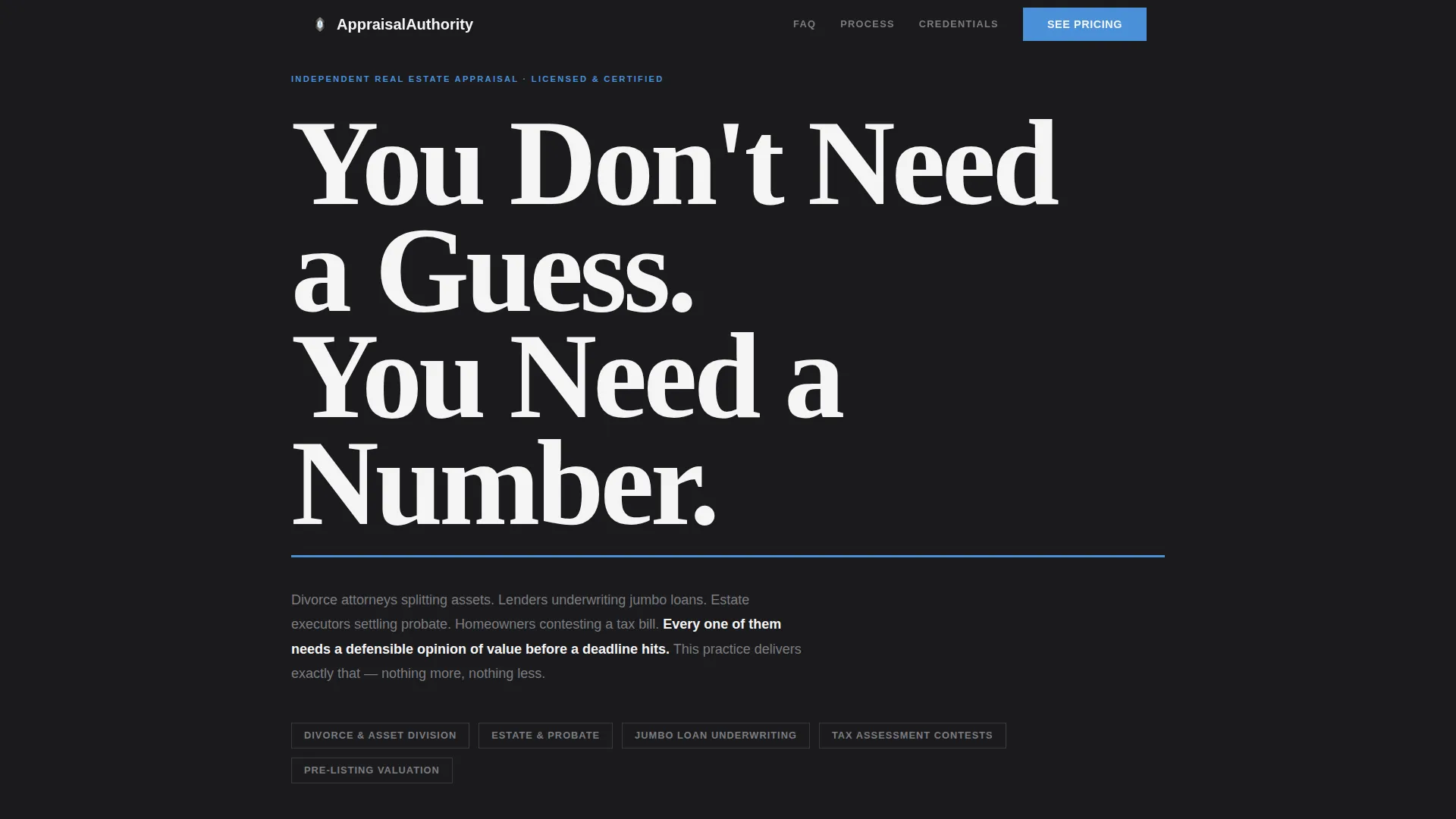
Giant Headline Hero Section
The header fills roughly eighty percent of the viewport width with stark white condensed type on a forge-black background. A single appraisal-blue underline pulses once to draw the eye down. No image, no illustration, just the headline and a subhead explaining who orders appraisals and why.
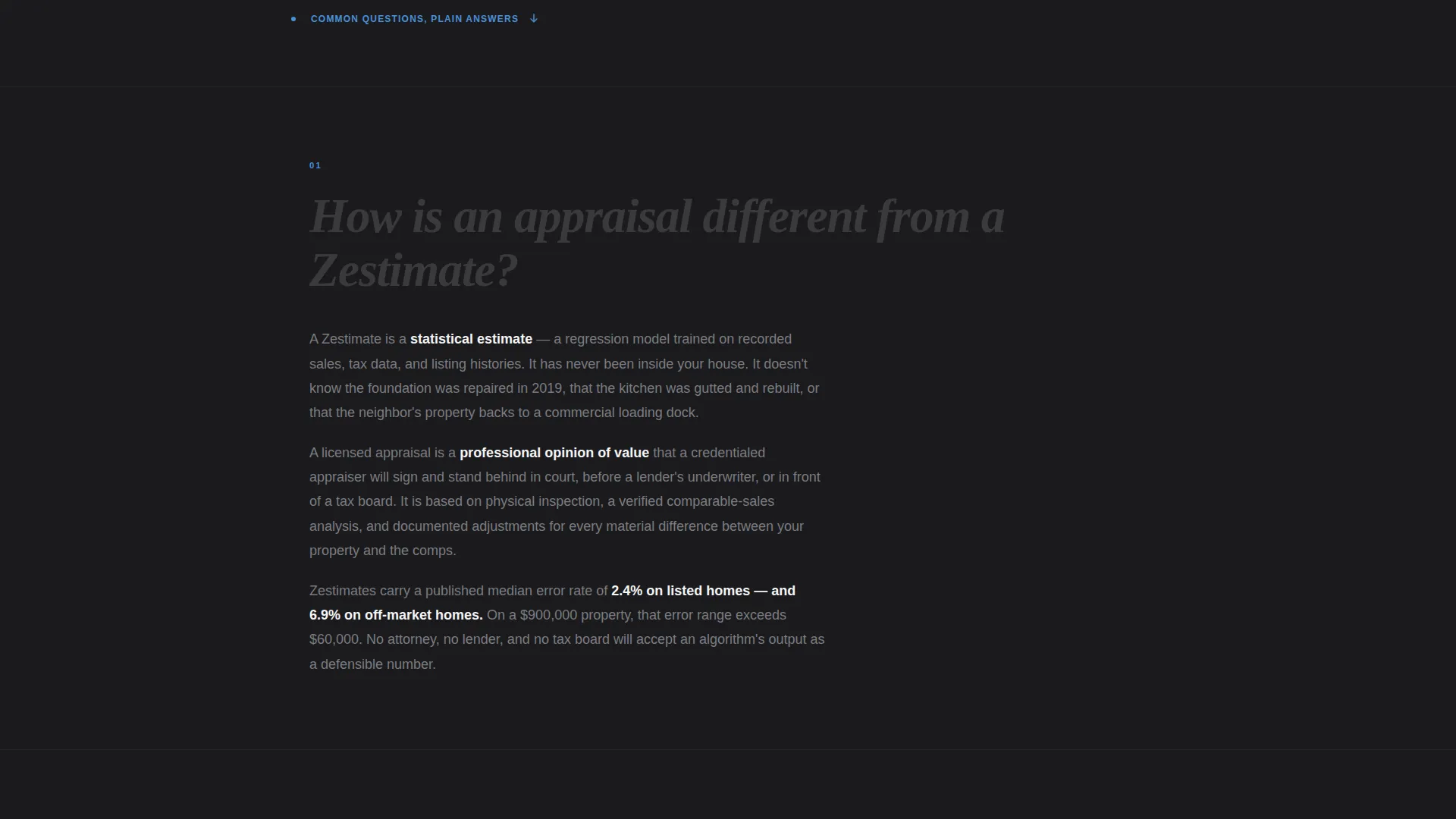
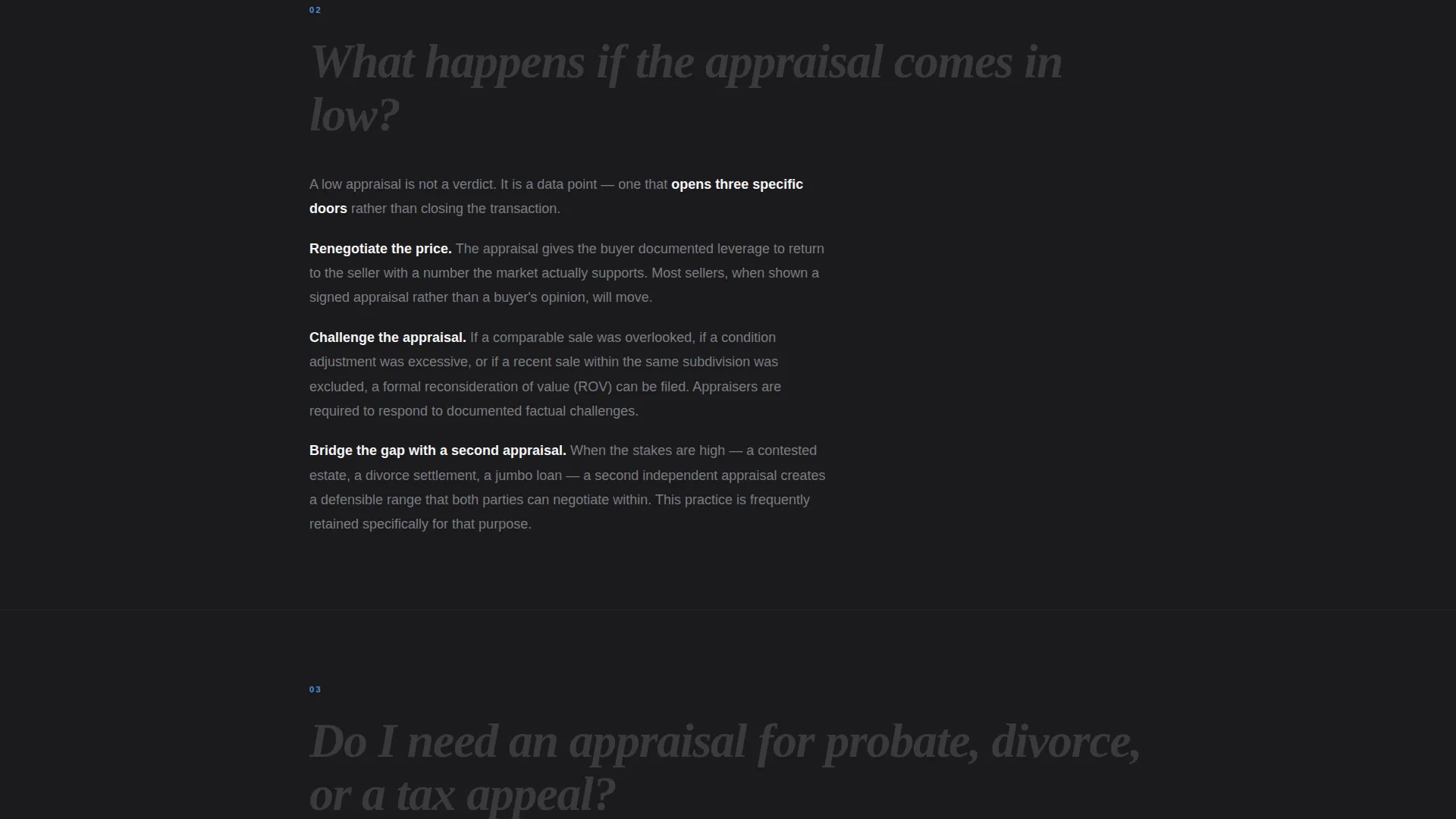
FAQ-Driven Scroll Layout
Each scroll section opens with a real question in oversized graphite type. The answer unfolds beneath it in measured, plain-spoken paragraphs. Bold key phrases serve as scannable anchors so readers can skim or read in full. The rhythm is ask, answer, breathe.
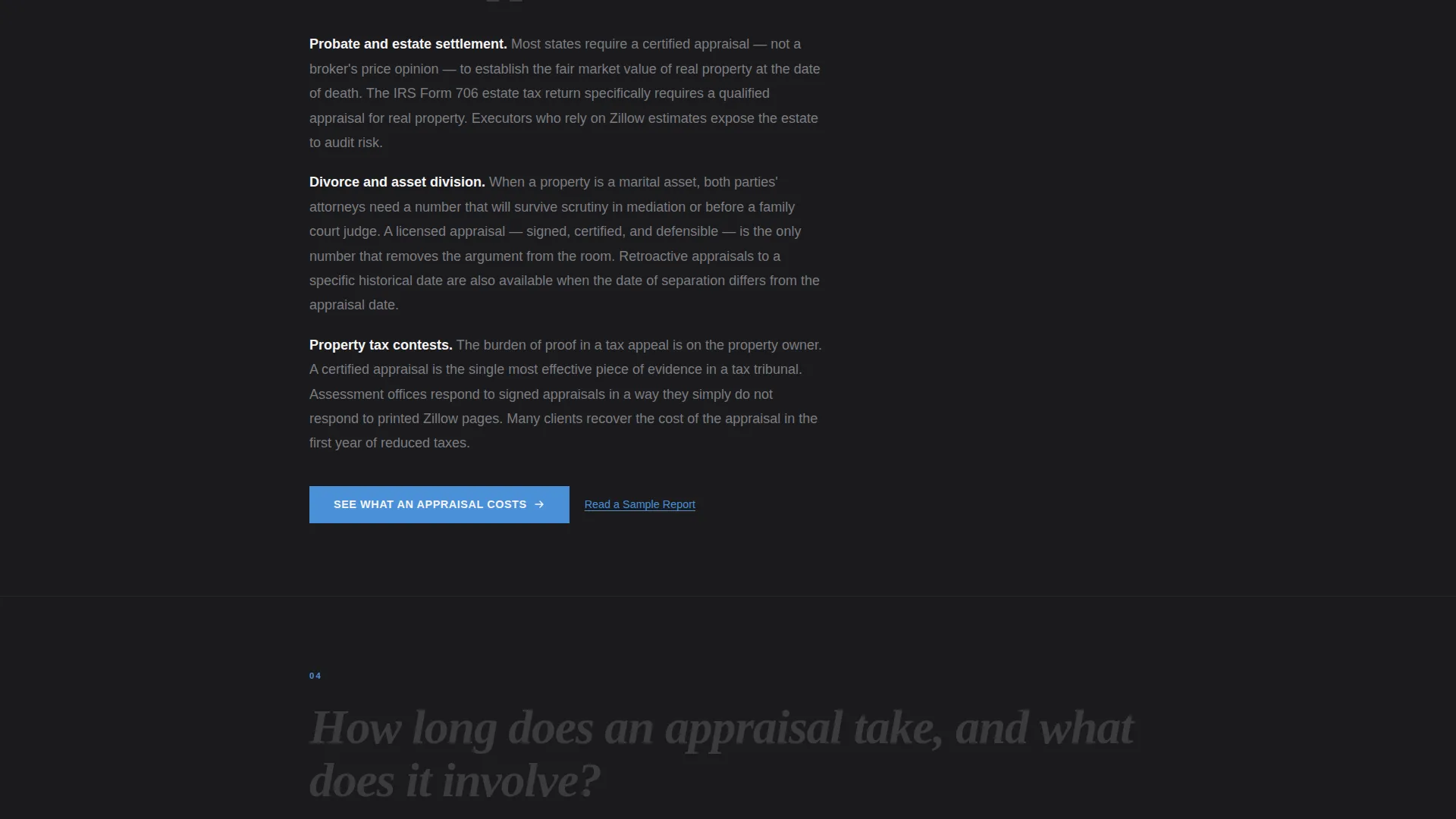
Dual Call-to-Action Placement
The primary call to action, "See What an Appraisal Costs," appears after the third FAQ answer and again at the bottom of the page. Both instances link to a detailed services and pricing page. Placement is earned, not forced.
Secondary Credibility Link
A text link reading "Read a Sample Report" gives skeptical visitors a way to verify professional credibility before committing to a click. This link addresses objections without requiring a sales pitch.
Monochrome Steel Color System
The palette uses forge black, brushed graphite, galvanized mid-gray, and cold white as its base. A single accent color, appraisal-blue, appears only on links, call-to-action buttons, and answer-reveal indicators. Nothing competes for attention.
No-Form Trust Architecture
This page deliberately omits a contact form. The design philosophy is trust first, then conversion. Visitors are guided to a pricing page only after their questions have been answered in full.
Page sections overview
| Section | Purpose |
|---|---|
| Hero headline block | Establishes authority with a bold, full-width headline and a brief subhead naming the client types served |
| FAQ scroll section one | Answers the first real visitor question with a plainspoken response and bold scannable anchors |
| FAQ scroll section two | Continues the question-and-answer rhythm, deepening trust with a second specific client scenario |
| FAQ scroll section three | Completes the third FAQ block before the first call-to-action placement |
| Primary call to action block | Presents the "See What an Appraisal Costs" button after trust has been established |
| FAQ scroll section four | Extends coverage to additional client scenarios such as probate and tax assessment |
| Secondary credibility link | Offers the "Read a Sample Report" text link for visitors who want proof before clicking |
| Closing call to action block | Repeats the primary call to action at the bottom of the page for visitors who scrolled the full page |
Design & branding system
The visual identity follows an Educational Guide theme expressed through a Monochrome Steel color system. Every color decision reinforces the feeling of a calibrated, professional practice rather than a sales-forward marketing site.
- Base palette: forge black (#1B1B1E), brushed graphite (#3A3A3C), galvanized mid-gray (#7C7C80), and cold white (#F4F4F5)
- Single accent: appraisal-blue (#4A90D9) used exclusively for links, call-to-action buttons, and answer-reveal indicators
- Typography: heavy condensed typeface for the headline; oversized graphite type for FAQ questions; plain-text paragraphs with bold key phrases for answers
Mobile & speed optimization
The single-column scroll layout is inherently well-suited to vertical mobile reading. There are no sidebars, complex grids, or media-heavy elements that would interrupt the reading flow on smaller screens.
- Single-column flow adapts naturally to mobile viewport widths without layout restructuring
- No images or illustrations in the hero section reduces visual load and keeps the headline dominant on all screen sizes
- Lightweight text-and-color design means fewer rendering dependencies across devices
How this template helps you convert
This template converts by removing friction before the visitor reaches the call to action. The FAQ format answers objections quietly and builds confidence section by section, so the pricing-page click feels like a natural next step rather than a sales push.
- Each FAQ answer resolves a specific objection a real client would have, reducing hesitation before the call to action appears
- The "See What an Appraisal Costs" button appears only after three full answers, so the visitor already trusts the appraiser's knowledge when they click
- The "Read a Sample Report" link gives risk-averse clients a credibility checkpoint that keeps them on the conversion path without requiring a form submission
Other information about this template
This template is well-suited for real estate appraisal professionals who want a web presence that matches the seriousness of the work they do. The design decisions are deliberate and consistent with how appraisal clients think and research.
- The page structure is ideal for appraisers serving lenders who need Uniform Residential Appraisal Report (URAR) work, divorce attorneys, estate executors, and homeowners filing formal tax-assessment challenges
- The template style is a single-column flow, distinct from split-screen or multi-panel layouts, which keeps the reading experience linear and uninterrupted
- The no-form philosophy suits practices where a phone call or pricing-page review is a better first step than an open intake form
- This template can support a real estate appraiser booking page workflow when paired with a separate scheduling or pricing page linked from the call-to-action buttons
Theme
Corporate Precision
Creative direction
Stats-First Impact
Color system
Monochrome Steel
Style
Split Screen (50/50)
Direction
Booking/Scheduling
Page Sections
Giant Headline Hero Section
Faq-driven Scroll Layout
Dual Call-to-action Placement
Secondary Credibility Link
No-form Trust Architecture
Monochrome Steel Color System
Related questions
Can I change the FAQ questions to match my actual client work?
Does this template include a contact form?
Is this template suitable for appraisers who work with lenders and attorneys?
Can I add my own sample report link?
How many FAQ sections does the template include?