Advanced Joint & Family Finance Professional Website Template
The Qualify joint income family loan landing page template is a single-page, zigzag-layout design built for fintech lenders targeting families who combine incomes on one unsecured loan application. It guides two or more applicants through eligibility, borrowing power, document requirements, and co-borrower liability, section by section, until clicking "Check Your Joint Eligibility" feels like the obvious next step.
by Rocket studio
Quick summary
Qualify is a conversion-focused landing page template for joint and family personal loan products. It uses an alternating zigzag layout, animated eligibility checklists, and a progressive qualification flow to move two-applicant households from curious to confident. Every section answers one borrower anxiety and ends with a teal call-to-action button that earns the click before asking for it.
Who this template is for
This template suits fintech lenders, non-banking financial companies, and credit product teams in the Indian market who lend money to families applying together. It is built for teams who want a polished, ready-to-launch page without starting from scratch.
- Lenders offering unsecured personal loans to married couples, adult siblings, or multigenerational households
- Product managers who need a desktop-first page with strong mobile response and scroll-triggered animations
- Marketing teams targeting borrowers with a combined income of ₹40,000 or more per month who want access to higher loan amounts
What problem this template solves
A solo borrower often cannot obtain the loan amount they need. Their credit score, income, or debt-to-income ratio falls short of what the lender requires. A joint application solves that, but most landing pages fail to explain how. Visitors arrive unsure whether they qualify, confused about documents, and anxious about shared liability.
- Solo applicants feel excluded when a page does not address their situation or offer a clear redirect
- Families do not understand co-borrower liability, so they abandon the form before they start
- Generic loan pages bury the document list, making it hard to prepare and easy to delay
What you get with this template
This template delivers a fully structured, single-page layout with five content sections, a linear footer, and every design element specified and ready to customize. The page is built to make each family member feel pre-qualified before they ever reach the primary call-to-action button.
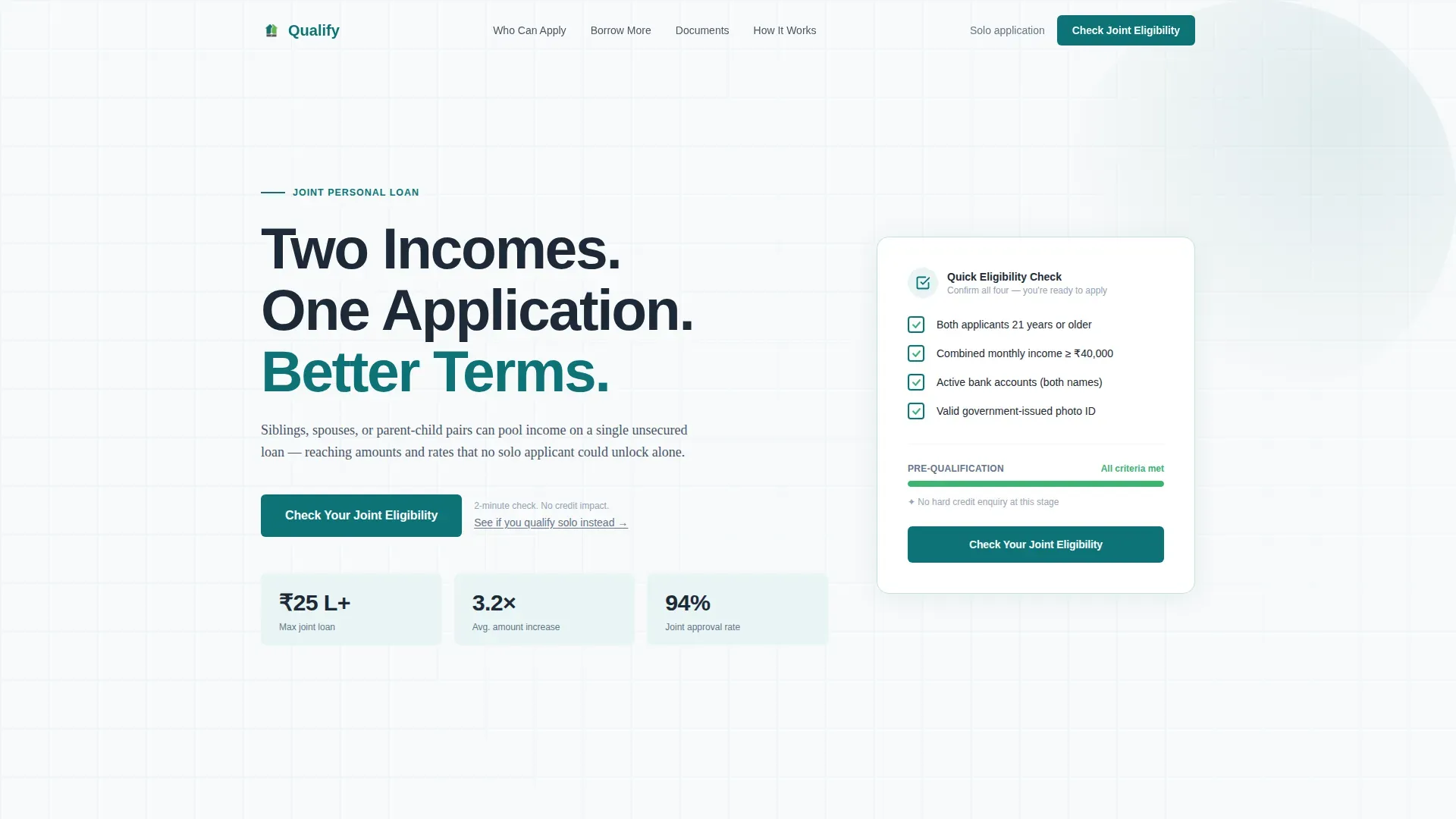
- A hero section with a giant flush-left headline and an animated eligibility checklist with cascading green checkmarks
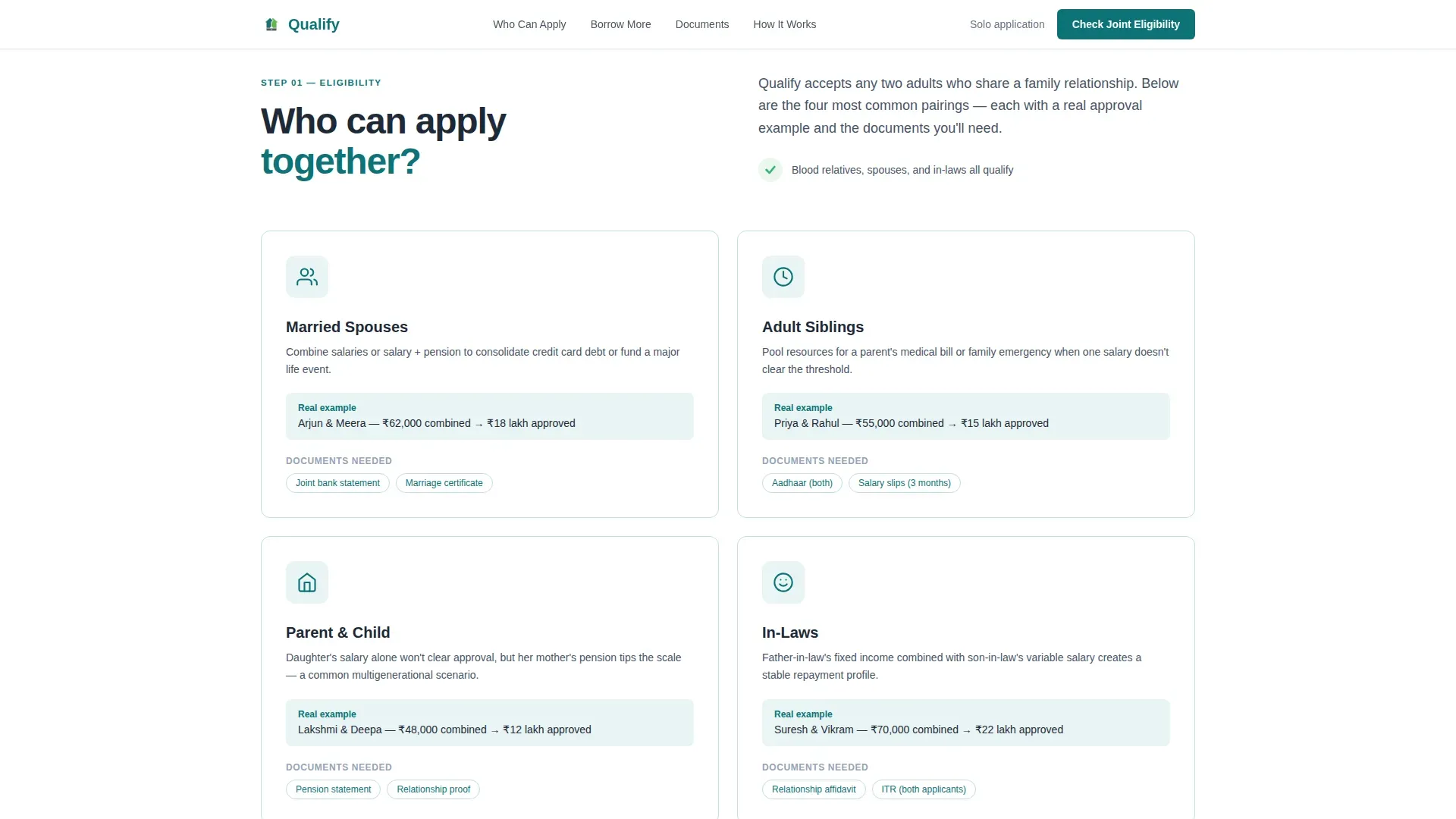
- Four zigzag body sections covering relationship eligibility, borrowing power comparison, document requirements, and co-borrower liability
- A primary teal call-to-action button anchored at the bottom of every alternating section, paired with the micro-line "2-minute check. No credit impact."
Feature list
A paragraph introducing the features: each built-in component addresses a specific moment in the borrower's decision journey, from first impression to final click.
Animated Eligibility Checklist in Hero
The header displays four teal-outlined checkboxes that cascade on page load with animated green confirmation marks. Criteria shown include both applicants being 21 or older, combined income at or above ₹40,000 per month, active bank account ownership, and valid identification. This makes visitors self-qualify immediately.
Solo-versus-Joint Borrowing Power Chart
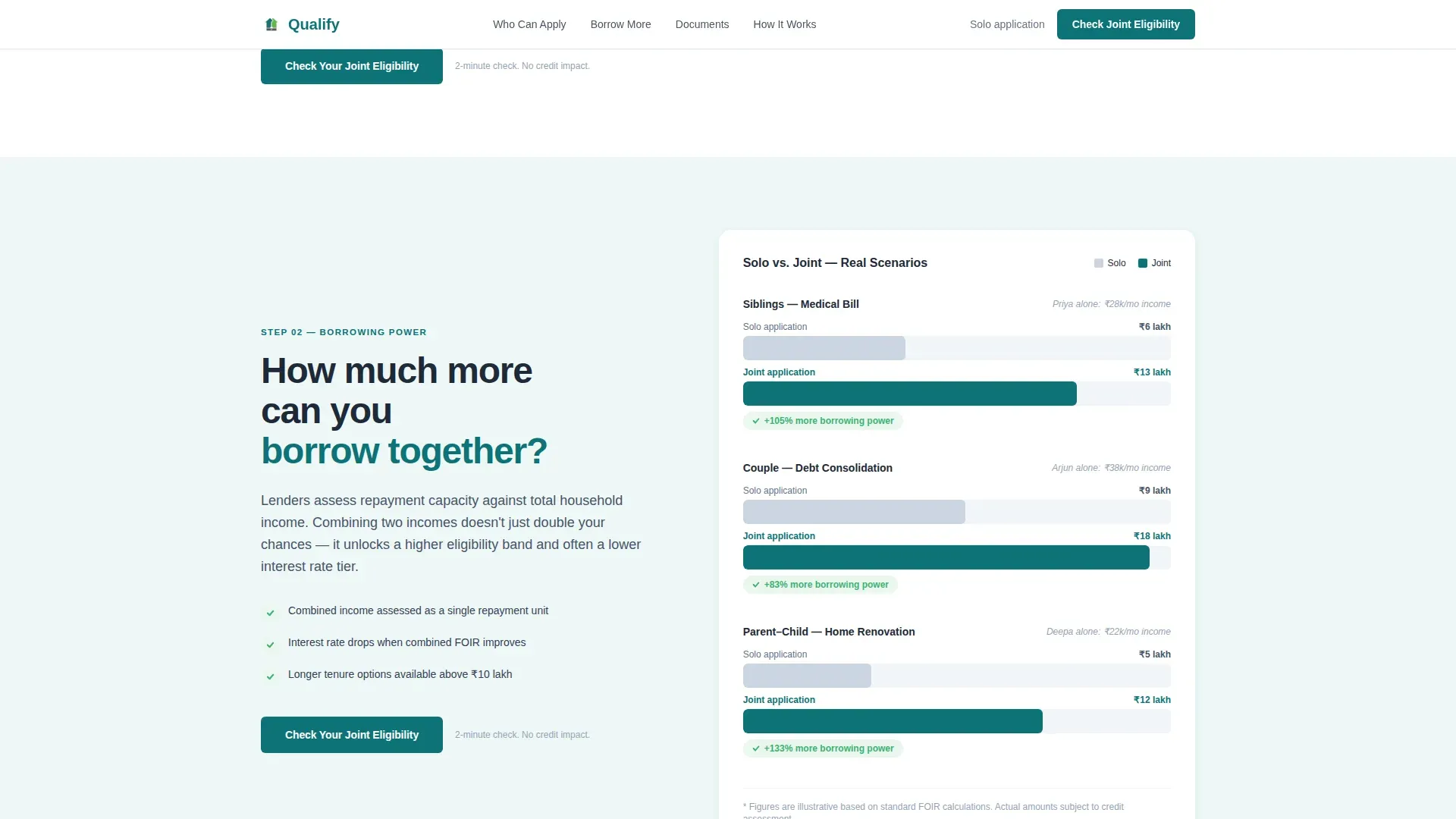
A scroll-triggered, animated bar chart compares what a solo borrower can access against what the combined loan application unlocks. Lenders add the gross monthly incomes of all borrowers to determine total repayment capacity, and this chart makes that difference visible before the reader reaches the call-to-action.
Downloadable Document Checklist
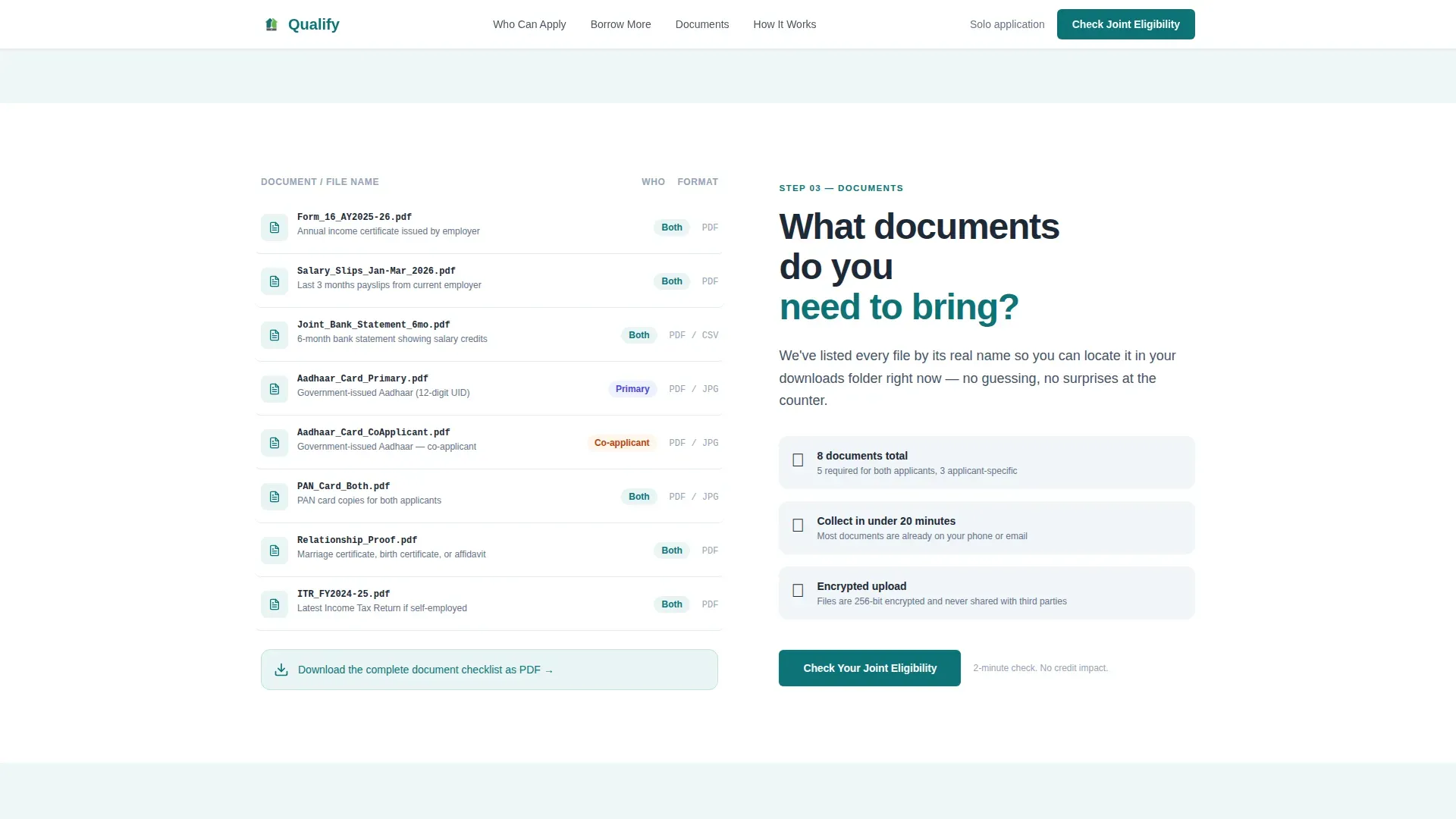
The documents section lists real file names, Form 16, salary slips, joint bank statements, so applicants know exactly what to gather. A clear list of needed files is required for all household members over 18, and this template surfaces that list in a format visitors can download and use immediately.
Co-Borrower Liability Diagram
A plain-language audit trail diagram addresses the most common anxiety in joint lending: what happens if one person cannot pay. All co-borrowers are equally responsible for the full debt, regardless of any private split of payments. This section states that directly and calmly, in a way that builds trust rather than fear.
Dual Call-to-Action System
The primary button reads "Check Your Joint Eligibility" and reappears at the bottom of every alternating section. A secondary text link, "See if you qualify solo instead", keeps solo visitors in the funnel. This two-path system captures both joint and individual intent without sending anyone away.
Page sections overview
| Section | Purpose |
|---|---|
| Hero Header | Bold headline with animated eligibility checklist |
| Who Can Apply | Relationship pairs with document icons |
| Borrowing Power | Animated solo-versus-joint bar chart comparison |
| Documents Required | Downloadable checklist with real file names |
| Co-Borrower Liability | Plain-language audit trail diagram |
| Linear Footer | Single-row footer with standard link pattern |
Design & branding system
The template follows a Corporate Precision visual theme using the Teal Catalyst color palette. Typography uses Plus Jakarta Sans for headings and DM Sans for body text, a pairing that feels organized and authoritative without being rigid.
- Deep boardroom teal (#0D7377) for primary buttons and interactive elements; charcoal slate (#1E2A38) for headlines; document white (#F7F9FA) for alternating background panels
- Warm approval green (#3CB371) reserved exclusively for checkmarks, progress indicators, and confirmation states, never used as a general accent
- No stock photography of families; the visual language relies entirely on typography, iconography, and the checklist format to communicate credibility
Mobile & speed optimization
The template is designed desktop-first with a strong mobile-responsive layout. Animations use IntersectionObserver reveals so scroll-triggered elements activate correctly on both screen sizes.
- The zigzag layout collapses gracefully to a single-column stack on smaller screens without losing section logic or call-to-action visibility
- Cascading checkmark animations and the scroll-triggered bar chart are built as client-side components, keeping static content lean and fast to render
- Server Components handle all non-interactive sections, reducing unnecessary JavaScript on initial load
How this template helps you convert
The page earns the click by completing the borrower's mental checklist before asking them to act. Every design decision serves the goal of making two applicants feel ready and confident together.
- The animated eligibility checklist in the hero confirms criteria instantly, so visitors self-qualify in seconds rather than guessing whether they are eligible for the joint loan
- The document section gives applicants a concrete preparation task, gather pay stubs, tax documents, and bank statements, which shifts their mindset from browsing to applying
- The dual call-to-action system ensures that neither joint applicants nor solo visitors leave empty-handed, protecting conversion across both audience segments
Other information about this template
This template is built for the Indian lending market and uses INR currency formatting, Indian document names such as Form 16 and salary slips, and localized placeholder names throughout. It is part of the broader family of joint and family finance landing page templates available on the platform.
- The qualify joint income family loan landing page template can be customized and downloaded after editing, making it a practical starting point for any lending product team
- A family loan agreement template that accompanies a joint application should specify the repayment schedule, the interest rate, the principal sum, and contingencies for late payments and late fees; this page template is designed to complement that agreement by setting borrower expectations clearly before they apply
- The family loan agreement should be detailed in writing; the loan shall bear interest at a specified rate, calculated on a monthly basis; the borrower agrees to repay the loan plus any applicable interest by the agreed date; and the agreement should be signed by both parties with valid signatures to ensure its legal standing
- When lending money to a family member, it is advisable to treat the arrangement like a business transaction; if a borrower defaults, the lender has the right to take legal action to recover the amount, including any applicable interest and late fees; this more critical issue is best addressed upfront in a clear, written loan agreement
- Setting an interest rate at or above the applicable federal rate helps parties avoid unnecessary tax liabilities; an interest free loan above gift thresholds can cause the lender to incur tax liabilities; states may also set anti usury limits that cap the interest a lender can charge, though these limits are often less relevant in family lending contexts
- The loan can be provided as cash, check, or bank transfer at the lender's discretion; the lender agrees to deliver the principal sum by the agreed date; and the governing law clause in the agreement clarifies which jurisdiction applies if either party needs to pursue legal action
- Lending money to a family member carries an opportunity cost; charging applicable interest can offset the cost of forgoing other investments; the family loan agreement template is free to use, can be edited, and is ready to download for use in MS Office or a compatible editor
Theme
Corporate Precision
Creative direction
Checklist & Audit
Color system
Teal Catalyst
Style
Zigzag/Alternating
Direction
Click-Through
Page Sections
Animated Eligibility Checklist Hero
Solo Versus. Joint Borrowing Chart
Downloadable Document Checklist
Co-borrower Liability Diagram
Dual Call-to-action System
Related questions
Who counts as a joint applicant on this landing page?
Can a solo visitor still use this page?
What documents does the template ask applicants to prepare?
How does the template handle co-borrower liability?
Can I customize the colors, text, and document names in this template?