Aqua — Premium Water Softening Landing Page Template
The Soften landing page template is built for Chicago water softener service providers who need to turn curious homeowners into booked appointments. It pairs split-screen educational content with neighborhood testimonials, a grain-hardness map, an ion exchange diagram, and a cost calculator, all driving visitors toward a single amber call-to-action button that leads to scheduling.
by Rocket studio
Quick summary
Soften is a Click-Through landing page template designed for Chicago water softener service businesses. It combines an Educational Guide aesthetic with a Testimonial Mosaic layout, using charcoal and amber tones to guide visitors from curiosity to confidence. Each scroll pair answers one buyer question with science on one side and a neighbor's real story on the other, ending every section with an amber button that books the appointment.
Who this template is for
This template is built for water treatment professionals serving the Chicago metro area. It speaks directly to the problems that local homeowners and landlords recognize on sight: white scale on glass, spotty dishes, itchy skin, and appliances dying ahead of schedule.
- Chicago-area plumbers and water softener installation companies targeting residential clients in neighborhoods like Bucktown, Logan Square, and Naperville
- Home services businesses that need a credibility-first landing page to convert research-mode visitors into booked service calls
- Landlords and property managers fielding tenant complaints about hard water problems and looking for a professional solution to present to residents
What problem this template solves
Chicago's municipal water supply averages 130 to 150 parts per million of hardness, or roughly 7.6 to 8.8 grains per gallon. That level of water hardness puts real financial strain on every household that hasn't addressed it. Hard water contains high concentrations of dissolved minerals, primarily calcium and magnesium, and the damage is slow, constant, and expensive.
- Most landing pages either oversell the science or skip it entirely, leaving visitors unconvinced and bouncing before they book
- Without a clear cost comparison, homeowners don't understand the urgency, so the investment in water softeners feels optional rather than necessary
- Generic templates lack the neighborhood-level social proof that Chicago homeowners need before they trust a service crew inside their home
What you get with this template
You get a fully designed, single-page layout that walks visitors through the hard water problem, explains the solution, and removes every hesitation between landing and booking. The template is structured around educational credibility and social proof working together across every scroll section.
- A split-screen hero section with a badge bar displaying certification emblems, a dramatic headline, and the primary call-to-action button
- A three-part Testimonial Mosaic that pairs educational content panels (grain map, ion exchange diagram, cost calculator) with real customer tiles showing neighborhood names, install photos, and before-and-after water test strips
- A full-width final call-to-action section in amber and charcoal, plus a linear single-row footer
Feature list
This template delivers a purpose-built set of components for a water softener service landing page. Each feature is grounded in the brief and serves the single goal of converting a hard water sufferer into a scheduled appointment.
Split-Screen Hero with Award Badge Bar
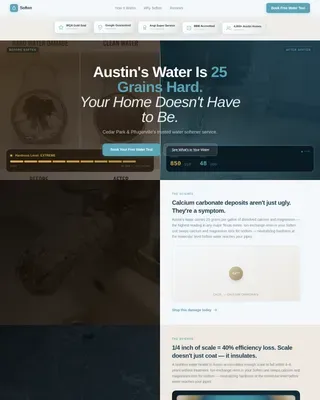
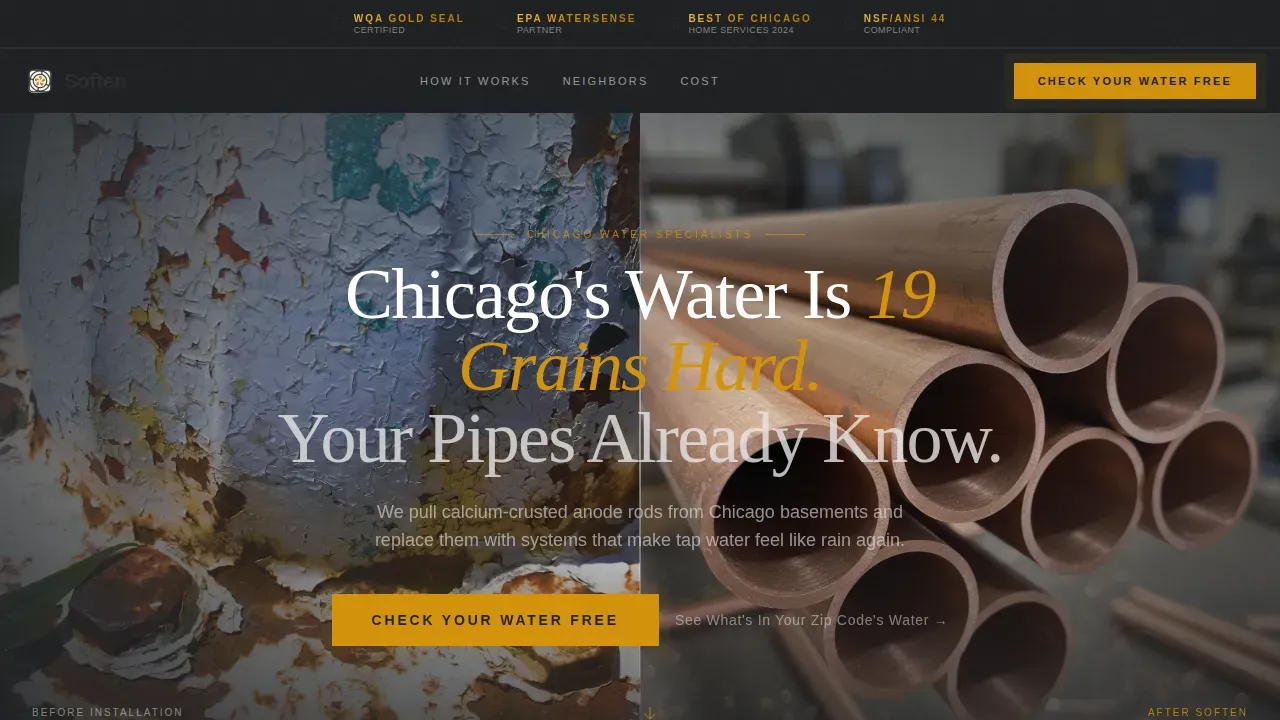
The hero section divides the viewport into two equal halves. The left side displays a close-up photograph of a corroded pipe interior with mineral deposits thick as coral. The right side shows a clean copper cross-section under workshop light. Above both sits a horizontal badge bar on a deep charcoal field, displaying certification emblems including WQA Gold Seal and EPA WaterSense Partner credentials rendered in amber foil detail. The headline fades in between the two panels: "Chicago's Water Is 19 Grains Hard. Your Pipes Already Know." The primary amber call-to-action button, "Check Your Water Free," appears directly below.
Testimonial Mosaic Scroll Layout
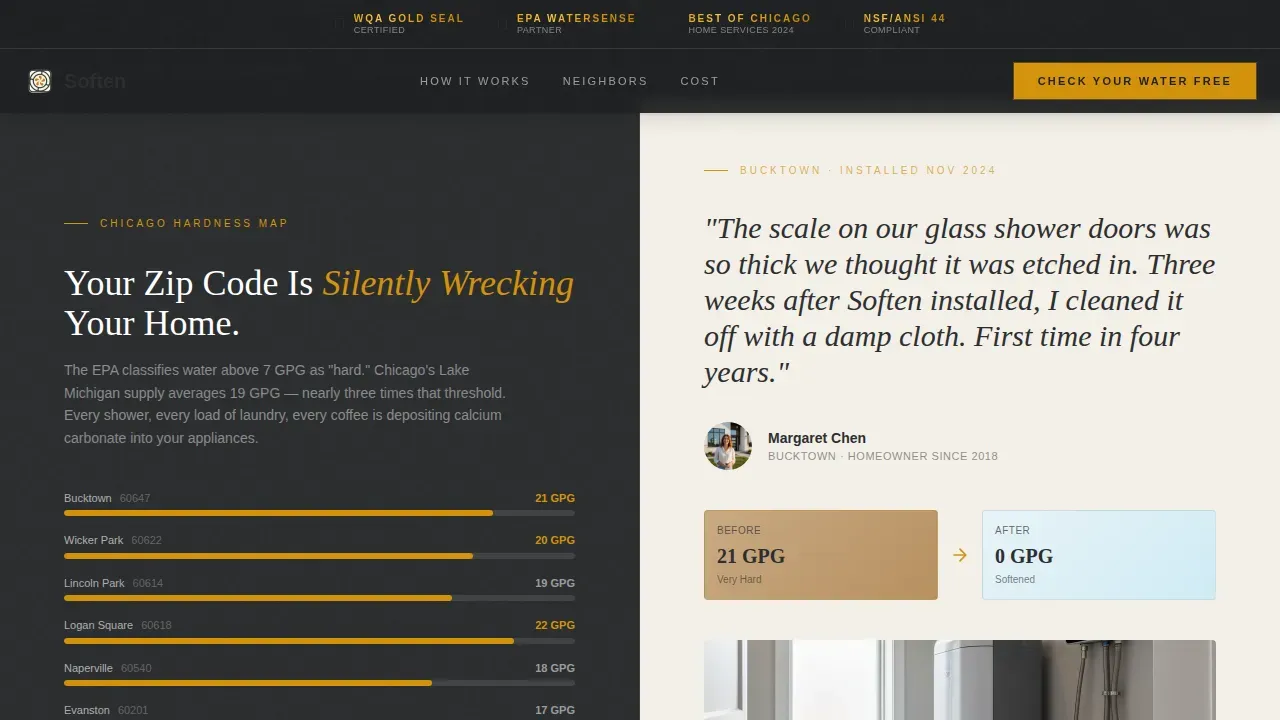
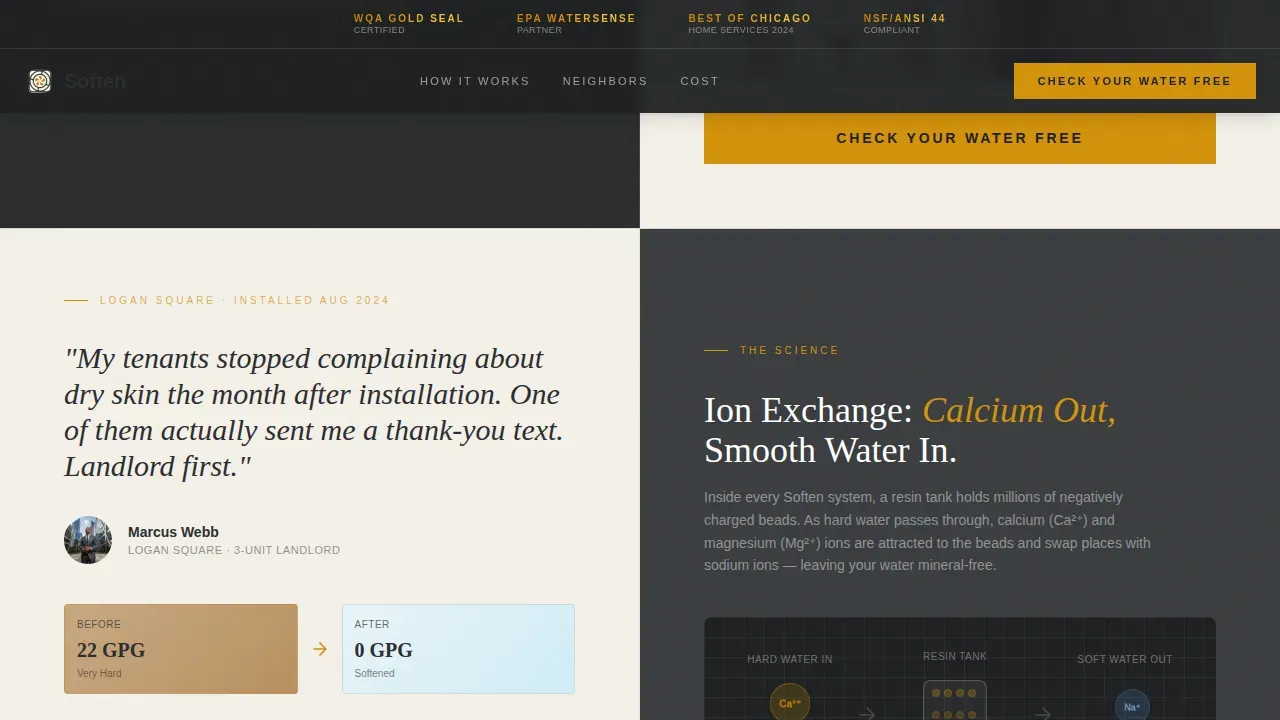
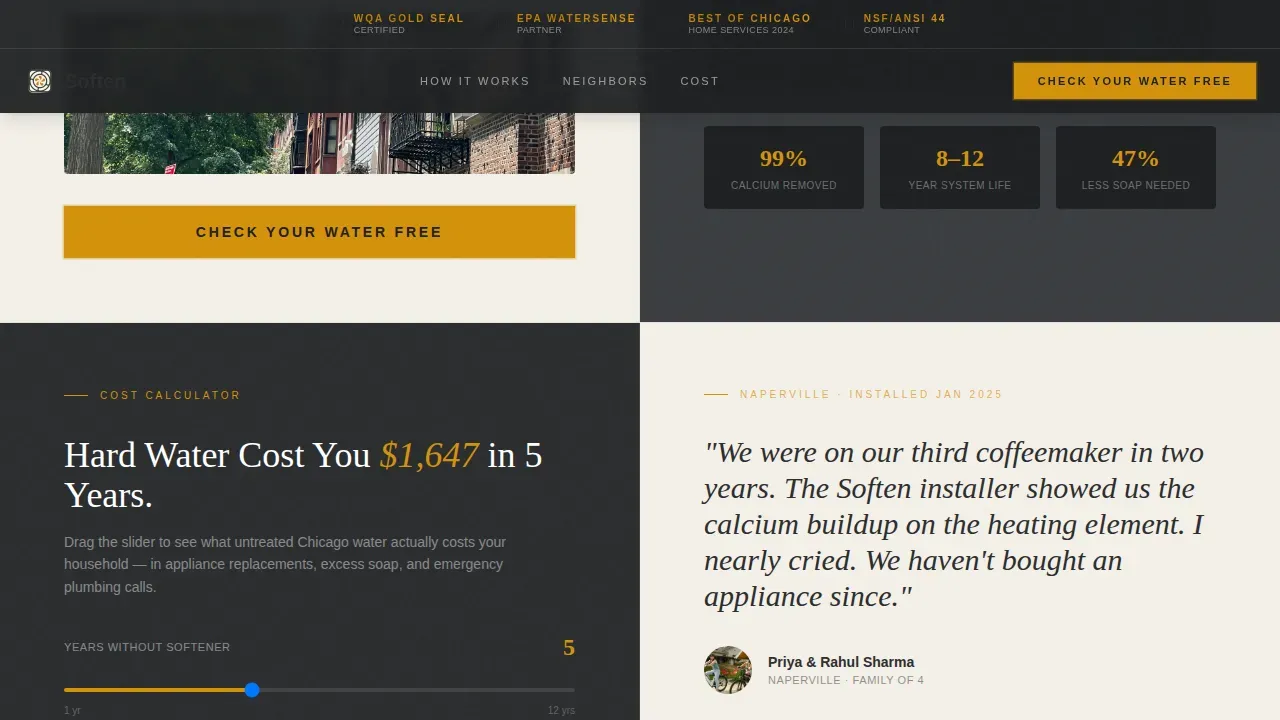
The core of the page is a three-section mosaic where every educational panel is paired with a customer testimonial tile. The first pair addresses water hardness and the Chicago water supply with a grain-hardness map of local zip codes. The second pair explains how water softeners work through an animated ion exchange diagram. The third pair presents a cost calculator showing appliance replacement expenses versus softener investment. Each testimonial tile includes the customer's neighborhood name, an install photo, and a before-and-after water test result. The amber call-to-action button repeats after every pair.
Interactive Cost Calculator
A slider-based cost calculator lets visitors input their household size and current appliance situation to compare the cost of untreated water damage against the investment in a water softener system. It surfaces real numbers around water heating costs, appliance lifespan reduction, and energy savings to make the case for acting now rather than later.
Secondary Educational Navigation Link
A secondary text link, "See What's In Your Zip Code's Water," appears alongside the primary button in the hero. It anchors visitors deeper into the educational mosaic sections for those not yet ready to book. This soft path keeps visitors engaged with the page content until the call-to-action feels natural.
Fade-In Animation and Scroll Reveal System
The template uses high-intensity animation throughout: fade-in-up stagger on section entries, scroll reveal transitions between mosaic panels, a marquee element in the header area, and an animated diagram for the ion exchange explanation. These animations make the page feel alive without distracting from the educational content.
Full-Width Final Call-to-Action Section
The page closes with a full-width amber push section on a charcoal background. It is designed to capture visitors who scrolled all the way through the mosaic and are now fully educated and socially convinced. The section leads directly to a lightweight scheduling page where visitors choose a two-hour window and enter their address.
Page sections overview
| Section | Purpose |
|---|---|
| Badge Bar Header | Display certifications and build immediate trust |
| Split-Screen Hero | Anchor attention with corrosion versus. clean contrast |
| Primary call to action Button | Push first-time visitors toward scheduling |
| Grain Map Panel | Educate visitors on local water hardness by zip code |
| First Testimonial Tile | Pair neighborhood proof with the hardness education |
| Repeated call to action Button | Re-engage visitors after the first mosaic pair |
| Ion Exchange Diagram | Explain how water softeners remove hard water minerals |
| Second Testimonial Tile | Reinforce trust with a second neighbor story |
| Repeated call to action Button | Capture visitors converted by the science section |
| Cost Calculator Panel | Show the financial cost of ignoring hard water |
| Third Testimonial Tile | Close the mosaic with a third verified install story |
| Repeated call to action Button | Final mosaic-level booking push |
| Full-Width Final call to action | Last amber push before the footer |
| Linear Footer | Single-row footer with essential links |
Design & branding system
The visual language borrows from the aesthetic of a well-made plumbing manual, authoritative and structured but warm enough to feel approachable. The color system pairs deep pipe-iron charcoal with warm amber to create a palette that feels earned rather than decorative. Amber acts as a highlighter pen across the page, drawing the eye to every fact and every booking button.
- Charcoal (#2B2D2F) forms the primary background for the header, badge bar, and call-to-action sections; amber (#D4920B) marks every interactive element and data highlight; soft limestone cream (#F4F0E8) backs content panels; bright faucet chrome (#E8E8E8) defines dividers
- Typography pairs Fraunces, a display serif that carries the weight of a headline like a pipe fitting holds pressure, with DM Sans for body copy that reads cleanly at every scroll speed
- The split-screen format is maintained across desktop at a strict 50/50 divide, with the educational diagrams and the testimonial tiles always facing each other as visual equals
Mobile & speed optimization
The template is built desktop-first, reflecting the split-screen nature of the mosaic layout, but it stacks cleanly on mobile with no loss of content hierarchy. Educational panels and testimonial tiles reflow into a single column, and the amber call-to-action button remains prominent at every breakpoint.
- Static sections use Server Components for efficient rendering; the cost calculator and interactive diagram elements use Client Components to keep dynamic interactions responsive without slowing the rest of the page
- Scroll reveal animations and the fade-in-up stagger are implemented so they degrade gracefully on slower connections, ensuring the educational content and call-to-action buttons are always accessible even before animations complete
How this template helps you convert
The page architecture is built around a single conversion goal: getting a Chicago homeowner to click an amber button and book a free water test. Every design decision, every section order, and every repeated call-to-action serves that goal.
- The badge bar and split-screen hero establish authority and curiosity in the first five seconds, before a visitor even reads a word of body copy, by showing the visual contrast between corroded pipe and clean copper
- The Testimonial Mosaic removes every remaining objection by pairing hard facts about water hardness, ion exchange, and cost with real neighbor stories, so by the third section the visitor both understands the problem and trusts the person fixing it
- The repeated amber call-to-action button after every mosaic pair means there is never more than one scroll section between a convinced visitor and the booking click, keeping the path to conversion short regardless of where on the page the decision happens
Other information about this template
This template is designed for service businesses that understand the difference between hard and soft water and need to explain that difference quickly to homeowners making a decision under real financial pressure. The content structure naturally accommodates the educational depth that water softening conversations require, including facts about water chemistry, hardness levels, and long-term maintenance.
- Hard water problems cost Chicago families an estimated $1,330 to $2,030 annually through premature water heater failure, increased energy consumption, higher detergent use, and appliance lifespan reduction of up to 50 percent
- Water hardness is measured in grains per gallon (GPG) or parts per million (PPM); Chicago's municipal water supply registers at very hard water levels, placing strain on every plumbing system, heating element, and appliance connected to the water supply
- Salt-based water softeners work through ion exchange: hard water flows into a tank filled with tiny resin beads carrying sodium ions; as water passes through, the resin beads swap sodium for calcium and magnesium, releasing softened water into the plumbing system and capturing hardness minerals for periodic salt-regeneration flush
- Salt-based systems require regular maintenance including salt replenishment and system checks; professional installation services typically include a home plumbing inspection and a walkthrough of maintenance requirements to ensure optimal performance over the system's lifespan
- Reverse osmosis systems offer complementary protection for drinking water by removing dissolved solids and multiple contaminants at a single faucet; an RO system paired with a whole-home water softener provides comprehensive protection across the entire home
- Reverse osmosis does not soften water for the whole home; for whole-home soft water, a dedicated salt-based softener system remains the right system for addressing water hardness at the source
- The Evolve Series water softening systems are designed specifically to handle very hard water and incorporate salt-saving technologies, with smart digital controls that track water consumption and regenerate only when necessary, reducing energy consumption and operating costs
- Businesses targeting well water customers can also use this template; well water often carries high levels of hardness minerals including calcium and magnesium, and in some cases heavy metals, making it a strong candidate for both water softeners and reverse osmosis systems
- Naturally soft water regions do not require softening, but Chicago's municipal water supply is far from naturally soft water territory, making this template highly relevant for the local market
- The water quality association provides certification standards that build trust with homeowners evaluating water softeners; displaying those credentials in the badge bar, as this template does, signals professional credibility before a single line of body copy is read
- Boiling water only removes temporary hardness and does not address the calcium and magnesium minerals that cause scale buildup, scale formation, and existing scale damage in pipes and on heating elements; this is a common misconception worth addressing in the educational sections of the page
- For businesses that install water softeners using professional crews rather than homeowners attempting installs with basic plumbing skills, this template's credentialing and badge system reinforces the value of licensed expert service over DIY approaches
- The soften hard water expert chicago water softener landing page template is available as a ready-to-deploy starting point for water treatment professionals entering or scaling within the Chicago home services market
Theme
Educational Guide
Creative direction
Testimonial Mosaic
Color system
Charcoal & Amber
Style
Split Screen (50/50)
Direction
Click-Through
Page Sections
Split-screen Hero with Badge Bar
Testimonial Mosaic Scroll Layout
Interactive Cost Calculator Slider
Animated Ion Exchange Diagram
Secondary Educational Text Link
Full-width Final Call-to-action Section
Related questions
What types of businesses is this landing page template best suited for?
Does the template include the scheduling page that the call-to-action button links to?
Can I use this template if my service area includes suburbs outside Chicago, like Naperville?
How does the cost calculator component work within the template?
Do I need professional installation experience to customize this template?