Expert Manufacturing Processes Comparison Website Template
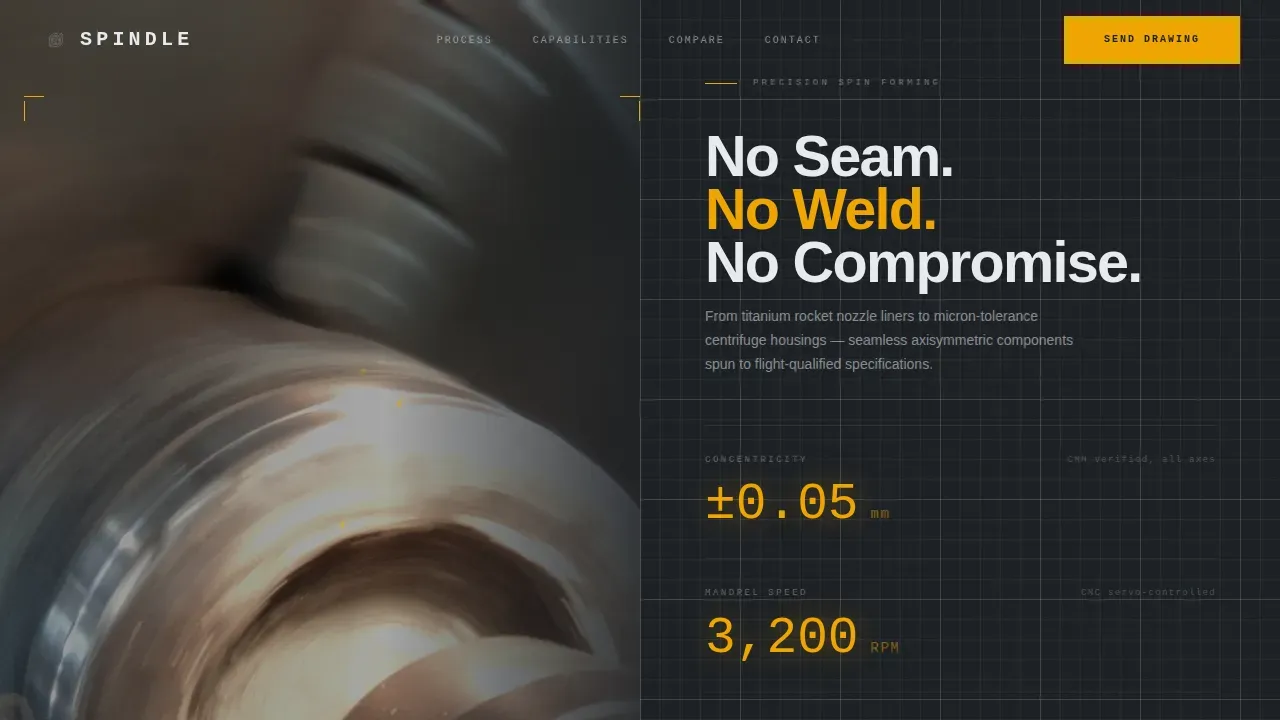
Spindle is a split-screen landing page template built for precision metal spinning service providers targeting aerospace, defense, and medical device industries. It pairs a live-spec metrics wall with a scrolling process timeline, a manufacturing comparison module, and a friction-reduced quote form, all rendered in an engineering blueprint visual style with deep graphite and amber accents.
by Rocket studio
Quick summary
Spindle is a single-page template designed for industrial metal spinning businesses. It converts procurement engineers into quote requests by letting data and process visuals do the selling. A split 50/50 layout, count-up spec numbers, and a sticky process comparison module give technical buyers exactly what they need before they ever reach the form.
Who this template is for
This template is built for precision metal spinning shops that sell to demanding industrial buyers. If your clients read tolerance callouts before headlines, this page speaks their language.
- Aerospace supply chain vendors producing rocket nozzle liners and flight-qualified spun components
- Defense contractors and procurement teams sourcing classified-spec seamless components
- Medical device manufacturers needing micron-tolerance housings from custom metal spinning operations
What problem this template solves
Metal spinning service providers often struggle to communicate technical credibility through generic web templates. Buyers in aerospace and defense need process evidence, not marketing copy. They need to see tolerances tighten and material data stack up before they trust a supplier.
- Procurement engineers cannot assess metal spinning capabilities from a standard portfolio page
- The metal forming process is poorly explained on most supplier sites, creating hesitation and lost leads
- Comparison data between spinning, stamping, and other metal forming methods is almost never presented clearly online
What you get with this template
This template delivers a fully structured, desktop-first landing page built around the technical decision-making flow of industrial buyers. Every section is positioned to reduce friction and build confidence.
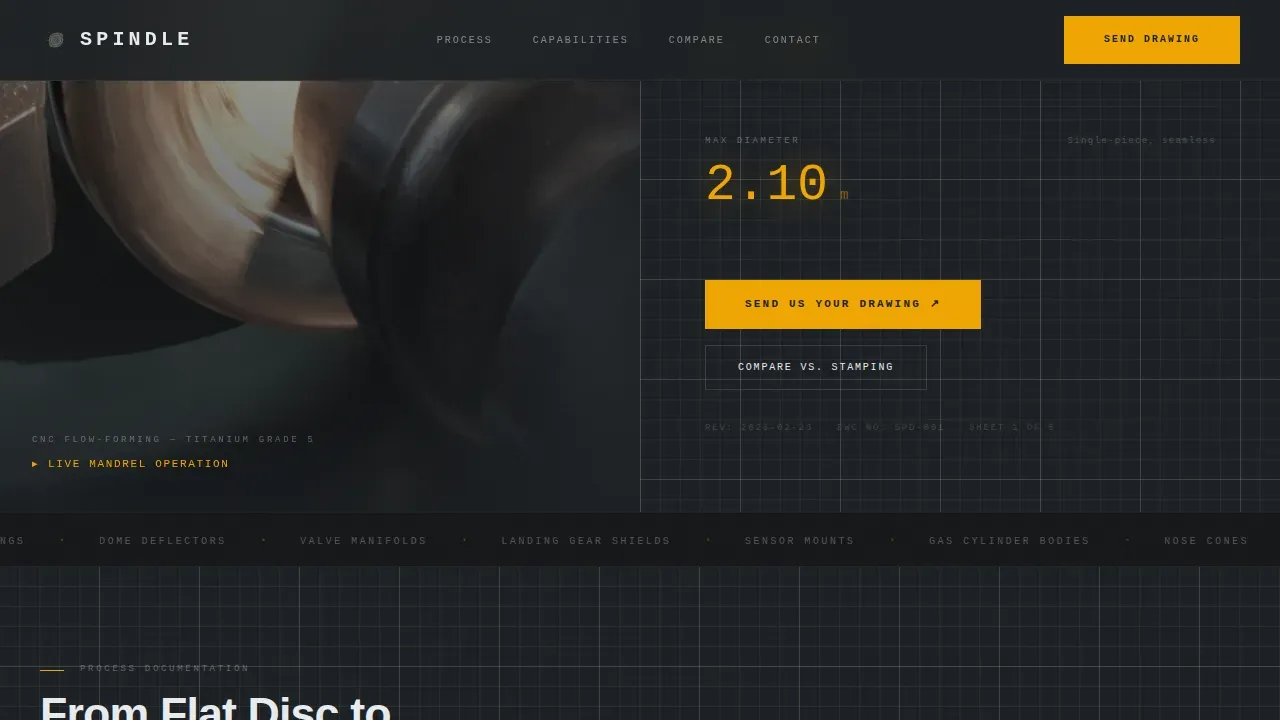
- A split-screen hero with a CNC lathe image panel and an animated spec metrics wall
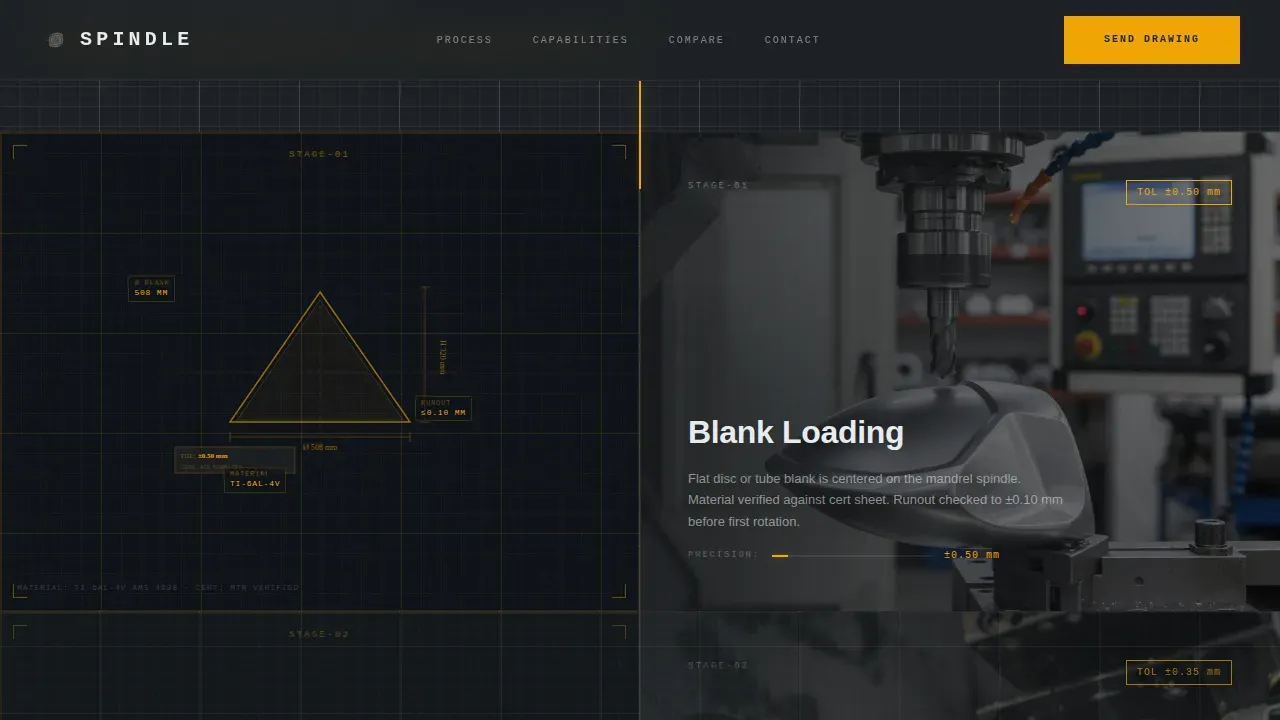
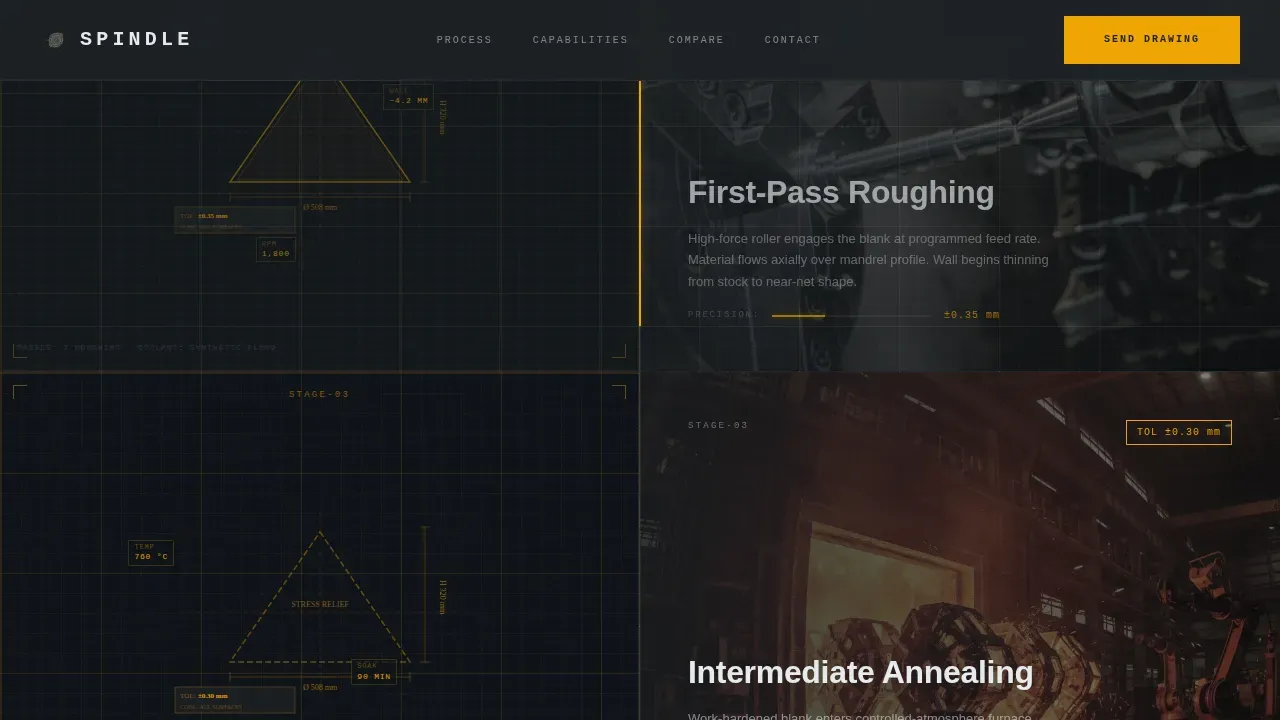
- A scrolling bilateral timeline that walks through each stage of the spinning process with blueprint drawings and shop-floor photography
- A sticky comparison module, a certifications strip, a quote form with file upload, and a minimal developer-style footer
Feature list
This template packages six high-impact components that work together to convert technically minded buyers at every scroll depth.
Animated Spec Metrics Hero
The right panel of the hero displays live-formatted numbers: concentricity, mandrel speed, minimum wall thickness, and maximum diameter. Each figure counts up on page load using a monospaced engineering typeface, amber on graphite, mimicking a digital micrometer settling on a reading. The left panel holds a CNC lathe photograph captured mid-operation.
Scrolling Process Timeline with Progress Bar
Six stages of the metal spinning process unfold as the visitor scrolls: blank loading, first-pass roughing, intermediate annealing, finish pass, coordinate measuring machine (CMM) inspection, and delivery crating. A thin amber spine bar tracks scroll depth. Tolerance values tighten visibly at each stage, so the scroll itself demonstrates increasing precision.
Sticky Process Comparison Module
A persistent toggle lets visitors switch between three head-to-head comparisons: spinning versus stamping, spinning versus hydroforming, and spinning versus machining from billet. Each view renders side-by-side data on material waste, tooling lead time, unit cost at low volume, and achievable wall uniformity. The primary call-to-action sits at the base of this module.
Dual Conversion Paths
The primary form asks for part diameter and material first via two dropdowns, then offers an optional drawing file upload in DXF or STEP format, followed by annual volume and target tolerance fields. A secondary path captures email addresses for engineers still in the research phase through a downloadable spec sheet offer.
Certifications and Trust Strip
A dedicated section displays industry certification badges with annotation-style labels. This positions the supplier's quality credentials visibly near the conversion zone, giving procurement engineers the documented proof of quality they require before initiating contact.
Engineering Blueprint Visual System
Every section uses blueprint-style GD&T (geometric dimensioning and tolerancing) technical drawings on the left panel paired with real shop-floor photographs on the right. Crosshatch grid lines, amber dimension callouts, and a dark graphite-to-charcoal background system create a cohesive engineering aesthetic that reinforces technical authority throughout the scroll.
Page sections overview
| Section | Purpose |
|---|---|
| Split-Screen Hero | Display live spec metrics alongside a lathe-in-action image |
| Process Timeline | Show each spinning stage with paired blueprints and photos |
| Comparison Module | Compare spinning versus. stamping, hydroforming, and billet machining |
| Certifications Strip | Present trust credentials near the conversion zone |
| Quote Request Form | Capture part diameter, material, file upload, and volume data |
| Secondary Email Capture | Convert research-phase engineers via spec sheet download |
| Minimal Footer | Provide navigation and contact details in a clean developer style |
Design & branding system
The visual identity follows an engineering blueprint theme built on a carbon fiber color system. The palette feels precise and purposeful, with every color assigned a strict functional role.
- Deep graphite (#1B1F23) and woven charcoal (#2D3436) cover all background surfaces, with faint crosshatch grid lines evoking engineering paper
- Technical white (#E8ECEF) is reserved for annotation text, grid lines, and body copy to maintain readability against dark backgrounds
- CNC-laser amber (#F0A500) appears only on dimension callouts, hover states, active data points, and the primary call-to-action, so the eye lands exactly where action is needed
Mobile & speed optimization
This template is designed desktop-first, reflecting how aerospace and defense procurement engineers actually work: at a workstation, reviewing drawings on a large screen. Mobile layout is supported as a secondary priority.
- Interactive components including the process timeline, comparison toggle, and count-up animations are built as client-side elements for smooth interactivity
- Static sections such as the certifications strip and footer are structured for efficient server-side rendering to keep the page responsive
- The split-screen layout, sticky comparison module, and file upload form are optimized for desktop viewport widths where engineering buyers spend the most time
How this template helps you convert
This template is structured so that every scroll depth does selling work. By the time a procurement engineer reaches the form, the data has already answered most objections.
- The hero immediately confirms credibility with real machine specs and a live-shot CNC lathe image, so visitors know within seconds they are in the right place
- The timeline turns the metal spinning process into visible proof, with tolerances tightening stage by stage until the completed part is flight-qualified
- The comparison module resolves the stamping-versus-spinning debate with side-by-side numbers, so the form submission feels like a logical next step, not a leap of faith
Other information about this template
This template is grounded in how industrial buyers actually evaluate a metal spinning service. The design and structure reflect documented best practices for manufacturing landing pages targeting high-scrutiny buyers.
- Metal spinning offers a cost effective path to producing rounded metal parts, especially at low-to-mid volume where stamping tooling costs are prohibitive
- The advantages of metal spinning over deep drawing and stamping include lower excess material waste, shorter tooling lead time, and the ability to produce seamless components without a seam or weld
- Steel and aluminum are the two most widely used materials in metal spinning; aluminum is lightweight and corrosion resistant, while stainless steel provides superior strength but demands greater pressure during forming
- Commonly spun metals include aluminum, stainless steel, copper, brass, and titanium, making metal spinning compatible with diverse industries from aerospace to medical
- The metal spinning process typically completes in five to ten minutes per cycle, making it ideal for prototyping and high volume production alike
- Flow forming extends standard metal spinning by applying axial pressure to thin and elongate the wall of a spun part, achieving uniform wall thickness and superior surface finish in a single operation
- A follower block supports the metal blank against the mandrel during flow forming passes, maintaining concentricity as the forming tool works the material
- Grain structure is refined during the spinning process, improving the mechanical properties of the finished piece compared to machined billet alternatives
- The Spindle precision metal spinning services landing page template also supports industry insights content, such as downloadable guides or CAD libraries, that position the supplier as a trusted partner throughout the buyer's research phase
- Deep drawing and flow forming share tooling principles with metal spinning but differ in how pressure is applied and how the final shape is achieved; this template's comparison module can surface those distinctions clearly
- Typical tolerances, maximum diameter, material thicknesses, and in house tooling capabilities should be listed in scannable specification blocks so engineers can vet the supplier without making a phone call
- For prototyping, a short run on the lathe can validate geometry before committing to large scale production tooling, and the form's volume field captures that intent early
- Computer numerical control (CNC) spinning systems automate the application of pressure through programmed spinning tools, enhancing repeatability across high volume production runs
- Wheel rims, heat treating fixtures, and flow-formed pressure vessels are examples of spun components that benefit from the same blueprint-driven design approach featured in this template
- Mild steel is also a viable material for spinning when cost is a priority and corrosion resistant coatings will be applied in post-processing
- Quality control at final inspection, including CMM verification of the completed part, is a stage this template highlights explicitly in the timeline section
- One cycle on a CNC lathe with calibrated spinning tools can produce a finished part ready for assembly, reducing the number of operations needed compared to billet machining
Theme
Engineering Blueprint
Creative direction
Timeline Progression
Color system
Carbon Fiber
Direction
Comparison/Versus
Page Sections
Count-up Spec Metrics Wall
Scrolling Six-stage Process Timeline
Sticky Manufacturing Comparison Toggle
Low-friction Quote Request Form
Certifications and Trust Strip
Dual Conversion Path Architecture
Related questions
What industries is this template suited for?
Can the comparison module show custom data for my shop?
What file types does the quote form accept?
How does the process timeline demonstrate precision?
What certification badges does the template support?