Immersive Advertising Agency Landing Page Template
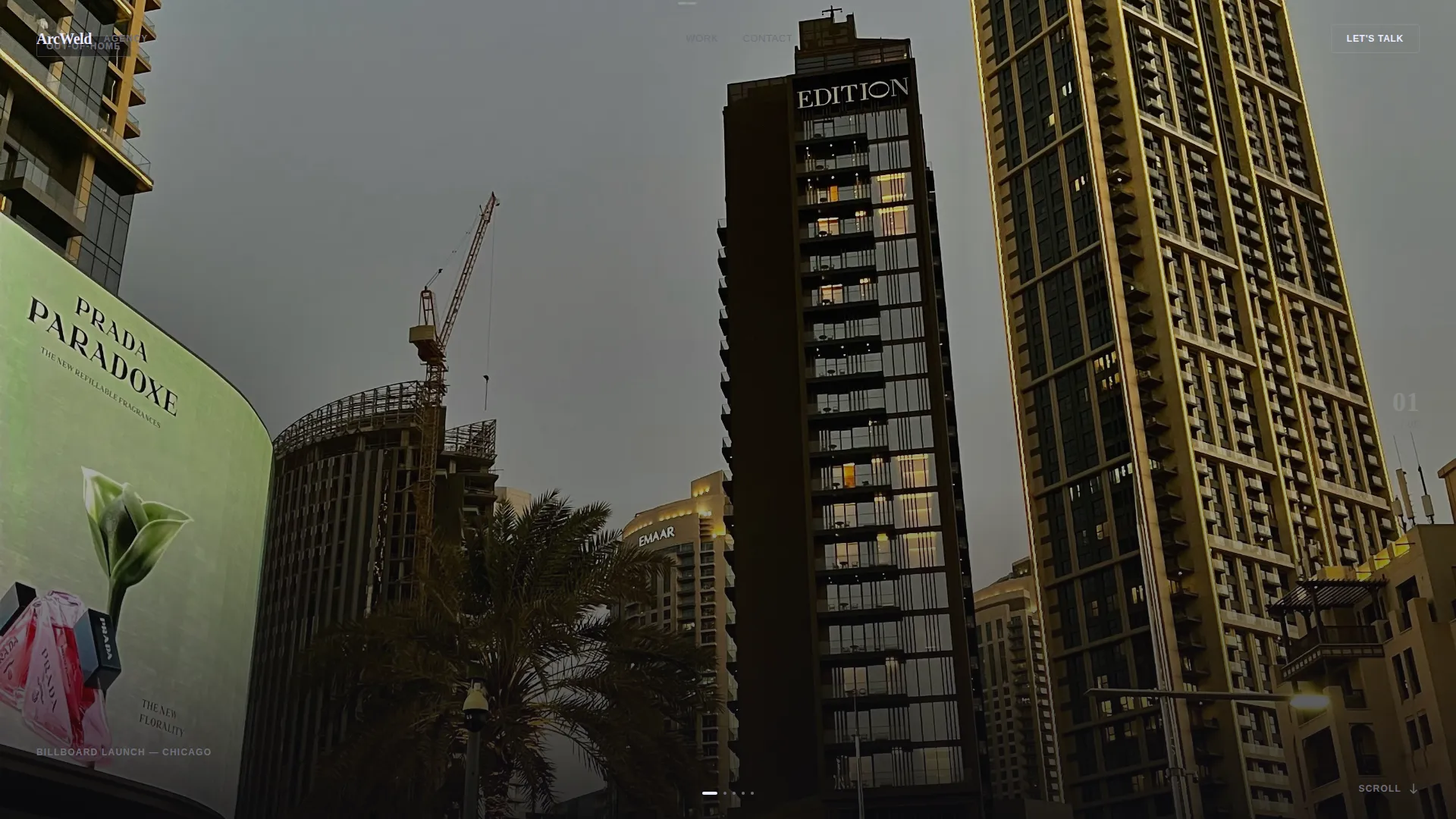
Arcweld is a dark, immersive advertising agency landing page built around a scroll-jacked header, a masonry campaign grid, and two high-intent calls to action. It is designed for agencies that pitch bold creative work to CMOs, marketing vice presidents, and brand leaders. The template uses a Monochrome Steel palette and a deliberate, cinematic visual flow to turn first impressions into partnership conversations.
by Rocket studio
Quick summary
Arcweld is a single-page advertising agency landing page built for creative teams that pitch hard and win bigger. It opens with a scroll-controlled cinematic sequence, flows into a progressive masonry campaign grid, and closes with a focused partnership form. The entire design runs on a Monochrome Steel color system that makes every element feel intentional and every click feel earned.
Who this template is for
This template is built for advertising agencies that work with serious marketing buyers. It speaks directly to shops that handle brand strategy, paid media, and campaign production at a level that justifies a pitch-room presentation.
- Advertising agencies pitching CMOs at mid-market direct-to-consumer brands
- Creative teams approaching Series B startup marketing leads who have outgrown patchwork freelancer setups
- Agency business development teams targeting legacy consumer brands ready for a creative reset
What problem this template solves
Most agency websites feel like brochures. They list services, show a logo grid, and ask visitors to get in touch. That passive approach loses high-value buyers fast. Arcweld solves the credibility and attention problem by making the page itself feel like the pitch.
- Prospects leave before they feel the agency's real creative weight
- Generic layouts fail to signal that the agency selects its clients, not just accepts them
- Static portfolio pages do not build the cumulative, walk-through-a-trophy-corridor effect that earns trust from senior buyers
What you get with this template
You get a fully designed, single-page advertising agency landing page that is ready to be customized with your own campaign imagery, metrics, and client names. Every section is built to deliver a specific job in the buyer journey.
- A scroll-jacked header that locks the viewport and plays a campaign montage one scroll tick at a time
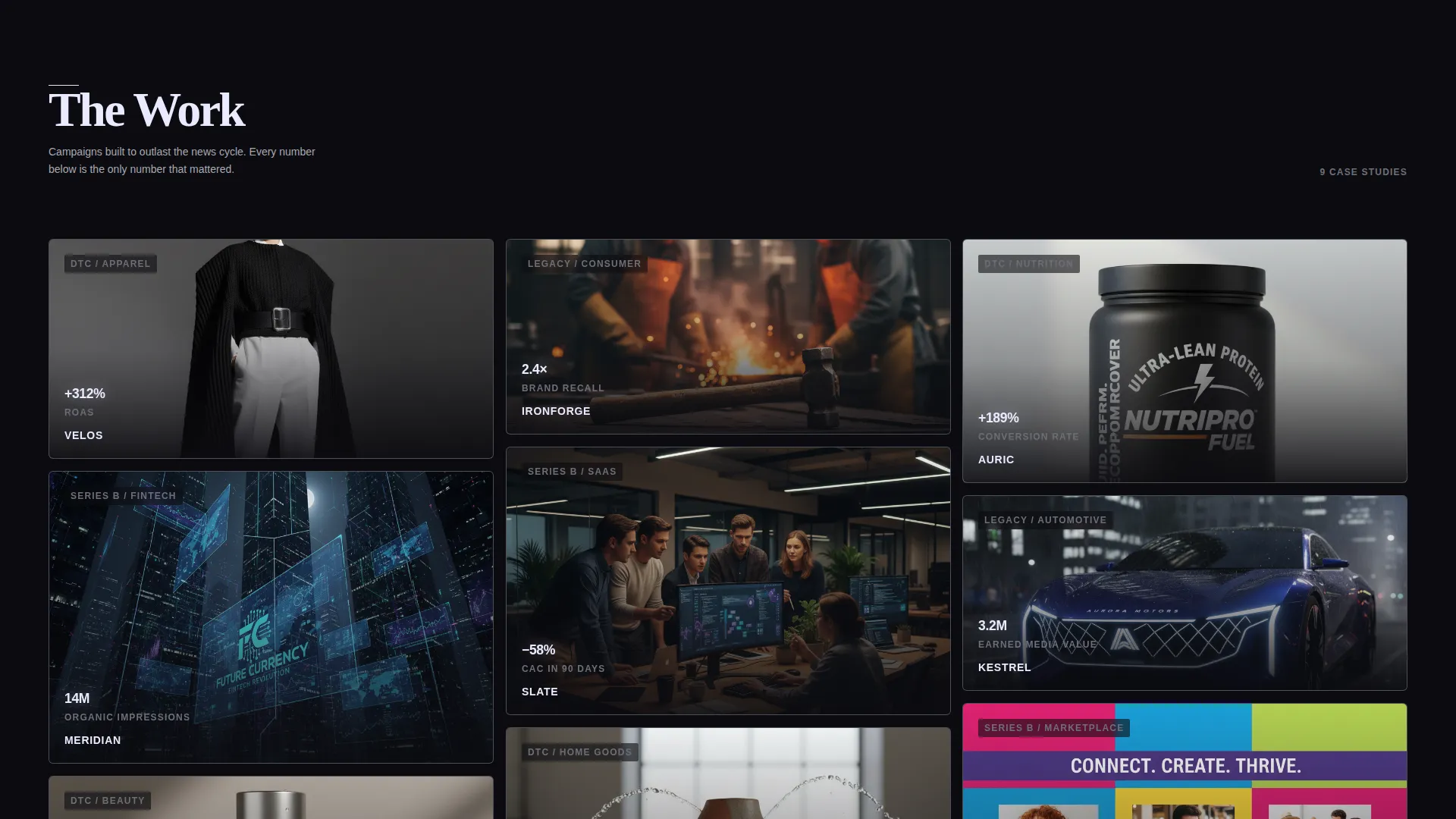
- A progressive masonry grid where each card shows a campaign image, a client logo, and a single bold metric in arc-weld white
- Two primary calls to action plus a secondary email-gated case study path built into every masonry card
Feature list
This template ships with a set of deliberate, purpose-built components. Each one is designed to move a senior marketing buyer from curious to committed.
Scroll-Jacked Cinematic Header
The viewport locks on load and the visitor's scroll wheel becomes a playback controller. Each scroll tick advances one beat through a rapid-cut campaign montage: a billboard going up in time-lapse, a social post's engagement counter spinning, a television spot's final frame, and a product flying off a shelf in slow motion. The sequence ends with five words at full viewport scale: "We make people pay attention." Then the scroll releases and the page begins.
Progressive Masonry Campaign Grid
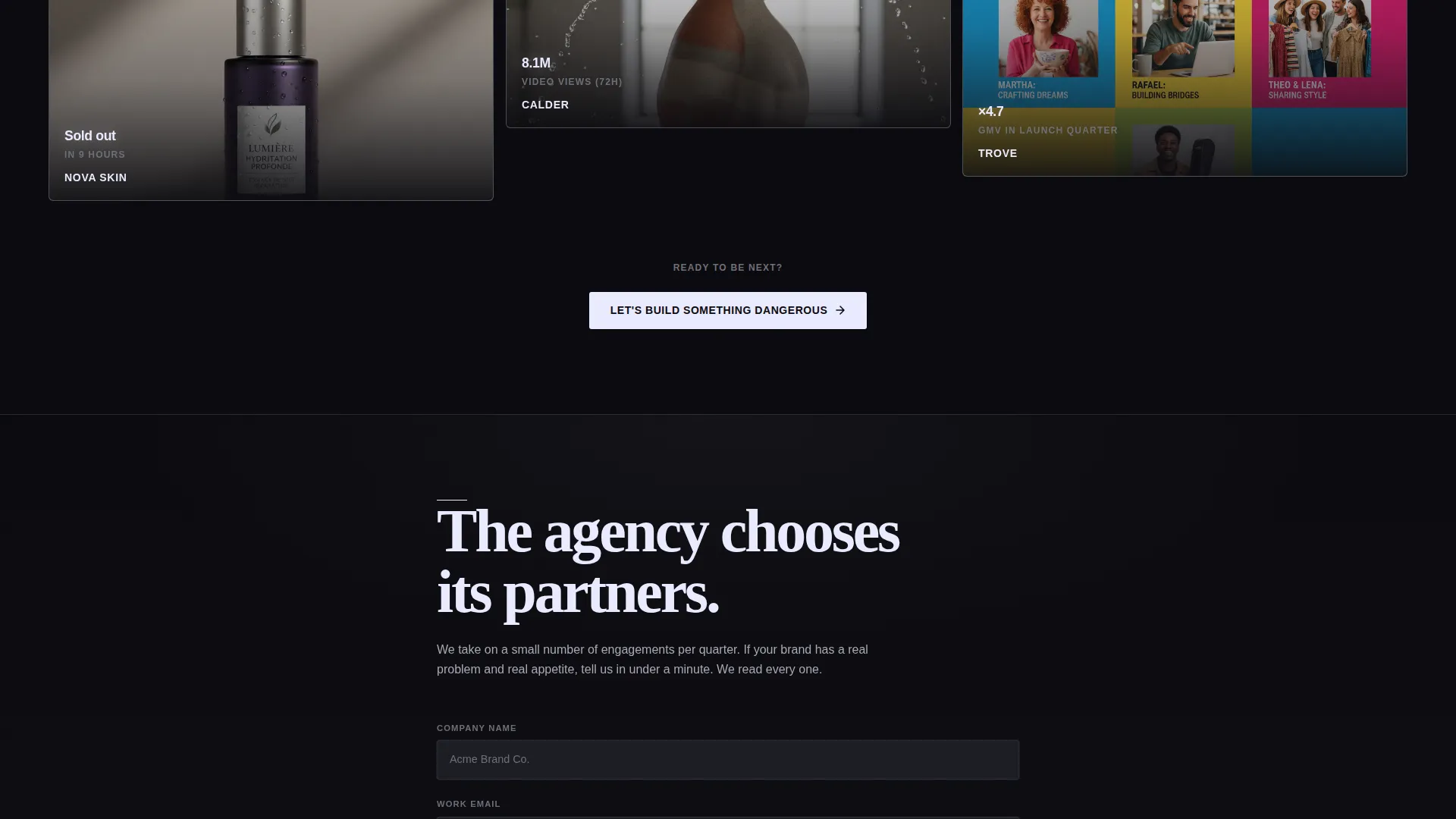
Cards load and stack in a staggered masonry layout at varied heights, creating visual rhythm that rewards exploration over linear reading. Each card carries a single arresting campaign image, a client logo, and one lone metric rendered in arc-weld white. The layout is designed to feel less like a portfolio and more like a walk through a hall of results.
Credibility Side-Rail with Client Name Crawl
As the visitor scrolls deeper into the grid, a persistent side-rail appears with a vertical text crawl of client names. The names grow more recognizable with each row, building authority through accumulation rather than declaration. The effect turns passive scrolling into an active sense of discovery.
Darkening Grid Atmosphere
The masonry grid subtly darkens as the visitor scrolls down. This progressive depth effect keeps visual tension high and signals that the further you go, the more there is to find. It prevents the page from feeling flat or static at any scroll position.
Dual-Placement Primary Call to Action
The primary call to action, "Let's Build Something Dangerous," appears twice: once floating after the scroll-jacked header sequence completes, and once anchoring the bottom of the masonry grid. Both placements use arc-weld white to train the eye that brightness means action.
Minimal Dark-Mode Partnership Form
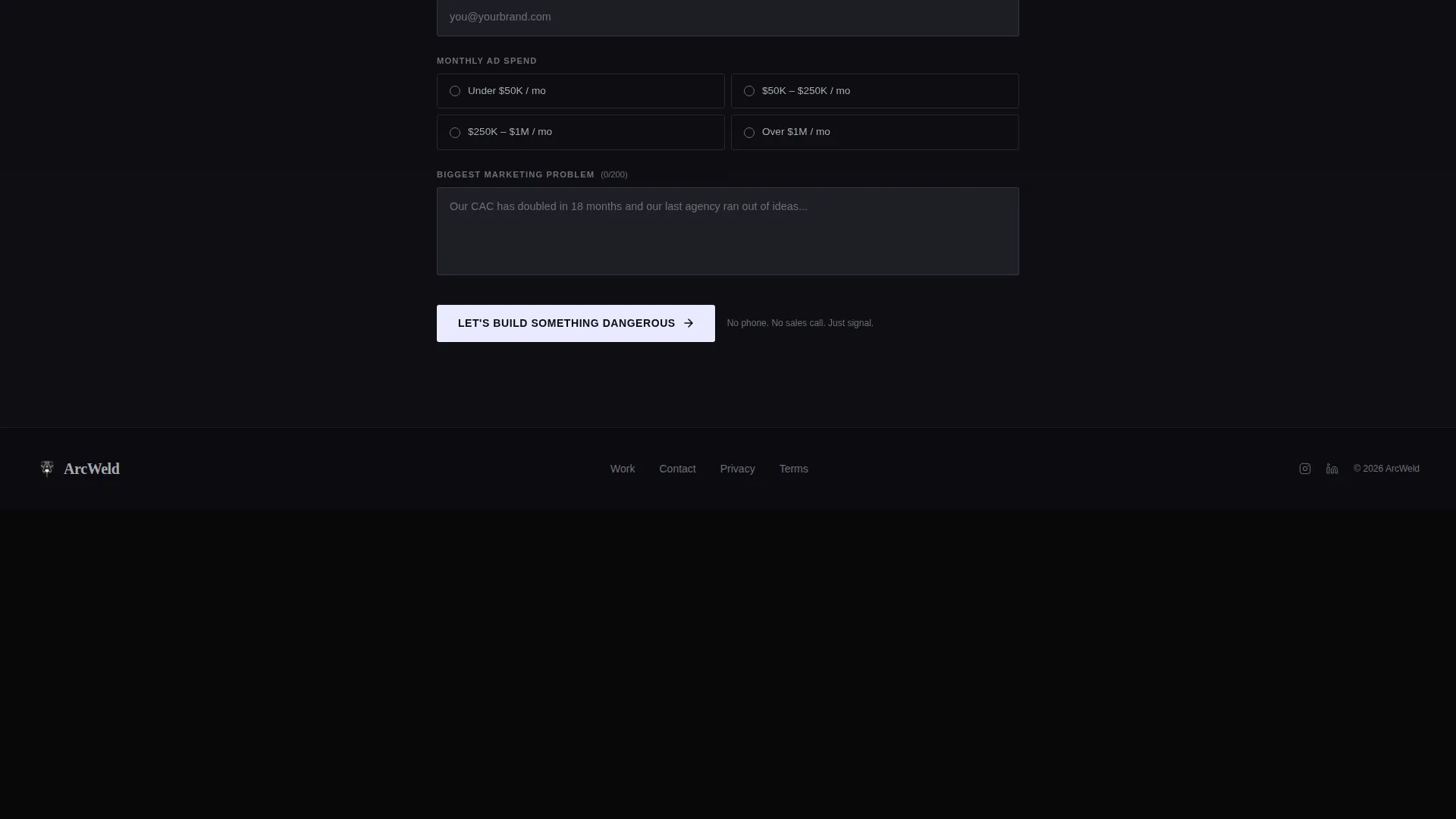
Clicking the primary call to action opens a focused, dark-mode form. Fields include company name, monthly ad spend range via four radio buttons, a single open-field marketing problem prompt with a 200-character cap, and a work email field. There is no phone field. The intentionally low friction and selective tone signal that the agency chooses its partners.
Page sections overview
| Section | Purpose |
|---|---|
| Scroll-Jacked Header | Opens the experience with a scroll-controlled campaign montage that ends with the agency's five-word position statement |
| Floating Primary call to action | Appears immediately after the header sequence and invites high-intent visitors to start a partnership conversation |
| Masonry Campaign Grid | Displays case study cards with campaign images, client logos, and single bold metrics in a staggered, progressive layout |
| Client Name Side-Rail | Runs a vertical crawl of client names alongside the grid to build credibility through accumulation |
| Grid-Anchored call to action | Closes the masonry section with a second placement of the primary call to action |
| Partnership Form | A minimal dark-mode form that captures company name, ad spend range, core marketing problem, and work email |
Design & branding system
The entire template runs on a Monochrome Steel color system. There is no warmth in the palette. Every surface is milled to tolerance and every color assignment has a clear job.
- Forge black (#0B0B0F) for all backgrounds, cold-rolled silver (#A8A9B4) for body text, and brushed gunmetal (#3A3A44) for card surfaces that lift slightly off the background
- Arc-weld white (#EAEAFF) reserved exclusively for calls to action, hover states, and campaign metrics, training the eye to associate brightness with something clickable or significant
- The overall visual identity follows a Dark Immersive theme with an Immersive Visual creative direction, giving the page the low-light, high-stakes atmosphere of a pitch room where the deck is already on screen
Mobile & speed optimization
The template is built with mobile display in mind. The scroll-jacked header and masonry grid are designed to translate the core visual experience across screen sizes without losing the cinematic atmosphere.
- The masonry grid reflows for smaller viewports, preserving staggered card heights and bold metric callouts at every breakpoint
- The partnership form is structured with large tap targets and minimal input fields, keeping the conversion path clean on mobile devices
How this template helps you convert
The conversion architecture in Arcweld is deliberate. Every element from the first scroll tick to the final form field is designed to qualify interest and lower resistance at the right moment.
- The scroll-jacked header forces full attention before any offer is made, so by the time the first call to action appears, the visitor's posture has already changed and curiosity is high.
- The masonry grid's "See the Full Case Study" path on each card gates the deep-dive content behind email capture, letting the visitor's own curiosity do the qualifying work instead of a hard sales prompt.
Other information about this template
Arcweld is a strong fit for creative agency business development teams that want their website to function the way their best campaigns do: with intention, layered impact, and a clear point of view on who the work is for.
- The template style is Masonry and Pinterest-inspired, making it well suited for visually driven agencies whose work is best understood through imagery rather than text-heavy case studies
- The landing page direction is Partnership and business-to-business focused, so the form and calls to action are calibrated for senior buyer conversations rather than consumer signups
- The selective, low-friction form design signals agency positioning: the right client fits the criteria, the wrong client self-selects out before the first conversation
Theme
Dark Immersive
Creative direction
Immersive Visual
Color system
Monochrome Steel
Style
Masonry/Pinterest
Direction
Partnership/B2B
Page Sections
Scroll-jacked Cinematic Header
Progressive Masonry Campaign Grid
Credibility Client Name Side-rail
Dual-placement Primary Call to Action
Minimal Dark-mode Partnership Form
Email-gated Case Study Path
Related questions
Who is this landing page template designed for?
Can I use my own campaign images and client metrics?
How does the scroll-jacked header work in practice?
What information does the partnership form collect?
Is this template suitable for a small boutique agency?