Escalator Technician Landing Page Template
Ascend is an editorial-style landing page template built for licensed escalator technician businesses. It uses a case study narrative structure, an Ink & Paper color system, and a lead generation layout to help facility managers, property directors, and transit procurement officers find and trust a qualified escalator maintenance provider, then request a site assessment with minimal friction.
by Rocket studio
Quick summary
Ascend is a single-page, editorial-style template for escalator technician businesses. It leads with a giant serif headline and documentary photography, then guides visitors through three escalating customer case studies. Amber callouts highlight key data points, and two conversion paths, a site assessment form and a downloadable audit checklist, capture leads at different stages of buyer readiness.
Who this template is for
This template is built for licensed escalator service companies that work across commercial and public infrastructure. It speaks directly to the buyers those companies need to reach: facility operations professionals, not consumers.
- Facility managers handling tenant complaints about stalled escalator units in malls, airports, or hospitals
- Property directors budgeting annual maintenance contracts for aging multi-unit escalator systems
- Transit authority procurement officers who require compliance documentation before approving a vendor
What problem this template solves
Most escalator service providers look identical online. A bland service page gives procurement officers no reason to choose one company over another. This template solves that trust gap with proof-first storytelling.
- Buyers arrive with skepticism and leave with confidence, because every claim is backed by a structured case study
- Procurement-stage visitors who are not ready for a phone call still have a low-friction conversion path through the audit checklist download
What you get with this template
You get a fully structured editorial landing page designed around real buyer psychology in the facilities and transit sector. The layout, copy structure, and conversion components are all included and ready to customize.
- A three-story case study narrative section that escalates from a single mall unit repair to a full transit system maintenance contract
- Two conversion paths: a site assessment request form and a gated PDF checklist download
- Sticky amber call-to-action button, amber data callouts, pull quotes, and a full-width lead form at the page base
Feature list
This section outlines the core template components included in Ascend, grounded in the source brief.
Giant Headline Left Header
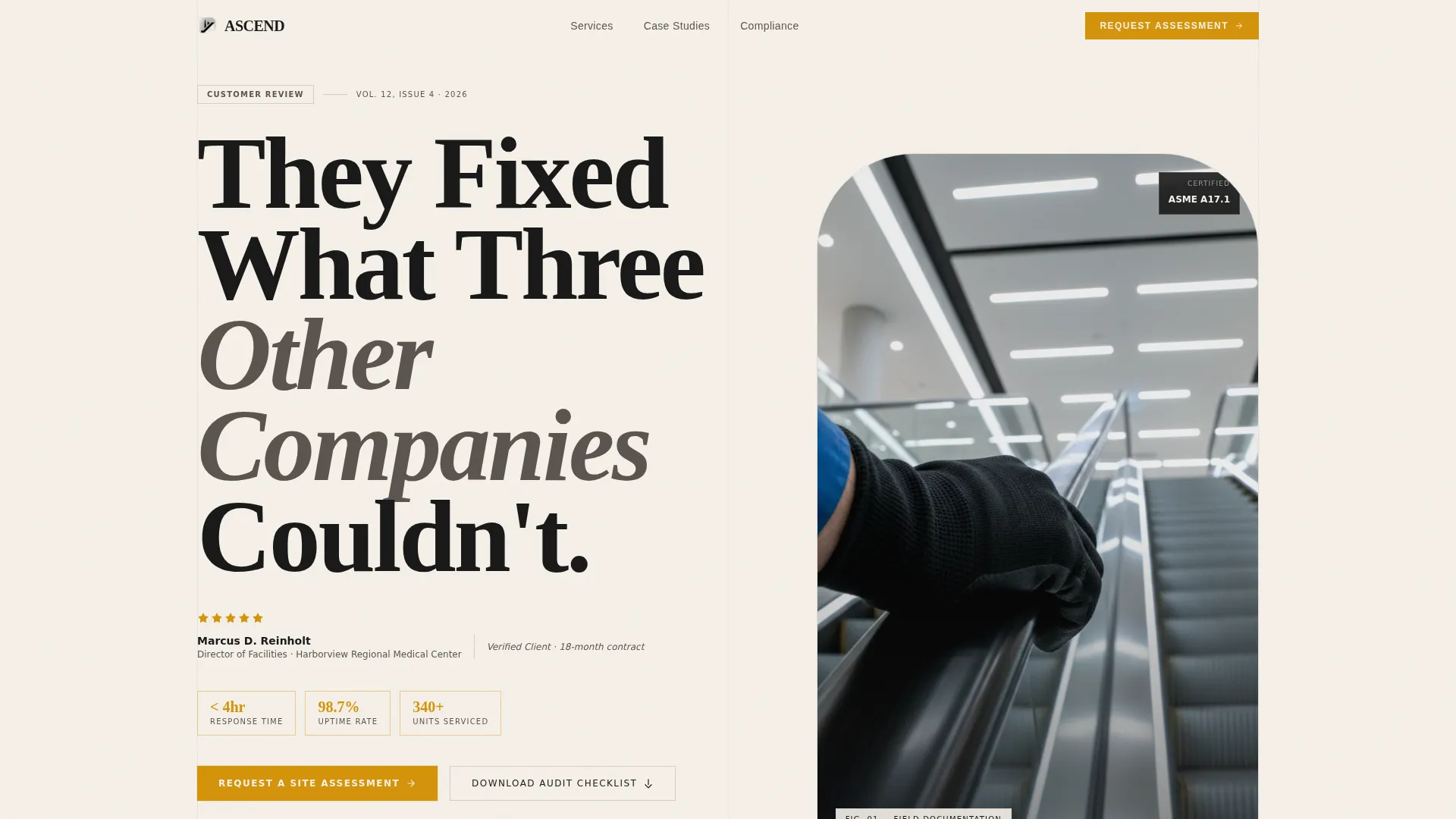
The header opens with a massive black serif headline set flush-left, filling roughly sixty percent of the viewport height. A five-star rating cluster, reviewer name, title, and facility appear beneath it in a quieter sans-serif. The right side holds a single high-contrast documentary photograph: a technician's gloved hand on a stainless-steel handrail, shot from below with fluorescent light streaking the metal.
Three-Story Case Study Narrative
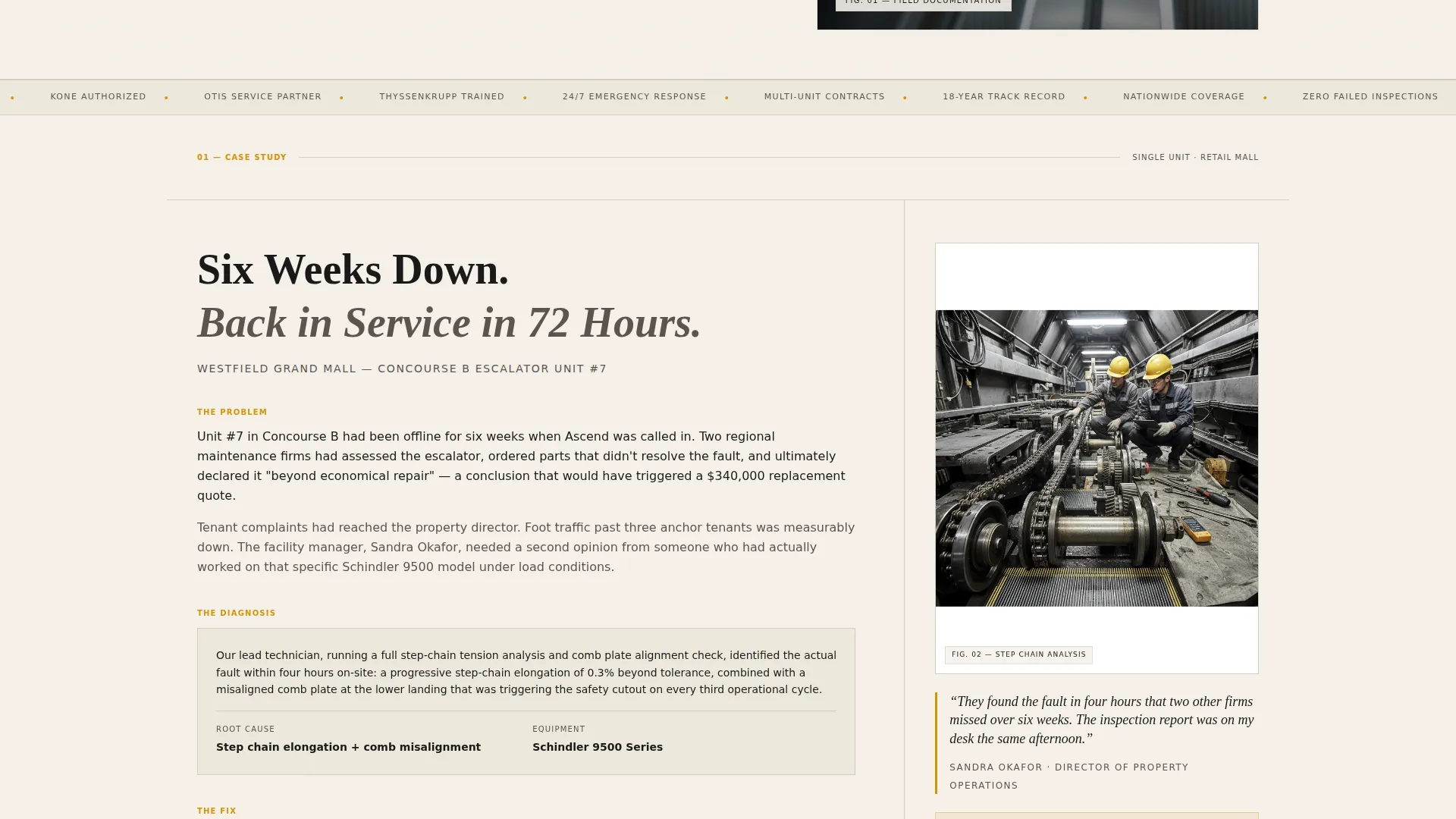
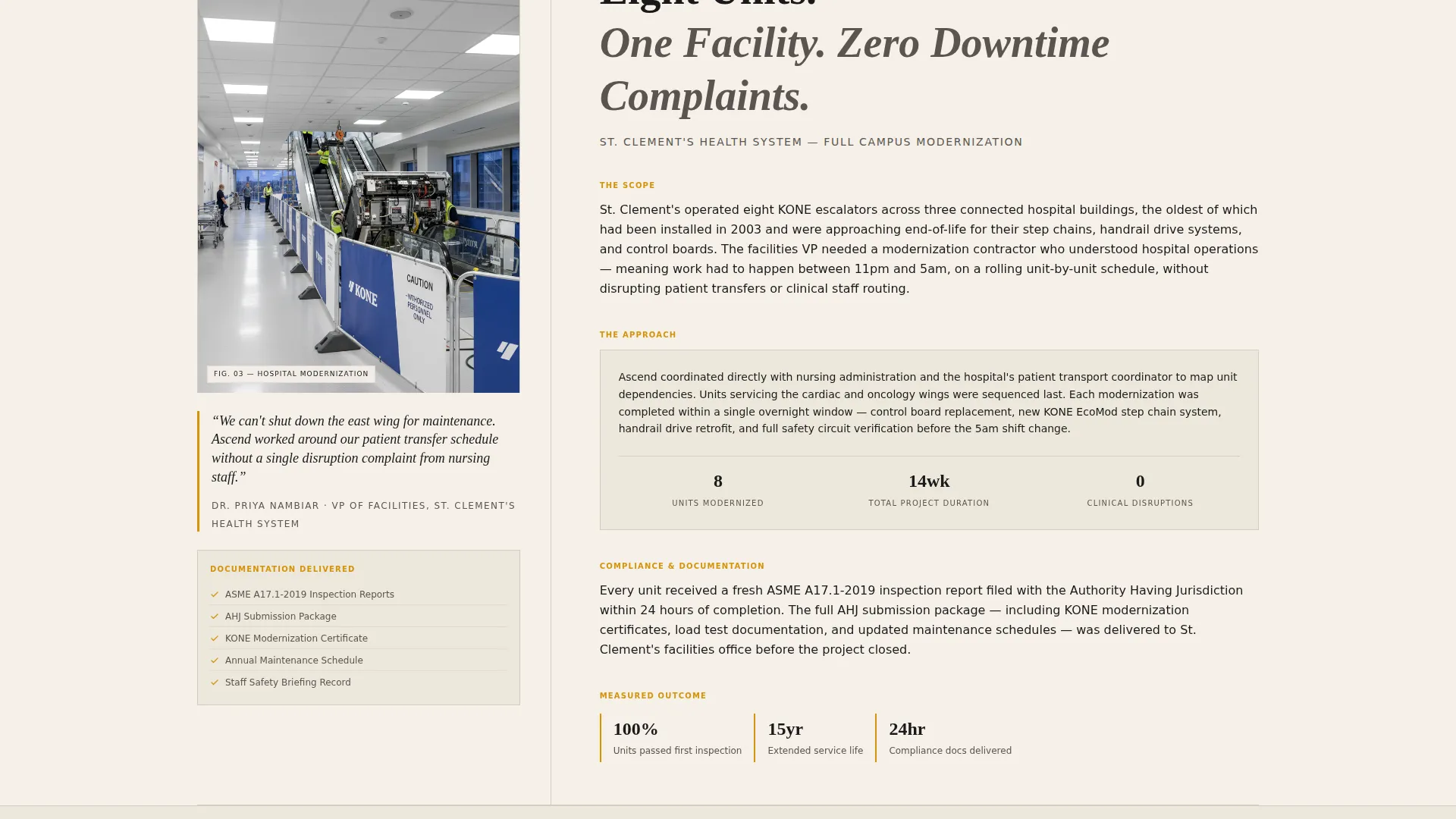
Three long-form customer stories are structured like magazine features. Each covers the problem, the diagnosis, the fix, and a measurable outcome. The stories escalate in scope: a single-unit mall repair, a multi-unit hospital modernization, and a full transit system maintenance contract. This progression signals growing capability with each scroll.
Amber Data Callouts
Small inline callout badges in service-alert amber are embedded throughout the case studies. They surface key figures such as response times, units serviced, and years of compliance history. These callouts function like highlighted line items on an invoice, drawing the eye without interrupting reading flow.
Pull Quote Sections
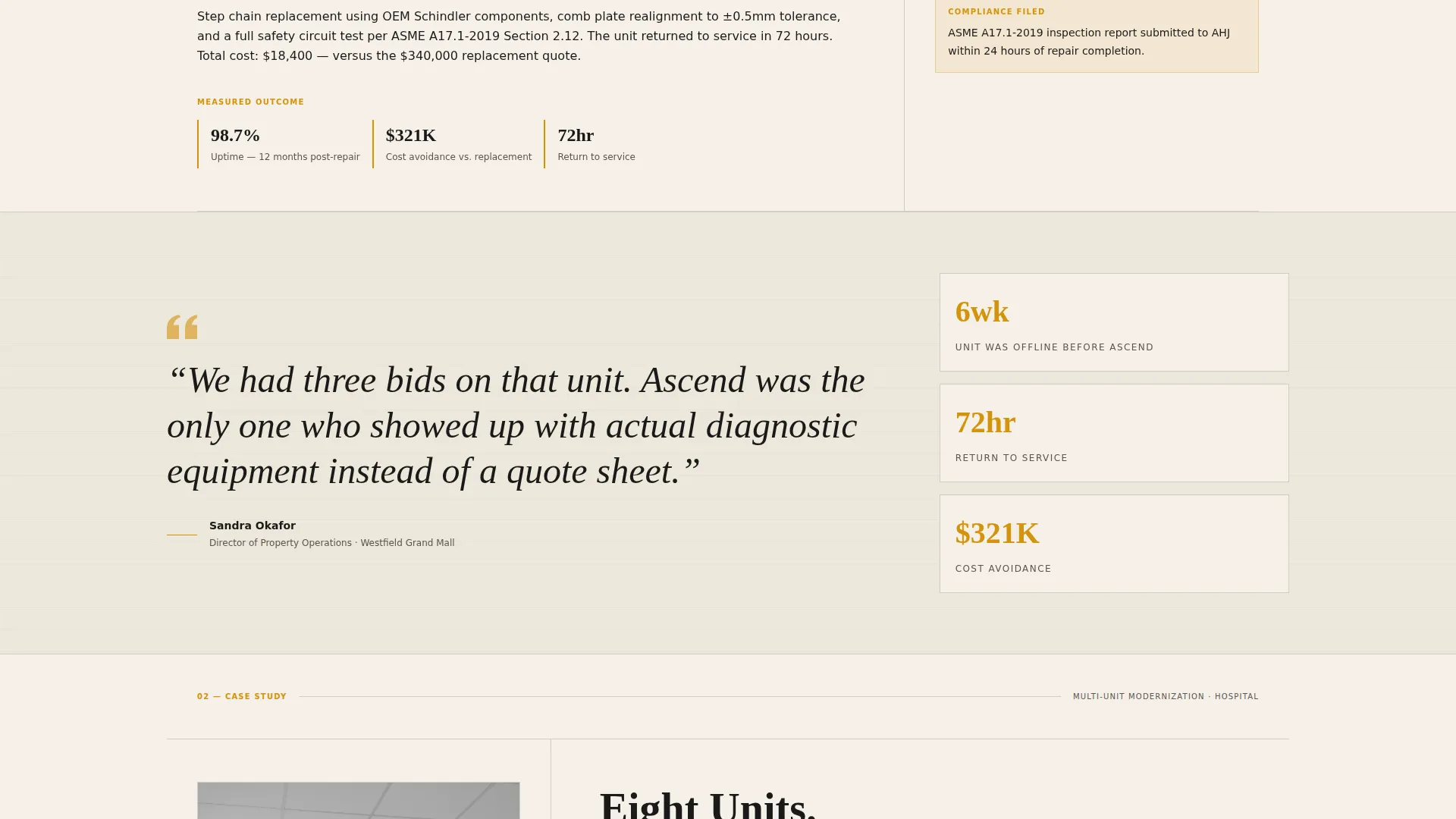
Between case studies, oversized italic pull quotes from facility managers are set against full-cream backgrounds. These sections serve as visual breathing room, reinforcing trust signals without requiring the visitor to read dense copy.
Dual Conversion Paths
The primary conversion path is a "Request a Site Assessment" form. It collects facility type via dropdown, number of escalator units, equipment manufacturer if known, and a brief description of the issue. Only a name and email are required upfront. A secondary path offers a downloadable "Escalator Maintenance Audit Checklist" gated behind email capture, designed for researchers who are not yet at the budget-approval stage.
Sticky Call-to-Action Button
After the second case study, a sticky amber button labeled "Request a Site Assessment" appears and remains accessible as the visitor continues scrolling. This keeps the primary conversion action visible without forcing it too early in the narrative.
Page sections overview
| Section | Purpose |
|---|---|
| Giant Headline Header | Opens with bold serif headline, five-star review credit, and documentary photograph |
| Case Study One | Single-unit mall repair story with problem, diagnosis, fix, and outcome |
| Pull Quote Block | Oversized facility manager quote as visual breathing room |
| Case Study Two | Multi-unit hospital modernization story with escalating complexity |
| Sticky call to action Button | Persistent site assessment prompt activated after second case study |
| Pull Quote Block | Second quote section reinforcing trust between narratives |
| Amber Data Callouts | Inline stat badges surfacing response times, units, and compliance history |
| Case Study Three | Full transit system maintenance contract story at highest stakes |
| Checklist Download | Gated PDF lead magnet for early-stage researchers |
| Full-Width Lead Form | Base-of-page site assessment form with facility type and equipment fields |
Design & branding system
The Ink & Paper color system creates the visual feel of a freshly printed trade journal. Every element earns its place on the page, and nothing decorative distracts from the content.
- Deep document black (#1A1A1A) carries all body text, headlines, and pull quotes; warm newsprint cream (#F5F0E8) dominates the background like uncoated stock
- Ruled-line gray (#D1CCC3) structures dividers and secondary information, while service-alert amber (#D4930D) is used sparingly for star ratings, callout badges, and call-to-action buttons
- Typography pairs a large-scale black serif for headlines and pull quotes with a clean sans-serif for supporting copy, reviewer credits, and form labels
Mobile & speed optimization
The editorial layout is designed to translate cleanly from desktop to smaller screens without losing its authoritative feel. Large type and high-contrast color ratios remain legible on mobile without requiring zooming.
- The sticky call-to-action button and the base lead form are both accessible on mobile, keeping both conversion paths reachable at any scroll depth
- The documentary photograph and amber callout badges are sized and positioned to remain impactful on narrower viewports without crowding the case study text
How this template helps you convert
The page is built around a deliberate progression from credibility to action. Visitors do not encounter a form before they have read enough to trust the service.
- The case study narrative builds trust incrementally across three stories, so procurement officers arrive at the conversion point already convinced rather than skeptical.
- Two distinct conversion paths serve different buyer stages: the site assessment form captures ready buyers, while the gated checklist captures researchers who need more time before committing.
Other information about this template
Ascend is suited for escalator service businesses that work with equipment from major manufacturers, including Schindler and KONE systems, which are explicitly mentioned as part of the target client context. The template is also designed with compliance-conscious buyers in mind. The brief references ASME A17.1, the American Society of Mechanical Engineers safety code for elevators and escalators, as a key credential that procurement officers expect a vendor to have documented.
- The case study structure can support real testimonials and real outcome data, making the page more persuasive as the business accumulates service history
- The "Escalator Maintenance Audit Checklist" lead magnet is especially well suited for buyers doing early-stage vendor research before budget approval
- The editorial and magazine-style visual direction sets this template apart from generic service-page templates in the facilities and trades category
Theme
Service Utility
Creative direction
Case Study Narrative
Color system
Ink & Paper
Style
Editorial/Magazine
Direction
Lead Generation
Page Sections
Giant Headline Left Header with Review Credit
Three Escalating Case Study Sections
Amber Data Callout Badges
Dual-path Lead Generation System
Sticky Site Assessment Call to Action Button
Pull Quote Visual Breaks
Related questions
Who is this landing page template designed for?
Can I customize the case studies to match my actual service history?
Does the lead form require visitors to provide a phone number?
What is the Escalator Maintenance Audit Checklist lead magnet?
Is this template a good fit if I service escalators across multiple facility types?