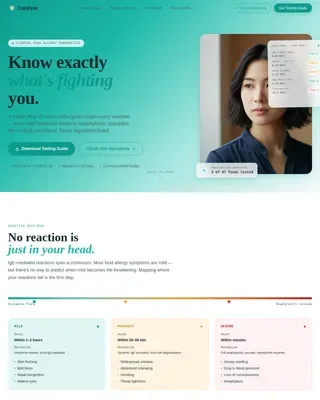
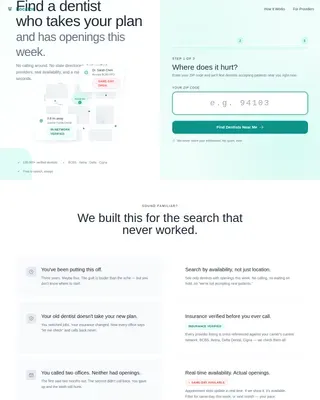
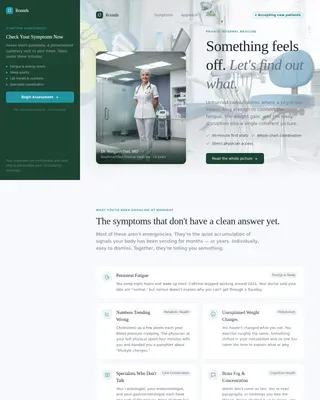
Advanced Allergy Testing Landing Page Template
The Assay precision drug allergy challenge booking landing page template is built for supervised allergy challenge clinics. It guides pre-surgical candidates, oncology patients, and parents through a transparent clinical pathway, then converts them with a dual-path booking form. One clean, single-column page earns trust and fills appointment slots.
by Rocket studio
Quick summary
This template gives a drug allergy challenge clinic a confident, clinical landing page that walks every visitor through the exact procedure they can expect. The page converts hesitant patients into booked appointments by making the allergy test process fully transparent, step by step, section by section.
Who this template is for
This template is designed for allergy clinic operators, immunology practices, and board-certified allergists who offer supervised drug allergy challenge services. It speaks directly to patients who carry outdated or unverified allergy labels and need a clear path to answers.
- Pre-surgical patients whose charts show a childhood drug allergy label that has never been re-evaluated
- Oncology patients and parents seeking to confirm or clear a suspected allergic reaction to a specific medication
- Referring physicians who want a professional page to send patients to before a formal referral
What problem this template solves
Patients avoid critical medicines for decades based on a single allergic reaction they may not even remember clearly. Over 90% of labeled penicillin allergies are not true allergies, yet those labels follow patients into surgery, cancer treatment, and everyday care. This page removes the confusion and presents a credible, safe path forward.
- Visitors arrive with fear and uncertainty about allergy test risks and what the procedure involves
- No existing page clearly maps the clinical pathway from intake to results in one scroll
- Hesitant patients abandon booking forms when the process feels opaque or the stakes feel too high
What you get with this template
You get a single-column flow landing page built around radical clinical transparency. Every section answers a silent patient objection before it forms, moving the visitor steadily from doubt to a confirmed appointment.
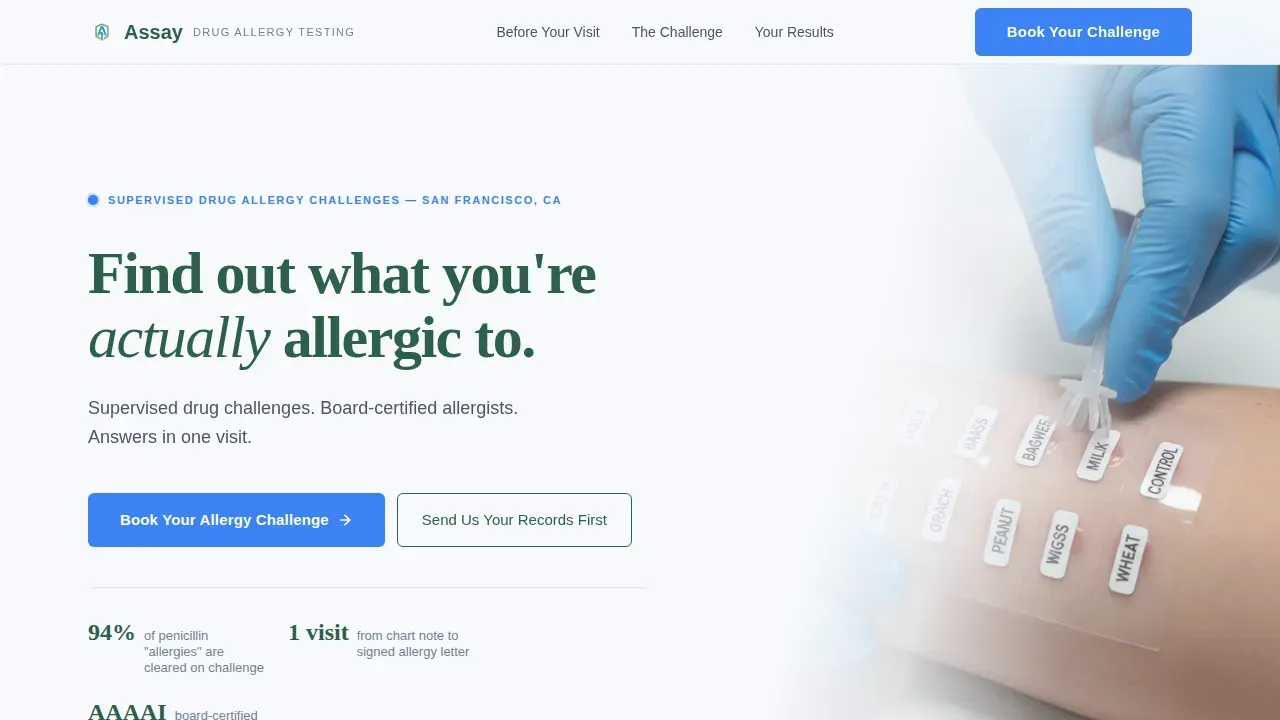
- A half-page hero with a left-weighted headline and space for a documentary-style clinical photograph
- Three sequential clinical pathway sections covering what happens before, during, and after the allergy challenge
- A dual-path booking form that lets patients either book directly or send records first
Feature list
This template includes purpose-built components for a supervised drug allergy challenge clinic. Each block is designed to inform, reassure, and convert.
Half-Page Hero with Clinical Photograph
The hero section pairs a bold alpine pine headline with a right-aligned clinical photograph placeholder. The composition is left-weighted, giving the headline room to command attention. A pulse-oximeter blue call-to-action button beneath the subline invites visitors to book their allergy challenge immediately.
Transparent Clinical Pathway Sections
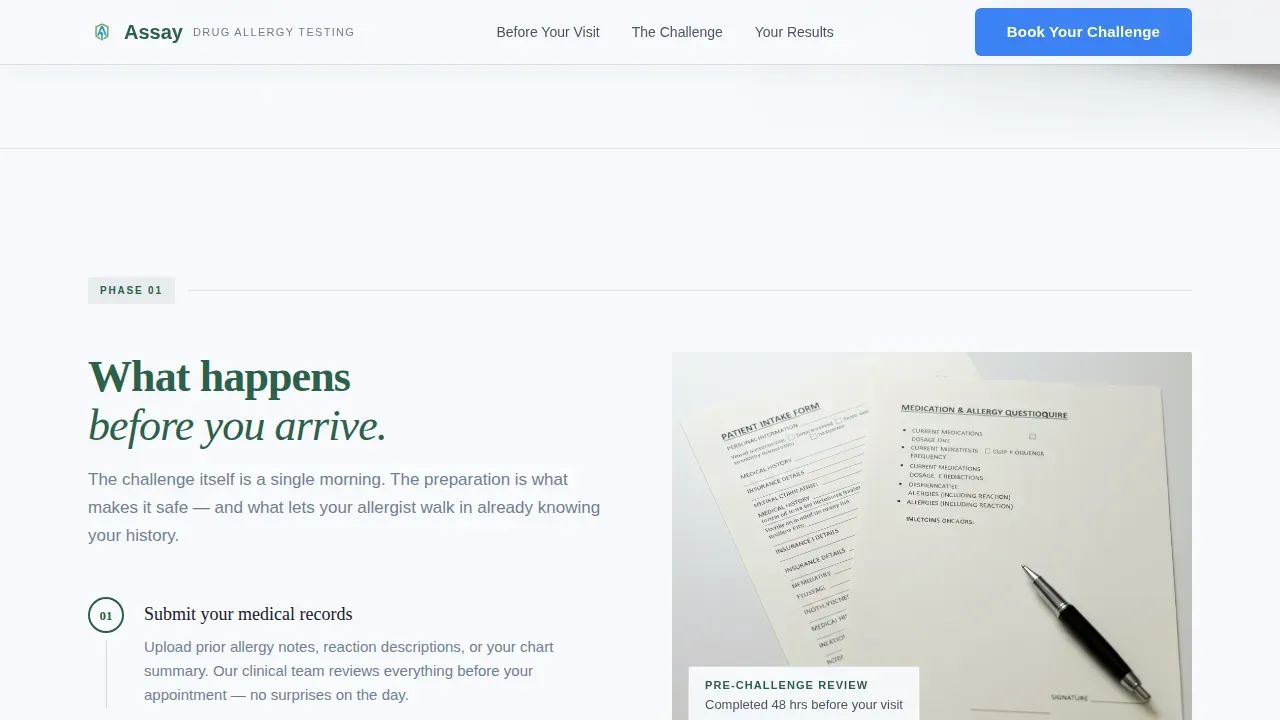
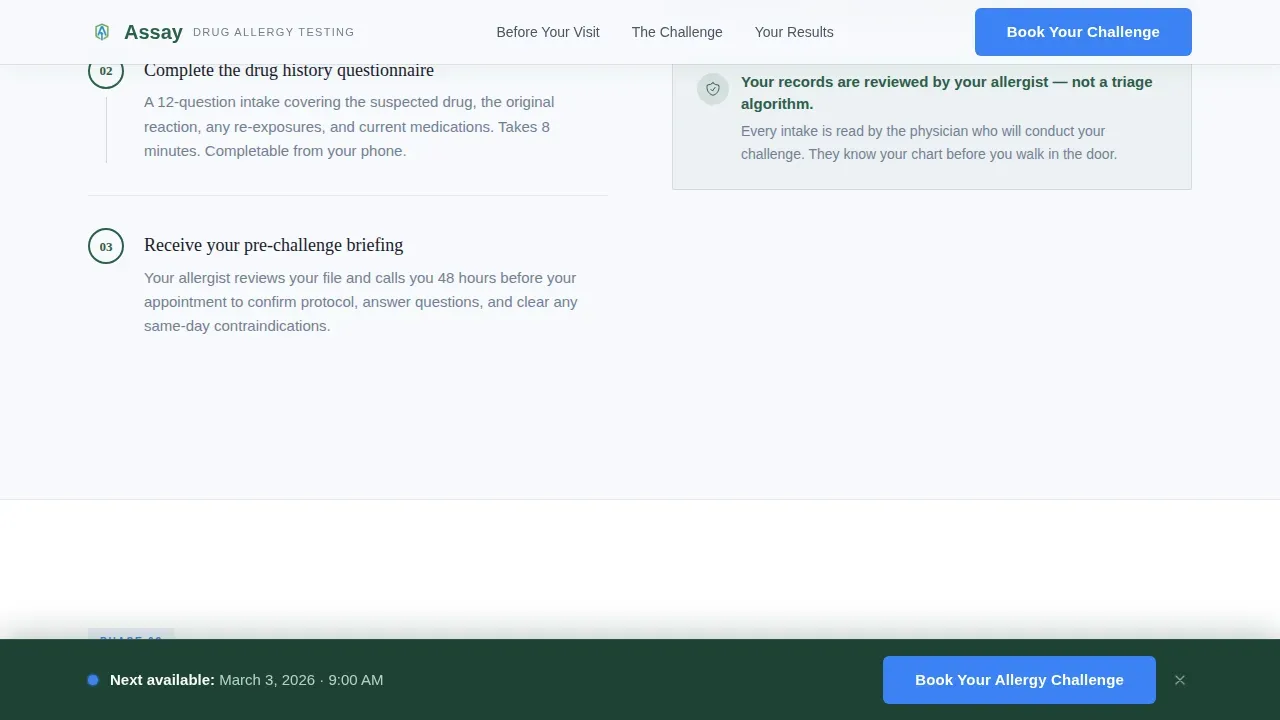
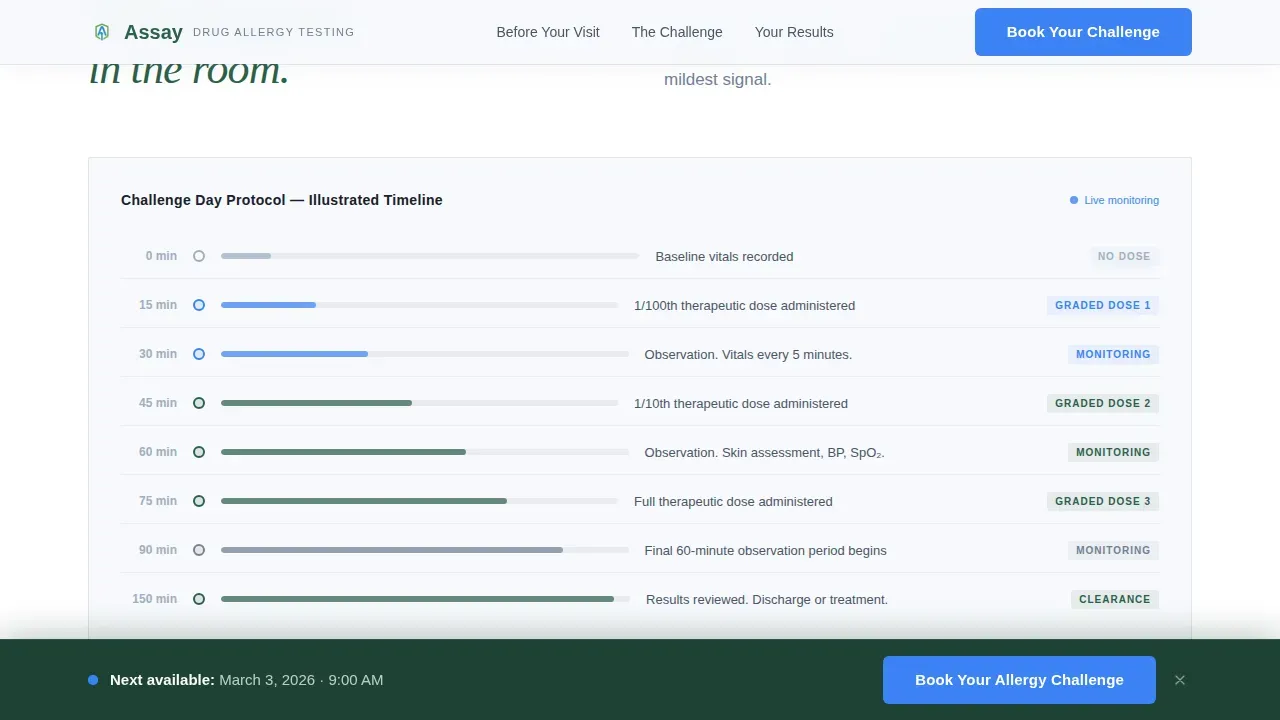
Three sequential sections unfold the full procedure like a glass-walled consultation room. The "Before" section covers medical history review and drug history questionnaire intake. The "During" section presents a graded dose protocol with a numbered observation timeline showing 15-minute monitoring intervals. The "After" section explains exactly what patients leave with.
Graded Dose Protocol Timeline
An illustrated timeline sits inside the "During" section to explain each phase of the supervised challenge test. Patients can see how the allergen dose increases gradually and how the clinic team will monitor for symptoms such as hives, signs of anaphylaxis, or changes in blood pressure at every interval.
Dual-Path Booking Form
The booking form offers two entry points. The primary path, "Book Your Allergy Challenge," collects suspected drug allergy via a structured dropdown, decade-based date of last reaction, optional referring physician, and preferred appointment window. The secondary path, "Send Us Your Records First," lets hesitant patients upload prior allergy documentation before committing to an appointment.
Persistent Bottom Call-to-Action Bar
After the second scroll, a fixed bottom bar keeps the booking call to action visible without interrupting the reading flow. This ensures that patients who finish reviewing the clinical pathway can proceed to booking without scrolling back to the top.
Physician-Signed Results Section
The "After" section communicates the tangible outcome: a typed, physician-signed allergy status letter. The copy makes clear that this letter is accepted by hospitals, pharmacies, and surgical teams, giving patients a concrete reason to book rather than wait.
Page sections overview
| Section | Purpose |
|---|---|
| Hero Header | Headline, subline, and primary booking call to action |
| Before the Visit | Medical record review and drug history questionnaire explained |
| During the Challenge | Graded dose protocol and monitored observation timeline |
| After the Test | Physician-signed allergy status letter and its clinical acceptance |
| Dual Booking Form | Book challenge directly or send records first |
| Footer Row | Single-row linear footer with practice contact details |
Design & branding system
The visual identity follows a Corporate Precision theme built on the Alpine Fresh color system. Every color choice reinforces clinical authority while keeping the page approachable and easy to read.
- Backgrounds use clinical snow (#F7F9FC), section dividers apply glacial slate (#4A5568) at 12% opacity, and headlines sit in alpine pine (#2D5F4A) for authoritative contrast
- Pulse-oximeter blue (#3B82F6) is reserved for call-to-action buttons and live-state indicators, making every booking prompt instantly visible
- Typography pairs Fraunces serif for headlines with DM Sans for body copy, combining warmth and clinical clarity in one readable system
Mobile & speed optimization
The template is built desktop-first, reflecting how most patients research a supervised allergy test before booking. A strong mobile fallback ensures the single-column layout remains fully readable and functional on any screen size.
- The single-column flow adapts cleanly to mobile viewports without restructuring the clinical pathway sequence
- The dual-path booking form is designed to stay compact, limiting fields to essential information so patients on smartphones can proceed without friction
- The persistent bottom call-to-action bar remains functional on mobile, keeping the booking prompt accessible at every scroll depth
How this template helps you convert
This page is engineered to move a cautious patient from first impression to confirmed booking in one focused scroll. Every design and copy decision reduces hesitation and builds the clinical trust needed to fill appointment slots.
- The transparent three-step clinical pathway answers the three core patient fears, "What do I do before?", "Is this safe?", and "What do I actually get?", before the visitor reaches the form
- The dual booking form path lowers the threshold for hesitant visitors by offering a "Send Records First" option, which turns a high-commitment decision into a low-commitment first step
Other information about this template
This page template supports a range of allergy testing contexts beyond penicillin challenges. The clinical pathway structure can be adapted to cover sulfa drugs, local anesthetics, non-steroidal anti-inflammatory drugs (NSAIDs), and other suspected allergens. The booking form dropdown is designed to accommodate this range through structured picklists, which enhance data accuracy at intake.
- Skin tests, including skin prick tests and intradermal testing, are standard diagnostic tools this clinic page can reference. Skin prick testing involves placing a small allergen extract on the skin surface and observing for a reaction. Blood test panels that measure immunoglobulin E (IgE) antibody levels in the blood can also be referenced as part of a broader allergy workup.
- Allergy types this template can address include food allergy, allergic rhinitis, asthma, eczema, conjunctivitis, and latex sensitivity, as well as reactions to foods, pollen, and pets. Each of these conditions shares the same core need: an accurate, clinically performed test to determine the true allergen trigger.
- Patients should discontinue antihistamines for at least 3 to 5 days before their appointment if their condition allows. This preparation instruction is helpful to include on the page to reduce avoidable rescheduling. Following all clinical advice before a visit improves the effectiveness and accuracy of the oral challenge or skin test performed on the day.
- The template structure also supports a physical exam note ahead of the supervised procedure, and the "Before" section can advise patients on what to bring, including a past medical history summary and any prior blood test or skin test results.
- AI-powered tools can help create comprehensive medical documentation templates for allergy clinics, and AI can assist in capturing complete medical history and current concerns during patient visits. The Assay precision drug allergy challenge booking landing page template is well suited to practices that want a professional online presence without building a full multi-page website from scratch. Templates for allergy clinic landing pages streamline the process of creating that presence quickly and accurately.
Theme
Corporate Precision
Creative direction
Transparent Process
Color system
Alpine Fresh
Style
Single Column Flow
Direction
Booking/Scheduling
Page Sections
Half-page Hero with Booking Call to Action
Transparent Three-step Clinical Pathway
Graded Dose Observation Timeline
Dual-path Booking Form
Persistent Bottom Call-to-action Bar
Physician-signed Results Block
Related questions
What types of allergy challenge does this page template support?
How does the dual-path booking form work?
What preparation instructions can this page communicate to patients?
Can the template be adapted for different allergy clinic specialties?
What does the patient leave with after the challenge test?