Medical Device Manufacturing Specialist Reviews Website Template
Assemble is a single-column landing page template built for medical device assembly services. It walks prospective partners through every production phase, from Design for Manufacturability review to sustained manufacturing runs, using a timeline-driven layout, a full-bleed photo header, and a credibility-first structure that earns trust before asking for the conversion.
by Rocket studio
Quick summary
Assemble is a precision-crafted landing page template for medical device assembly companies. It follows a scroll-driven timeline layout that mirrors a real device build lifecycle. The design uses an Engineering Blueprint theme with a Fire and Earth color palette. Two conversion paths guide qualified B2B visitors toward a build review request or a gated capability brief download.
Who this template is for
This template is designed for contract manufacturers and assembly service providers operating in the medical device space. It speaks directly to technically literate buyers who evaluate vendors on process rigor, documentation depth, and scalability.
- Medtech original equipment manufacturers facing FDA submission deadlines
- Series B startup founders scaling a prototype from pilot to full production volume
- Procurement directors at established device companies exploring nearshore assembly options
What problem this template solves
Most industrial service pages bury their credentials and lead with generic claims. A medtech buyer arrives with specific anxieties: tolerance capability, validation documentation, and volume scalability. This template addresses each anxiety in sequence before the primary call to action ever appears.
- Visitors question whether the assembler can hold sub-millimeter tolerances on complex housings
- Buyers worry about whether process validation documentation will satisfy a 510(k) submission
- Procurement teams need to know whether production can scale without drift or requalification delays
What you get with this template
You get a fully structured, single-column landing page that takes a visitor from first impression to conversion request without a single detour. Every section has a defined role in the buyer's journey, and the visual system reinforces technical authority throughout the scroll.
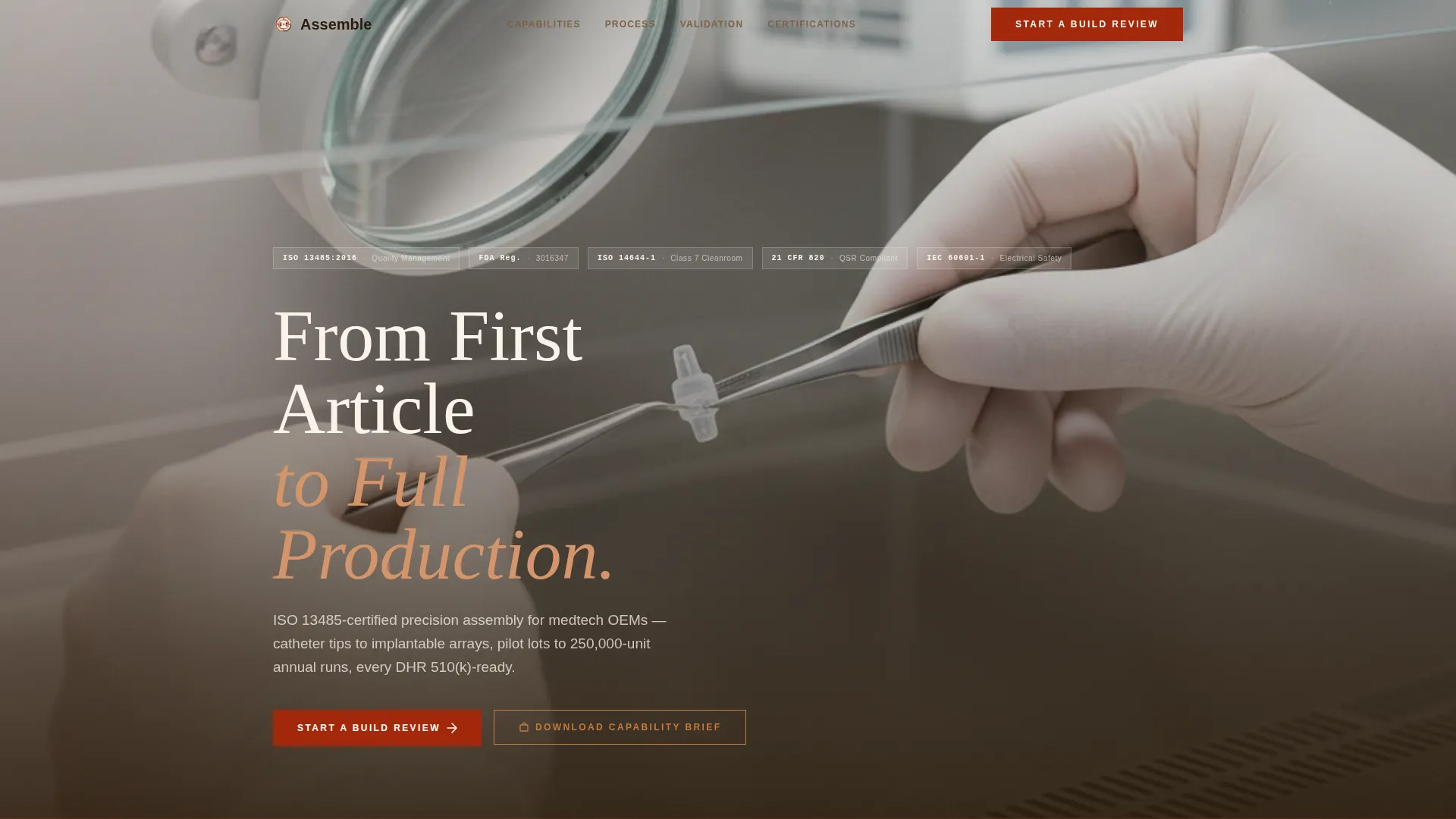
- A full-bleed macro photo header with a fade-in headline over the lower third
- A scrolling ticker of component tolerances held, ISO 13485 certification callouts, and FDA registration number displays
- Two conversion paths: a primary build review request form and a secondary gated capability brief download
Feature list
A paragraph introduces each feature. Every item below maps directly to a described template capability.
Timeline-Driven Section Progression
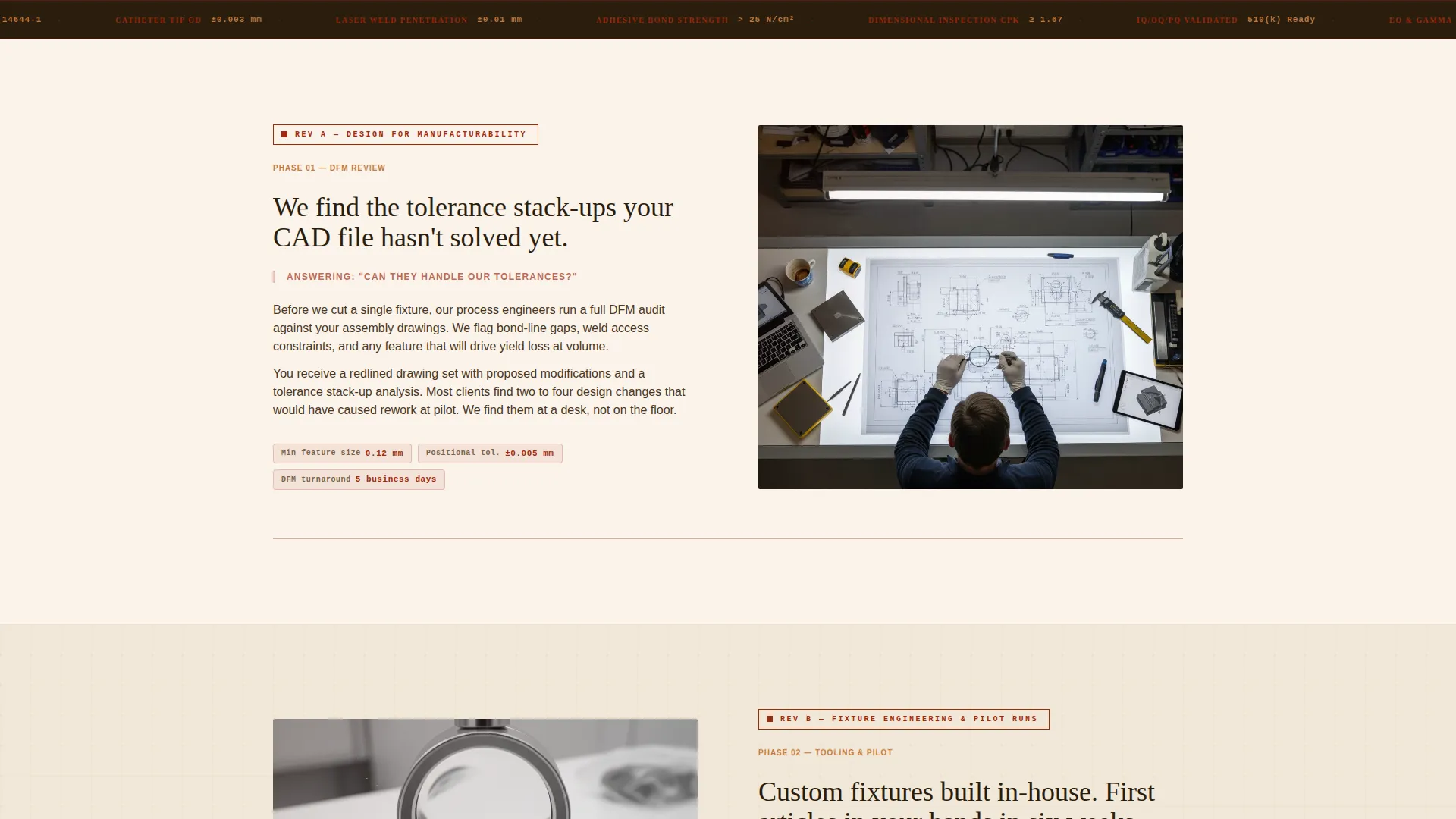
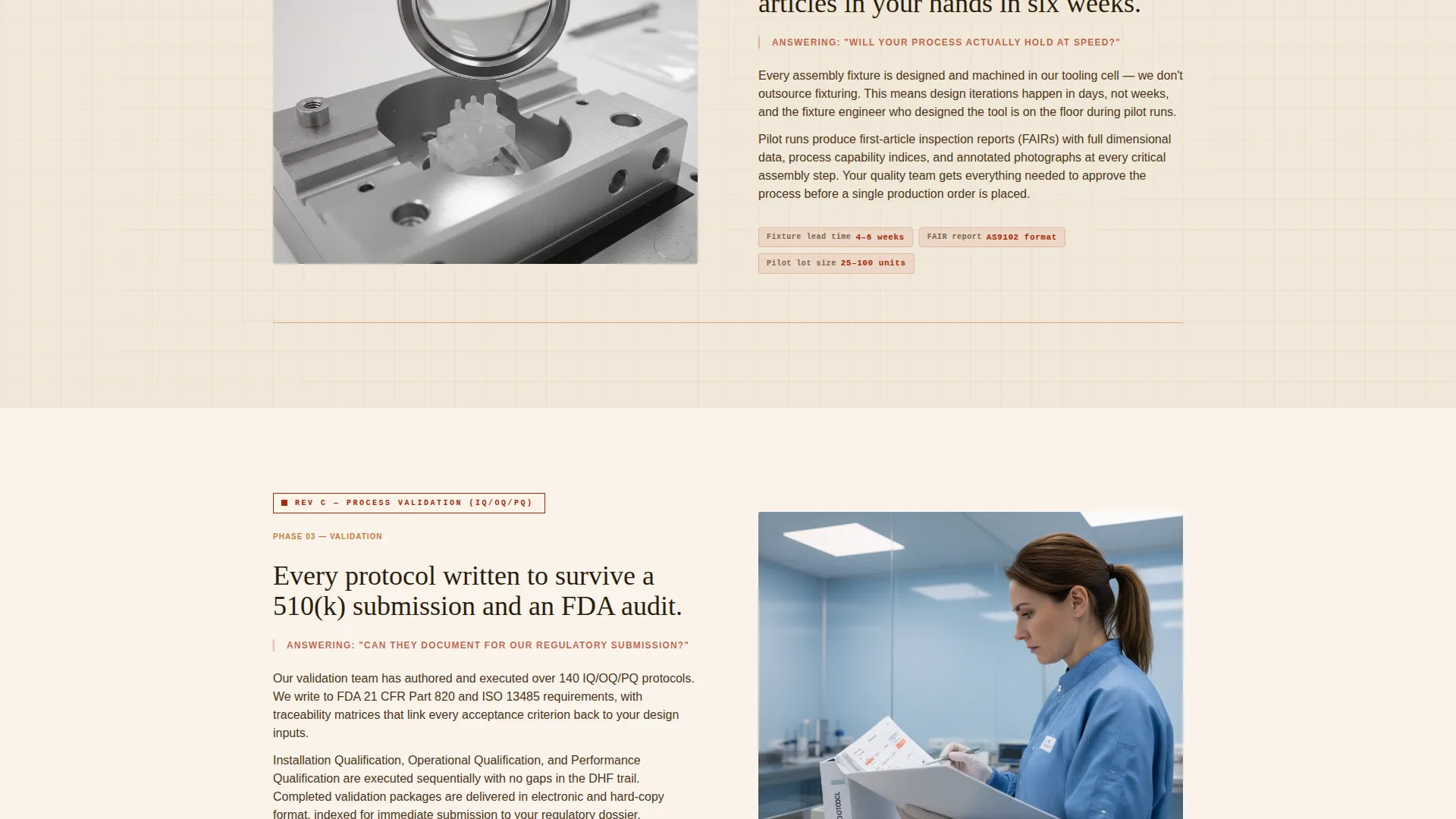
The layout walks visitors through five discrete production phases: Design for Manufacturability review, fixture engineering, pilot runs, process validation (Installation Qualification, Operational Qualification, and Performance Qualification), and sustained production. Each phase is anchored by a left-aligned stage marker styled after a blueprint revision block. The scroll itself becomes the argument for capability.
Full-Bleed Photo Header
The header opens with a macro shot of an assembler's gloved hands inside a laminar flow hood, holding a catheter tip component at razor-thin depth of field. A single headline, "From First Article to Full Production," fades in over the lower third of the image. The shot sets technical tone immediately and filters the audience before the first word of body copy.
Credibility Ticker and Proof Block
A scrolling ticker displays component tolerances held in production. Alongside it, ISO 13485 certification and FDA registration numbers appear as visible, front-loaded proof elements. This evidence lands before the primary form, so trust is already established when the conversion moment arrives.
Dual Conversion Path Design
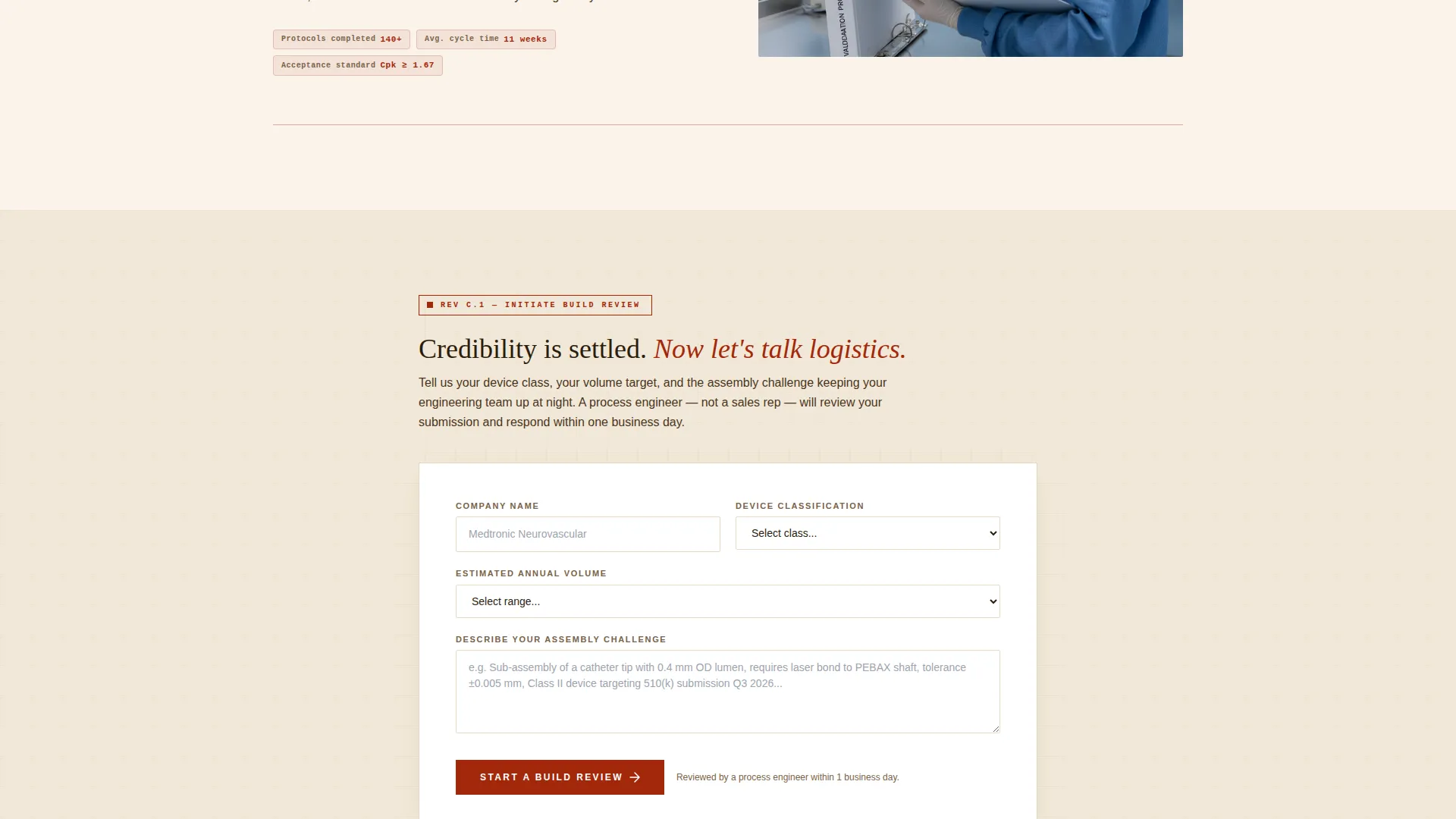
The primary call to action, labeled "Start a Build Review," appears first beneath the header and repeats after the process validation section. The form captures company name, device classification (Class I, II, or III via dropdown), estimated annual volume range, and a free-text field for describing the assembly challenge. A secondary path offers a downloadable capability brief gated behind email address and role title.
Engineering Blueprint Visual System
Section dividers render as thin forge-red rules that echo redline markings on engineering drawings. Backgrounds alternate between fired-white and a faint loam tint to separate phases clearly. The visual language signals precision without relying on stock design conventions common to generic industrial pages.
Imagery Progression from Drawing to Reality
Early sections pair CAD overlays and tolerance stack-up graphics with stage markers. As the visitor scrolls deeper, imagery transitions to real production photography. The page literally develops from blueprint to finished device, reinforcing the narrative that this team bridges specification and execution.
Page sections overview
| Section | Purpose |
|---|---|
| Full-Bleed Header | Establishes technical tone and introduces the headline |
| Credibility Proof Bar | Displays certifications, registration numbers, and tolerance ticker |
| Design for Manufacturability | Opens the timeline with DFM review stage content |
| Fixture Engineering Phase | Details tooling and fixture development capabilities |
| Pilot Run Stage | Describes low-volume first-article and pilot production |
| Process Validation Block | Covers IQ, OQ, and PQ documentation for regulatory submissions |
| Primary call to action Form | Captures build review requests with classification and volume fields |
| Sustained Production Phase | Addresses scalability, volume ramp, and production consistency |
| Capability Brief Download | Secondary gated path for downloadable service documentation |
| Repeated call to action Section | Reinforces the build review request after the validation narrative |
Design & branding system
The template uses an Engineering Blueprint theme rooted in a Fire and Earth color system. Every color choice serves a functional role: warmth signals craftsmanship while precision details signal reliability.
- Forge-red (#A3280A) is used for primary accents, call-to-action buttons, and section rule dividers
- Kiln-fired clay (#C47A3B) handles secondary highlights and hover states throughout the page
- Deep loam (#2B1D0E) is the dominant text color, and fired-white (#FAF3EB) serves as the primary page canvas
Mobile & speed optimization
The single-column flow structure adapts naturally to narrower viewports without requiring layout restructuring. Every section was designed with vertical scrolling in mind, which benefits mobile visitors navigating a long-form B2B page.
- Single-column layout eliminates horizontal overflow issues on tablet and phone screens
- Full-bleed imagery and alternating background sections maintain visual hierarchy at any viewport width
- Compact form fields and a clear dropdown for device classification keep the mobile conversion path friction-free
How this template helps you convert
The conversion strategy in this template is sequential. It earns credibility first, then presents the ask. Nothing in the layout asks for commitment before it has answered the buyer's most likely objections.
- Front-loaded proof elements, including the tolerance ticker and certification displays, resolve trust questions before the first form appears, so the visitor arrives at the call to action already confident rather than skeptical.
- The repeated "Start a Build Review" call to action after the process validation section catches buyers who needed to see the full documentation argument before they were ready to engage, capturing conversions that a single-placement form would miss.
Other information about this template
This template is well suited to medical device contract manufacturing pages where the buying cycle is long and the decision-maker is technically trained. The structured phase layout supports conversations with quality engineers, regulatory affairs managers, and operations leads, not just marketing audiences.
- The template style is Single Column Flow, which keeps complex technical content digestible without sidebars or competing panels
- The creative direction follows a Timeline Progression model, making it easy to adapt for related niches such as electromechanical assembly, catheter manufacturing, or implantable device fabrication
- The Engineering Blueprint theme and Fire and Earth palette are distinct enough to stand apart from typical clinical-white medical industry pages, giving the service a manufacturing-floor identity rather than a hospital aesthetic
Theme
Engineering Blueprint
Creative direction
Timeline Progression
Color system
Fire & Earth
Style
Single Column Flow
Direction
Partnership/B2B
Page Sections
Timeline-driven Production Phase Layout
Full-bleed Macro Photo Header
Front-loaded Credibility Proof Bar
Dual B2B Conversion Path
Imagery Progression
Engineering Blueprint Visual Language
Related questions
Who is the primary audience for this landing page template?
What conversion actions does this template support?
Can this template be adapted for other types of device assembly services?
What regulatory credibility elements are included in the template?
Is this a single-page template or a multi-page website?