Immigration Law Blog Website Template
Asylum is a split-screen landing page template built for asylum and refugee attorneys. It pairs editorial serif typography with a humanitarian journal aesthetic to earn trust from vulnerable visitors. The layout alternates case micro-stories with institutional credentials, drives leads through a focused modal form, and keeps the primary call to action reachable from every scroll position.
by Rocket studio
Quick summary
Asylum is a single-page template designed for immigration attorneys who handle asylum petitions, withholding claims, and Convention Against Torture cases. It uses a 50/50 split-screen layout to alternate human testimony with courtroom credentials. Every design decision serves one purpose: helping a frightened person feel heard and then take the step of reaching out.
Who this template is for
This template is built for legal professionals whose work sits at the highest-stakes end of immigration law. It is equally useful for solo practitioners and small firms that need to communicate authority without feeling cold or corporate.
- Asylum and refugee attorneys seeking consultation leads from distressed immigrants
- Immigration law practices serving non-English-speaking, trauma-affected, or detained clients
- Pro bono legal teams and nonprofit immigration advocates who need a credible public-facing page
What problem this template solves
Most legal landing pages either look like a generic firm directory or drown visitors in legalese. Neither works for asylum seekers who are often in crisis, navigating an unfamiliar country, and using a phone with limited battery. This template solves that gap directly.
- Visitors in distress need to feel safe before they will share personal details, and the editorial design provides that emotional safety
- Attorneys need to prove both human empathy and courtroom competence on the same page, and the testimony-plus-credentials rhythm does exactly that
- The modal form reduces friction by asking only three focused questions, lowering the barrier for first contact
What you get with this template
The template delivers a complete, publication-ready single-page layout with every section pre-structured and ready to populate with real firm content. No section is left as a blank placeholder.
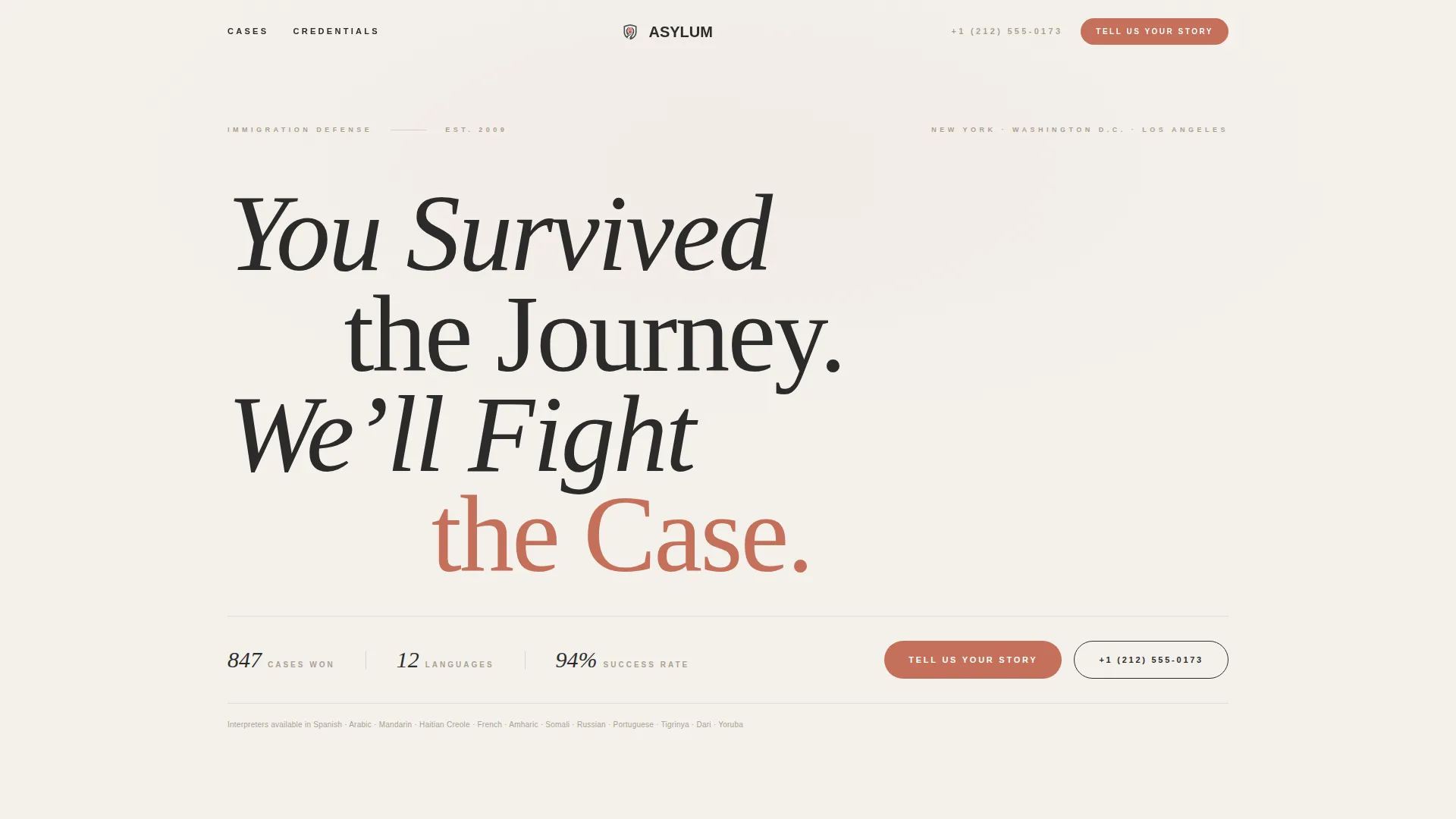
- A hero section with a giant centered serif headline, a firm stats bar, and a primary call-to-action button in terracotta
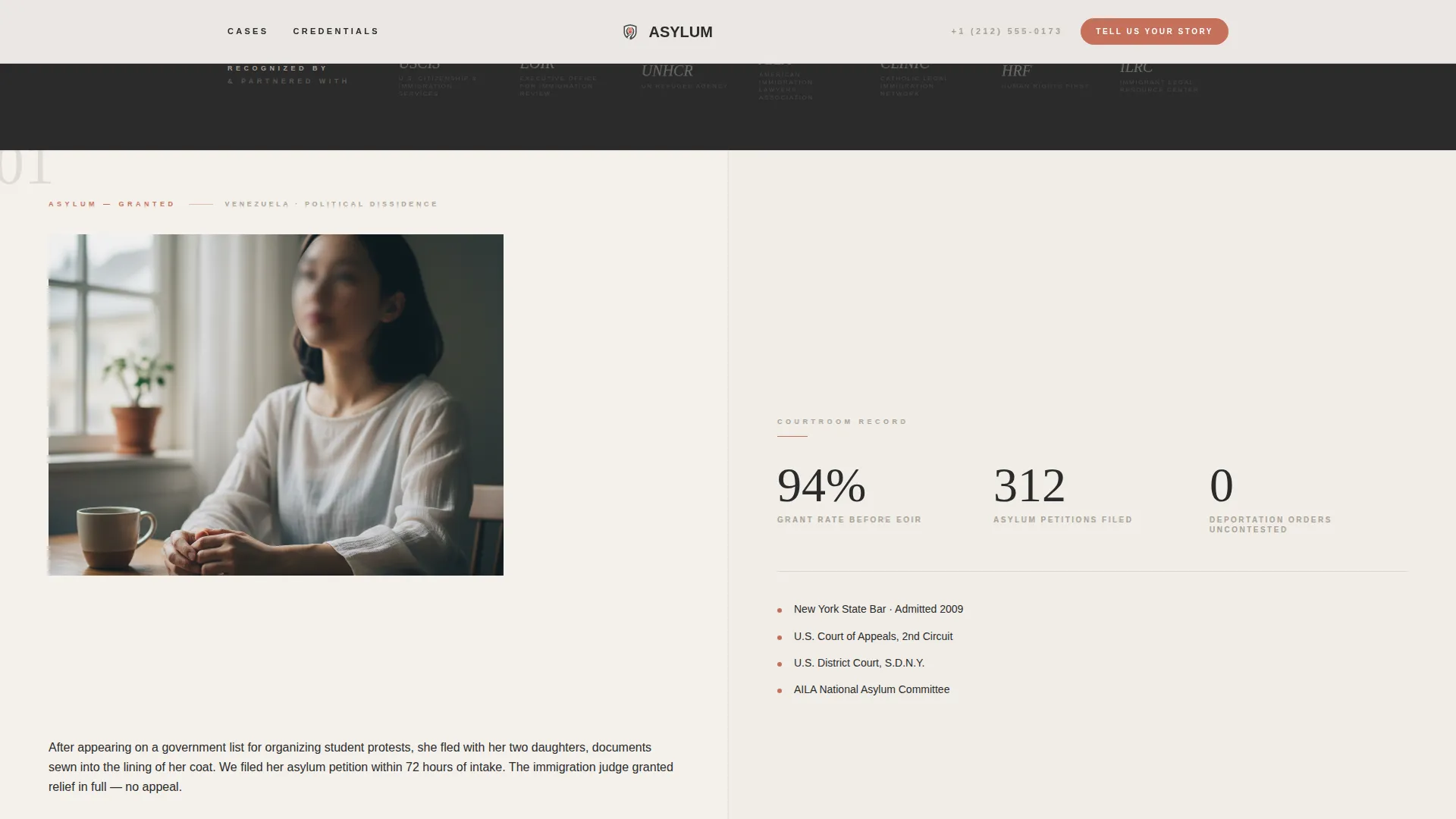
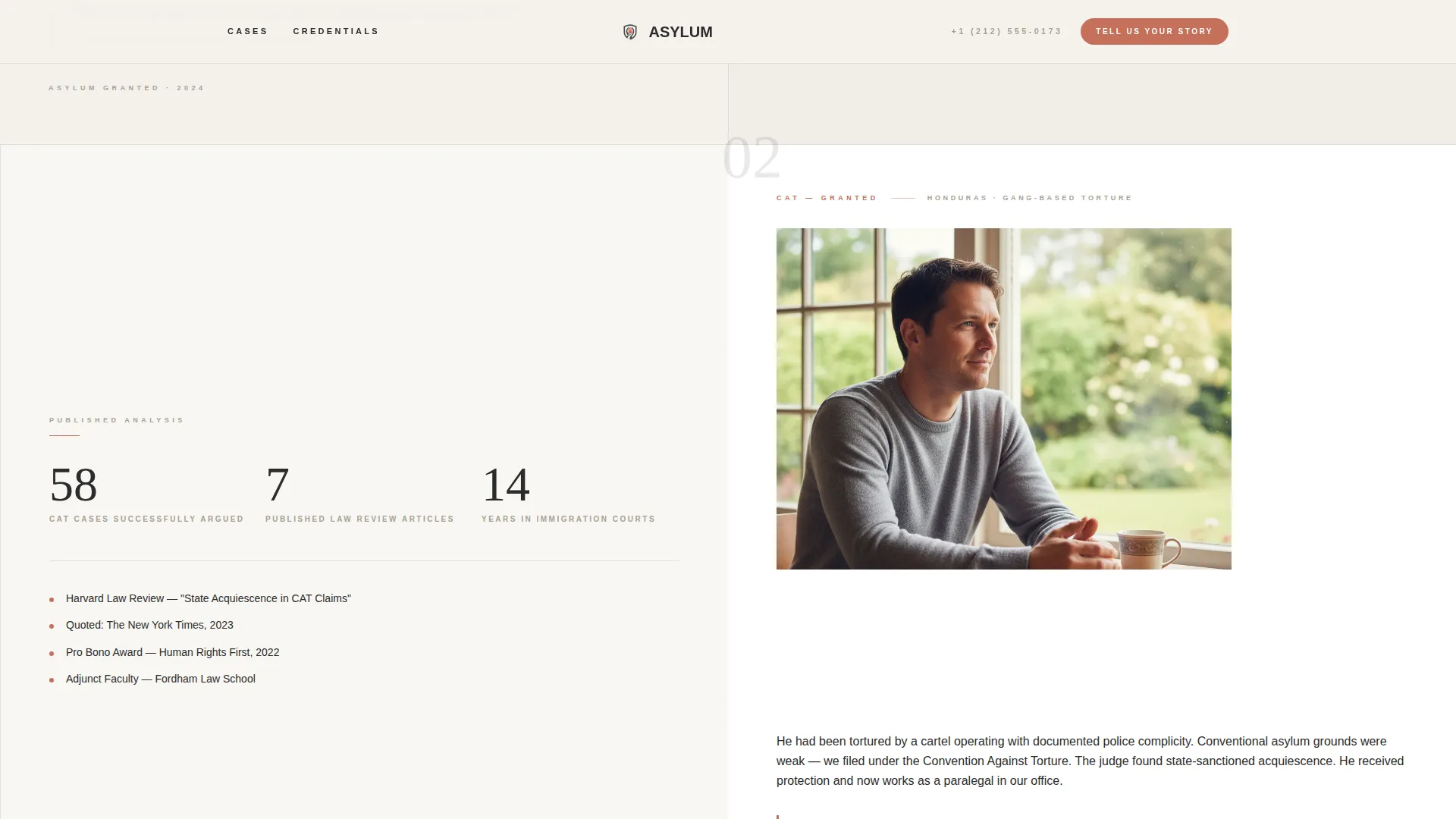
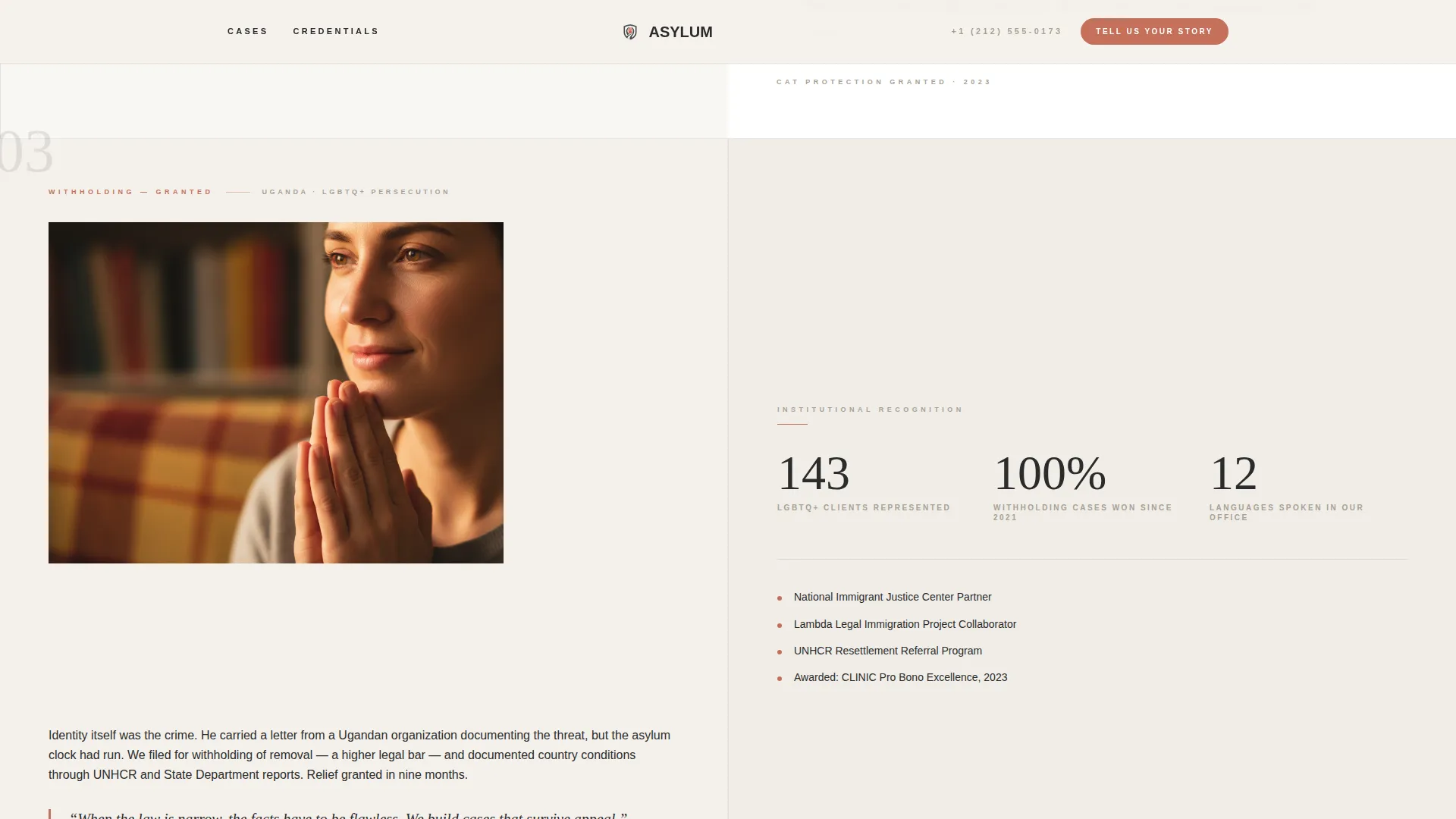
- Alternating 50/50 split-screen blocks pairing anonymized client portraits and case micro-stories with institutional logos, bar admissions, and courtroom win statistics
- A three-step modal contact form, a persistent mobile call-to-action bar, and a multilingual interpreter notice with time-zone-aware phone hours
Feature list
This template ships with six purpose-built components drawn directly from the brief.
Giant Centered Serif Hero
The hero opens with an enormous DM Serif Display headline set on a cloud-white field. Below it, a single line in warm newsprint gray carries the firm name, case wins, and languages spoken. Typography carries the full visual weight here; no competing imagery is needed.
Alternating Split-Screen Testimony Blocks
Each scroll section pairs a left column of editorial case micro-stories with a right column of credentials. Stories name the country of origin, persecution type, and outcome in three sentences. Credentials include bar admissions, institutional affiliations, published legal analyses, and win-rate figures.
Institutional Authority Logo Wall
Immediately below the hero, a dedicated strip displays logos for recognized bodies such as the United States Citizenship and Immigration Services, the Executive Office for Immigration Review, the United Nations High Commissioner for Refugees, the American Immigration Lawyers Association, and pro bono partner organizations. This strip anchors the attorney's credibility before the visitor reads a single case story.
Three-Step Modal Contact Form
The primary call to action opens a calm modal form that asks three questions in sequence: country of origin via dropdown, type of fear (persecution, torture, or identity-based harm), and current immigration status (no status, pending, or detained). The sequence keeps each step simple and prevents overwhelm.
Persistent Mobile Call-to-Action Bar
On mobile, a fixed bottom bar keeps the "Tell Us Your Story" button visible at all times. Clients who are in transit or in crisis can reach the form without scrolling back to the top.
Multilingual Contact Path
A secondary contact block lists a direct phone number with hours displayed across four United States time zones. A short notice reads that interpreters are available in 12 languages, directly addressing the language barrier that stops many asylum seekers from making first contact.
Page sections overview
| Section | Purpose |
|---|---|
| Hero headline block | Opens with heavy serif headline and firm stats bar |
| Primary call to action button | Launches the three-step modal form |
| Authority logo strip | Displays institutional affiliations to anchor trust |
| Split testimony block | Pairs case micro-story with credentials on each scroll |
| Case outcomes grid | Shows editorial stats alongside human context |
| Contact call to action section | Offers modal form plus phone number and interpreter note |
| Mobile sticky bar | Keeps call to action visible throughout mobile scroll |
| Footer arc pattern | Logo and tagline left, navigation links right |
Design & branding system
The visual language is drawn from long-form humanitarian journalism. Think pages of uncoated stock, large-format photography, and ink that feels considered rather than digital. Every element earns its place on the page.
- Color system: cloud white (#F4F1EC) backgrounds, deep editorial charcoal (#2B2B2B) for primary text, warm newsprint gray (#A8A093) for secondary text, and muted terracotta (#C4705A) reserved exclusively for links, calls to action, and pull-quote borders
- Typography: DM Serif Display drives all headlines with heavy weight and generous letter-spacing; Manrope handles body text with clean, readable spacing
- Photography direction calls for anonymized editorial portraits shot in natural window light with hands visible, printed large enough to hold eye contact without identifying the subject
Mobile & speed optimization
The template is designed with a mobile-first hierarchy, recognizing that many asylum seekers access the internet on a phone while in transit, in a shelter, or in a moment of limited time and bandwidth.
- The persistent bottom bar keeps the contact call to action reachable on every screen without requiring a scroll back to the top
- The modal form loads lazily so the initial page draws fast, and images are sized and formatted for optimized delivery
- Scroll reveals and staggered text animations are set to medium intensity, keeping motion purposeful rather than distracting on smaller screens
How this template helps you convert
The template earns trust before it asks for anything, which is the only conversion strategy that works with trauma-affected visitors.
- The hero headline and stats bar immediately signal that this attorney has won cases like yours, giving a distressed visitor a reason to keep reading before any ask is made
- The alternating testimony-and-credentials rhythm builds cumulative trust across the full scroll, so by the time a visitor reaches the contact section, they have seen real outcomes paired with real institutional proof
- The three-step modal form and multilingual phone path offer two different comfort levels for first contact, meeting each visitor where they are rather than forcing a single channel
Other information about this template
This template is part of a curated collection of legal and compliance landing page templates. It sits within the immigration law category with a specific focus on asylum and refugee attorney practices.
- The template uses the Cloud Canvas color system, the Logo Wall Authority creative direction, and the Editorial Magazine theme, all of which are named design systems within the broader template collection
- The header concept is classified as Giant Headline Centered, and the layout style is Split Screen 50/50, making it straightforward to identify and match within a larger template library
- The footer follows Arc Pattern 7, placing the firm logo and tagline on the left with navigation links on the right, keeping the close of the page as clean as the open
Theme
Editorial Magazine
Creative direction
Logo Wall Authority
Color system
Cloud Canvas
Style
Split Screen (50/50)
Direction
Lead Generation
Page Sections
Giant Centered Serif Hero
Alternating Split-screen Blocks
Institutional Logo Wall
Three-step Modal Contact Form
Persistent Mobile Call-to-action Bar
Multilingual Phone Contact Block
Related questions
Can I replace the placeholder case stories and credentials with my firm's real information?
Does the modal form come pre-built with the three-step sequence?
Is this template suitable for clients who speak languages other than English?
Can a nonprofit or pro bono immigration team use this template?
What layout style does this template use?