Atelier is a masonry-style healthcare design portfolio landing page built for architects and interior designers who work in health and wellness spaces. It pairs floating parallax photos with a scroll-triggered award gallery, a fixed waitlist bar, and an editorial color system to present completed projects with gallery-quality calm. No coding knowledge required to get started.
by Rocket studio
Loading preview…
Quick summary
Atelier is a single-page portfolio landing page designed for healthcare architects and interior designers. It uses a masonry gallery layout to display award-paired project cards, a floating parallax photo hero, and a fixed waitlist call-to-action bar. The template communicates expertise through quiet visual authority rather than bold claims, letting completed projects and earned recognition do the work.
Who this template is for
This template is built for design professionals who create spaces where health and wellness outcomes matter. It speaks directly to practitioners whose portfolio needs to earn trust before a single word is read.
Healthcare interior designers and architects who want to showcase completed hospital, clinic, or care-home projects to commissioners and trust directors
Design studio founders preparing to launch a full case library and seeking early waitlist signups from potential clients such as NHS trust officers, private clinic founders, and healthcare facility directors
Architecture and interiors portfolio websites serving a broad audience of healthcare sector decision-makers who review work on desktop before commissioning
What problem this template solves
Most portfolio website templates are built for creative generalists. They lack the tone, structure, and social proof layers that healthcare commissioners expect before awarding a contract. Potential clients in this sector are cautious, detail-oriented, and time-poor.
A generic portfolio website fails to demonstrate domain expertise or communicate the evidence-based outcomes that healthcare administrators search for
Without a clear awards display and outcome metrics, visitors cannot judge whether a studio's design process is suitable for regulated, patient-centered environments
Starting from scratch forces designers to build pages, layout logic, and brand elements that should already exist in a focused template
What you get with this template
This landing page template delivers a complete, styled starting point for a healthcare design portfolio. Every section is composed and ready to populate with your own projects and photography.
Theme
Atelier Studio
Creative direction
Award & Recognition
Color system
Ink & Paper
Direction
Waitlist/Coming Soon
Page Sections
Floating Parallax Photo Hero
Award-paired Masonry Gallery
Scroll-triggered Staggered Reveals
Fixed Waitlist Bar with Timed Prompt
Recognition Bar and Philosophy Strip
Ink and Paper Editorial Design System
Related questions
Do I need coding knowledge to use the Atelier template?
Is Atelier a full portfolio website or a single landing page?
How does the fixed waitlist bar appear during scrolling?
Can I display project outcome metrics alongside award citations?
Can I showcase different types of healthcare spaces with this template?
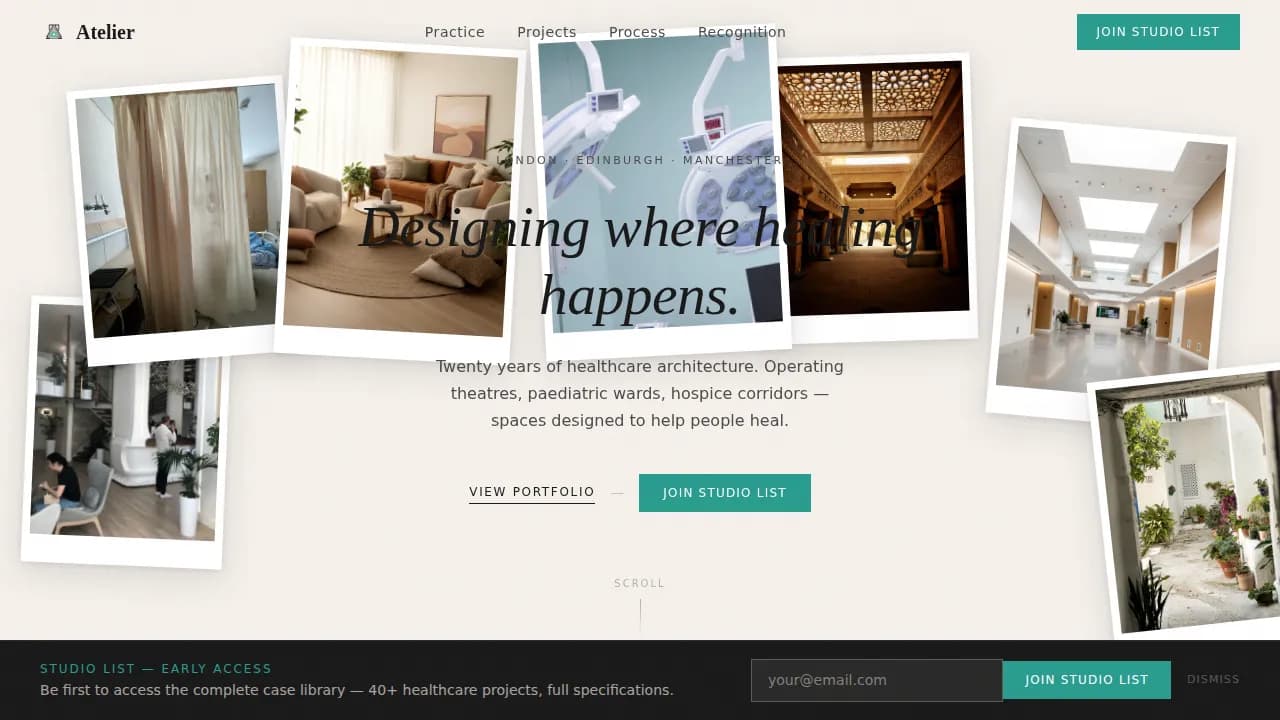
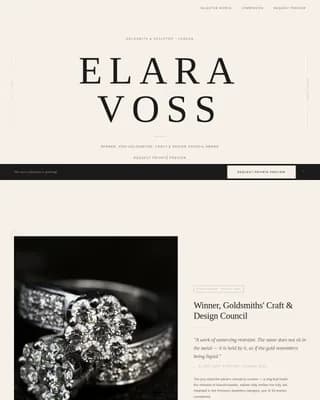
A floating parallax hero section with six or seven portfolio photos softly rotated at slight angles over a cotton-stock background, with a typewriter serif headline that types itself as the page loads
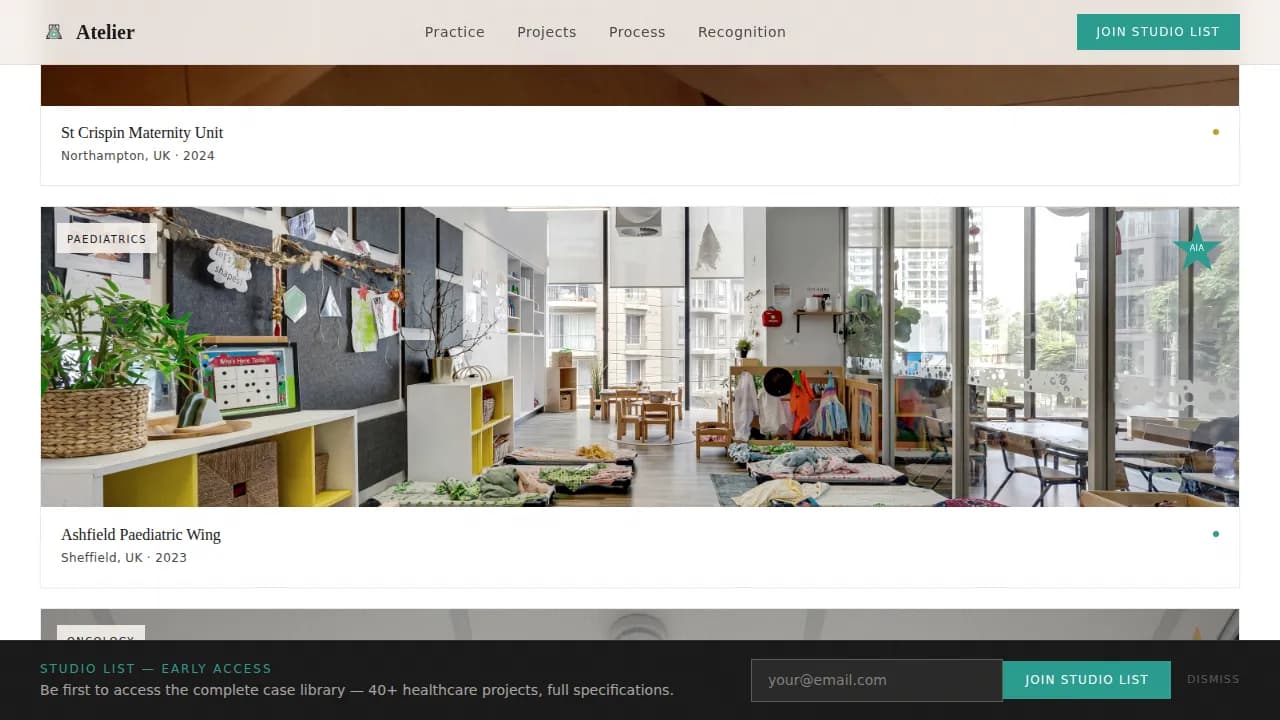
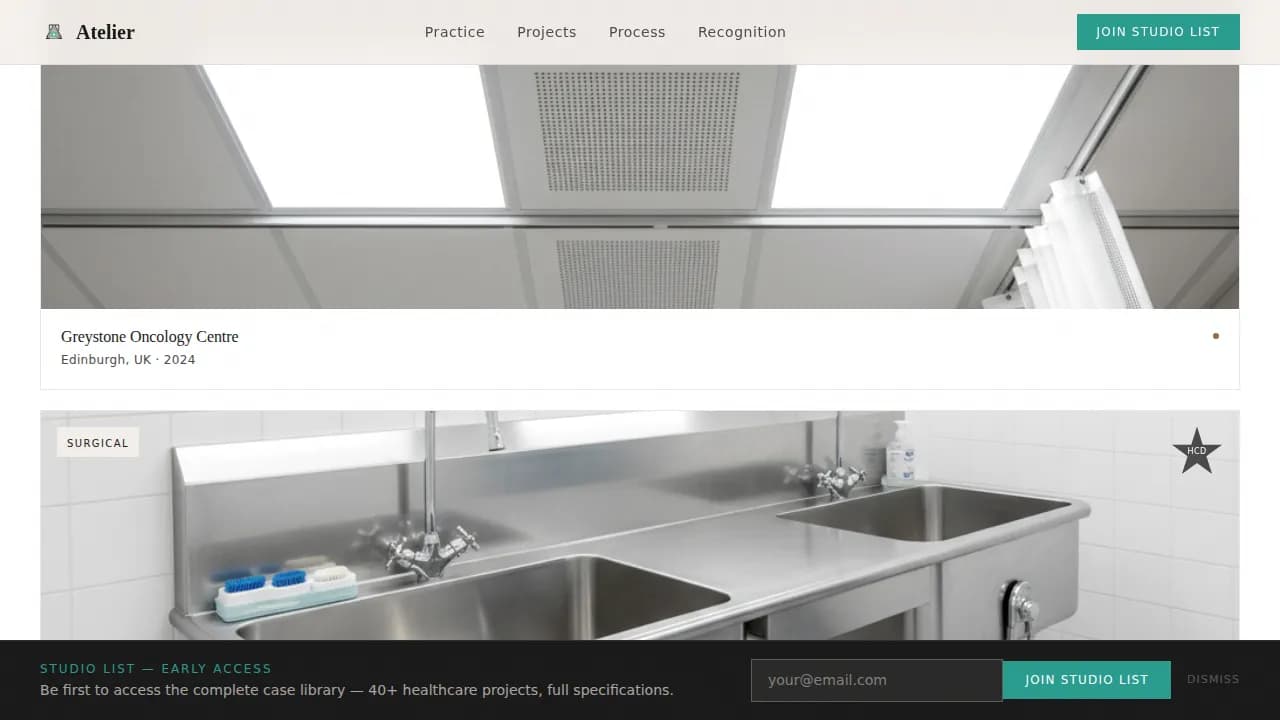
A masonry gallery where each project card is paired with its award rosette, a jury citation that appears on hover, and one key design outcome metric such as patient recovery time or staff satisfaction score
A recognition bar, a three-column philosophy strip, and a fixed bottom waitlist bar with a single email input field that appears after the visitor reaches the third scroll depth
Feature list
This section describes the core built-in features of the Atelier template. Each feature is grounded in the design brief and reflects what users will find inside the template files.
Floating Parallax Photo Hero
The hero section displays six or seven portfolio photos of completed healthcare interiors. Each photo is softly rotated at a slight angle and drifts with subtle cursor parallax. Images hover over the cotton-stock background like Polaroids on a studio desk. Beneath the constellation of photos, a serif headline types itself into view. The effect is unhurried and draws visitors in before any text is read.
Award-Paired Masonry Gallery
The masonry gallery is the core of the portfolio showcase. Each card pairs a completed project photograph with the accolade it earned, such as a RIBA rosette or an AIA citation. On hover, the card expands to reveal a brief jury citation and one key design metric, for example a measurable change in patient recovery time, infection rates, or staff satisfaction scores. Evidence-Based Design outcomes grounded in real numbers give potential clients the depth they need to make commissioning decisions.
Scroll-Triggered Card Reveals and Staggered Animation
As users scroll down the page, masonry cards reveal themselves with staggered animation. Each new card adds to the cumulative sense of authority. The scroll rhythm is deliberate and calm, reflecting the unhurried aesthetic of a gallery monograph rather than a fast-moving marketing site. The scroll-triggered behavior is built into the template and requires no additional setup.
Fixed Waitlist Bar with Email Capture
A single-field email input bar is fixed to the bottom of the viewport. It appears after the visitor reaches the third scroll depth, by which point the masonry gallery has already presented sufficient evidence of expertise. The bar reads "Join the Studio List" and carries secondary text noting early access to 40 or more healthcare projects with full specifications. The timing is intentional: the waitlist feels like early access to something already proven.
Recognition Bar and Philosophy Strip
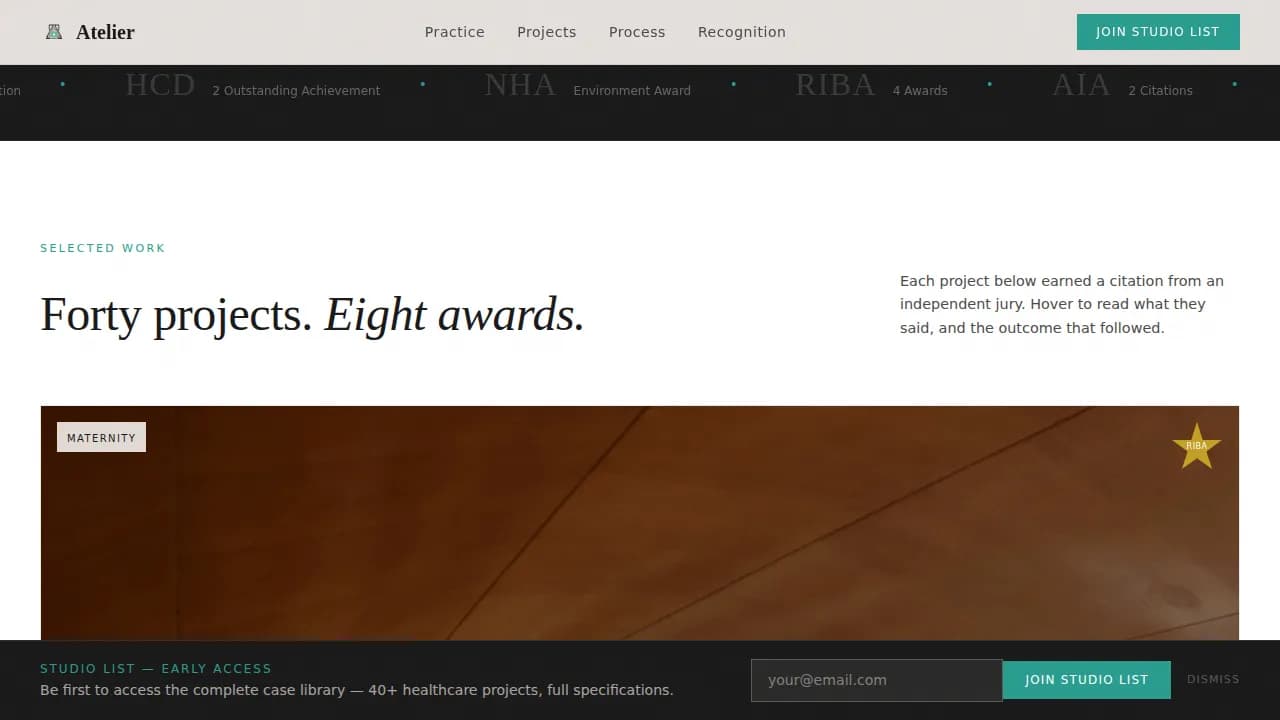
A horizontal recognition bar displays award body logos including RIBA, AIA, AHEAD, RICS, and HCD, giving visitors a scannable row of credentialing at a glance. Below it, a three-column asymmetric editorial strip presents the studio's design philosophy across three pillars: light, material, and flow. This section communicates the thinking behind the projects without requiring long blocks of text, keeping the landing page design lean and focused.
Ink and Paper Color System and Editorial Typography
The template uses a carefully composed palette of archival black, warm cotton stock, graphite pencil, and a single surgical teal accent. Teal is reserved for interactive states and the waitlist button. Typography pairs Fraunces serif headlines with DM Sans for body and interface text. The combination produces a matte, tactile aesthetic that feels like a hand-bound design monograph rather than a generic web template.
Page sections overview
Section
Purpose
Floating Photo Hero
Opens the landing page with parallax portfolio photos and a typewriter serif headline
Masonry Award Gallery
Displays completed projects paired with awards, jury citations, and outcome metrics
Recognition Bar
Presents award body logos in a horizontal scroll for quick credibility scanning
Philosophy Strip
Three-column editorial layout communicating the studio's core design principles
Fixed Waitlist Bar
Captures email signups with a timed bottom-bar prompt after the third scroll depth
Footer
Horizontal flow footer with essential studio links and contact information
Design & branding system
The visual identity is built around restraint. Every design decision reinforces the gallery monograph feeling described in the brief, where negative space is as important as what it frames.
Color palette: archival black (#1A1A1A) for text, warm cotton stock (#F5F0EB) and pure white (#FFFFFF) for alternating backgrounds, graphite pencil (#4A4A4A) for secondary text, and surgical teal (#2A9D8F) reserved exclusively for interactive states and the waitlist button
Typography: Fraunces serif for headlines to carry warmth and editorial weight, DM Sans for body copy and interface elements to keep usability high and text scannable across all pages
Ample white space around every project card treats each portfolio piece like a museum exhibit, giving visitors room to focus without visual noise competing for attention
Mobile & speed optimization
The template is designed desktop-first, which reflects how healthcare commissioners typically review portfolio work. However, it is built to maintain mobile responsiveness so that the site remains accessible across every device a visitor might use.
Mobile responsiveness ensures that the masonry layout, floating hero, and fixed waitlist bar all adapt gracefully for tablet and mobile screens, supporting the reality that over 60 percent of healthcare web traffic arrives on mobile devices
Lightweight section architecture uses server-rendered components for static sections such as the recognition bar and philosophy strip, with client-side rendering reserved for the interactive hero and masonry gallery, keeping the overall page weight low
The staggered animation and parallax effects are optimized so that they do not block the initial paint, helping users reach the content quickly and maintain engagement through the scroll journey
How this template helps you convert
This landing page is structured to earn the waitlist signup through demonstrated authority rather than upfront persuasion. The sequence is deliberate and mirrors the trust-building process that healthcare commissioners follow in practice.
The floating parallax hero and typewriter headline create an immediate first impression of calm expertise, engaging visitors before they consciously evaluate the studio, which aligns with the principle that effective landing pages use a compelling headline to engage users immediately
The masonry award gallery builds cumulative credibility as visitors scroll, presenting high quality images of completed projects alongside real award citations and measurable design outcomes, so that by the time the fixed waitlist bar appears, the signup feels like access to something already proven rather than a speculative promise
Other information about this template
This section covers additional context about the Atelier template, including how it fits into the wider landscape of portfolio website templates and what designers should know before using it.
The Atelier award winning healthcare design portfolio landing page template is a single-page landing rather than a multi-page website, making it ideal for studios preparing a coming-soon presence ahead of a full portfolio website launch
Portfolio website templates designed for the healthcare sector are less common than general creative templates. Atelier fills this gap by combining the aesthetic of a modern healthcare website with the project-display structure of an architecture portfolio
The template supports documentation of work history through project cards and award citations, giving users a structured way to present completed projects without writing long case-study pages from scratch
Choosing the right portfolio website template means considering style, colors, and features that align with your professional brand. Atelier's Ink and Paper color system and editorial typography create a brand-consistent foundation that healthcare design professionals can build on
The landing page design draws on principles from inspiring healthcare website design, including user-centric navigation, a clear navigation bar implied by the footer structure, and a visual hierarchy that guides visitors from hero to gallery to waitlist without confusion
Trauma-Informed Design principles, which prioritize safety, dignity, and calm through muted color palettes and considered materials, are reflected in the template's overall aesthetic and the descriptions each project card can carry
Nature-Integrated Care, which uses biophilic design to connect patients with nature for healing, is one of the portfolio themes this template is built to present, with sections that can describe hospice corridors mimicking forest canopies or pediatric spaces designed with patient wellness in mind
Evidence-Based Design, or EBD, improves clinical outcomes, reduces stress, and enhances patient safety. The outcome metric field on each masonry card is designed to surface exactly this kind of evidence for visiting administrators and commissioners
The Jefferson Health Care Honickman Center in Philadelphia won a 2025 AIA Award for its pleated glass facade and specialized design for neurodivergent patients, demonstrating the kind of acclaimed project this template's card layout is built to showcase
City of Hope - Hope Plaza, designed by EwingCole, won the 2025 IIDA Best of Competition, and the Children's Healthcare of Atlanta Arthur M. Blank Hospital by ESa and Page was recognized for its large-scale impact, the sort of landmark projects that belong in a portfolio of this caliber
San Jose's North East Medical Services PACE center received the 2025 IIDA Transformation and Innovation Award, reflecting the breadth of healthcare design excellence that portfolio websites in this sector should be prepared to present
Original photography fosters stronger engagement than stock photos. This template is built around the assumption that users will populate it with their own high quality images of completed spaces
Clients in this sector value testimonials from hospital administrators or clinicians about how design improved operations. While the template focuses on award citations and outcome metrics, the card description fields can also carry short testimonial excerpts from commissioning clients
Many portfolio website templates come with built-in support resources. Users exploring this template can access platform support to help with setup and customization without needing deep coding knowledge
Tools like Mockplus can help healthcare designers create interactive prototypes and test user flows before committing to a final build, making them a useful companion for studios planning the broader website beyond this landing page