Therapeutic Vestibular Rehabilitation Landing Page Template
Steady is a hero-dominant vestibular and balance therapy landing page built for clinics that retrain the inner ear. It follows a Day-in-the-Life scroll narrative, walking visitors from morning dizziness through clinical treatment to confident recovery. A custom trail illustration, botanical color system, and sequenced lead-generation form make this landing page feel as purposeful as the therapy it represents.
by Rocket studio
Quick summary
Steady is a single-page, hero-dominant landing page template built for vestibular and balance therapy clinics. It uses an immersive trail metaphor, a hand-illustrated hero section filling ninety percent of the viewport, and a scroll-driven Day-in-the-Life narrative to walk prospective patients from their first dizzy morning through a full course of physical therapy and into confident, steady recovery.
Who this template is for
This landing page is designed for vestibular and balance therapy specialists who need a website that earns trust fast. The template speaks directly to patients who feel dizzy, unsteady, or afraid of falls, and it gives clinics the visual language and conversion structure to turn those visitors into booked appointments.
- Physical therapy clinics that specialize in vestibular rehabilitation and inner ear conditions
- Specialty practices serving post-concussion patients, older adults diagnosed with benign paroxysmal positional vertigo (BPPV), and migraine sufferers with vestibular symptoms
- Healthcare providers who want a landing page that communicates warmth, clinical credibility, and a clear path to booking
What problem this template solves
Vestibular disorders are notoriously hard to describe. Symptoms such as dizziness, vertigo, nausea, and imbalance are invisible to others, which makes patients feel isolated and uncertain. Most therapy websites feel cold or generic. They list services without helping the visitor feel understood. This landing page solves that communication gap directly.
- Patients who feel dizzy often struggle to explain what they experience, making it hard to find the right specialists; this template uses natural, empathetic language to describe their symptoms back to them
- Generic therapy website designs fail to convey the specific expertise required to treat inner ear dysfunction; this template signals clinical authority through structured content and purposeful design
- Clinics lose potential patients when their website does not answer the right questions at the right moment; this landing page sequences information so visitors understand the therapy before they reach the booking form
What you get with this template
You get a fully structured, single-page landing page built around a scroll-driven patient journey. Every section serves a purpose, from the illustrated hero that establishes emotional resonance to the sequenced intake form that converts understanding into action. The template is desktop-first with a strong mobile layout.
- A ninety-percent viewport hero section featuring a custom SVG trail illustration with parallax depth, a hand-lettered serif headline, and a primary call-to-action button
- A Day-in-the-Life scroll narrative with five defined content zones: morning dizziness, clinic arrival and assessment, treatment exercises, patient story pull-quote, and the lead-generation form set in the lightest clearing section
- A secondary conversion path offering a free downloadable "Home Balance Check" PDF gated behind an email field, capturing visitors not yet ready to book an appointment
Feature list
This section describes the key built-in capabilities of this landing page template. Each feature is drawn directly from the design brief and serves a specific role in the patient-to-patient conversion journey.
Hero Illustration with Parallax Trail
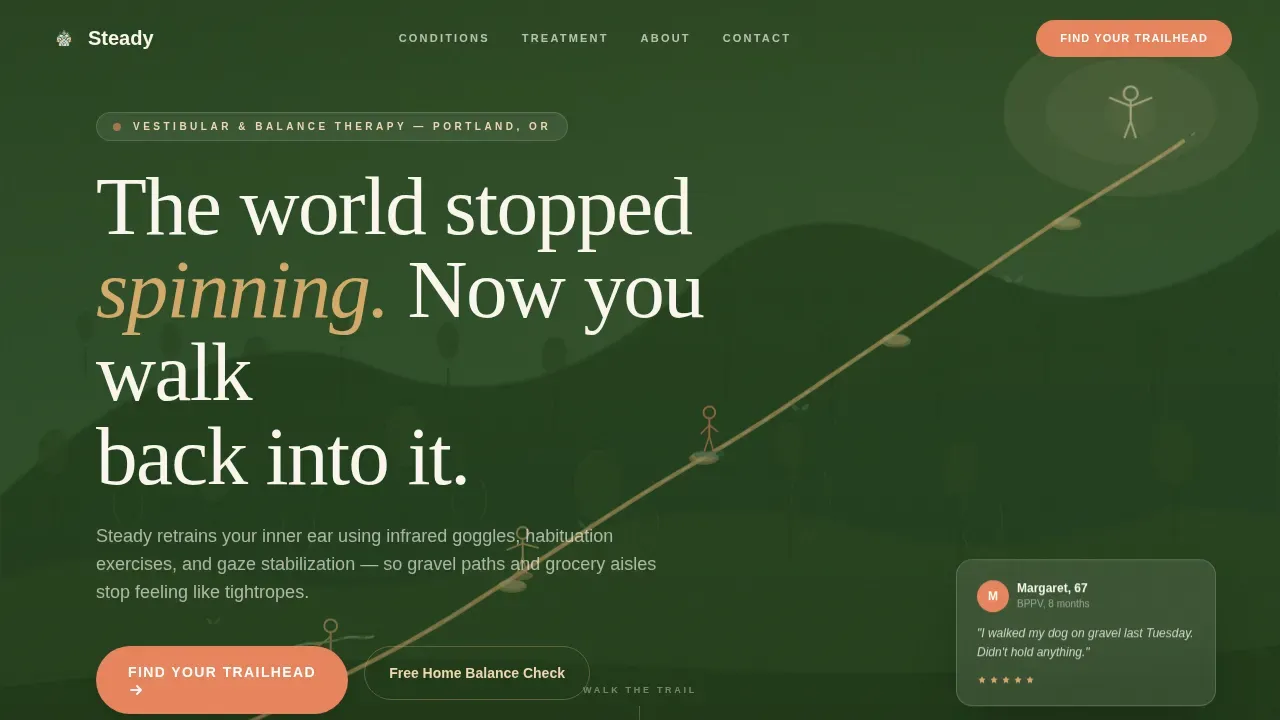
The hero section occupies ninety percent of the viewport and is anchored by a custom botanical ink illustration. A stylized trail winds from the bottom-left to the top-right of the frame, passing through layered terrain rendered in textured, hand-drawn style. Small illustrated figures balance on stepping stones, grip branch-formed handrails, and finally stand open-armed on a ridge. Subtle parallax depth gives the scene a sense of movement as the visitor scrolls. The headline, set in Fraunces serif, reads: "The world stopped spinning. Now you walk back into it." No photography competes with this illustration. It is the brand identity of the landing page itself.
Day-in-the-Life Scroll Narrative
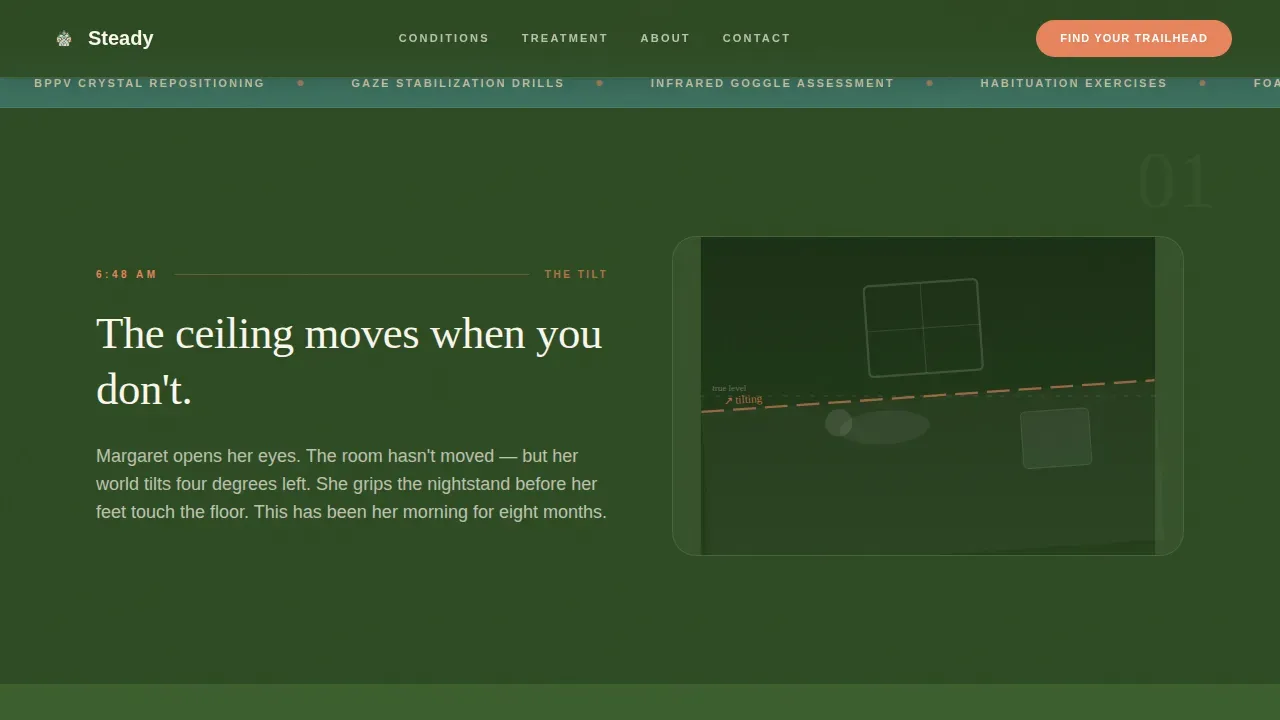
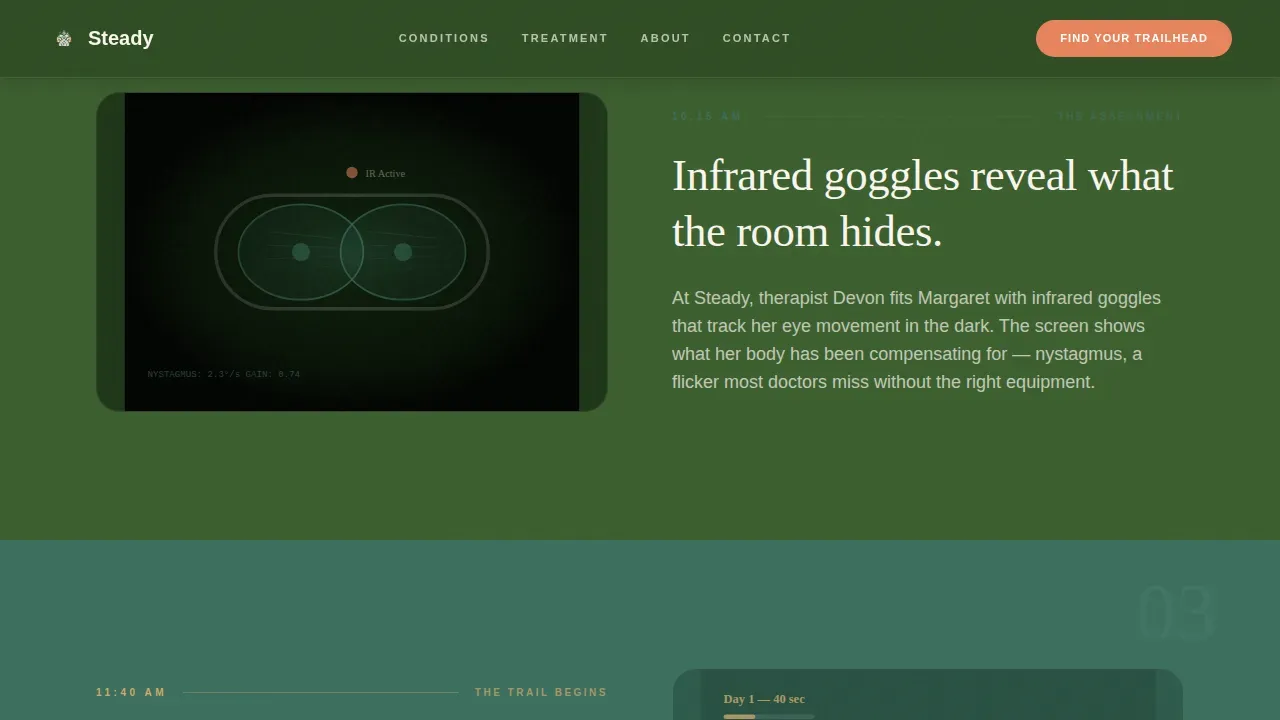
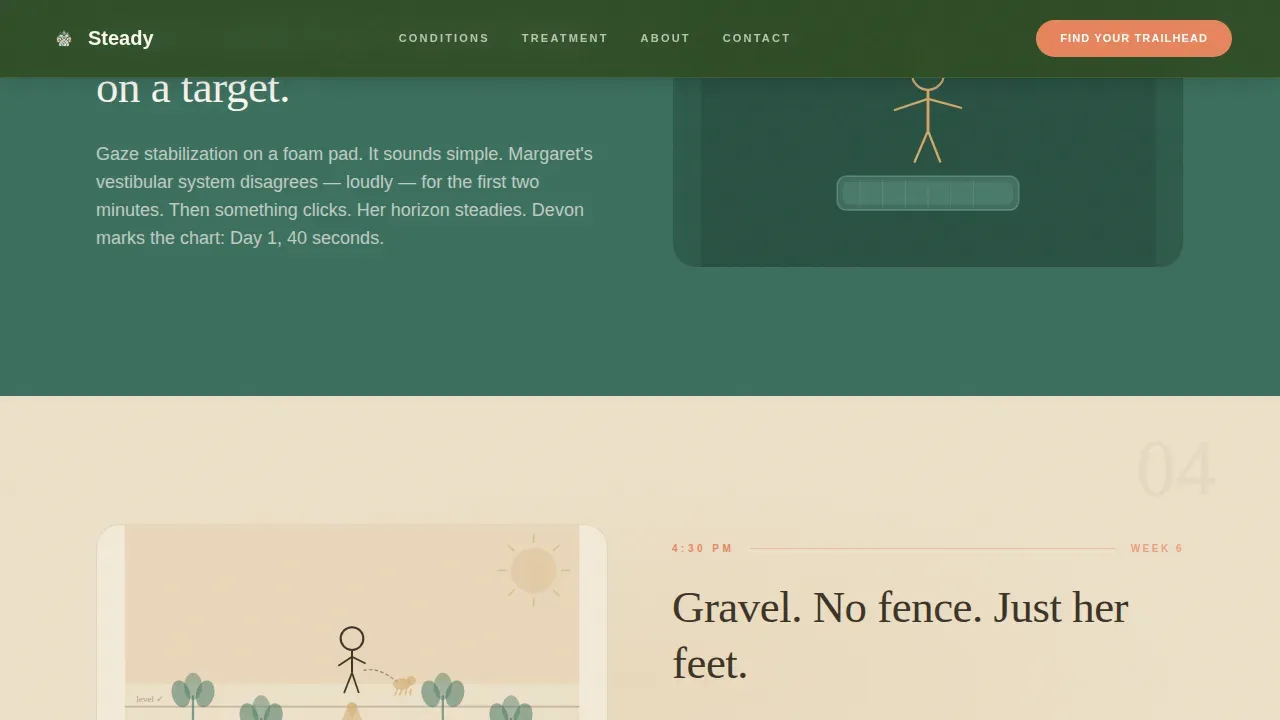
The scroll follows a single named patient from morning to evening. The first zone shows the room tilting at dawn, rendered with a gently skewed horizon line to help visitors feel what dizzy mornings actually feel like. The second zone covers the clinic visit: meeting the therapist, the assessment using infrared goggles, and the warm illustrated vignette of the clinical space. The third zone depicts treatment on the trail metaphor: boulders becoming balance boards, river crossings becoming gait training, foam paths becoming habituation exercise routes. The fourth zone shows the patient walking an uneven garden path at dusk, the horizon perfectly level. Each scroll transition shifts the background color one step lighter, moving from deep trail moss to open sandstone, physically embodying the emotional arc from tension to relief.
Sequenced Lead-Generation Intake Form
The primary conversion element is a short, three-question intake form that sits in the lightest, most open section of the landing page. The form asks visitors about their symptom type, how long their symptoms have lasted, and their preferred appointment window. Each question appears in sequence rather than all at once, reducing friction and matching the calm, step-by-step pace of the broader therapy philosophy. The primary call-to-action button reads "Find Your Trailhead" and anchors directly to this form.
Illustrated Terrain Patient-Type Cards
The Conditions section presents three patient types, each illustrated as a terrain card. This structure helps visitors self-identify quickly, whether they are a post-concussion athlete, an older adult whose doctors confirmed that inner ear crystals have shifted (BPPV), or a migraine sufferer who has been dizzy so long they have forgotten what still feels like. The terrain card format keeps this section visually consistent with the trail metaphor while delivering clinical specificity.
Secondary Download Conversion Path
Not every visitor to a vestibular therapy landing page is ready to book. This template includes a secondary conversion path: a free "Home Balance Check" PDF gated behind a simple email field. This captures leads who need more time, are still researching their symptoms, or want to perform a self-assessment before speaking with a specialist. Interactive self-assessment tools like this are proven to improve conversion rates on physical therapy websites by helping patients determine their readiness before booking.
Scroll-Linked Background Color Transition
The background color is not static. It shifts incrementally through the scroll, starting at deep trail moss at the top and moving through fern-shadow teal to warm sandstone at the bottom. This scroll-linked transition reinforces the Day-in-the-Life narrative arc, giving visitors a subtle, embodied sense of moving forward from the disorientation of a vestibular disorder toward the open, steady ground of recovery.
Page sections overview
| Section | Purpose |
|---|---|
| Hero Trail Illustration | Establishes brand identity and emotional tone with the custom SVG trail, parallax depth, and primary headline |
| Morning Dizziness Zone | Opens the Day-in-the-Life narrative with a skewed horizon showing how vertigo symptoms feel at the start of a day |
| Clinic Arrival Scene | Depicts meeting the therapist and undergoing an inner ear assessment with infrared goggles in a warm illustrated vignette |
| Treatment Trail Sequence | Maps each physical therapy exercise to a trail metaphor: balance boards, gait training, habituation drills on foam |
| Patient Conditions Cards | Presents three patient types as illustrated terrain cards so visitors can self-identify and feel seen |
| Patient Story Pull-Quote | A named testimonial woven through the scroll that narrates the emotional arc from dizziness to steady recovery |
| Lead Generation Form | A sequenced three-question intake form anchored to the "Find Your Trailhead" call-to-action button |
| Secondary Download Path | Email-gated "Home Balance Check" PDF for visitors not yet ready to book an appointment |
| Footer Pattern | Horizontal footer layout with clinic contact information and navigation |
Design & branding system
The visual identity follows an Adventure Terrain theme expressed through a Botanical color system. The palette feels like a field guide held in both hands: earthy botanical ink on soft, fibrous paper with hand-drawn marginalia in burnt orange. Typography is set in Fraunces for headlines and DM Sans for body text, pairing warmth with legibility. Every design decision reinforces the idea that recovery is a trail worth walking.
- Color palette: trail moss (#2D4A22) as the primary, sun-warmed sandstone (#D4A96A) as the secondary, fern-shadow teal (#3B6F5E) for mid-scroll sections, wildflower (#E8845C) reserved exclusively for call-to-action buttons and progress indicators, and weathered bark (#3A3226) for body text
- Illustration style: textured botanical ink with a hand-drawn, layered terrain aesthetic; no photography; the custom SVG illustration carries the full visual weight of the landing page
- Scroll-linked visual transitions: the background shifts from mossy dark at the top to sandstone light at the bottom, creating a spatial metaphor for moving from the disorientation of vertigo symptoms toward open, confident ground
Mobile & speed optimization
Most patients who research vestibular disorders and physical therapy services do so on their phones, often during an episode or immediately after. This landing page template is built desktop-first but includes a strong, fully considered mobile layout. Every illustrated section, the intake form, and the secondary download path are structured to perform well on smaller screens.
- The scroll narrative, background color transitions, and intake form sequence are all designed to function clearly on mobile viewports, with tap targets and form fields sized for ease of use during the research phase
- The hero illustration and terrain cards are structured to reflow gracefully on narrow screens, preserving the visual logic of the trail metaphor without requiring horizontal scrolling
- The landing page uses server components for static content sections and isolates client-side rendering to animations and the interactive intake form, keeping the experience responsive across devices
How this template helps you convert
This landing page is structured around one insight: patients searching for vestibular therapy are often scared, frustrated, and not sure what physical therapy can do for their inner ear symptoms. The template resolves that uncertainty before asking for anything. By the time a visitor reaches the intake form, they have already walked through the full patient journey in illustrated form.
- The Day-in-the-Life scroll narrative builds empathy and understanding first, so visitors arrive at the "Find Your Trailhead" form already feeling that the clinic understands what dizzy days feel like and how therapy can help them walk confidently again
- The sequenced three-question intake form reduces friction by presenting one question at a time, matching the calm, patient pace of vestibular rehabilitation and making it easier for anxious or symptomatic visitors to complete the form without feeling overwhelmed
- The secondary "Home Balance Check" PDF download creates a lower-commitment entry point, capturing email addresses from visitors who need more time before they book, so no potential patient leaves the landing page without a next step
Other information about this template
This template sits within the Wellness and Fitness category, specifically the Chiropractor and Physiotherapy subcategory, and is purpose-built for the Vestibular and Balance Therapy niche. It carries a strong intersection match across its creative direction, color system, and landing-page conversion strategy. The following notes cover additional context useful for clinics evaluating this template.
- Vestibular disorders can be caused by infections, neurological conditions, head trauma, and other conditions such as labyrinthitis and vestibular neuritis; this landing page is written to serve patients diagnosed with any of these underlying causes
- Conditions covered by the template's patient-type cards include BPPV (where the Epley maneuver is a common treatment), post-concussion dizziness, chronic vertigo, and motion sickness triggered by visual environments or passive motion; the template's language can be adapted to describe whichever services your clinic offers
- The brain's ability to compensate for inner ear dysfunction is the clinical foundation of vestibular rehabilitation; the template's narrative arc mirrors this neurological process, beginning in disorientation and ending in stability, so the landing page structure itself communicates how therapy works
- Patients with vestibular disorders often feel isolated because their symptoms, including dizziness, nausea, ringing in the ears, and neck discomfort, are invisible to others; the template's Day-in-the-Life format addresses this isolation directly by naming and illustrating those experiences
- Supporting family members and friends to understand vestibular disorders is part of effective patient education; clinics using this landing page can adapt the patient story section to speak both to the person suffering and to the people who walk alongside them
- The "Home Balance Check" PDF download supports patient education for people who are not yet diagnosed or who are slowly building the confidence to seek help; it gives them something useful while building trust with the clinic
- The negative effect of untreated vestibular dysfunction on day to day life, including falls, withdrawal from activity, and anxiety about moving through public spaces, is addressed through the scroll narrative rather than clinical language alone, making the stakes feel real without being alarming
- The template's Botanical color system and Adventure Terrain theme were selected because they feel grounded and active without the clinical coldness that many therapy website designs default to; the field-guide aesthetic signals that recovery is purposeful, tactile, and absolutely achievable
- The steady find your trailhead vestibular therapy landing page template is available on this platform and is built to be customized with your clinic's name, therapist profiles, specific services, and contact details
- Platforms such as the one offering this template also provide professional, modern website templates suitable for a range of physical therapy and specialty healthcare practices; clinics looking for a broader website solution can explore additional templates alongside this focused landing page
Theme
Adventure Terrain
Creative direction
Day-in-the-Life
Color system
Botanical
Style
Hero-Dominant (90/10)
Direction
Lead Generation
Page Sections
Hero Trail Illustration with Parallax Depth
Day-in-the-life Scroll Narrative
Sequenced Three-question Intake Form
Secondary Email-gated PDF Download
Illustrated Patient-type Terrain Cards
Scroll-linked Background Color System
Related questions
Who are the ideal patients for a clinic using this template?
Can I adapt the intake form questions to match my clinic's intake process?
Does the template include the Home Balance Check PDF or do I need to create it?
Is this landing page suitable for patients who are not yet diagnosed?
How does the scroll narrative help convert hesitant visitors?