AdTech Startup Professional Website Template
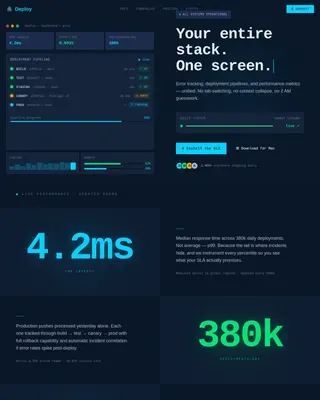
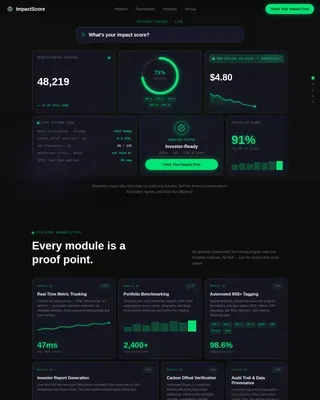
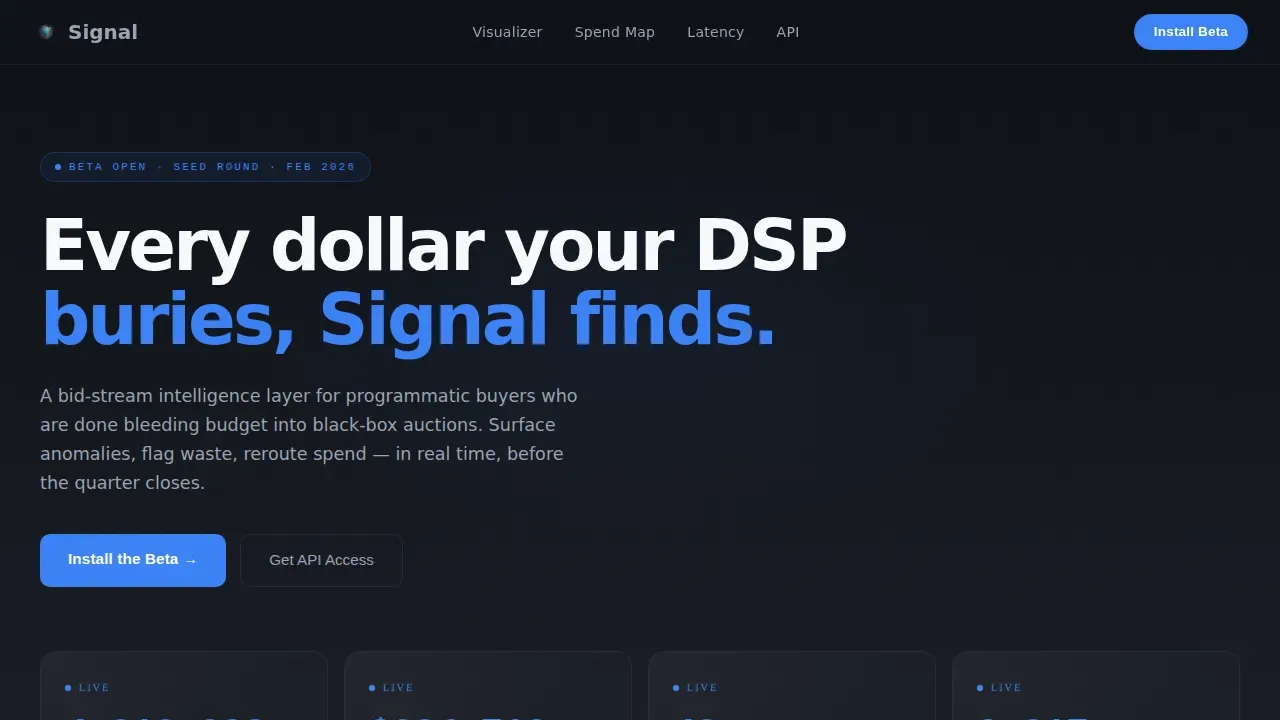
Signal is a scroll-reveal landing page template built for adtech seed-stage startups. It presents a programmatic advertising command center with dark glass panel metrics, an interactive bid-stream visualizer, a spend-leak map, and a latency comparison slider. The design uses a Monochrome Steel palette and drives visitors toward a beta app download or API access signup.
by Rocket studio
Quick Summary
Signal is a single-page, scroll-reveal landing page template designed for an adtech seed-stage startup building a real-time programmatic spend command center. The layout materializes section by section as the visitor scrolls, moving from live-animated hero metrics through interactive explorers to a dark-glass install card. Every element earns the download before asking for it.
Who This Template Is For
This template is purpose-built for founders and product leads who need to communicate a complex programmatic advertising intelligence tool to a technically literate but time-pressured audience. It speaks directly to people who live inside demand side platforms and need proof before they commit to anything.
- Media traders at mid-market agencies managing programmatic ad campaign budgets across multiple tabs simultaneously
- Growth leads at direct-to-consumer brands whose cost-per-acquisition is creeping past breakeven on programmatic ads
- Independent ad ops consultants who bill by the dollar they recover from wasted ad spend
What Problem This Template Solves
Programmatic advertising moves fast. Real time bidding auctions complete in under 100 milliseconds, yet most command dashboards show data that is minutes or hours old. By the time a trader spots a bid-stream anomaly, budget has already evaporated across multiple ad exchanges. A generic SaaS landing page cannot convey that urgency or demonstrate the product's live intelligence layer.
- Visitors cannot trust a static screenshot to prove a real time data product works, so the template replaces screenshots with interactive, anonymized live data throughout the scroll
- The page earns the install by letting potential buyers experience the product before the call to action appears
- A single, focused conversion path removes decision friction for both the beta downloader and the technical buyer seeking API access
What You Get With This Template
You receive a complete, production-ready landing page template structured around five distinct content sections and a footer. Every interaction point is defined in the brief, from the sticky pill call to action in the top rail to the dark-glass install card at the scroll climax. The template is designed desktop-first for media traders on large monitors, with a responsive layout for other devices.
- A hero section with four live-animated dark glass panel metrics, a bid-stream visualizer with draggable channel filter, an interactive spend-leak map, a latency comparison slider, and a call to action climax card with platform toggles and an email field
- JetBrains Mono typography for data labels and monospace counters, paired with DM Sans for body copy and headlines
- A Linear Single-Row footer and a sticky reactor-blue pill call to action that follows the visitor through the entire scroll
Feature List
This template ships with a focused set of interactive and visual features derived directly from the project brief. Each feature is designed to move a skeptical programmatic buyer from curiosity to conviction.
Dark Glass Panel Hero with Live Metric Counters
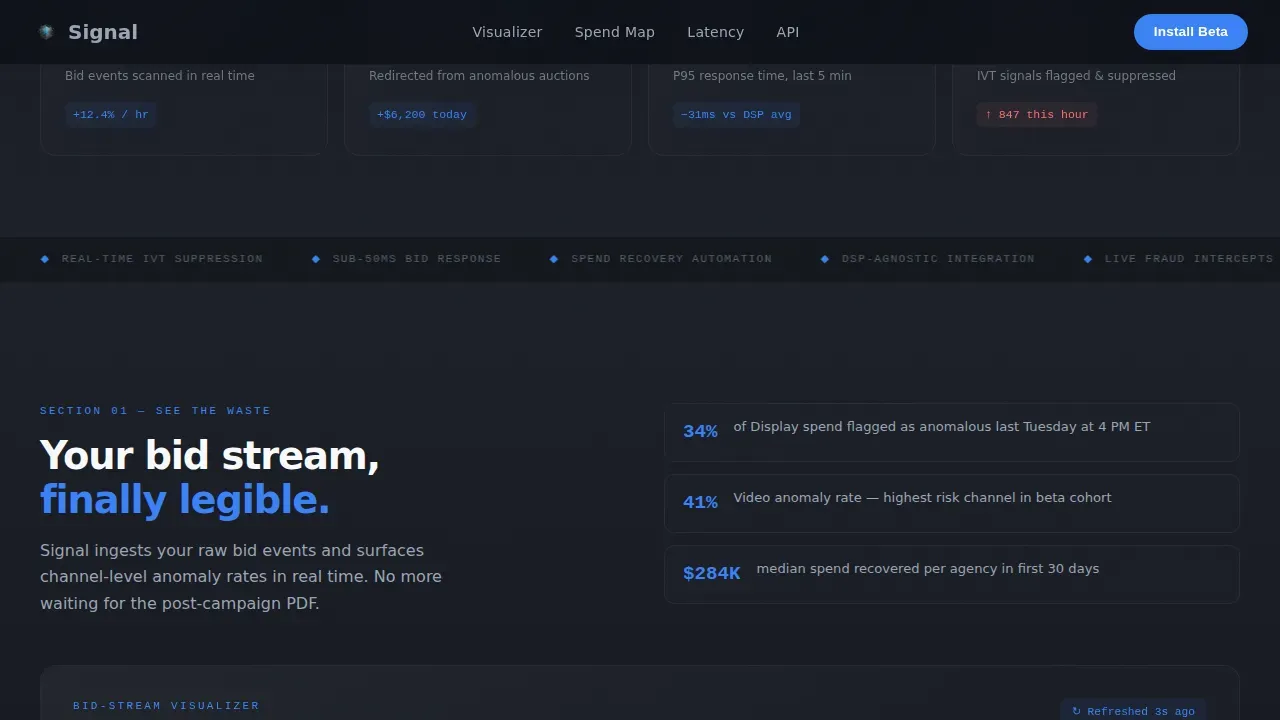
Four translucent, frosted-glass cards float over a near-black void in the hero section. Each panel displays a single live-animated metric: impressions audited, spend recovered, bid latency, and fraud intercepts. The numbers tick upward in reactor-blue monospace type, and cursor movement shifts subtle reflections across the glass surfaces, making the hero feel like peering through a server-room window at your own campaign performance data. There is no hero image and no stock photography. The product interface is the visual.
Draggable Bid-Stream Visualizer
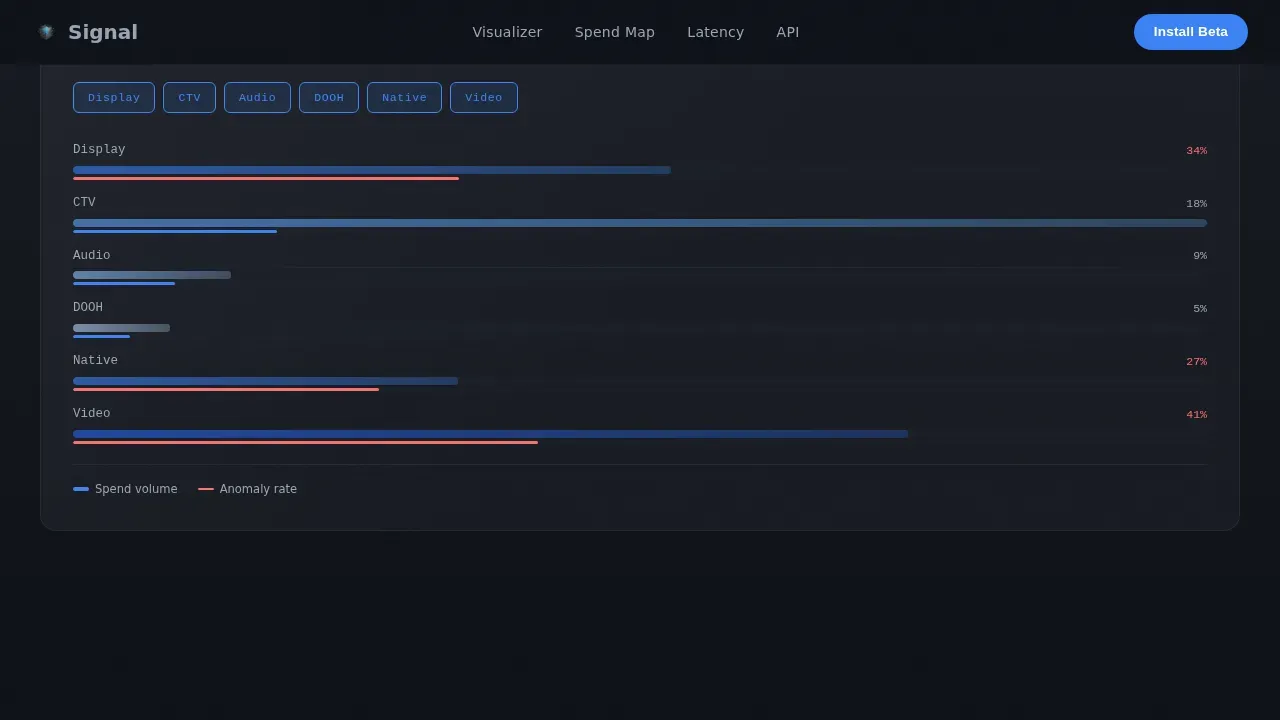
The first interactive section below the hero is a bid-stream visualizer that the visitor can drag to filter by channel. This section surfaces live anomaly data across ad inventory sources, letting the user see exactly where a bid request is losing value. It demonstrates the platform's core capability, showing real time bidding data in motion rather than describing it in bullet points. The section supports the narrative arc of "see the waste" before the visitor moves deeper into the page.
Interactive Spend-Leak Map
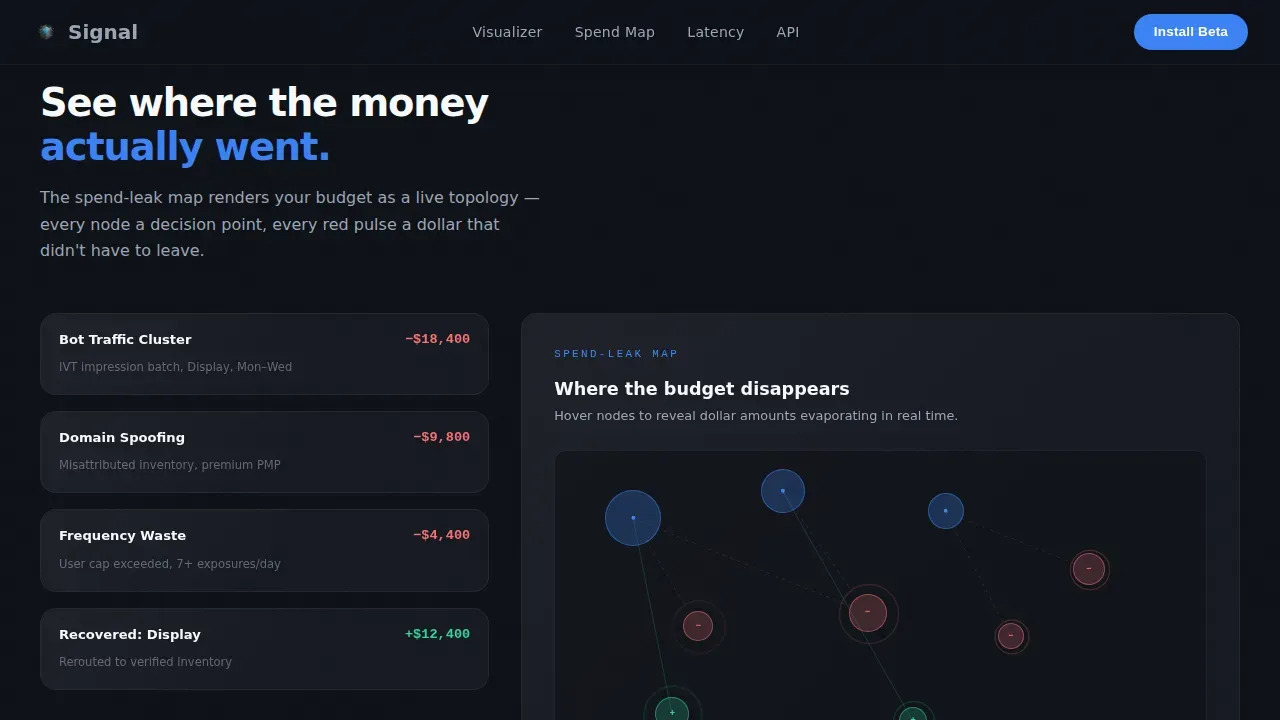
Hovering over nodes on the spend-leak map reveals dollar amounts evaporating across the programmatic advertising supply chain. The map visualizes how ad spend disappears between the ad server, the ad exchange, supply side platforms, and demand side platforms before a single ad impression is ever served. This section quantifies the waste and makes the product's value proposition concrete and personal to anyone managing programmatic advertising campaigns.
Latency Comparison Slider
A draggable slider lets the visitor pit Signal's bid response time against legacy demand side platform DSP response times side by side. This section translates millisecond-level technical differentiation into a tactile proof point. Visitors who understand that the entire real time bidding process completes in under 100 milliseconds immediately grasp why latency matters for campaign goals and bidding strategies.
Dark-Glass call to action Install Card with Platform Toggles
The scroll climax delivers a full dark-glass install card with macOS and Windows platform toggles and a single email field for the download link. A secondary path labeled "Get API Access" targets the technical buyer who wants to pipe the real time data feed into existing dashboards. The sticky pill call to action in the top rail ensures the conversion option is always one click away, even for visitors who decide to install the beta early in the scroll.
Scroll-Reveal Progressive Materialization
Every section materializes from darkness as the visitor scrolls, using an Intersection Observer pattern for reveal timing and request animation frame counters for the live metric animations. The page's structure escalates the narrative from "see the waste" to "quantify the waste" to "watch it disappear," so the scroll itself functions as a guided onboarding experience for the product.
Page Sections Overview
| Section | Purpose |
|---|---|
| Hero Glass Panels | Display four live-animated metrics: impressions audited, spend recovered, bid latency, fraud intercepts |
| Bid-Stream Visualizer | Let visitors drag-filter channel data and observe real time bidding anomalies |
| Spend-Leak Map | Surface hoverable nodes that reveal dollar amounts lost across the programmatic supply chain |
| Latency Comparison Slider | Compare Signal's bid response speed against legacy demand side platforms |
| call to action Install Card | Drive beta app downloads via platform toggles, email field, and API access path |
| Linear Footer | Close the page with a single-row footer pattern |
Design & Branding System
The visual identity runs on a Monochrome Steel color system that feels engineered rather than decorated. Backgrounds graduate from forge black (#0E1117) at the top to brushed gunmetal (#1C2028) as the visitor scrolls deeper. Body text sits in cold alloy gray (#9BA4B5), headlines render in pure white (#F8FAFC), and every interactive element glows in reactor-blue (#3B82F6) on hover, behaving like a status LED waking up on a machined aluminum chassis.
- Forge black and gunmetal backgrounds create the cockpit atmosphere; the reactor-blue accent is reserved exclusively for live data pulses and interactive hotspots
- JetBrains Mono handles all data labels, metric counters, and monospace readouts; DM Sans handles headlines and body copy for clear visual separation between interface data and narrative text
- Cursor parallax on glass panels, counter animations, draggable filter interactions, and hover-reveal nodes are all specified in the brief, making every proof point tactile rather than passive
Mobile & Speed Optimization
The template is designed desktop-first, reflecting the reality that media traders and ad ops professionals typically work on large monitors where bid-stream data, ad impressions counts, and spend charts need breathing room. The layout is built to be responsive for smaller screens without degrading the interactive sections.
- CSS native scroll behavior and Intersection Observer handle section reveal timing, keeping the progressive materialization effect smooth without heavy dependencies
- Request animation frame counters power the live metric animations in the hero panels, keeping counter updates efficient and visually precise
- The desktop-first approach prioritizes the primary user context while the responsive layout ensures the page remains usable when a visitor lands on a mobile app browser or smaller device
How This Template Helps You Convert
The page is structured as a progressive proof sequence. Each section raises the stakes and deepens the visitor's investment before the install card appears. By the time a visitor reaches the call to action climax, they have already interacted with anonymized live data and experienced the product in a limited but meaningful way.
- The hero's live-animated dark glass panels create immediate credibility. A visitor sees real numbers ticking upward in the first seconds on the page, establishing that the platform processes real time data rather than displaying static reports.
- The interactive bid-stream visualizer, spend-leak map, and latency slider each add a layer of hands-on experience. Dragging a filter or hovering over a spend node transforms a skeptical media buyer into an active participant, making the install decision feel like a natural next step rather than a leap of faith.
Other Information About This Template
This section covers additional context that supports buyers evaluating the template for a programmatic advertising intelligence product.
Programmatic advertising automates the process of buying and placing digital ads, making it faster and more efficient than traditional methods. Real time optimization in programmatic advertising allows advertisers to adjust their ad spend and targeting strategies on the fly to maximize campaign performance. Programmatic advertising is projected to reach $779 billion in global spending by 2028, making it the dominant force in modern digital advertising.
A demand side platform DSP is a software system that allows advertisers to buy digital ad inventory from multiple sources in an automated fashion. Demand side platforms empower advertisers to purchase ad impressions that match specific criteria, ensuring their message reaches the most relevant audience members. DSPs can integrate with data management platforms (DMPs) to enhance targeting capabilities through first party data and third party data. DMPs collect, organize, and activate large sets of audience data from various sources, and advertisers use them to create audience segments that are pushed to demand side platforms for targeted programmatic ads.
Supply side platforms (SSPs) enable digital publishers to manage and sell ad space in an automated way. The primary goal of an SSP is to maximize the revenue a publisher earns from their ad inventory. An ad exchange connects the demand from demand side platforms with the supply from supply side platforms, facilitating real time auctions for ad impressions. The ad exchange collects all incoming bids, determines the winner, and notifies the relevant DSP. Modern real time bidding systems handle upwards of 600 billion bid requests per day across multiple ad exchanges.
The RTB process generates valuable performance data that demand side platforms use to refine future bidding strategies, creating a continuous improvement cycle. Dashboards are crucial for real time bidding environments, enabling teams to instantly adjust bids or reallocate budgets. A pacing tracker shows whether a programmatic ad campaign is under-pacing, over-pacing, or on track against campaign goals. Real time visibility allows for instant redirection of funds away from underperforming ad inventory, lowering cost-per-acquisition across programmatic campaigns.
Interactive visualizations such as drill-down charts and heatmaps let users filter data by audience segments or geography. Configurable notifications are triggered by predefined conditions, such as a sudden dip in cost-per-acquisition or a spike in cost-per-thousand impressions. Automated triggers notify users via email or in-app alerts if a key performance indicator drops below a certain threshold. This approach transforms a static dashboard into a proactive management tool, reducing operational costs for advertising efforts across multiple channels.
The Signal real time programmatic spend command center landing page template is designed to communicate all of this infrastructure to a technical buyer in a single, scrollable experience. The template supports ad campaigns spanning display, video ads, connected TV, and mobile app environments. It is suited to programmatic advertising campaigns that need precise targeting, cross device targeting, and accurate targeting across audience segments built from first party data and third party data.
Real world examples from global brands illustrate the power of this approach. Nike's programmatic video advertising campaign used dynamic creative optimization to deliver personalized content to its target audience. Coca-Cola leveraged real time bidding to target specific audience segments during key sporting events, resulting in increased ad recall. Amazon's programmatic display ads effectively reached potential buyers with ads tailored to previous shopping behaviors. Procter and Gamble used programmatic advertising to deliver hyper-targeted ad creatives to precise audience segments. Audi's programmatic video campaign reached diverse target audiences with relevant ad creatives, increasing engagement. Unilever focused on precise audience targeting and achieved high ad recall. McDonald's used programmatic digital display ads for retargeting, driving conversion data upward. Toyota's dynamic creative optimization in their programmatic ad campaign boosted engagement. Spotify designed programmatic audio ads tailored to user behavior and listening habits. Disney's cross-platform programmatic advertising campaign promoted its latest movie across multiple channels, including connected TV and mobile app placements, with strong results.
The template's design supports brand safety messaging within the spend-leak map and anomaly detection sections, enabling advertisers to show how ad fraud is flagged before it consumes ad spend. Enabling advertisers to visualize where their ad delivery is failing, the template builds trust by surfacing ad fatigue signals, ad requests that return no valid bid, and ad formats that underperform across specific audience segments. The page content is structured so that each scroll section adds one more data point to the visitor's understanding of the platform's value, leading naturally to the install card and measurable outcomes for the team adopting it.
- The template uses a Linear Single-Row footer pattern, keeping the page close focused and distraction-free after the call to action
- The sticky reactor-blue pill call to action in the top rail captures visitors who decide to install the beta before reaching the scroll climax
- The "Get API Access" secondary call to action targets technical buyers who want to buy digital ad inventory intelligence by piping the data feed directly into their own ad server or dashboard
Theme
Startup Velocity
Creative direction
Interactive Explorer
Color system
Monochrome Steel
Direction
App Download
Page Sections
Dark Glass Panel Hero with Live Metric Counters
Draggable Bid-stream Visualizer
Interactive Spend-leak Map with Hover Reveals
Latency Comparison Slider
Call to Action Climax Install Card with Platform Toggles
Scroll-reveal Progressive Materialization
Related questions
What is the difference between a DSP and an SSP?
What are the four types of programmatic advertising?
What is the difference between a DSP and programmatic advertising?
How do DSPs and SSPs work together?
Who is this landing page template built for?