Inclusive Nonprofit Mission Landing Page Template
The Advocate template is a zigzag education access nonprofit landing page built for organizations fighting inequitable school funding. It pairs stark policy data with real family stories, guides website visitors through a Hero's Journey narrative arc, and drives a single clear conversion: downloading a practical advocacy toolkit. Deep fern, warm parchment, and persimmon make every call to action impossible to miss.
by Rocket studio
Quick summary
The Advocate template is a fully structured nonprofit landing page designed for education access advocacy organizations. It uses a zigzag alternating layout to move website visitors through a narrative arc, from the funding crisis, through real policy struggles, to a toolkit-powered turning point, and finally to documented transformation. Every section earns the visitor's trust before asking for anything in return.
Who this template is for
This template speaks directly to people who show up because they believe showing up is the work. It is built for organizations whose advocacy efforts sit at the intersection of legal action, community organizing, and policy reform inside the American public school system.
- Parents navigating Individualized Education Program (IEP) denials, enrollment lotteries, or chronically underfunded neighborhood schools
- Public school teachers watching classroom budgets shrink and looking for coalition resources and educational content they can actually use
- Policy staffers and community advocates searching for model legislation, legal templates, and vetted educational resources they can adapt for a state capitol
What problem this template solves
Every non profit has a story worth telling, but many organizations lack a nonprofit website that tells it well. A nonprofit's website serves as a frontline storyteller, fundraiser, and trust-builder, and most off-the-shelf pages fail on all three counts. Nonprofit websites must embody clarity, credibility, and compassion from the very first click, yet generic templates rarely deliver that combination for organizations doing complex advocacy work.
This template solves that directly:
- It replaces a cluttered, purpose-less digital presence with a single-focus nonprofit landing page that communicates the organization's mission within seconds of arrival
- It removes the problem of overwhelming visitors with too many options by anchoring the entire page around one primary conversion, the toolkit download, supported by a secondary ungated policy brief link
- It bridges the gap between emotional storytelling and hard data, so the landing page speaks to parents at a personal level and to policy staffers through rigorous evidence in the same scroll
What you get with this template
This template gives advocacy organizations a ready-to-launch structure that doubles as a resource library, a donor engagement tool, and a public awareness platform, all in one cohesive nonprofit landing page. The page earns every conversion by proving impact before asking for contact information.
- A Hero's Journey narrative layout with five distinct content zones: the crisis, the struggle, the turning point, the transformation, and a footer conversion block
- Prominently displayed calls to action in a persimmon button color that stands out sharply against the parchment and fern palette, making the toolkit download visible without scrolling
- A resource library section with inline win stories attached to each resource link, so visitors understand exactly how each tool has worked in a real advocacy campaign
Feature list
This section covers the core built-in capabilities of the Advocate template. Each feature is grounded in what the prompt describes and what the zigzag content layout delivers.
Rotated Hero Testimonial Card
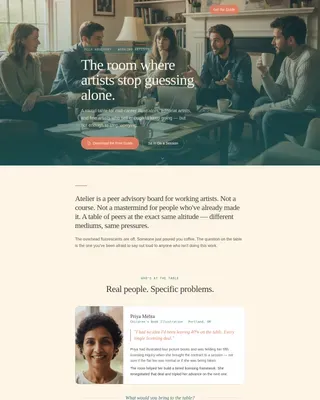
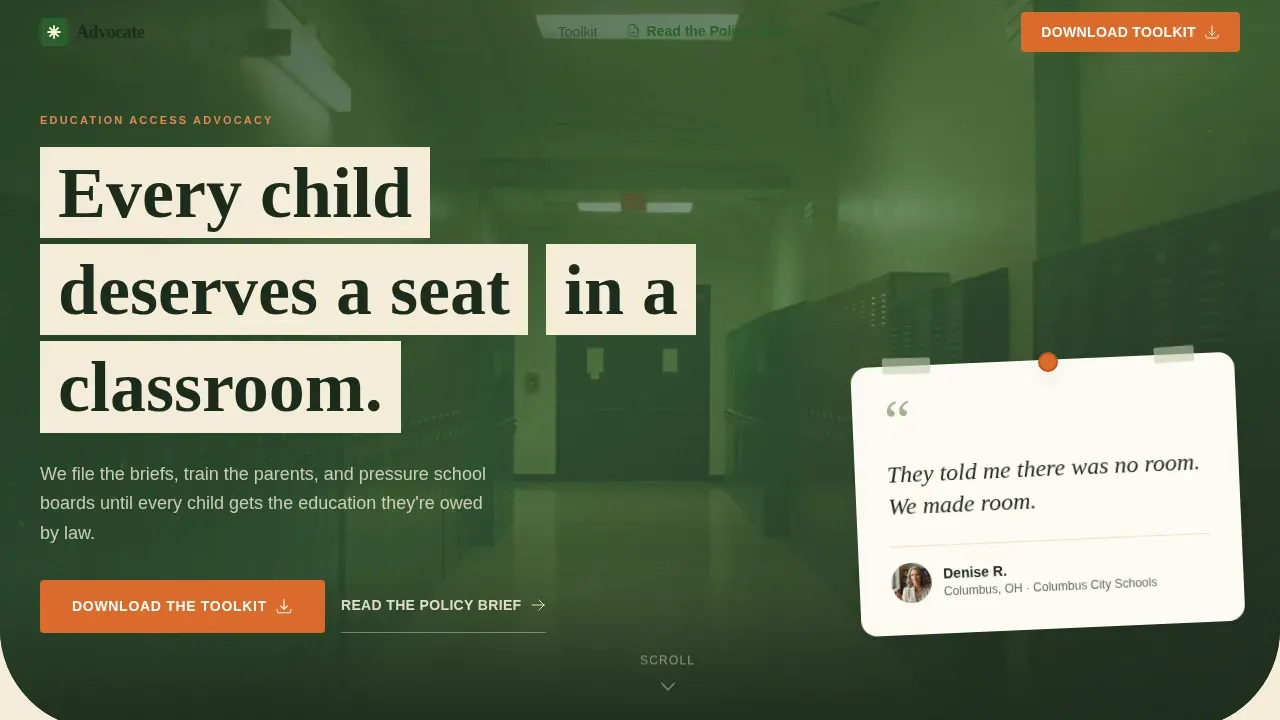
The page opens with an oversized testimonial card slightly rotated as if pinned to a corkboard. A parent's handwritten-style quote appears in a large serif font against a soft-focus school hallway photograph. The card carries a first name, city, and school district below the quote, establishing an emotional connection before a single statistic appears. This approach reflects the principle that compelling visuals and storytelling are essential for engaging visitors on nonprofit websites.
Zigzag Alternating Content Sections
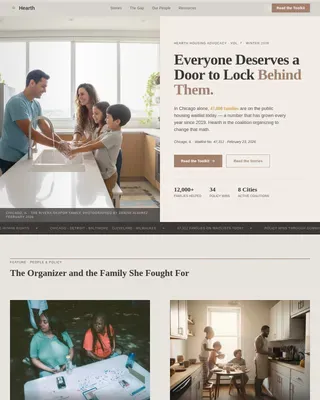
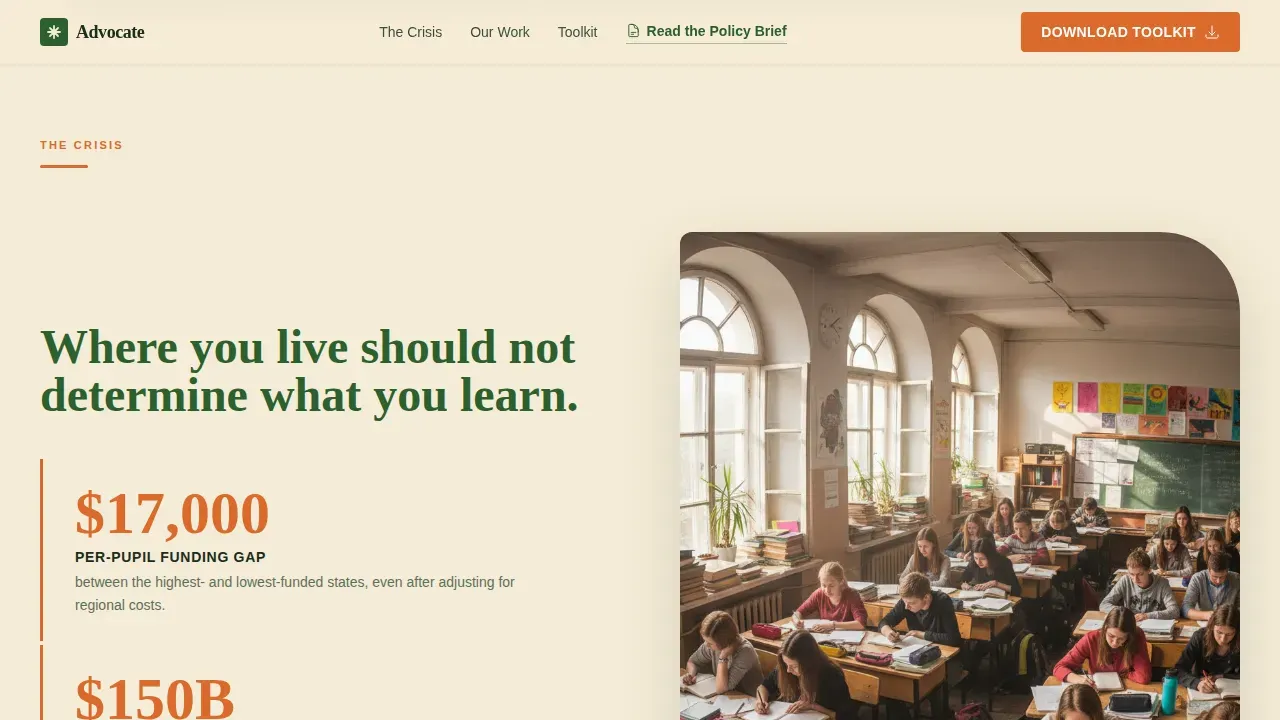
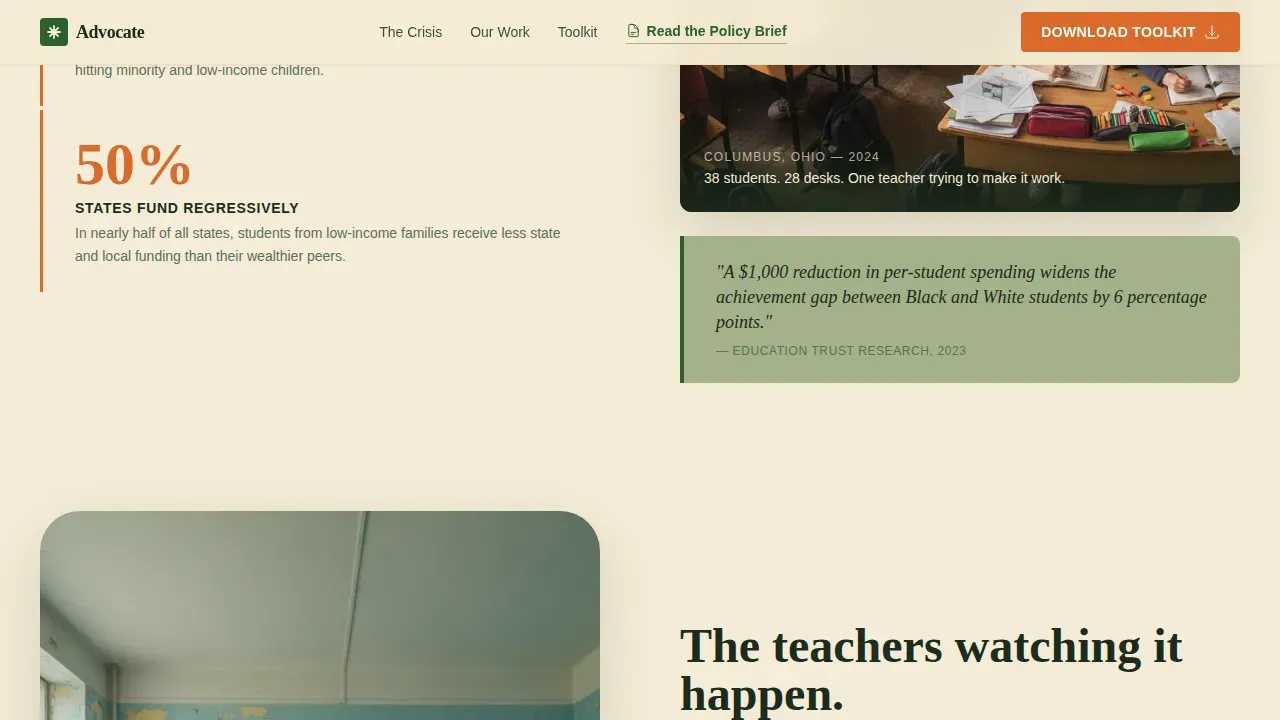
The core layout alternates data and human narrative across five content zones. Funding-gap statistics appear on one side while overcrowded classroom photography appears on the other. Policy battle vignettes, a denied appeal letter, a packed school board meeting, a parent testifying, rotate sides so the scroll feels like a conversation between evidence and experience. This keeps visitors engaged and prevents passive consumption. High quality images and high quality photos are placed intentionally throughout, maintaining visual rhythm and emotional weight.
Toolkit Download Conversion Block
The primary calls to action appear twice: once after the turning-point section and again at the footer. Each instance uses a persimmon-colored button that is prominently displayed against the parchment canvas. The accompanying form requests only four fields, first name, email, role, and state, keeping the donation form principle of limiting fields to what is truly essential. This streamlined approach respects visitor behavior and reduces drop-off.
Persistent Secondary Conversion Path
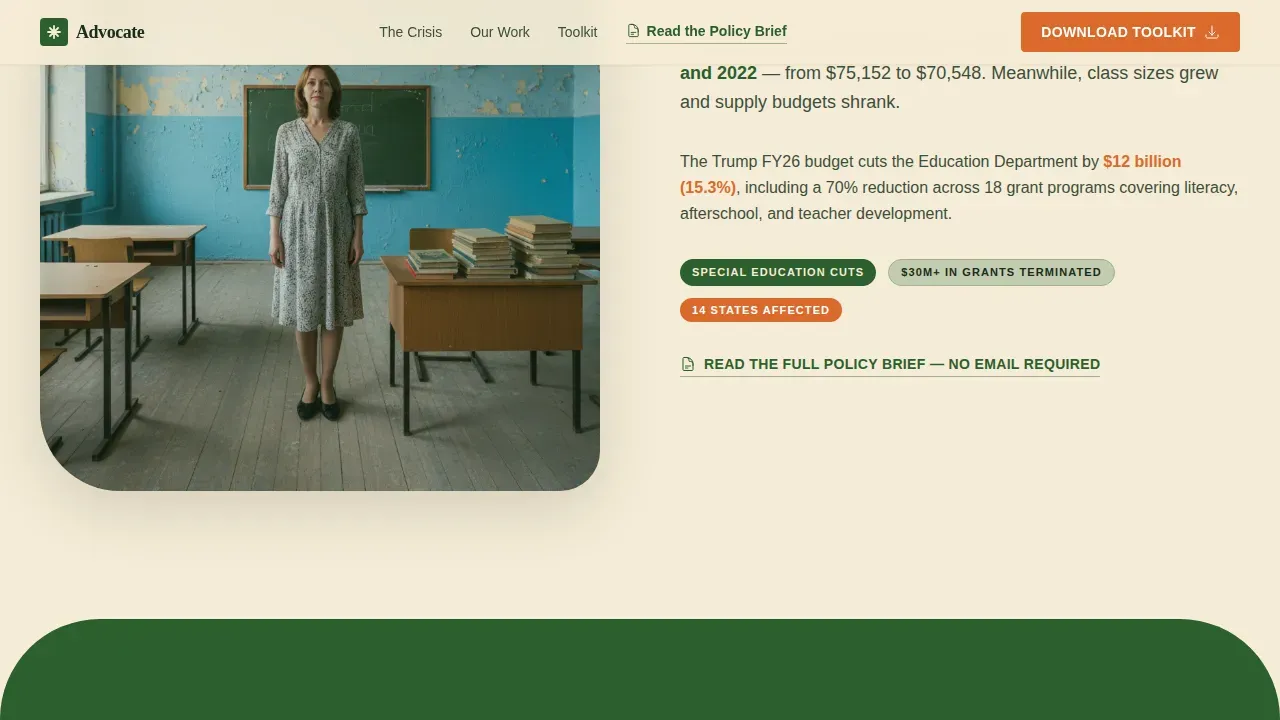
A persistent sidebar link labeled "Read the Policy Brief" offers ungated access to a flagship report. This secondary path builds trust with website visitors who are not yet ready to share contact information. It encourages continued engagement and keeps the resource library accessible without requiring a donation form or sign-up. This dual-path structure means the nonprofit landing page serves both browsers and committed advocates simultaneously.
Outcomes Data and Testimonial Grid
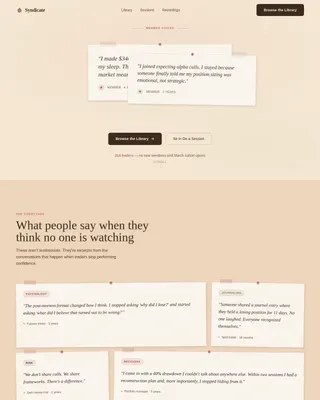
The transformation section displays outcomes data in a bento-style grid alongside a second set of family testimonial cards. Bold numbers convey impact transparently, reflecting the best practice that using bold numbers or infographics can convey impact such as the number of students trained. New success stories are paired directly with the second toolkit download call to action, reinforcing trust at the moment of decision.
Scroll-Triggered Reveal Animations
Staggered zigzag entries and scroll-triggered reveals animate each section into view as the visitor scrolls. Subtle parallax applies to the hero photograph. Hover states activate on resource cards, and an accordion powers the on-page frequently asked question. These interactive features and interactive elements create a sense of depth and momentum without requiring heavy JavaScript or harming load performance.
Page sections overview
| Section | Purpose |
|---|---|
| Hero Testimonial Card | Opens with a rotated parent quote card over a school hallway photo to create instant emotional connection |
| Funding Crisis Zigzag | Pairs stark funding-gap statistics on one side with an overcrowded classroom photograph on the other |
| Struggle Vignettes | Alternating blocks showing real policy battles: IEP denial letter, board meeting photo, parent testimony |
| Turning Point Resources | Toolkit links and legal templates, each preceded by an inline story of a family who used that resource and won |
| First Toolkit call to action | Persimmon button with a short four-field form capturing name, email, role, and state |
| Transformation Bento | Outcomes data grid and second round of family testimonial cards showing documented wins |
| Second Toolkit call to action | Repeated download prompt at the footer, reinforcing the primary conversion before the visitor leaves |
| Arc Browser Footer | Split footer with logo and tagline on the left, navigation links on the right |
Design & branding system
The Advocate template uses a Botanical color system rooted in a Civic Service theme. The palette feels like a field guide pressed between the pages of a civics textbook, earthy, trustworthy, and alive without being loud. Web design choices here are deliberate: every color serves a role, and no element competes with another.
- Deep fern green (#2D5F2E) anchors headers and section backgrounds; warm parchment (#F5ECD7) provides the primary canvas; muted sage (#A3B18A) tones secondary containers and pull-quotes; persimmon (#DA6A2C) is reserved exclusively for buttons and urgent callouts, appearing sparingly so every instance carries weight
- Typography pairs Fraunces serif for headlines with DM Sans for body text, creating the civic warmth of a community library Saturday morning, readable, grounded, and confident
- The engaging design maintains consistency across all zigzag sections, so the intuitive layout guides visitors through the narrative arc without visual confusion or distraction
Mobile & speed optimization
More than 50% of users access nonprofit sites via mobile devices, and this template acknowledges that parents are often reading at school board meetings on their phones. Mobile optimization is built into the layout structure, not added as an afterthought. Responsive design ensures the zigzag sections stack gracefully on smaller screens, and the intuitive navigation remains clear at every breakpoint.
- Buttons are sized for easy tapping on mobile devices, following mobile-first design principles that ensure calls to action are never too small to activate on a touchscreen
- Server Components power the static content sections, while minimal JavaScript handles scroll animations, keeping the page light and reducing the risk of high abandonment rates caused by slow load times
- The intuitive layout adapts across screen sizes without losing the visual hierarchy that makes the page scannable, so a teacher on a laptop and a parent on a phone both get a streamlined user experience
How this template helps you convert
A well-designed nonprofit landing page can significantly increase the likelihood of conversion and engagement. This template is structured around a single, focused conversion path, the toolkit download, with every section building the case for that action. The headline of the landing page immediately communicates the organization's mission and impact, and the design enforces a 1:1 attention ratio by removing competing navigation menus.
- The page moves visitors through a Hero's Journey arc that creates a compelling narrative and a growing sense of collective action, so by the time the first download button appears, the visitor already understands why the toolkit matters and has seen proof that it works
- Calls to action are strategically placed at two high-intent moments, after the turning point and at the footer, and each is supported by a compelling subheadline that reinforces the call to action and addresses urgency without resorting to pressure tactics
- Social proof is layered throughout: testimonial cards, partner logos in the footer, outcomes data in the transformation section, and inline win stories attached to every resource link, because building trust through social proof and success stories can significantly influence visitors' perceptions and decisions at a personal level
Other information about this template
The Advocate template is suited to organizations working across a wide range of equity-related causes, not only school funding. The layout and narrative structure adapt to any cause where evidence and lived experience need to coexist on the same page. Teams looking to create landing pages for gender equity campaigns, legislative action drives, or public awareness initiatives around issues as varied as the global water crisis will find the zigzag structure flexible enough to carry a different story.
- This template supports social media integration through footer link blocks and shareable resource card layouts, helping nonprofit's supporters spread awareness of advocacy campaigns in their own networks
- The donation page pathway can be layered in using the existing call to action block structure: organizations that want to encourage donations or support monthly donations can repurpose the toolkit download form as a donation form with minimal adjustment, keeping the donation process simple and transparent
- Teams can adapt the event calendar and event details blocks within the resource section to promote upcoming community programs, volunteer sign ups, or volunteer opportunities tied to their advocacy campaigns
- The footer's Arc Browser Split pattern supports partner logos and trust signals, making it easy for organizations to display coalition partners and nonprofit's supporters prominently at the bottom of the page
- Educational programs and educational articles can be linked directly from the resource library section, giving the page depth as an educational content hub without overwhelming visitors with too many paths
- For organizations using embedded videos to document policy wins or parent testimony, the zigzag section containers support multimedia elements that fit naturally beside data panels
- The template structure supports custom integration of third-party form tools, and teams with access to analytics can track visitor behavior and use performance data to test calls to action, visuals, and form fields over time, reflecting the best practice of regularly testing different elements to improve conversion rates
- The advocate civic education access nonprofit landing page template is the only template in this collection built specifically for education access non profit organizations operating in the United States public school system
- Non profit organizations and non profit teams of all sizes can use this page without coding skills, since the layout is pre-structured and the design system is self-contained
- The target audience for this template spans multiple roles, parents, educators, policymakers, and journalists, and the four-field form captures role data at sign-up so organizations can segment their outreach from the start
- Engaging educational content, actionable tips in the resource library, and educational resources that link to vetted policy documents all reinforce credibility and support the organization's programs and the broader organization's work
- The page is designed to maintain consistency across all sections, so website visitors who scroll from hero to footer experience a unified digital space that feels as intentional as the cause it represents
Theme
Civic Service
Creative direction
Hero's Journey
Color system
Botanical
Style
Zigzag/Alternating
Direction
Content/Resource
Page Sections
Rotated Hero Testimonial Card
Zigzag Alternating Narrative Sections
Dual Toolkit Conversion Blocks
Persistent Ungated Policy Brief Link
Outcomes Data and Testimonial Bento Grid
Scroll-triggered Reveals and Hover States
Related questions
Who is this landing page template designed for?
Can I adapt this template for a different advocacy cause?
How does the toolkit download form work?
Does this template support a donation page or donation form?
Is the page optimized for mobile devices?