Bench - Curated Operator Staffing Landing Page Template
Bench is a single-column landing page template built for curated staffing agencies that place senior operators into startups within seventy-two hours. It combines warm editorial design with a focused lead-generation flow, featuring operator profiles, a trust-building process section, and a minimal intake form that turns urgent hiring needs into qualified conversations fast.
by Rocket studio
Quick summary
The Bench template is a single-column flow landing page designed for a staffing agency that connects startups with pre-vetted senior talent in seventy-two hours. Every section builds trust through real faces, real outcomes, and a frictionless form. The layout guides a hiring manager from first impression to submitted lead without distraction.
Who this template is for
This template is built for staffing founders, recruitment leads, and operators who want a high-converting page that speaks directly to time-pressured startup decision-makers. It suits any business that places senior contractors or interim employees into growth-stage companies.
- Staffing agency owners launching a curated talent placement service
- Recruiters and talent teams offering interim or fractional operator staffing
- Founders or heads of people building a bench-driven recruitment platform for startups and scale-ups
What problem this template solves
When a critical role opens without warning, most companies lose days to slow recruitment processes, bloated job search tools, and cold candidate pipelines. This template addresses that urgency head-on. It gives a staffing agency a focused, trustworthy web presence that converts panicked hiring managers into confident leads.
- A chaotic hiring process wastes runway and delays projects at exactly the wrong moment
- Generic staffing website pages fail to communicate speed, curation, or the human quality of the bench
- Visitors need proof before they commit, and most templates bury it or skip it entirely
What you get with this template
You get a complete, ready-to-customize single-column landing page that plan out every beat of a high-urgency staffing pitch. The template is structured so recruiters can publish quickly without rebuilding from scratch for every campaign.
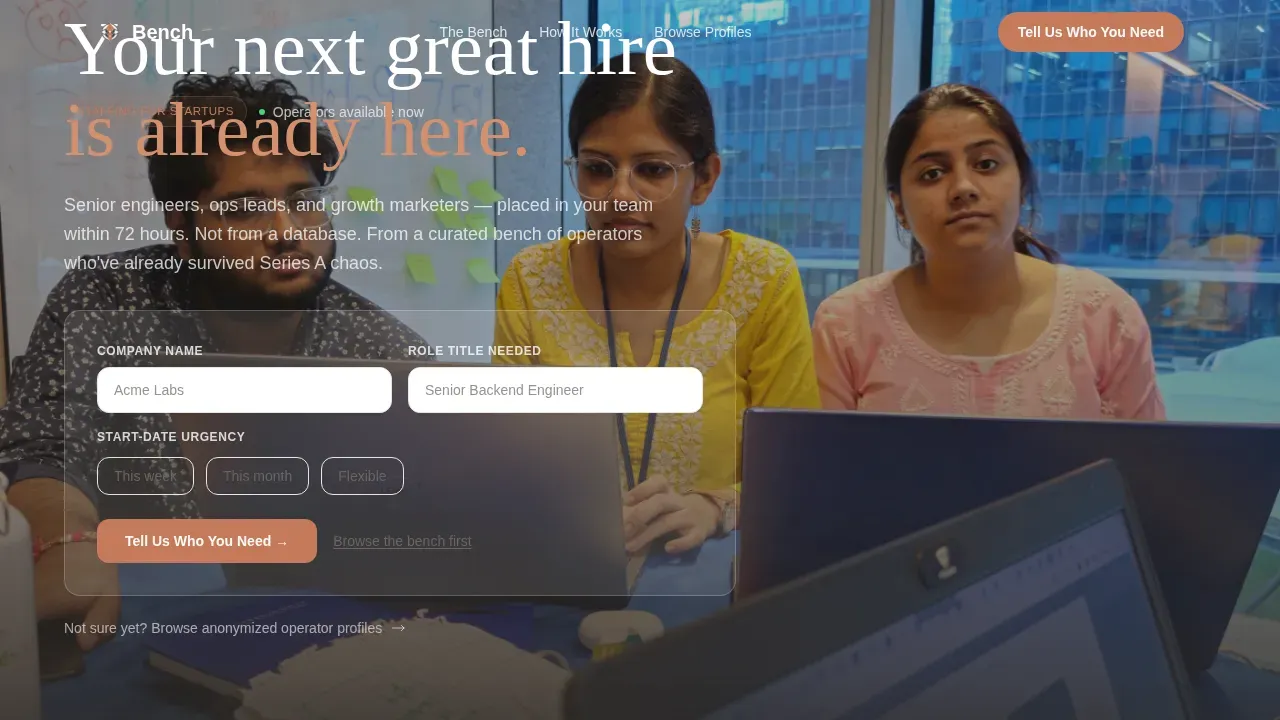
- A cinematic hero section with a fade-in headline and an ember-accented lead form
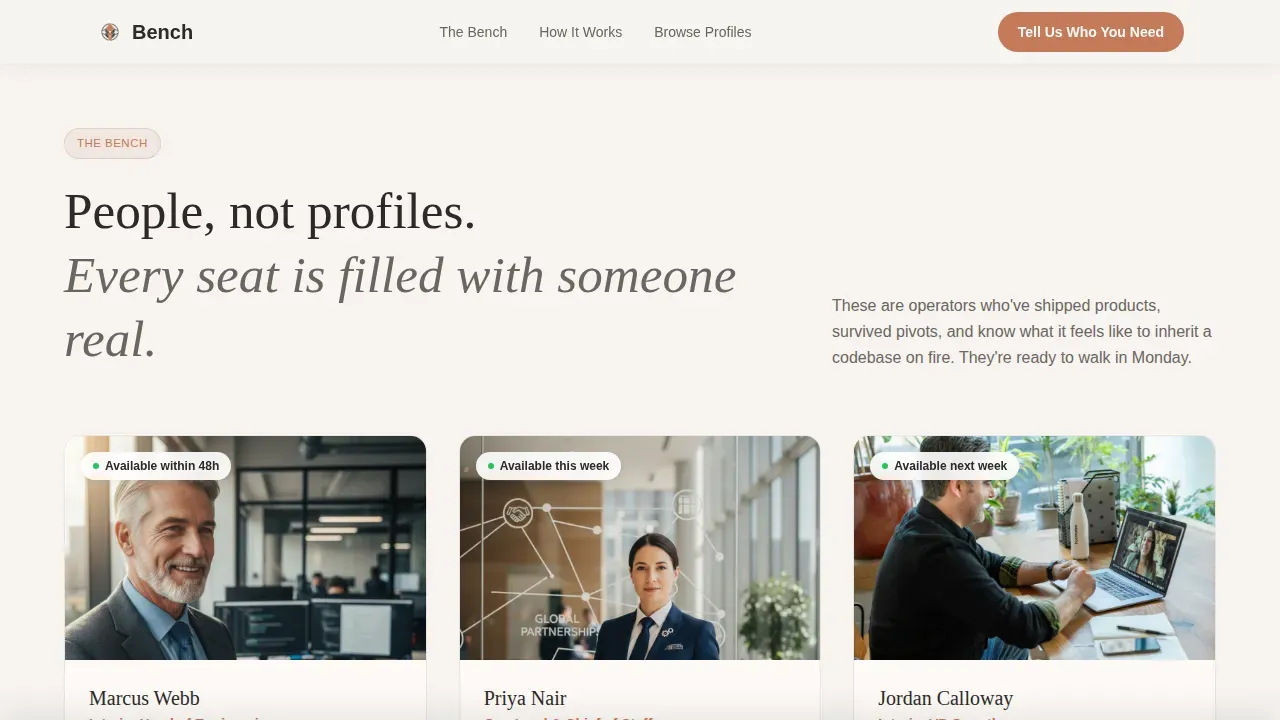
- Three named operator profile cards with role history and one-sentence social proof quotes
- A process section illustrated with candid conversation artifacts and a secondary "Browse the Bench" path
Feature list
This template identifies clear conversion opportunities at every scroll point and equips your staffing business with the resources to act on them.
Cinematic Hero with Integrated Lead Form
The hero opens with a wide-format team photo at eye level, shallow depth of field, and the headline "Your next great hire is already here" fading in over warm imagery. Directly below sits the primary form: company name, role title, and an urgency selector for this week, this month, or flexible. Minimal fields keep friction low and encourage submissions from busy candidates and clients alike.
Named Operator Profile Cards
Three operator cards display real names, roles previously filled, and a one-sentence quote tied to a specific company outcome. Each card supports hover states that reveal further detail. This section builds bench credibility faster than any bullet list of services, because a hiring manager trusts a face and a result over a claim.
How It Works Process Section
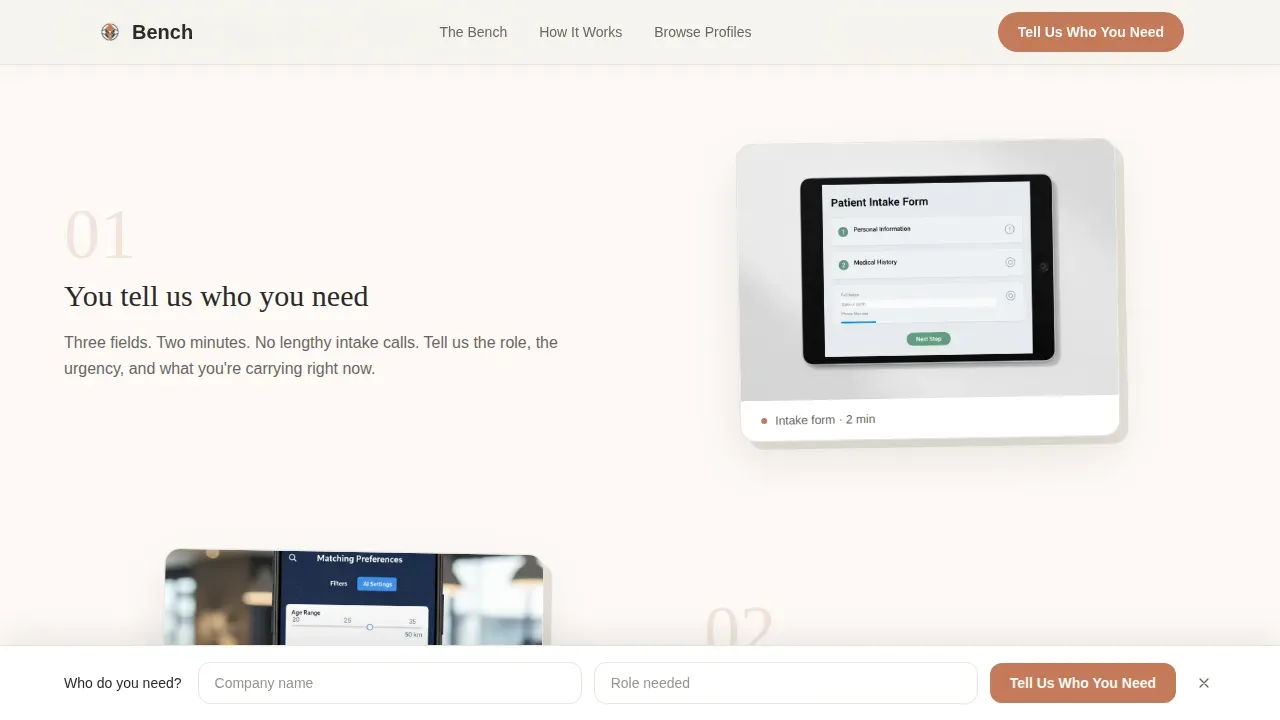
The process section uses cropped photos of actual working moments rather than abstract icons. A Slack thread screenshot, a video call frame, and a handwritten onboarding checklist illustrate each matching step. This approach gives visitors a tangible sense of how the staffing system operates and where their data goes after they submit the form.
Sticky Bottom Call-to-Action Bar
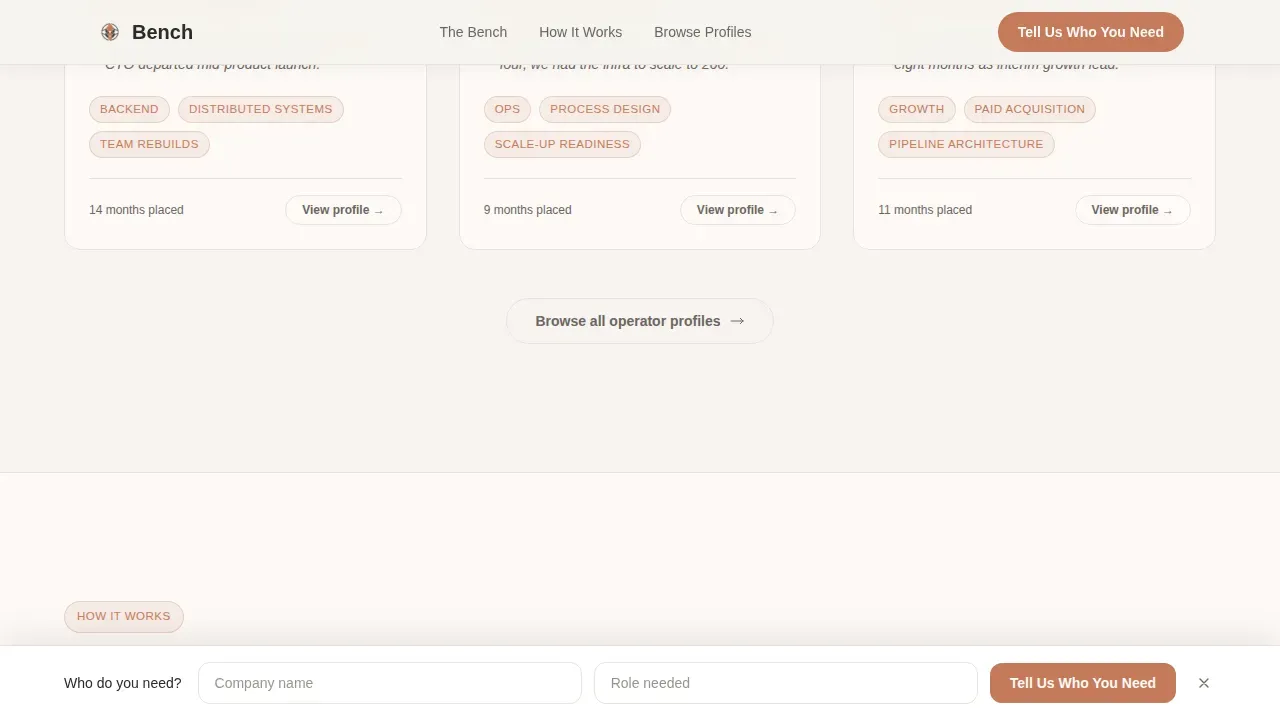
After the second scroll, a sticky bottom bar keeps the primary call to action visible throughout the rest of the page. The bar carries the same ember accent color as the hero form button, maintaining visual consistency. Users who scroll to evaluate the bench still have an immediate path to begin the conversation.
Social Proof and Metrics Section
A dedicated trust section displays specific outcomes: role titles filled, time-to-placement data, and company-type references with named metrics. Including credible metrics adds authority and supports strategic workforce planning conversations with skeptical founders. This section helps track the staffing agency's record in a format that decision-makers can scan in seconds.
Secondary Browse Path
A "Browse the Bench" link leads to anonymized operator profiles for visitors who want to evaluate talent before committing. This secondary path captures leads who are in an early research phase. It also supports a more proactive recruitment process by letting potential clients self-qualify before speaking to a manager.
Page sections overview
| Section | Purpose |
|---|---|
| Hero with Form | Deliver headline, photo, and primary lead capture |
| Operator Profile Cards | Showcase real talent and build immediate trust |
| How It Works | Illustrate the matching and onboarding process |
| Social Proof Block | Present outcomes, metrics, and company references |
| Call-to-Action Form | Repeat primary form and offer secondary browse path |
| Footer | Provide linear single-row links and contact details |
Design & branding system
The visual identity follows a Community Hearth theme using a Cloud Canvas color system. The palette feels like a well-worn linen notebook on a reclaimed-wood desk: nothing competes, everything breathes. Typography pairs Fraunces serif headings for warmth with DM Sans body text for clarity.
- Warm white (#F7F4F0) dominates backgrounds; hearthstone gray (#6B6560) anchors dividers and secondary type
- Muted ember (#C47A5A) lights up calls to action, hover states, and sticky bar buttons
- Deep charcoal (#2C2926) carries all primary body copy and headings that need weight
Mobile & speed optimization
The template is built desktop-first to serve CTOs and founders browsing during the workday, but it carries full mobile support so no lead is lost to a broken layout on a smaller screen. The page layout is optimized for fast rendering with server components handling static sections and minimal client-side code for interactive elements.
- Scroll reveals use staggered cubic-bezier animation to feel smooth without adding heavy scripts
- Sticky bottom bar and operator card hover states are implemented with lightweight interactivity
- Photo parallax in the hero section is handled efficiently to keep the page feeling fast and focused
How this template helps you convert
The entire page is structured around one primary goal: fill the intake form. Every design and layout decision supports that action without pulling attention elsewhere.
- The hero form appears above the fold so the first step for any visitor is immediately clear, with the urgency selector making the submission feel relevant to their timeline
- The sticky bottom bar keeps the call to action visible after scroll, so a hiring manager who paused to read operator profiles can convert without scrolling back up
- The "Browse the Bench" secondary path captures future leads by letting cautious visitors build confidence before they commit, reducing drop-off without sacrificing focus
Other information about this template
This template is part of a broader family of staffing templates designed for companies that need to move fast without sacrificing quality. It can support strategies across multiple departments by acting as a modular base that teams can customize per role category or business unit. Recruiters who plan campaigns around specific operator competencies will find the layout easy to adapt without touching the underlying code structure.
- The bench curated operator staffing landing page template concept applies beyond startups; it maps well to any staffing agency placing senior contractors in transportation, logistics, or manufacturing where operator credibility is a key hiring metric
- Human resources and people operations teams can use this template structure to develop internal talent pages that track bench-ready candidates and support succession planning
- Strategic workforce planning ideas translate naturally into the page's process and social proof sections, giving organization-level buyers the data and narrative they need to plan approvals
- The template store allows you to publish this layout as-is or customize it per campaign, helping teams implement faster and monitor progress across multiple active projects
- A supervisor or office manager can act as the page owner, maintaining form routing, monitoring submissions, and updating operator profiles without needing developer support
- Proactive staffing strategies benefit from automation in form routing so no inbound lead waits longer than necessary for a first response
Theme
Community Hearth
Creative direction
Team & People
Color system
Cloud Canvas
Style
Single Column Flow
Direction
Lead Generation
Page Sections
Cinematic Hero Section with Lead Form
Named Operator Profile Cards
Illustrated How It Works Section
Sticky Bottom Call-to-action Bar
Social Proof and Metrics Block
Secondary Browse the Bench Path
Related questions
Can I customize the operator profile cards with my own team data?
How does the urgency selector in the lead form work?
Is this template suitable for staffing agencies outside the startup sector?
What is the Browse the Bench secondary path for?
Does the sticky bottom bar appear on mobile as well as desktop?