Complete Public Transportation Professional Website Template
Berth is a civic-grade landing page template built for deep-water port authorities. It uses a zigzag alternating layout to balance mandate with operational proof, guiding shipping agents, freight forwarders, and importers toward a structured berth request form or tariff download. The design speaks with institutional confidence from the first line to the final call to action.
by Rocket studio
Quick summary
Berth is a single-page template designed for port and maritime authorities. It opens with a full-viewport serif manifesto, then alternates between civic declarations and operational evidence across five paired sections. The layout builds jurisdictional credibility before asking anything from the visitor, so every form submission feels like contacting a public institution rather than completing a sales funnel.
Who this template is for
This template serves organizations that manage working harbors and need to communicate both civic purpose and operational precision to a professional audience. It is built for teams that field daily inquiries from commercial maritime operators.
- Port authorities and harbor management bodies publishing official berth availability and tariff information
- Shipping line agents, freight forwarders, and importers researching vessel scheduling and cargo clearance windows
- Municipal or regional planners who need a credible public-facing presence for waterfront and trade corridor communications
What problem this template solves
Port authority web presences often fail in one of two directions. They either look too corporate and lose public trust, or they look too governmental and lose commercial usefulness. Berth solves both problems at once.
- Stakeholders cannot find berth scheduling, tariff structures, and dwell-time fee information in one clear place
- The authority has no structured digital path for capturing vessel details, cargo type, and agent contact information before a berth window is confirmed
- There is no visual language that communicates both civic mandate and live operational credibility to a professional maritime audience simultaneously
What you get with this template
The template delivers a fully structured single-page layout with every section pre-built and logically sequenced. Nothing needs to be created from scratch; the architecture is ready to receive real port data and go live.
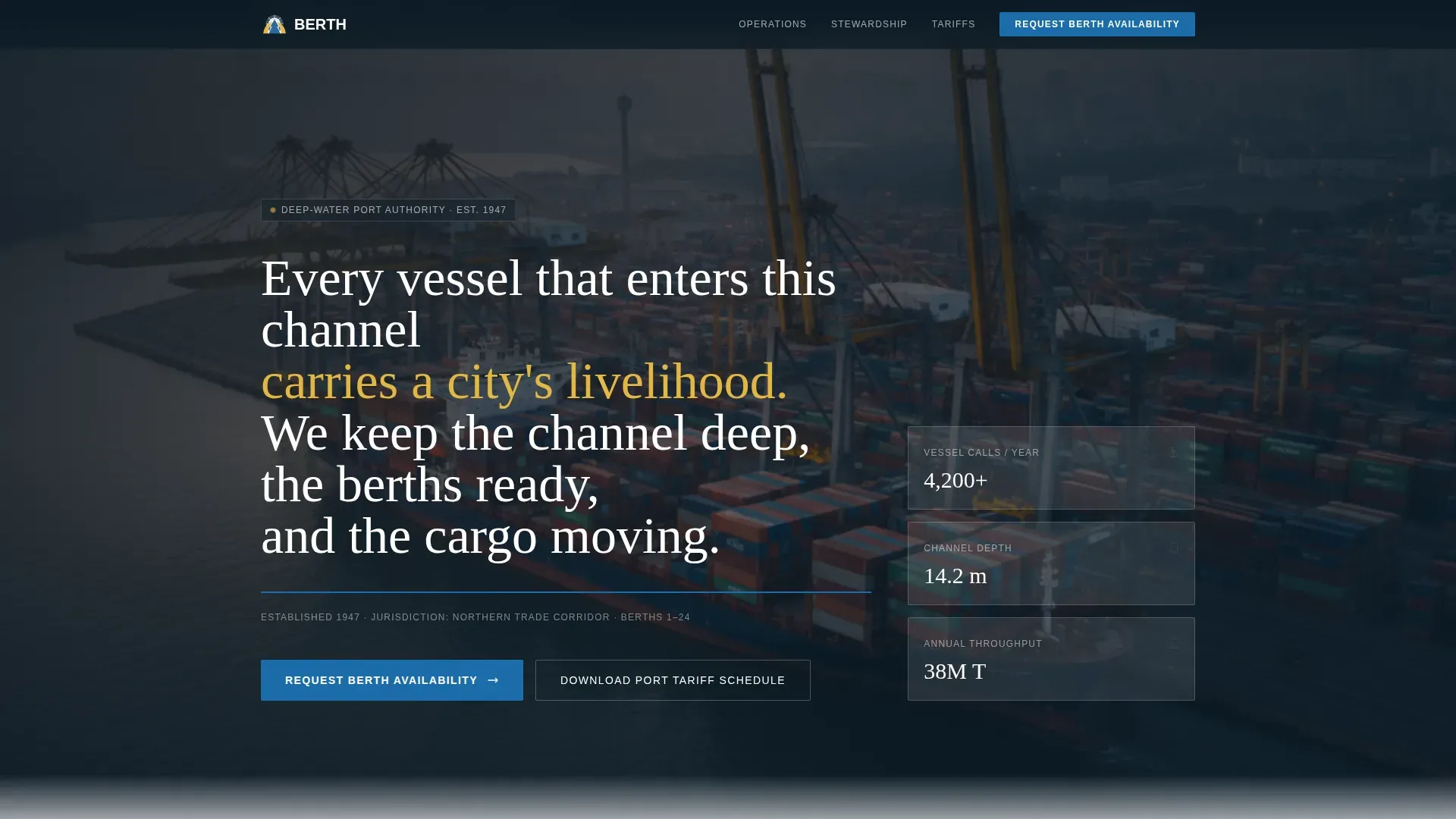
- A cinematic hero section with a civic serif manifesto, glassmorphic stat cards, and a persistent top-bar call-to-action button reading "Request Berth Availability"
- Five alternating zigzag content sections covering safe passage mandate, vessel traffic operations, environmental stewardship, channel and infrastructure data, and a combined berth request form with tariff download
- A linear single-row footer rounding out the institutional layout
Feature list
This section covers the core built-in capabilities that make Berth work as a professional port authority landing page.
Zigzag Alternating Section Layout
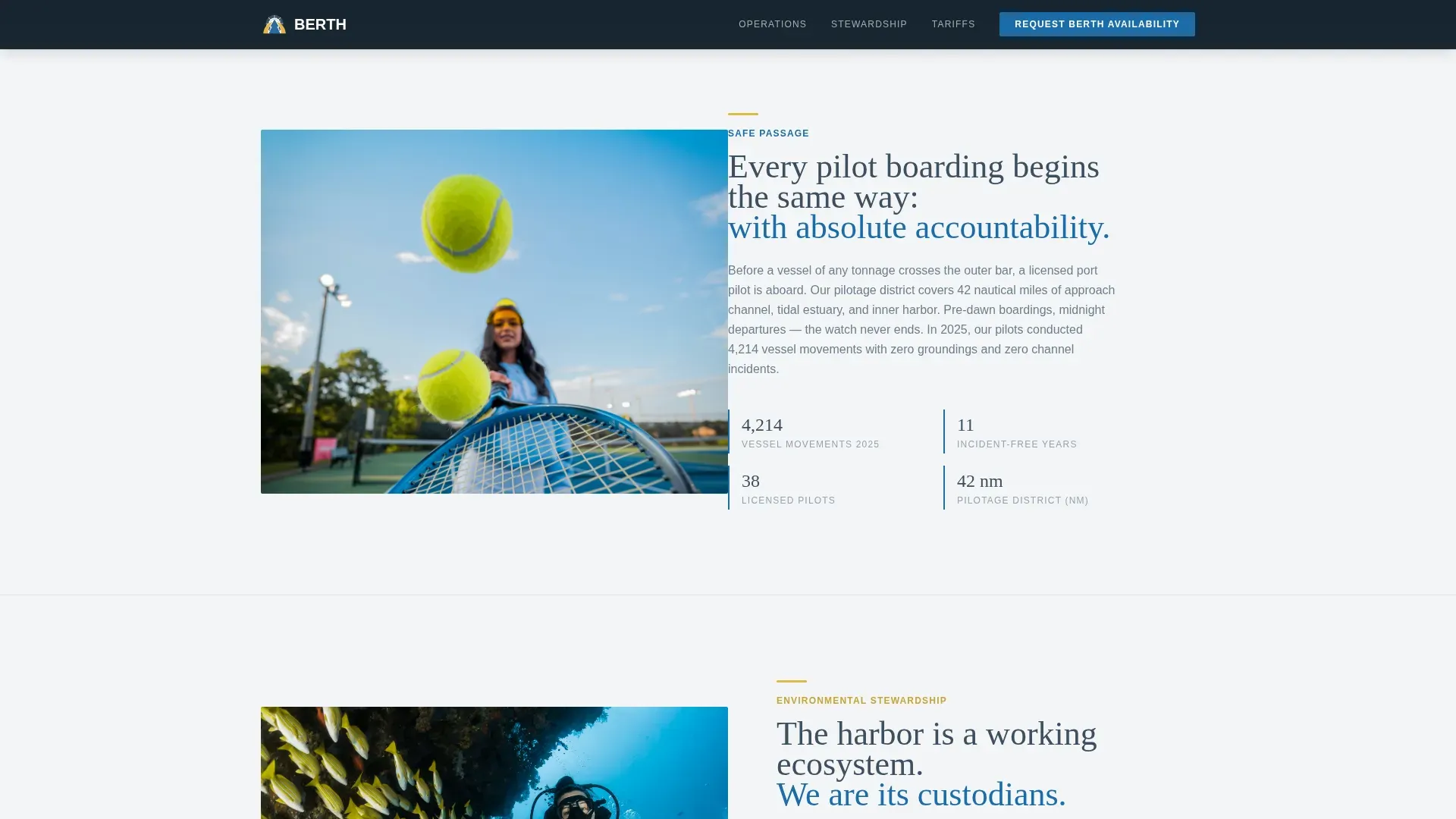
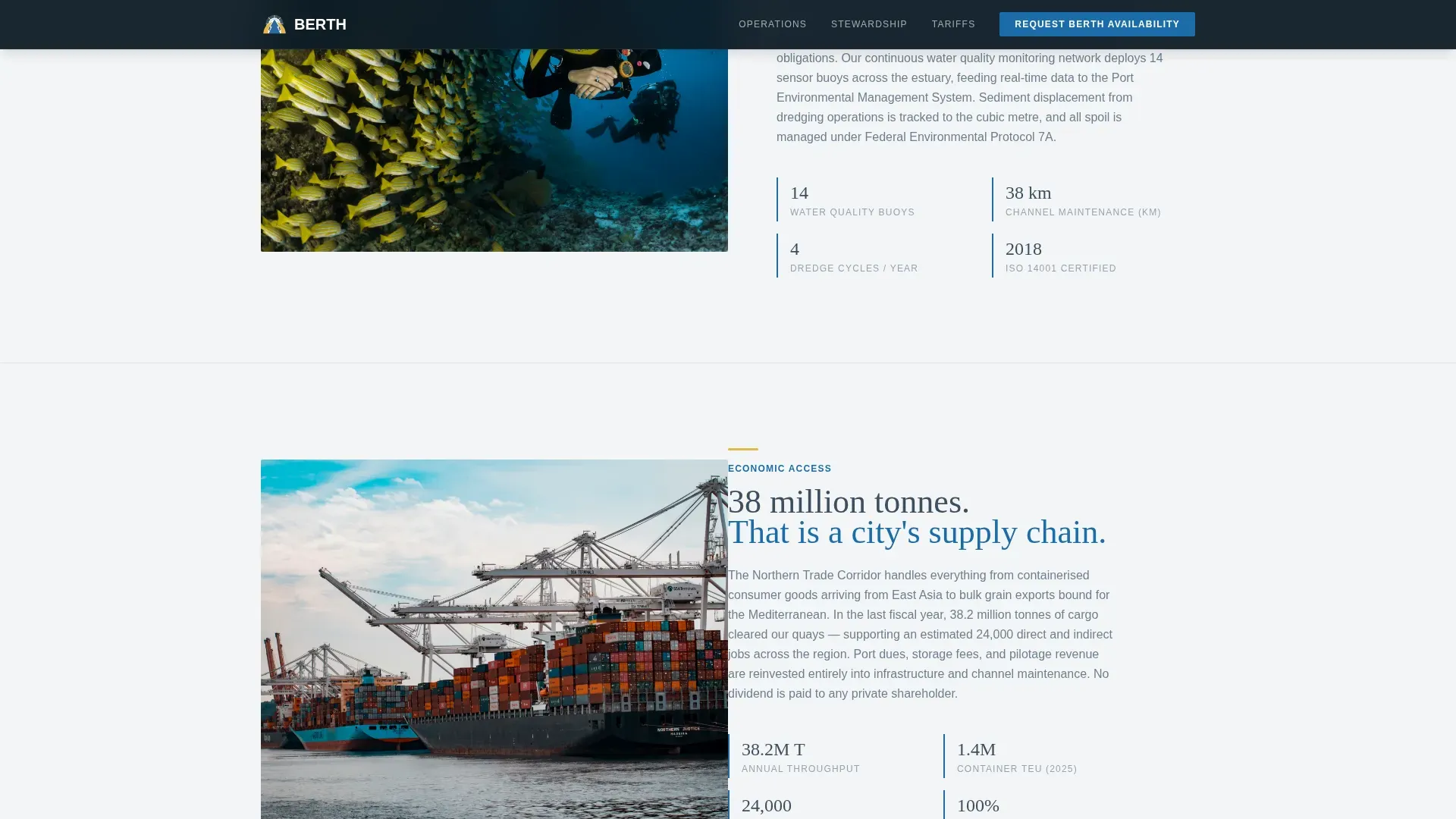
Each content pair zigzags left and right, mirroring the rhythm of an annual report. Left-aligned sections present the civic mandate in plain declarative language. Right-aligned sections answer with operational proof: vessel traffic figures, channel depth data, and tonnage throughput. The alternating structure keeps the scroll purposeful and escalating in scale.
Full-Viewport Serif Manifesto Hero
The hero opens with three lines of large serif type set against cloud white. The civic declaration reads like text etched into a public building's lintel. Below the text, a thin signal-blue rule separates the statement from the authority's founding year and jurisdiction in small caps. No image competes with the words.
Persistent Top-Bar Call to Action
A "Request Berth Availability" button lives in the top navigation bar throughout the entire scroll. It stays visible whether the visitor is reading the mandate sections or reviewing infrastructure data, reducing friction for users who are ready to act before reaching the form.
Structured Berth Request Form
The lead generation form at the base of the page collects vessel name, length overall (LOA) and draft, preferred arrival window, cargo type via a dropdown (container, bulk, liquid, roll-on/roll-off, and cruise), and agent contact details. The form is built to feel institutional, not promotional.
Tariff Download Secondary Path
A "Download Port Tariff Schedule" prompt captures email addresses from stakeholders who are researching costs but not yet ready to schedule a berth. This secondary path ensures the page generates value from every visitor type, not just those booking immediately.
Scroll-Triggered Reveal Animations
Sections use scroll-triggered reveals, staggered fade-ins, and image hover zoom effects. The animation level is intentionally moderate, consistent with the documentary maritime tone. Motion draws attention to data points without undermining the page's institutional gravity.
Page sections overview
| Section | Purpose |
|---|---|
| Hero Manifesto | Establishes civic authority with full-viewport serif declaration and stat cards |
| Safe Passage Mandate | Left-aligned civic declaration on navigational safety and public duty |
| Vessel Traffic Operations | Right-aligned operational proof with vessel traffic numbers and scheduling data |
| Environmental Stewardship | Left-aligned mandate covering harbor environmental monitoring responsibilities |
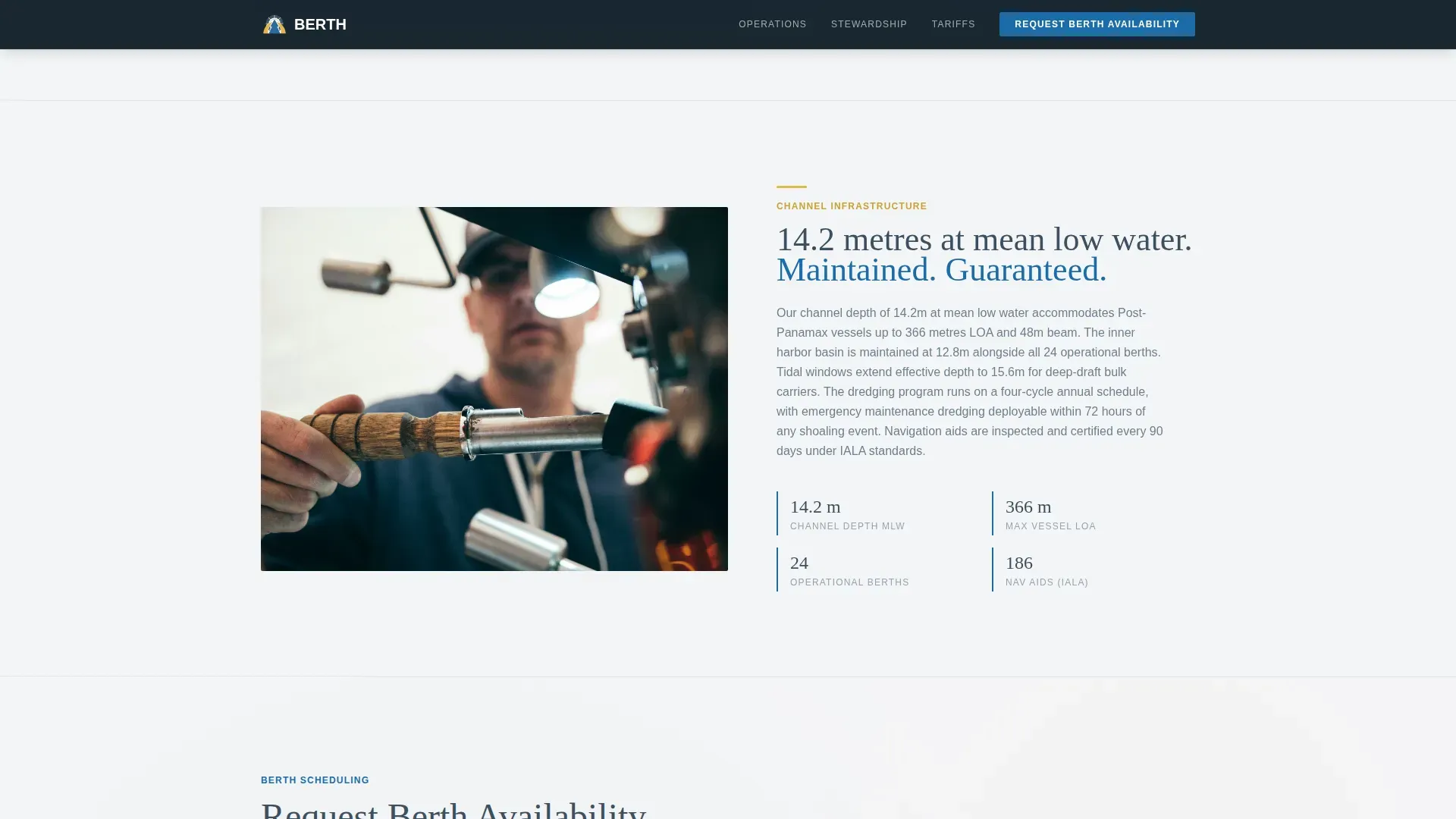
| Channel Infrastructure Data | Right-aligned channel depth maintenance schedules and throughput figures |
| Berth Request Form | Combined lead generation form and tariff download call to action |
| Footer | Linear single-row institutional footer |
Design & branding system
The visual identity follows a Civic Service theme built on the Cloud Canvas color system. Every color carries meaning, the same way colors on a nautical chart do. Nothing is decorative.
- Cloud canvas white (#F4F5F7) background, harbor slate (#3D4F5F) for body text and dividers, signal blue (#1B6CA8) for buttons and navigational accents, and bollard yellow (#E2B842) reserved for highlights, alert badges, and hover states
- Typography pairs Fraunces serif for all headlines, giving the page civic weight, with DM Sans for body copy and interface elements, keeping everything legible and practical
- Photography direction is documentary, not stock: aerial drone shots of berth operations, close-ups of mooring lines under tension, and tugboat spray imagery reinforce the annual-report gravitas throughout
Mobile & speed optimization
The template is built desktop-first, reflecting that its primary users are port operations staff working at workstations. Full mobile responsiveness is included so shipping agents and freight forwarders can access information from any device.
- Static sections are structured as Server Components to reduce unnecessary client-side load
- The interactive berth request form and scroll animations run as Client Components, keeping dynamic behavior isolated and efficient
- The zigzag layout reflows cleanly on smaller screens, preserving the left-right content pairing in a stacked single-column format on mobile
How this template helps you convert
Berth earns the form submission before asking for it. The page builds jurisdictional trust and operational credibility across every section, so by the time a visitor reaches the form, filling it in feels natural.
- The persistent top-bar "Request Berth Availability" button creates a low-friction path for ready-to-act visitors at any point in the scroll, without waiting for them to reach the bottom
- The structured berth request form collects exactly the vessel and cargo details a port authority needs to process an inquiry, making it useful to both parties and reinforcing the institutional tone
- The secondary "Download Port Tariff Schedule" email capture converts cost-researching visitors who are not yet ready to book, extending the page's reach across the full decision timeline
Other information about this template
Berth is part of a broader family of civic and government templates designed for public-sector organizations with professional B2B audiences. A few additional details worth noting:
- The template uses 24-hour time format throughout, consistent with global maritime operational standards
- Tariff and fee references are structured for United States dollar (USD) pricing, making it ready for North American port authority use cases
- The header concept is classified as a Quote and Manifesto type, which distinguishes it from image-led or data-led hero designs and gives it an unusually strong first impression for a civic landing page
- The intersection match score of 13 reflects a highly specific alignment between the Government and Public category, the Public Transportation subcategory, and the Port and Maritime Authority niche
- The template style is Zigzag and Alternating, a layout approach that works particularly well for organizations that need to communicate both values and evidence in equal measure without one overshadowing the other
Theme
Civic Service
Creative direction
Vision & Mission
Color system
Cloud Canvas
Style
Zigzag/Alternating
Direction
Lead Generation
Page Sections
Zigzag Alternating Content Layout
Full-viewport Serif Manifesto Hero
Persistent Top-bar Call to Action
Structured Berth Request Form
Tariff Download Secondary Path
Scroll-triggered Reveal Animations
Related questions
Who is the primary audience for this landing page template?
Can I customize the cargo type options in the berth request form?
Does the template include both lead generation paths?
What typography and color system does this template use?
Is this template suitable for a port authority handling multiple vessel types?