Port & Harbor Professional Website Template
Berth is a hub-and-spoke landing page template built for deep-water bulk cargo terminals. It targets commodity traders, mining conglomerates, and agricultural cooperatives with a structured, audit-style layout. Sticky anchor navigation, spec tables, and a procurement-focused form flow turn every section into a verifiable capability check before the visitor ever reaches the contact form.
by Rocket studio
Quick summary
Berth is a single-page, anchor-navigated landing page template designed for bulk cargo terminal operators. It uses an Engineering Blueprint visual theme and a Checklist and Audit creative direction to guide high-value B2B prospects through berth specs, discharge rates, storage capacity, multimodal connectivity, and compliance credentials in a logical due-diligence sequence.
Who this template is for
This template is built for operators and marketers running deep-water bulk cargo terminals. It speaks directly to the procurement and logistics teams at the companies most likely to sign terminal services agreements.
- Commodity traders chartering Panamax-class vessels who need verified discharge rate guarantees before cargo commitments
- Mining conglomerates routing ore or concentrate through coastal corridors who require precise berth and draught specifications
- Agricultural cooperatives managing seasonal harvest peaks who need confirmed storage and handling throughput data
What problem this template solves
Most bulk terminal web pages present general overviews that force a shipping desk to follow up with multiple calls before they can complete even basic due diligence. That friction costs conversions. Berth solves this by mirroring the exact sequence a procurement team works through before signing a terminal services agreement.
- Operational data is front-loaded so visitors can self-qualify against their own cargo profile before reaching any form
- Each anchor-navigated spoke answers a bold operational question then delivers spec tables and certified throughput figures to close the argument
- The primary call to action appears in the sticky navigation and after every second section, reducing the distance between conviction and contact
What you get with this template
You get a fully structured, single-page layout built around six anchor-linked spoke sections. The template organizes every piece of terminal capability information that a B2B buyer needs, in the order they need it.
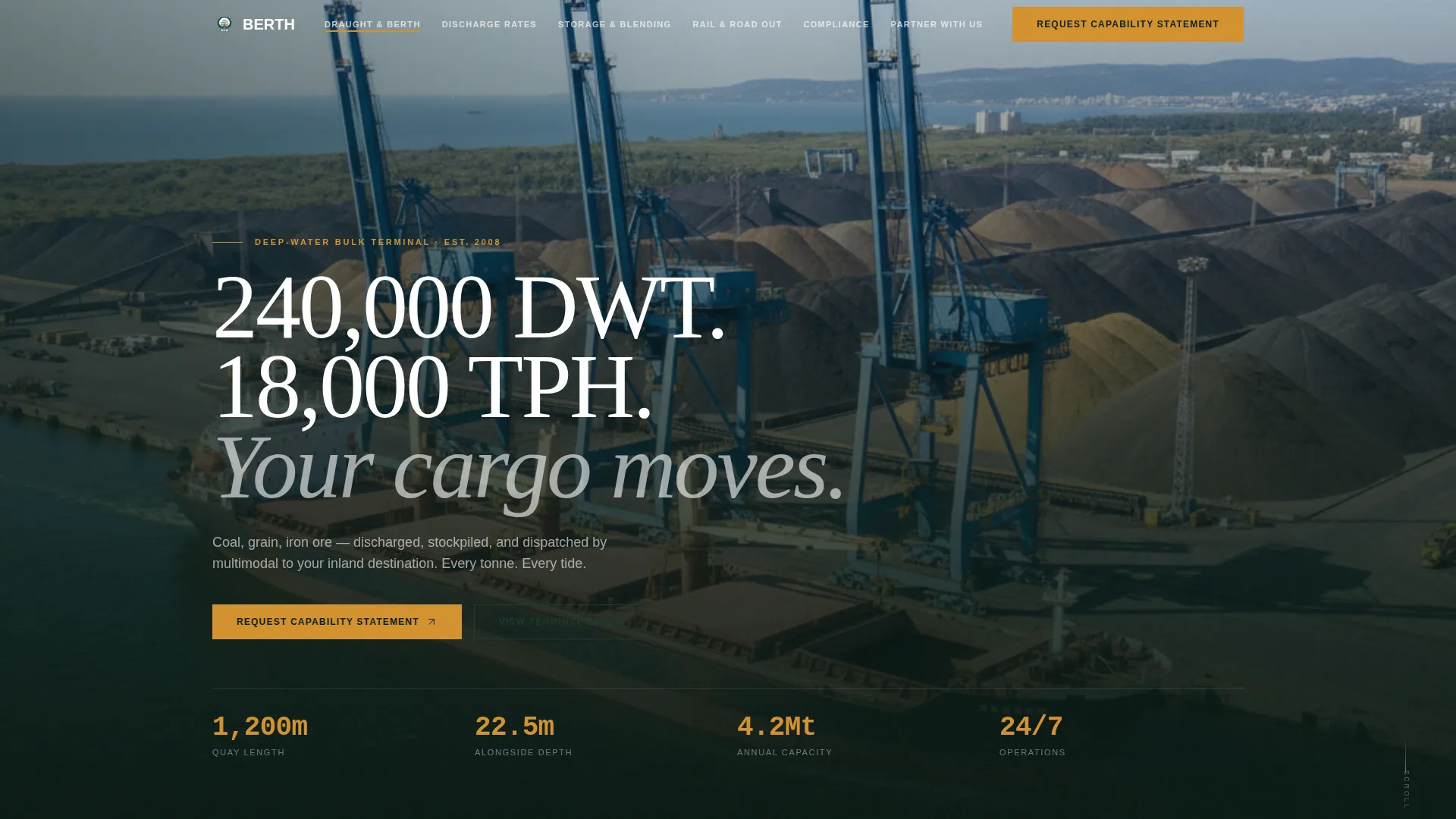
- A full-bleed header photo section with a headline overlay referencing deadweight tonnage and tonnes-per-hour figures, giving immediate operational credibility
- Six labeled anchor sections covering draught and berth, discharge rates, storage and blending, rail and road logistics, compliance credentials, and a partner inquiry section
- A primary conversion form collecting company name, commodity type via dropdown, estimated annual tonnage via range slider, and preferred contact method, plus a secondary email-gated download path for a berth allocation schedule
Feature list
This section describes the core built-in components and layout features included in the Berth template.
Sticky Anchor Navigation Bar
The navigation pins to the top of the viewport as the visitor scrolls. Each link uses terminal vernacular labels: Draught and Berth, Discharge Rates, Storage and Blending, Rail and Road Out, Compliance, and Partner With Us. This keeps orientation clear across a long, data-heavy page.
Full-Bleed Header with Headline Overlay
The header uses a bridge-wing perspective photograph showing the terminal, three aligned gantry cranes, and spreading stockpiles. A headline fades in over the image. The visual immediately communicates operational scale before a single word of body copy is read.
Checklist and Audit Section Structure
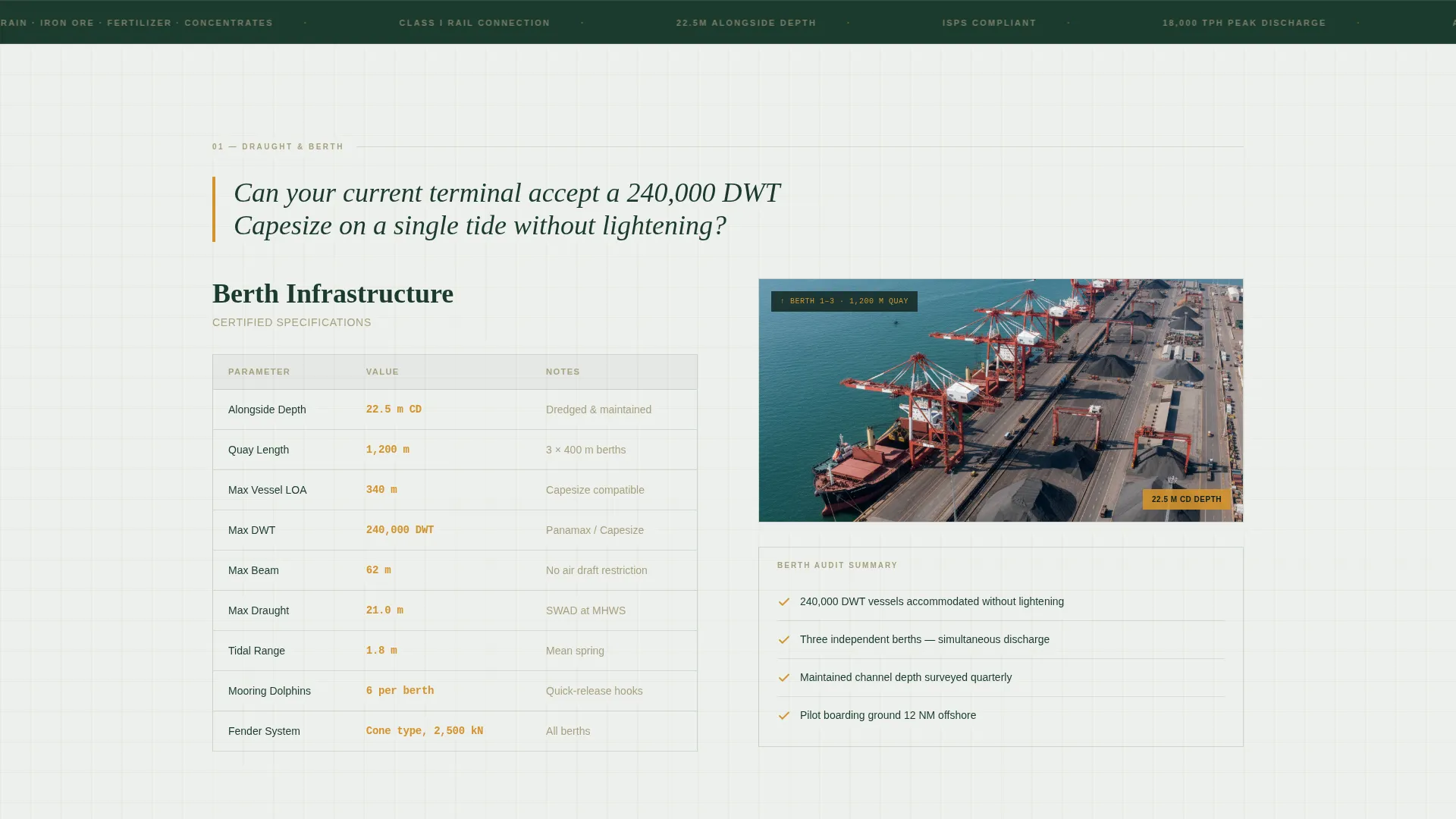
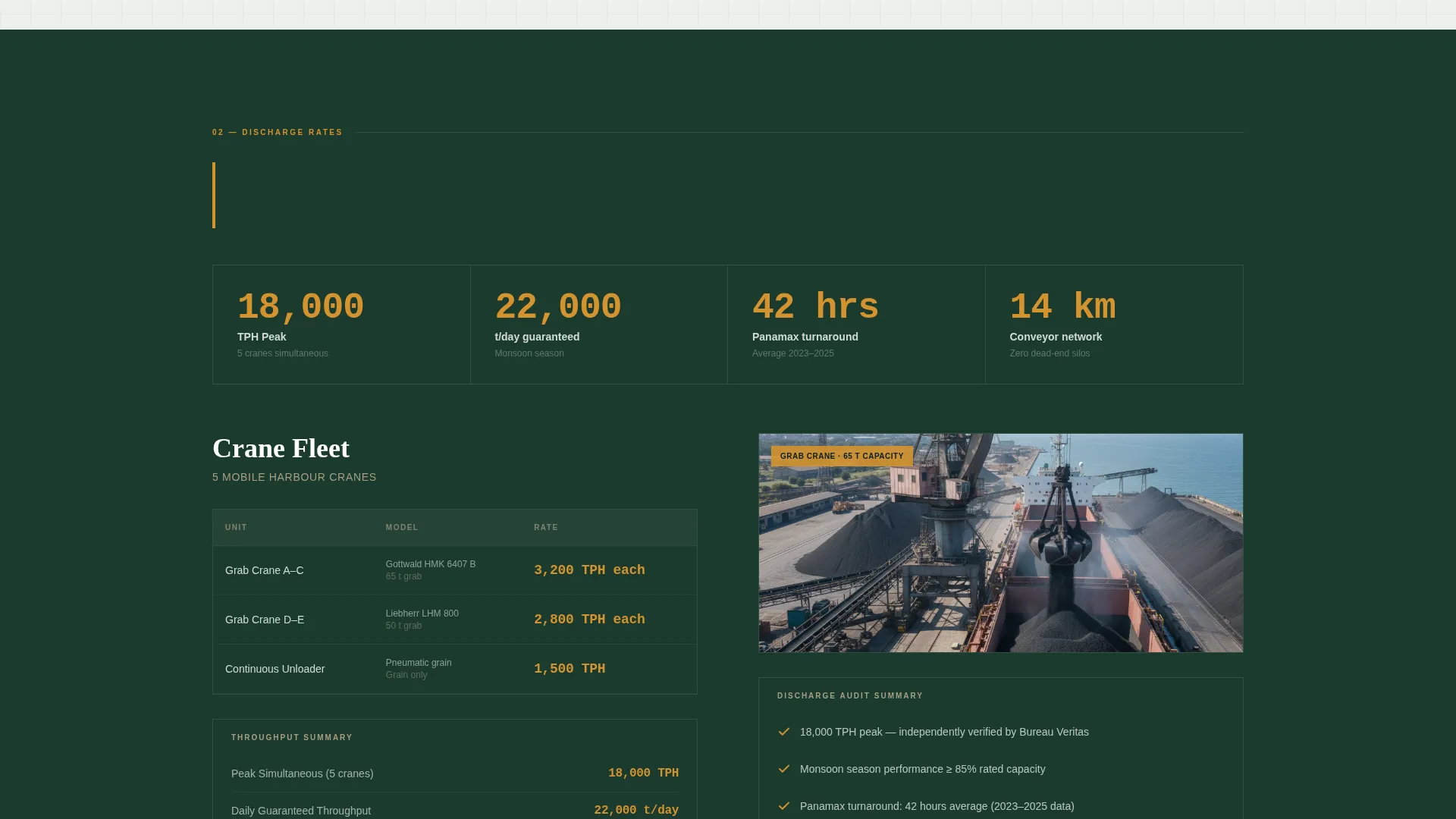
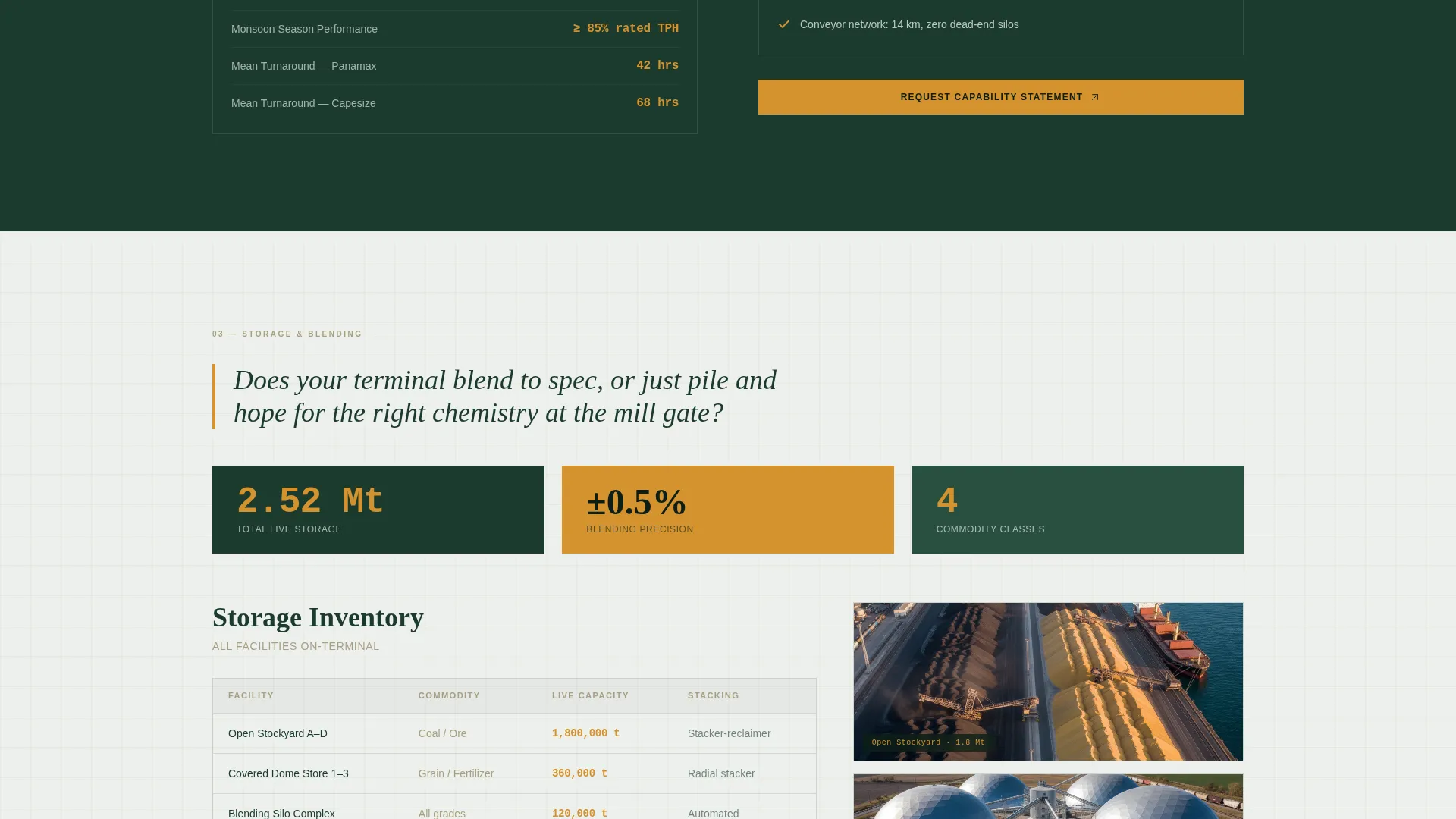
Every spoke section opens with a bold operational question, then answers it with spec tables, certified throughput data, and annotated aerial photography. Each section closes with a green checkmark summary row. The scroll becomes a procurement audit the visitor is already completing.
Dual Conversion Path Layout
The primary call to action, "Request Terminal Capability Statement," appears in the sticky nav and repeats after every second spoke section. A secondary path offers a downloadable berth allocation schedule behind an email gate, capturing prospects who are still in the comparison phase.
Structured B2B Inquiry Form
The contact form collects four data points: company name, commodity type selected from a dropdown covering coal, grain, ore, fertilizer, and other, an estimated annual tonnage range slider, and preferred contact method. This makes every submission immediately actionable for a terminal's commercial team.
Engineering Blueprint Visual Theme
The layout uses technical white backgrounds, deep canopy green structural elements, surveyor's khaki accents for secondary information, and safety-signal amber reserved for calls to action and data callouts. The result feels like a site plan on a portacabin wall: authoritative, grounded, and industry-specific.
Page sections overview
| Section | Purpose |
|---|---|
| Full-Bleed Header | Establish terminal scale and headline specs at first glance |
| Draught & Berth | Present water depth, vessel size limits, and berth dimensions |
| Discharge Rates | Show certified handling throughput data with spec tables |
| Storage & Blending | Detail stockpile capacity and blending or segregation capabilities |
| Rail & Road Out | Communicate multimodal onward transport connectivity options |
| Compliance Section | Display environmental and operational compliance credentials |
| Partner With Us | Host the primary B2B inquiry form and secondary download gate |
Design & branding system
The template applies a Forest Trust color system within an Engineering Blueprint theme. Every color choice carries a deliberate operational signal, referencing the physical environment of a working deep-water terminal.
- Deep canopy green (#1B3A2D) for structural headers and section backgrounds, communicating environmental authority and operational seriousness
- Surveyor's khaki (#A89F81) for secondary text, data labels, and section dividers, evoking stockpile roads and site plans
- Technical white (#EDF0EC) for body copy backgrounds, keeping long data tables and spec blocks legible
- Safety-signal amber (#D4922E) reserved exclusively for call-to-action buttons and data callouts, drawing the eye to conversion points and key figures
Mobile & speed optimization
The Berth template is designed to remain readable and navigable across device sizes. Long data tables and spec sections are structured to reflow cleanly on smaller screens.
- The sticky anchor navigation collapses into a compact format on mobile viewports so the spoke labels remain accessible without obscuring content
- Spec tables and checkmark summary rows are styled to scroll horizontally on narrow screens rather than breaking layout
- The inquiry form inputs, including the range slider and dropdown, are sized for comfortable touch interaction on mobile devices
How this template helps you convert
The Berth template converts because it respects how B2B buyers in the bulk cargo sector actually make procurement decisions. It removes uncertainty before the visitor reaches any form.
- Front-loaded operational data, including draught limits, discharge rates, and storage volumes, lets a shipping desk verify terminal fit against their own cargo profile during the first scroll
- The repeated placement of the primary call to action in the sticky nav and after every second spoke section means the invitation to connect appears at exactly the moments when conviction peaks
- The secondary email-gated download provides a low-commitment entry point for prospects in early comparison, capturing contact details from buyers who are not yet ready to submit a full inquiry
Other information about this template
Berth is purpose-built for the bulk cargo terminal niche within the broader marine and maritime sector. It is a strong fit for port and harbor operators who need a credible, content-rich landing page that works as a digital capability statement.
- The template sits in the Port and Harbor subcategory of the Marine and Maritime category, with a Bulk Cargo Terminal niche focus
- The Hub and Spoke anchor navigation structure is well-suited for terminals that need to present multiple independent capability areas without requiring separate pages
- The Checklist and Audit creative direction is specifically chosen to mirror the procurement logic of shipping desks and commodity trade teams, not just to organize content visually
- The Partnership and B2B landing page direction means every layout decision prioritizes the needs of commercial decision-makers over general awareness audiences
- This template is part of a curated template marketplace and can be customized to reflect a specific terminal's actual throughput figures, certifications, and commodity focus
Theme
Engineering Blueprint
Creative direction
Checklist & Audit
Color system
Forest Trust
Style
Hub & Spoke (Anchor Nav)
Direction
Partnership/B2B
Page Sections
Sticky Anchor Navigation Bar
Full-bleed Header with Headline Overlay
Checklist and Audit Section Layout
Dual Conversion Path Design
Structured B2B Inquiry Form
Engineering Blueprint Color System
Related questions
Who is the primary audience for this template?
Can I customize the commodity types in the inquiry form dropdown?
How does the dual conversion path work?
Is this template suitable for a terminal that handles only one commodity?
What makes this layout different from a standard port services page?