Religious & Cultural Architecture Professional Website Template
Bimah is a sacred synagogue architecture landing page template built for design practices that guide congregations from first sketch to finished sanctuary. It combines a cinematic scroll sequence, a high-contrast Ink and Paper visual identity, and a gated Building Committee Toolkit download to convert building committee members and rabbis into qualified leads.
by Rocket studio
Quick summary
Bimah is a single-page landing page template for a synagogue architecture and sacred space design practice. It opens with a monumental serif headline, unfolds through a layered cinematic scroll sequence, and closes with a low-friction gated form. The template is designed to establish authority with building committees before asking for anything in return.
Who this template is for
This template is built for architecture and sacred design practices that work specifically with Jewish congregations and community institutions. If your studio guides clients from feasibility studies through capital campaign completion, this page speaks directly to the people who hire you.
- Building committee chairs and synagogue presidents navigating multi-year capital campaigns
- Rabbis envisioning new or renovated sanctuaries that honor tradition without freezing it in time
- Jewish Community Center directors expanding into dedicated worship space for the first time
What problem this template solves
Building committees are careful, deliberate decision-makers. They research for months before contacting a firm. A generic architecture portfolio page does not address their specific concerns about halachic requirements, acoustic planning, accessibility codes, or capital campaign phasing. Bimah solves this by leading with teaching rather than selling.
- Committees arrive with deep uncertainty and need credibility signals before they trust any firm
- Rabbis and lay leaders need proof that a practice understands both liturgical intent and construction reality
- First-time JCC clients have no reference point and need structured guidance to even know what questions to ask
What you get with this template
You get a complete, single-page layout designed to carry a visitor from initial curiosity to confident form submission. Every section is sequenced to build trust progressively, delivering real value before any gated ask appears.
- A full five-section page structure: hero, cinematic scroll, three teaching panels, project library teaser, and toolkit download form
- A Monochrome Steel color system with parchment cream backgrounds, scribal black type, tarnished silver body text, and Torah-pointer brass accents
- Fraunces display serif headings paired with DM Sans body and interface text for a high-contrast editorial feel
Feature list
This section covers the core functional and design capabilities built into the Bimah template.
Monumental Hero Header
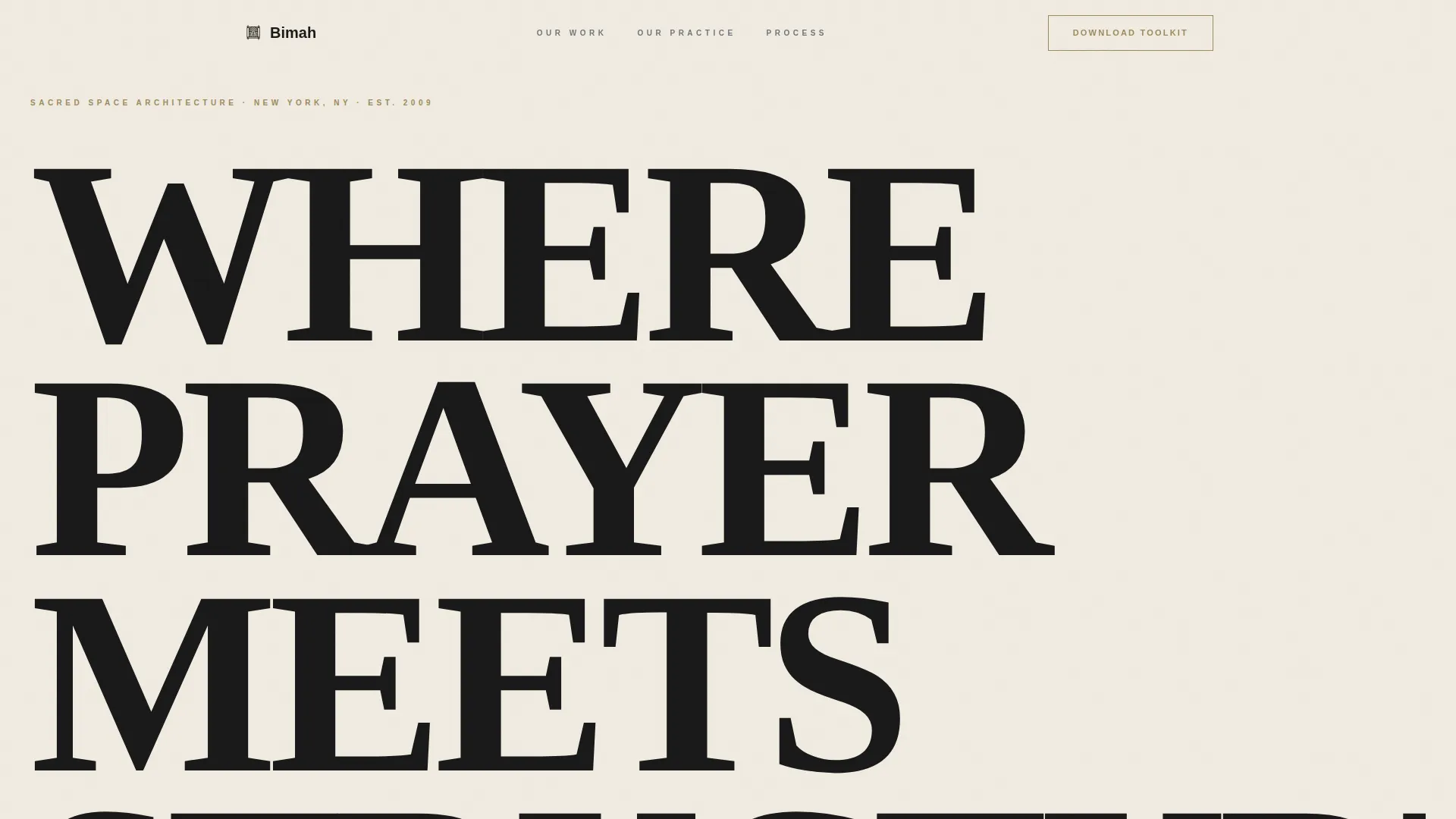
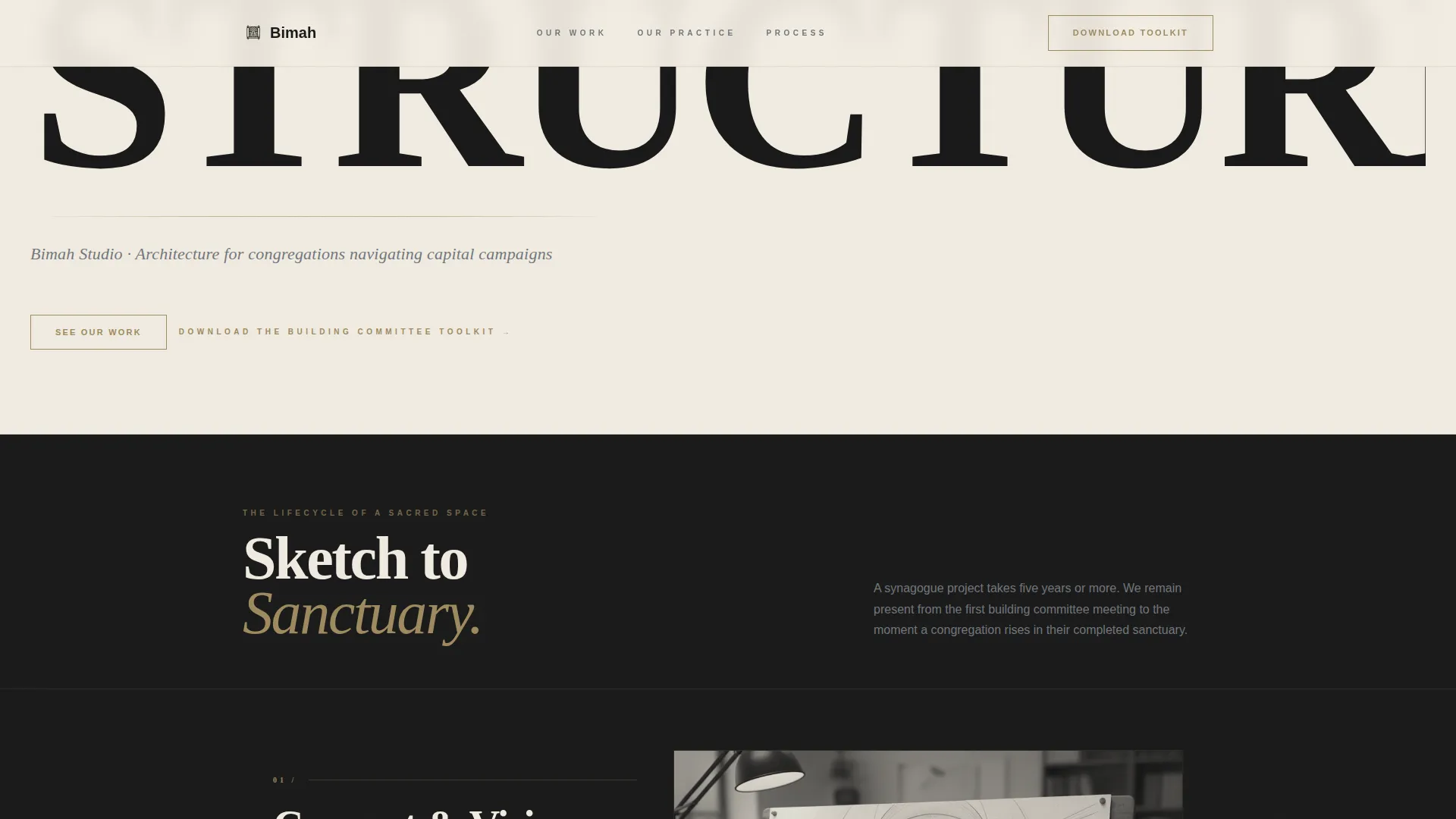
The hero opens with the headline "WHERE PRAYER MEETS STRUCTURE" set in a high-contrast serif so large the letters bleed past the viewport edges. A thin brass rule sits below, followed by a single line of silver italic text carrying the studio name and location. No image competes with the type.
Cinematic Layered Scroll Sequence
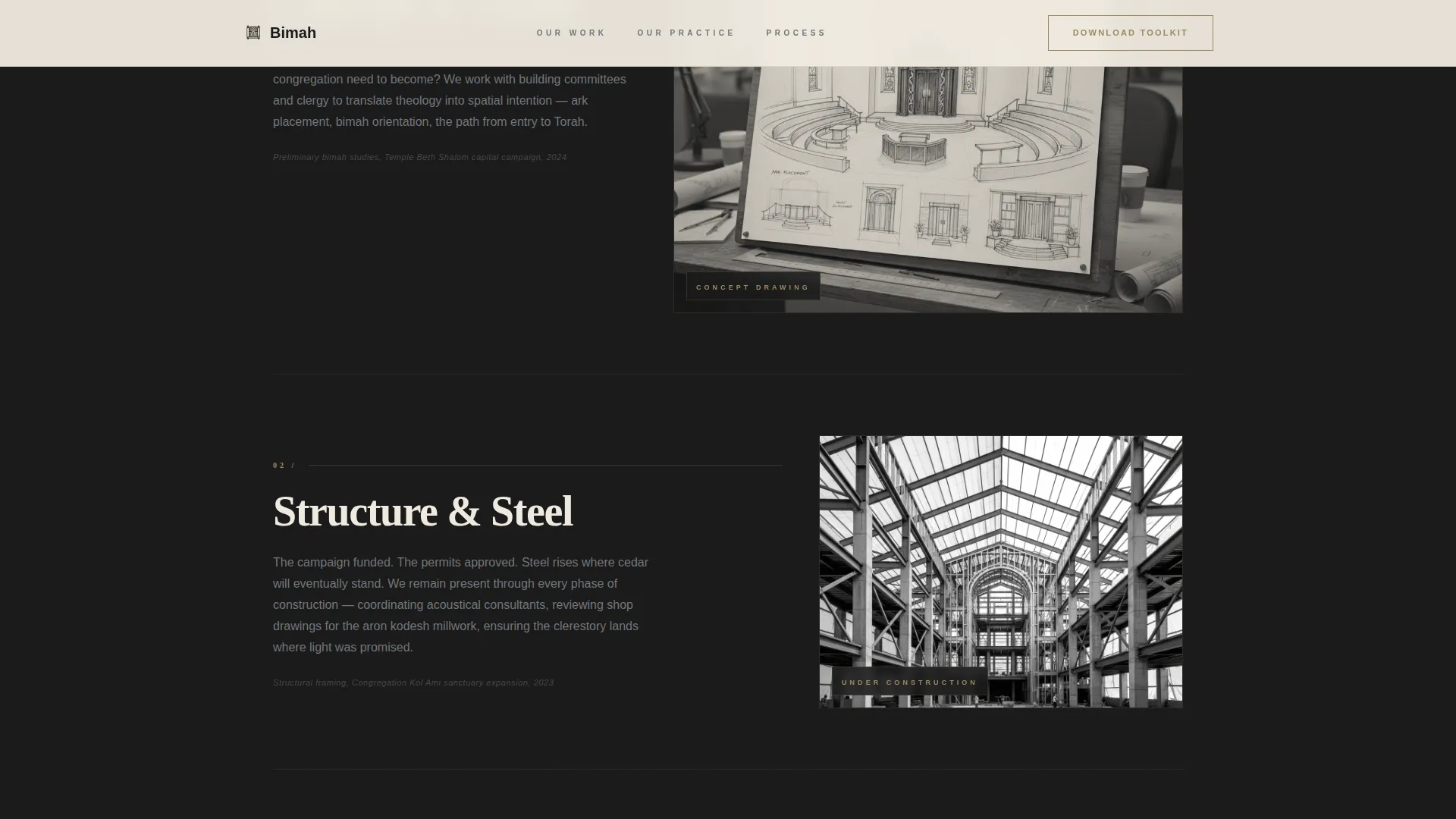
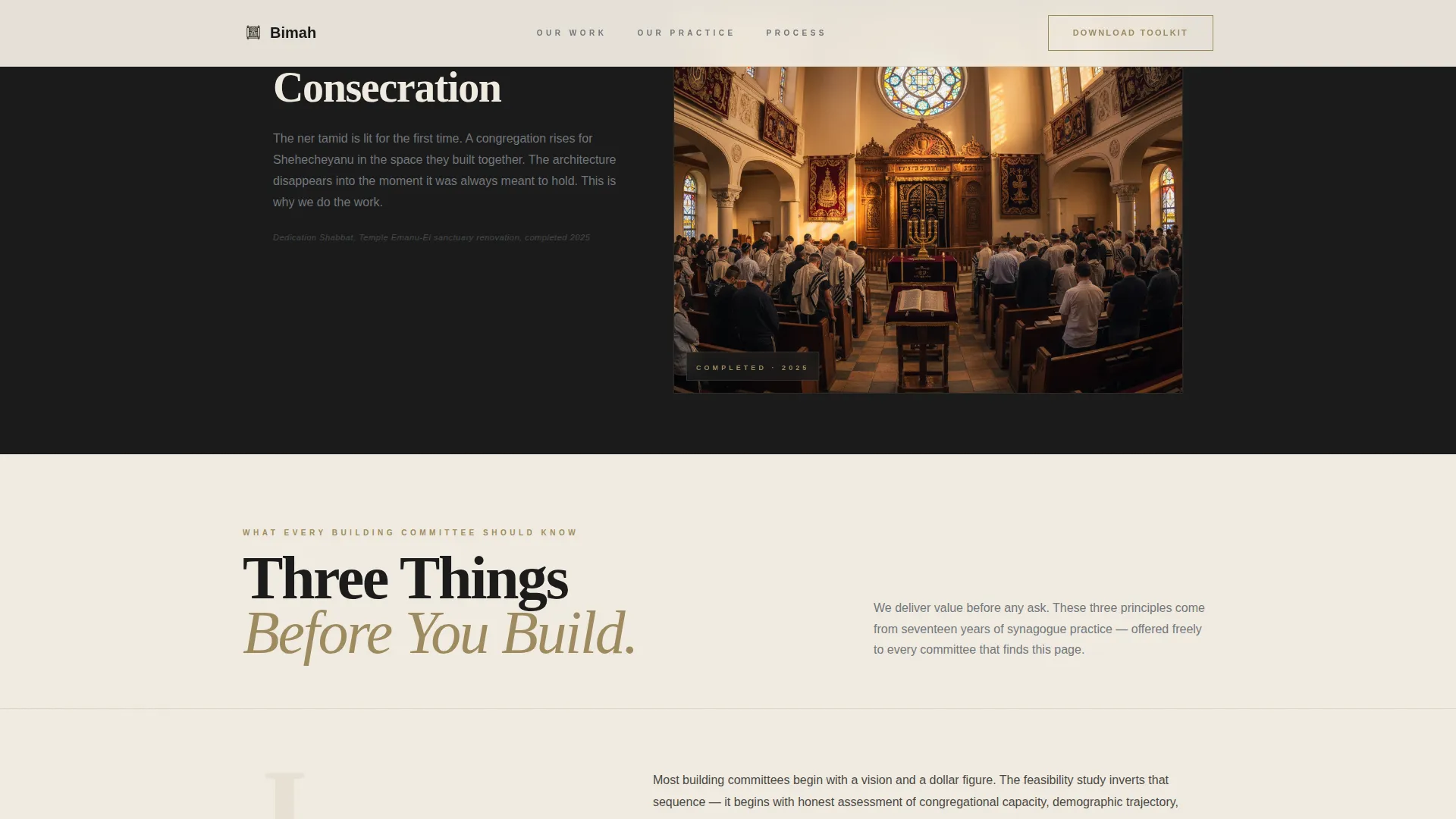
As the visitor scrolls, translucent vellum-like panels carrying pencil-sketch concept drawings slide beneath one another like drafting paper on a light table. Construction photography emerges in desaturated monochrome, followed by full-color sacred moments as the grayscale-to-color transition breaks through. The page literally builds the building as you scroll.
Value-First Teaching Panels
Three dedicated scroll sections establish the studio as the authority a committee needs before they ever fill in a field. The panels cover feasibility studies, acoustic planning for cantorial music, and accessibility considerations for bimah design. This content runs before any gated ask appears.
Project Library Teaser
An asymmetric bento layout previews ungated case studies organized by congregation size and denomination. Named congregations, denomination, city, square footage, campaign size, and completion year appear as social proof. A secondary call to action invites visitors to explore the full project library without requiring a form submission.
Gated Toolkit Download Form
The primary call to action offers a downloadable Building Committee Toolkit covering feasibility studies, capital campaign phasing, accessibility codes, and acoustic planning. The form asks only for name, congregation name, and email, keeping friction low and trust high.
Overlap and Layered Card System
Layered cards float with subtle brass-edged shadows, creating visual depth that evokes stacked manuscripts. Backgrounds alternate between scribal black and parchment cream sections. The overlap and layered template style gives the page a sense of physical depth without relying on photography to carry the weight.
Page sections overview
| Section | Purpose |
|---|---|
| Hero Headline | Establish monumental presence and studio identity |
| Cinematic Scroll Sequence | Show the full arc from concept sketch to completed sanctuary |
| Teaching Panel: Feasibility | Demonstrate expertise in capital campaign planning |
| Teaching Panel: Acoustics | Address cantorial music and sanctuary acoustic planning |
| Teaching Panel: Accessibility | Cover bimah design and accessibility code considerations |
| Project Library Teaser | Provide ungated social proof by congregation and denomination |
| Toolkit Download Form | Convert visitors with a low-friction gated PDF offer |
| Footer | Carry studio contact and navigation in minimal horizontal flow |
Design & branding system
The Ink and Paper visual identity draws on the aesthetic of a Talmudic manuscript: black ink on aged paper, marginal layers of commentary surrounding a central text. Every design decision reinforces the weight and deliberateness of sacred architecture work.
- Color system: scribal black (#1A1A1A) and parchment cream (#F0EBE0) form the alternating section backgrounds, tarnished silver (#71767C) carries body text, and Torah-pointer brass (#9E8A5E) is reserved strictly for links and interactive states
- Typography: Fraunces serves as the high-contrast display serif for all headings; DM Sans handles body copy and interface elements for clean legibility
- Layered card components use brass-edged box shadows to suggest depth, and the parallax scroll animation peels each layer forward as the visitor moves down the page
Mobile & speed optimization
The template is designed desktop-first, reflecting how building committees typically review architectural materials together on large screens during committee meetings. It remains fully responsive for mobile visitors.
- Parallax layer-peeling animations and Intersection Observer staggered reveals are handled through dedicated client components, keeping static sections rendered server-side
- Grayscale-to-color scroll transitions are built for smooth playback on desktop without degrading the experience on smaller screens
- The form component includes inline validation to reduce submission errors on any device
How this template helps you convert
Bimah is structured around a trust-first conversion model. The page earns credibility across multiple scroll sections before presenting its primary call to action.
- The three teaching panels deliver genuine, practical value on feasibility, acoustics, and accessibility before any form appears, positioning the studio as the most knowledgeable voice in the room.
- The ungated project library teaser gives skeptical committee members a secondary path to explore real project outcomes by congregation size and denomination, deepening confidence without requiring a commitment.
- The gated Toolkit download form asks only for name, congregation name, and email, making the conversion step feel like receiving a resource rather than entering a sales funnel.
Other information about this template
This template is built specifically for the synagogue design niche within religious and cultural architecture. It reflects the reality that Reform and Conservative congregations approach capital campaigns with extended timelines, multiple stakeholders, and heightened sensitivity to both tradition and practicality.
- The template style is Overlap and Layered, using the Cinematic Sequence creative direction to guide visitors through a visual narrative that mirrors the actual arc of a building project
- The header concept is a Giant Headline Centered, a deliberate choice that treats typography as architecture rather than decoration
- The landing page direction is Content and Resource, meaning value delivery precedes every conversion ask
- The color system is Monochrome Steel, and the visual theme is Ink and Paper, both drawn from manuscript and scribal traditions appropriate to the subject matter
Theme
Ink & Paper
Creative direction
Cinematic Sequence
Color system
Monochrome Steel
Style
Overlap/Layered
Direction
Content/Resource
Page Sections
Monumental Hero Headline Section
Cinematic Layered Scroll Animation
Value-first Teaching Panels
Ungated Project Library Teaser
Low-friction Toolkit Download Form
Overlap and Layered Card Depth System
Related questions
Who is the ideal user of this template?
What does the gated form download offer?
Can building committees browse project work without submitting a form?
What typography does this template use?
Is this template suited for a Jewish Community Center expanding into worship space?