School Age (5-10) Products & Booking Website Template
Bloom is a children's therapy landing page template built for mental health practices serving school-age children. It combines a warm Photo Grid Mosaic header, zigzag question-and-answer sections with micro-interactions, a four-panel illustrated session story, parent and teacher testimonials, and a free Family Feelings Toolkit download form into one cohesive, picture-book-warm single page.
by Rocket studio
Quick summary
Bloom is a single-page therapy template designed for child mental health practices. It guides parents from quiet concern to confident first step through warm visuals, jargon-free questions, and a free illustrated toolkit download. The zigzag layout, soft watercolor palette, and interactive scroll experience make the page feel as safe as the practice it represents.
Who this template is for
This template is built for child therapists and mental health practices that work with school-age children between the ages of 5 and 12. It speaks directly to the parents, teachers, and pediatricians who are first to notice that something feels off.
- Child therapists and counseling practices looking for a parent-friendly first impression online
- Mental health clinicians who want a low-friction way to offer a free resource before asking for an appointment
- Practices serving referral networks of teachers and pediatricians who need a credible, reassuring page to send families to
What problem this template solves
Parents rarely search for "child therapy." They search for answers to specific, worrying moments: unexplained stomach aches, classroom meltdowns, or a child who has stopped talking about school. This template meets them at that exact point of recognition, not at the clinical end of the journey.
- It removes the barrier of clinical language by opening each section with a real parent question
- It gives families a free, tangible resource before asking them to commit to anything
- It helps practices communicate warmth and safety visually, so a nervous parent scrolling alongside their child does not feel alarmed
What you get with this template
The template includes a fully structured, single-page layout with five named sections, a complete Soft Mist color system, Playful Geometric visual styling, and interactive components built into the scroll experience.
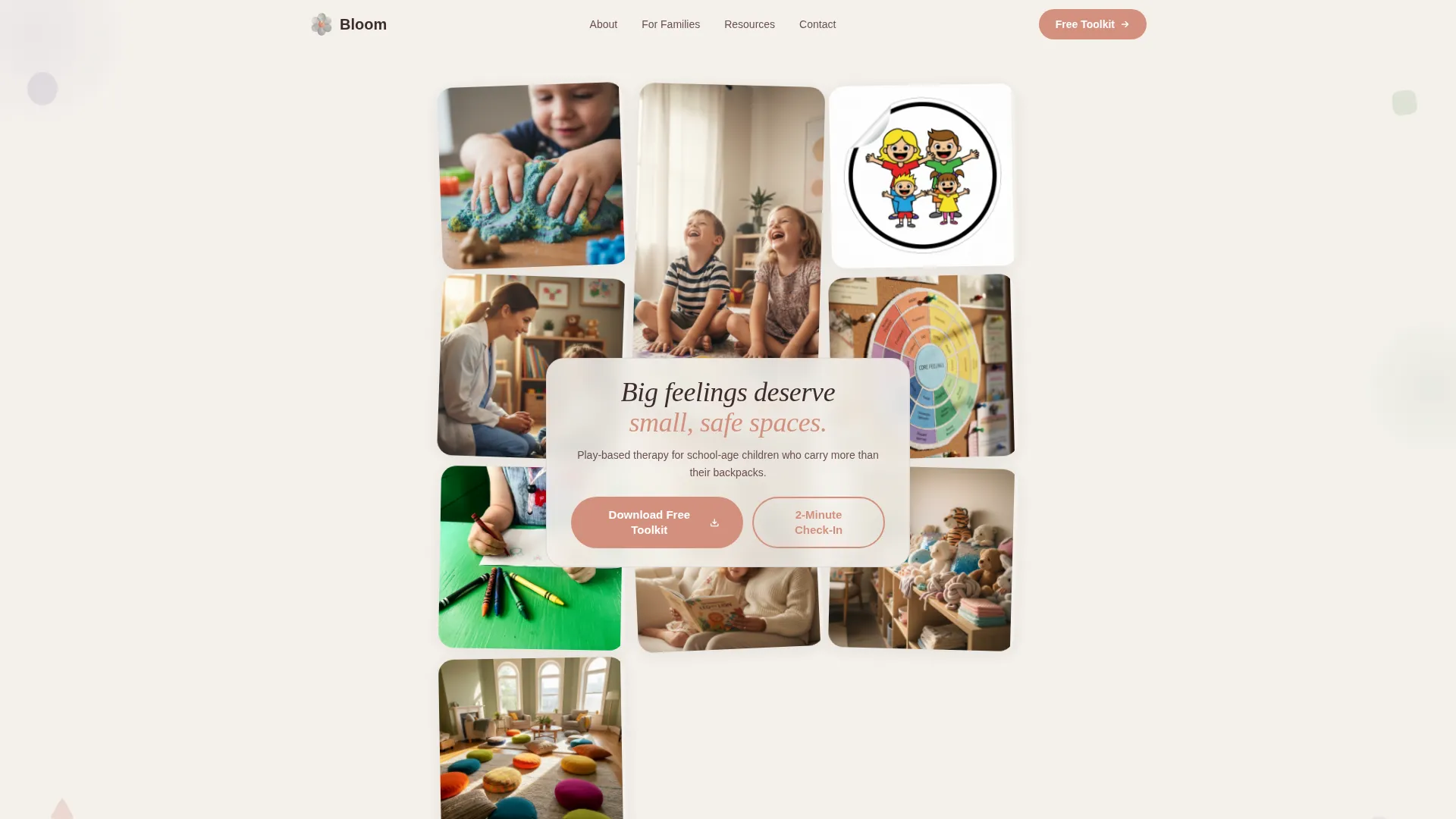
- A nine-tile Photo Grid Mosaic header with staggered animation and a fade-in hand-lettered headline
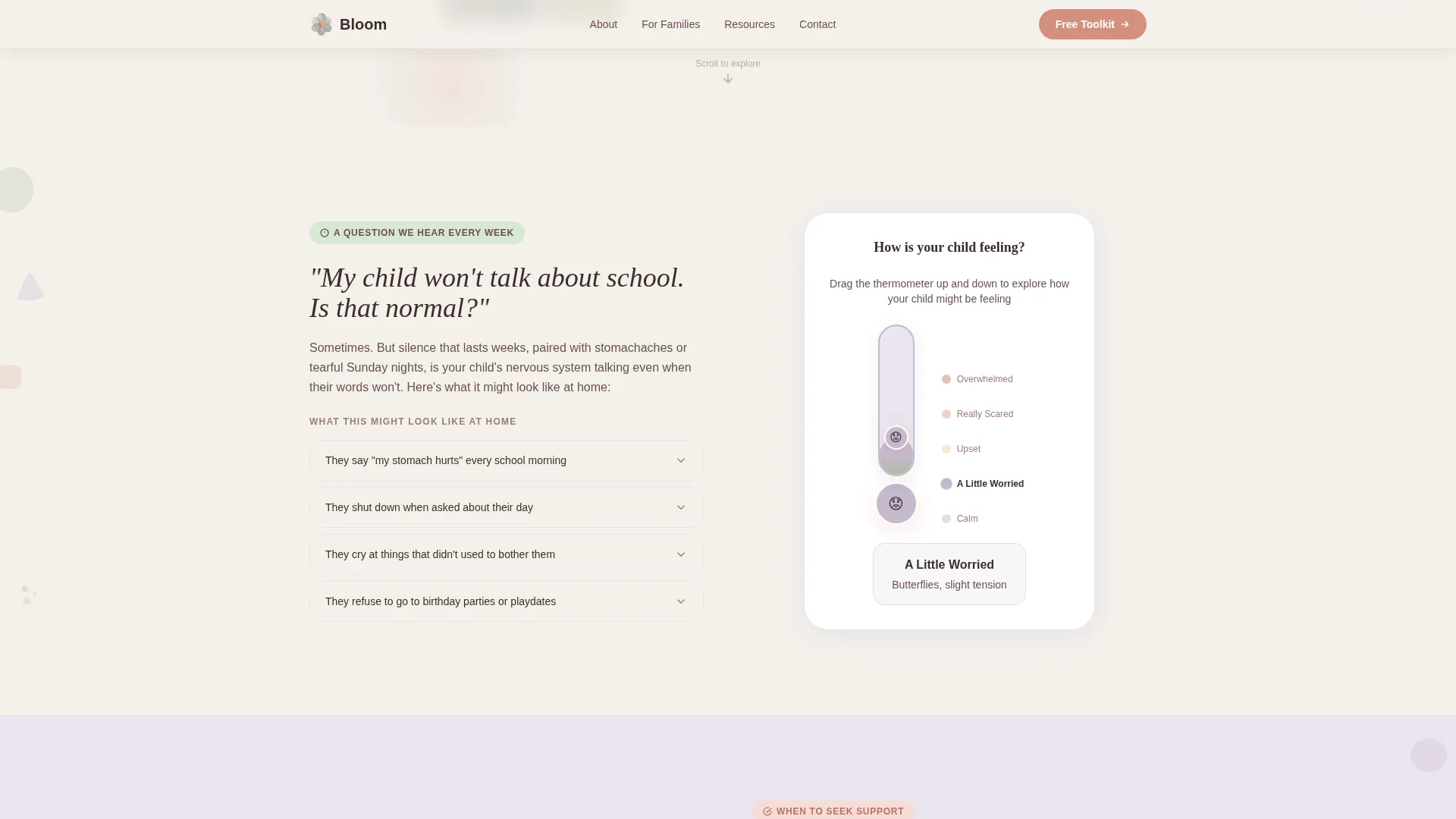
- Three zigzag question-and-answer sections, each with a micro-interaction such as a draggable feelings thermometer, a clickable accordion, or a four-panel illustrated story
- A dual call-to-action section combining a toolkit download form and a secondary two-minute check-in questionnaire
Feature list
This section describes the core functional and design components delivered with the Bloom template.
Photo Grid Mosaic Header
Nine unevenly sized image tiles are arranged in a loose grid with generous rounded corners and slight rotation. A hand-lettered headline fades in across the center after the mosaic loads, giving the page a calm, picture-book opening rather than an aggressive above-the-fold pitch.
Zigzag Question-and-Answer Sections
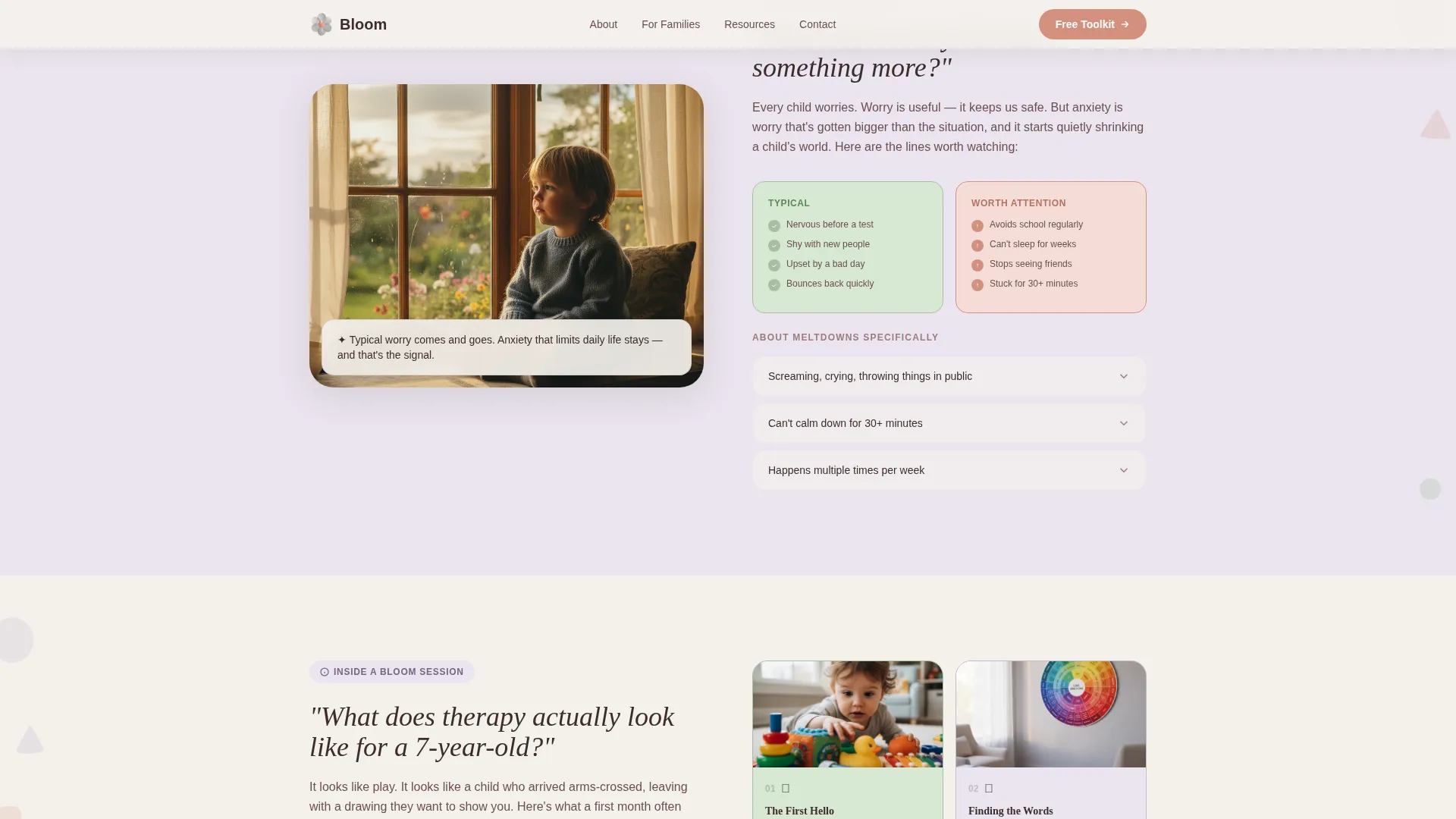
Three alternating sections each open with a real parent question written in plain, everyday language. Each section expands into a short, jargon-free answer paired with an embedded micro-interaction, turning a typical content block into an inviting, choose-your-path scroll experience.
Interactive Micro-Interactions
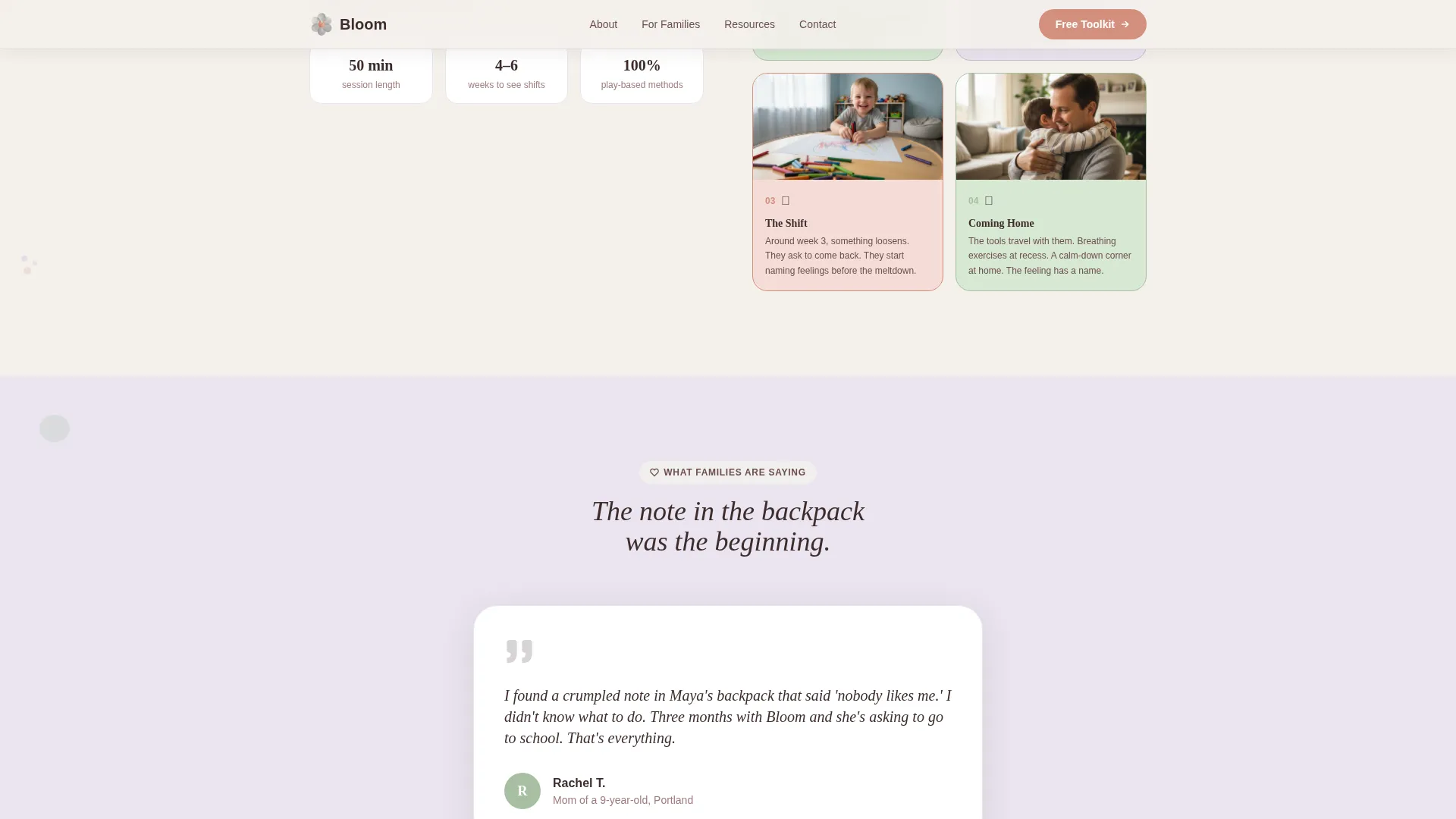
The scroll experience includes a draggable feelings thermometer, a clickable accordion revealing what a behavior looks like at home, and a four-panel illustrated story of a therapy session. These components keep parents engaged without requiring any technical knowledge to use.
Family Feelings Toolkit Download Form
A free illustrated PDF offer sits at the bottom of the page. The form collects only a first name and email address, with an optional checkbox for parents who are ready to schedule a first visit. The toolkit lowers commitment while the checkbox opens a quiet door to booking.
Two-Minute Check-In Call to Action
A secondary interactive questionnaire appears mid-scroll and links parents to a personalized result page with next-step resources. It helps families gauge whether their child's behavior is within a typical developmental range or warrants professional support.
Stacked Testimonial Cards
A social proof section uses a stacked card depth treatment to display parent testimonials, a teacher quote, and a pediatrician referral-style note. Each card format reflects the real mix of people who first recognize a child's need for support.
Page sections overview
| Section | Purpose |
|---|---|
| Hero Mosaic Header | Introduces the practice with nine warm photo tiles and a gentle fade-in headline |
| Zigzag Q&A | Addresses three real parent questions with jargon-free answers and micro-interactions |
| How It Works | Tells a therapy session story across four illustrated panels |
| Testimonials | Builds trust with parent, teacher, and pediatrician-style social proof cards |
| Toolkit and Check-In | Delivers the free Family Feelings Toolkit form and the two-minute check-in questionnaire |
| Footer | Provides a clean linear single-row footer with practice navigation and contact |
Design & branding system
The Bloom template uses a Soft Mist color system that feels like watercolor paint drying on thick paper. Every color choice was made so that a nervous child scrolling alongside a parent would not feel startled. Fraunces is used for display headings to add a warm, hand-crafted quality, while DM Sans handles body text for clean readability.
- Warm cloud white (#F4F1EC) as the primary background, muted lavender (#C5B9CD) for section alternation, gentle sage (#A8BFA2) on callout cards and icons, and quiet terracotta (#D4907E) reserved for interactive elements and calls to action
- Rounded triangles, wobbly circles, and soft-cornered squares float in the page margins as friendly geometric companions, consistent with the Playful Geometric theme
- Image tiles carry generous rounded corners and slight rotation, reinforcing the felt-board, picture-book warmth throughout the layout
Mobile & speed optimization
The template is designed with equal weight given to mobile and desktop experiences. Parents are most likely to land on the page from a mobile device, while pediatricians and teachers accessing the page for referral purposes tend to use a desktop browser.
- Images are lazy-loaded to reduce initial page weight across all devices
- CSS animations are GPU-accelerated, keeping scroll reveals and the mosaic stagger smooth without heavy processing
- The single-column zigzag layout adapts cleanly for smaller screens, preserving the interactive micro-interactions on mobile
How this template helps you convert
Bloom is built around a content-first conversion model. The free toolkit is the primary offer, and every section of the page gently builds the emotional readiness a parent needs before they are willing to take a next step.
- The mosaic header and fade-in headline create an immediate sense of safety and warmth, reducing the anxiety a parent may carry into the page
- Each zigzag question section meets parents at their actual worry, builds recognition, and moves them naturally toward the toolkit offer and the optional scheduling checkbox
Other information about this template
This template is a strong fit for child mental health practices in the United States that serve the school-age range of 5 to 12 years old. It is particularly well suited for solo practitioners and small group practices that want a polished, emotionally intelligent online presence without building a full multi-page website.
- The Playful Geometric visual style makes the page approachable for both parents and the children who may glance at it during a visit
- The template style is Zigzag/Alternating, which creates natural visual rhythm and clear reading flow across all five content sections
- The footer follows a Linear Single-Row pattern, keeping the end of the page clean and uncluttered
- The creative direction, labeled Interactive Explorer, means the scroll is designed to feel participatory rather than passive, helping parents feel agency rather than anxiety as they read
Theme
Playful Geometric
Creative direction
Interactive Explorer
Color system
Soft Mist
Style
Zigzag/Alternating
Direction
Content/Resource
Page Sections
Photo Grid Mosaic Header
Zigzag Question-and-answer Layout
Interactive Scroll Micro-interactions
Family Feelings Toolkit Download
Two-minute Check-in Questionnaire
Stacked Social Proof Cards
Related questions
Who is the Bloom template designed for?
What interactive features does this template include?
What does the primary call to action offer visitors?
Can the colors and fonts be changed to match my practice brand?
Does the template work well on mobile devices?