Tween (10-13) Products & Specialist Booking Website Template
Bloom is a tween mental health therapy landing page built for practices that support children ages 10 to 13. It uses a botanical field-journal aesthetic, an animated isometric hero, and a Hero's Journey scroll structure to guide parents from recognition to booking. The primary call to action is "Book a First Visit," with a secondary email-capture path for families who need more time.
by Rocket studio
Quick summary
Bloom is a single-page therapy landing page designed for tween-focused mental health practices. It blends a warm botanical visual identity with a narrative scroll structure to build trust with parents, school counselors, and pediatricians. Every section moves the reader one step closer to booking a first visit for their 10-to-13-year-old.
Who this template is for
This template is built for pediatric mental health practitioners who specialize in the tween age group. It speaks directly to the adults who notice something is off before the child can name it themselves.
- Private therapy practices focused on children ages 10 to 13
- School counselors who need a referral resource they can trust and share
- Pediatricians and family doctors who regularly note anxiety in young patients
What problem this template solves
Parents often sense a change in their child months before they find the right support. The gap between "something feels wrong" and "I booked an appointment" is filled with doubt, searching, and second-guessing. This template closes that gap.
- It reframes tween behavioral signals as communication rather than defiance or drama
- It shows parents a clear, warm path from recognition to a booked first visit
- It removes the friction of explaining why this practice is different from generic child therapy
What you get with this template
You get a fully structured, single-page landing page that tells a complete story from the first scroll to the booking form. Every section is purposeful and content-ready.
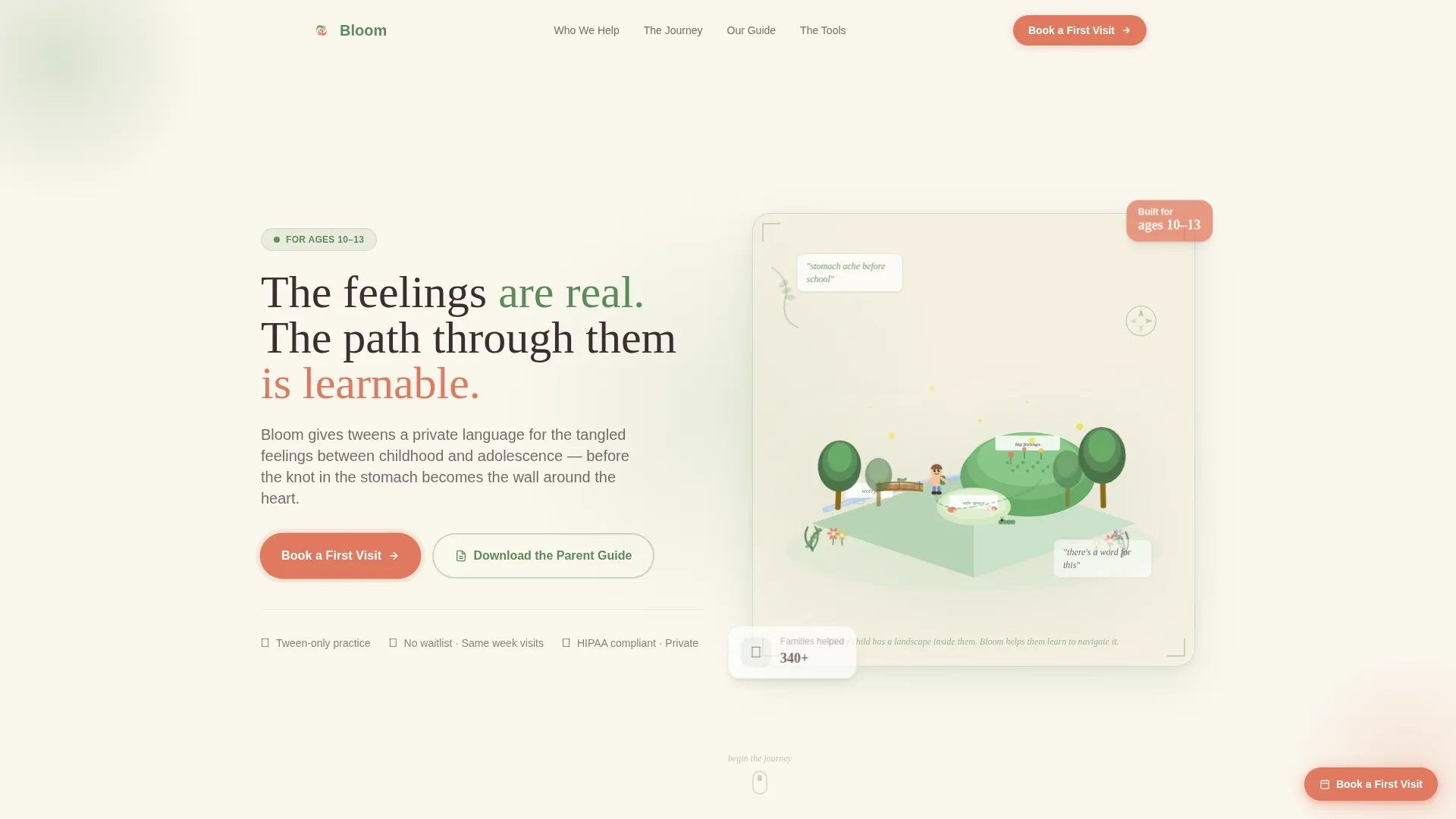
- An animated isometric hero section with a botanical illustrated world and a fade-in headline
- A seven-section zigzag layout following the Hero's Journey narrative arc
- A three-question scheduling form and a secondary email-capture modal for the parent guide
Feature list
This template is built around specific, prompt-backed components that work together to earn the click.
Animated Isometric Hero Illustration
The header features a detailed, gently animated botanical world viewed from above at a three-quarter angle. A tween character navigates labeled landmarks including a bridge called "worry," a hill called "big feelings," and a clearing called "safe space." Leaves sway, water moves, and fireflies drift in a scene that feels alive but never startling.
Hero's Journey Zigzag Scroll Structure
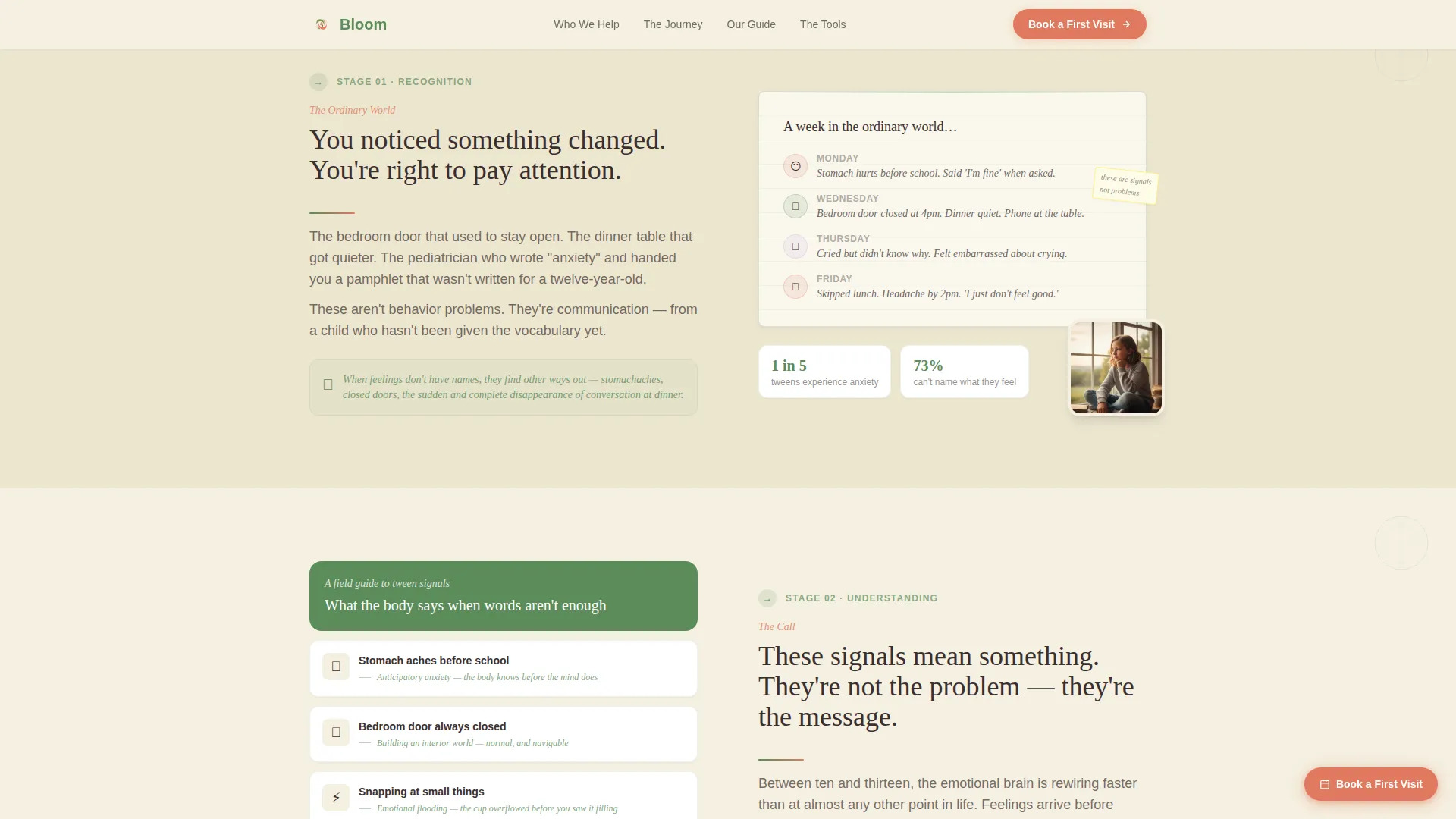
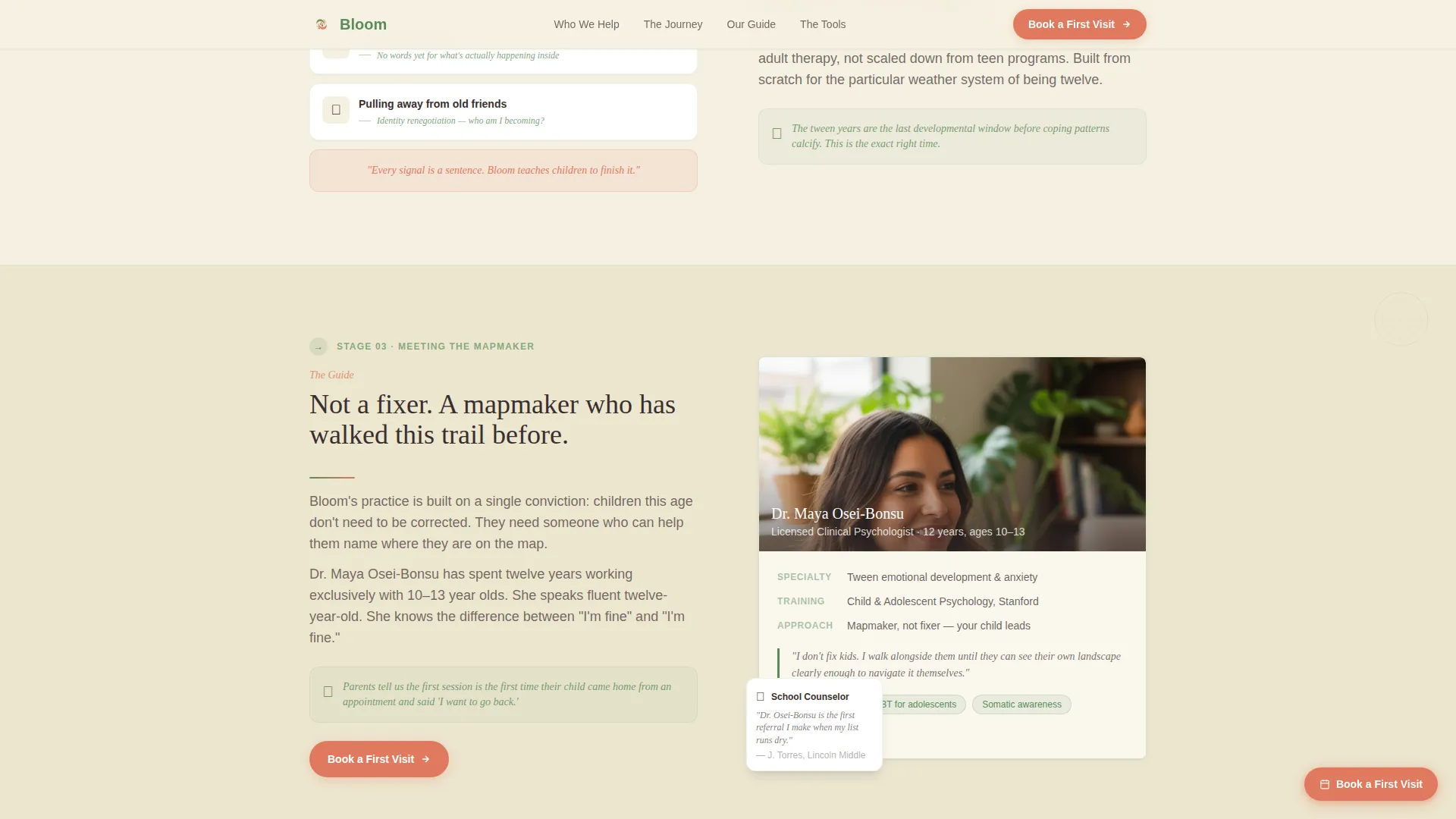
Each alternating section represents a stage of the narrative arc. The sequence moves through the Ordinary World, the Call, the Guide, the Tools, the Return, and finally the booking form. This structure educates and builds trust simultaneously as the parent scrolls.
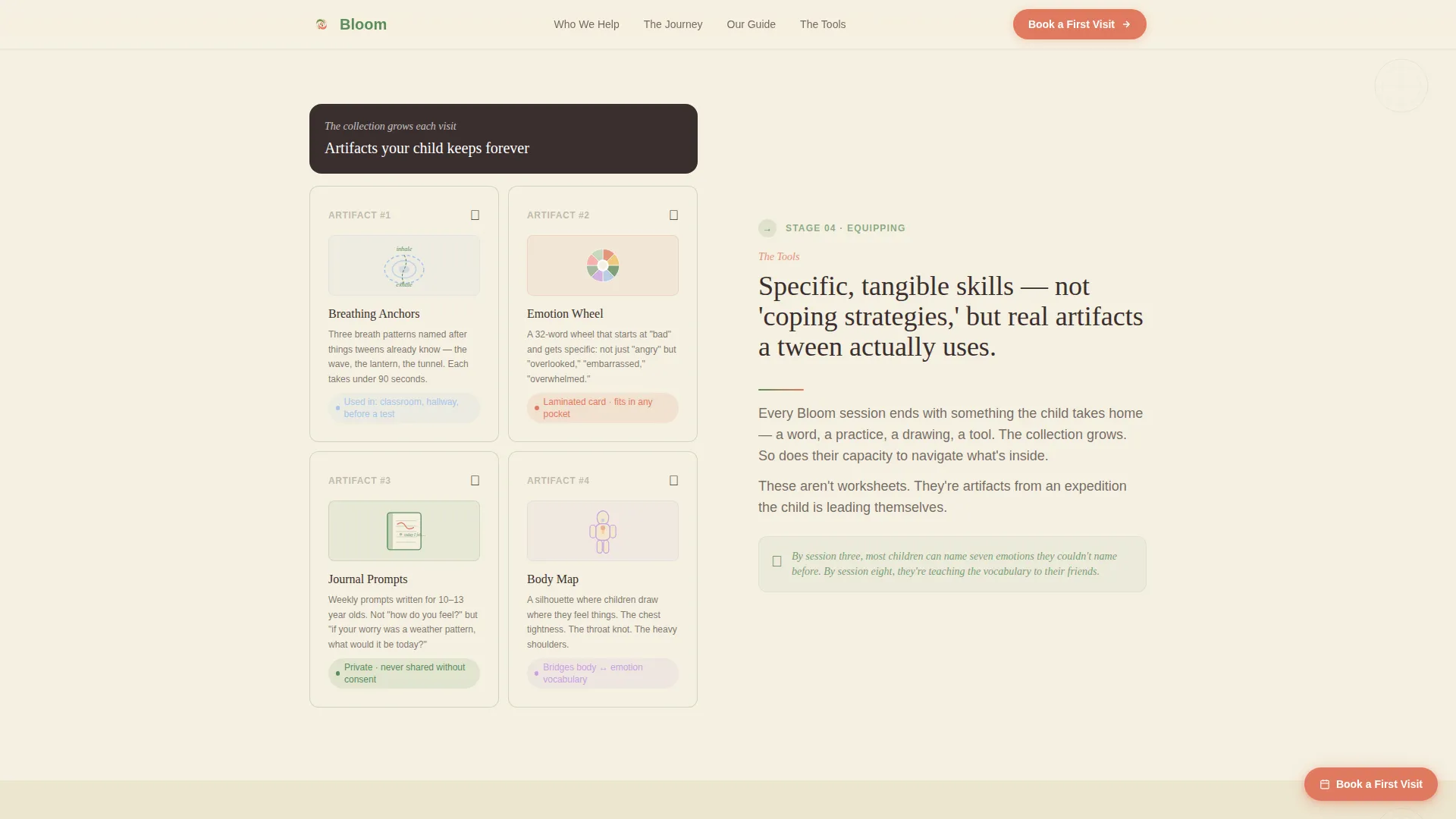
Illustrated Therapeutic Artifact Cards
The Tools section presents tangible skill-building resources as illustrated artifact cards. Breathing anchors, emotion wheels, and journal prompts are displayed as collectible items the tween character gathers along the journey, making abstract therapeutic concepts feel concrete and approachable.
Sticky "Book a First Visit" Call to Action
After the Guide section, a coral-colored booking button pins gently to the bottom of the viewport. It stays visible without interrupting the reading experience, keeping the conversion path accessible throughout the rest of the page.
Three-Question Scheduling Form
The booking form asks only three things: the child's age via dropdown (10 to 13), what prompted the visit as optional open text, and a preferred day and time. The minimal form reduces friction and respects the emotional weight of the moment.
Secondary Email Capture for Parent Guide
A "Download the Parent Guide" path collects email addresses from families who are not yet ready to book. This secondary conversion option keeps the practice in contact with parents who are still building confidence.
Page sections overview
| Section | Purpose |
|---|---|
| Hero with animation | Introduce the practice and invite the first scroll |
| Ordinary World | Show what unnamed feelings look like day to day |
| The Call | Reframe tween behavioral signals as meaningful communication |
| The Guide | Present the therapist as a warm, experienced mapmaker |
| The Tools | Reveal illustrated skill-building artifacts and techniques |
| The Return | Show what navigable home and school life looks like after therapy |
| Booking form | Capture the appointment with a minimal three-question form |
| Footer | Close with horizontal layout and contact essentials |
Design & branding system
The visual identity follows an Educational Guide theme with a botanical field-journal aesthetic. Every color and font choice reinforces warmth, groundedness, and credibility without clinical coldness.
- Color palette: soft fern green (#5B8C5A), warm parchment (#F5F0E1), deep loam (#3B2F2F), and blooming coral (#E07A5F) reserved for calls to action and interactive highlights
- Typography: Fraunces serif for headlines (warmth and story), DM Sans for body text (readability and clarity)
- Visual style: pressed botanical illustrations, handwritten-annotation details, field-journal textures, and a single wildflower motif used as a navigational bookmark
Mobile & speed optimization
This template is built with a mobile-first priority because parents most often discover tween therapy resources on their phones, frequently during school pickup or quiet evening moments.
- Scroll-linked zigzag section reveals and staggered entry animations are handled client-side to keep static content fast
- The sticky call-to-action button and email-capture modal are designed for thumb-friendly interaction on small screens
- The booking form uses a dropdown and minimal open-text fields to reduce mobile typing friction
How this template helps you convert
The page earns the booking by demonstrating genuine fluency in tween emotional experience rather than making generic promises.
- The narrative scroll structure guides the parent through recognition, understanding, and trust before presenting the booking form, reducing the psychological distance between arriving and committing.
- Social proof from parent testimonials with specific outcomes, a school counselor endorsement, and a pediatrician quote appears at the Return section, reinforcing credibility at the moment closest to conversion.
- The two-path conversion system (book now or download the guide) captures both ready and almost-ready families, widening the top of the practice's pipeline without adding complexity.
Other information about this template
This template is category-matched to the Kids and Family vertical with a specific focus on the tween (ages 10 to 13) mental health support niche. It is built for the Booking and Scheduling landing-page direction, meaning every design and copy decision serves the goal of a booked first visit.
- The intersection match score for this template is 13, reflecting a precise alignment between category, subcategory, and niche
- The template style is Zigzag and Alternating, which keeps the page visually dynamic while reinforcing the Hero's Journey narrative
- Animation level is high, including SVG breathing illustration, floating elements, and scroll-linked reveals
- The footer uses a horizontal layout pattern suited to single-page therapeutic practice sites
- English (US) localization is built in, with 12-hour time format used in the scheduling form
Theme
Educational Guide
Creative direction
Hero's Journey
Color system
Botanical
Style
Zigzag/Alternating
Direction
Booking/Scheduling
Page Sections
Animated Isometric Hero Section
Hero's Journey Zigzag Layout
Illustrated Therapeutic Artifact Cards
Sticky Coral Booking Button
Minimal Three-question Booking Form
Secondary Email Capture Modal
Related questions
Who is this landing page template designed for?
What does the booking form collect from families?
Is there a way to capture families who are not ready to book yet?
Can I customize the therapist section with my own credentials?
How does the visual design speak to both tweens and their parents?