Urban Planning & Design Professional Website Template
Blueprint is a full-width immersive landing page template built for master planning practices. It combines brutalist typography, animated infrastructure diagrams, and scroll-depth-gated lead capture into one monumental single-page experience. Designed for firms presenting city-scale work to municipal authorities, sovereign wealth funds, and institutional clients, it converts through demonstrated intellectual depth before it ever asks for a name.
by Rocket studio
Quick summary
Blueprint is a full-width immersive landing page template for master planning and urban design practices. It opens with a massive aerial photograph and viewport-scale brutalist typography. Visitors scroll through three full-viewport case environments before a gated methodology PDF download form appears. The design is heavy, deliberate, and built to impress decision-makers operating at the scale of cities.
Who this template is for
This template is purpose-built for urban design firms and master planning practices that work at geographic scale. It speaks directly to the clients those firms are trying to reach: public authorities, institutional investors, and boards with long planning horizons.
- Master planning and urban design firms presenting city-scale or district-scale portfolios
- Principal architects and urban strategists pitching sovereign city, campus expansion, or new district mandates
- Practice directors who need a content-led lead generation page, not a portfolio brochure
What problem this template solves
Most architecture and planning websites communicate at the scale of buildings. A master planning practice operates at the scale of entire districts, transit corridors, and thirty-year visions. That gap in presentation erodes credibility before a single conversation begins.
- Generic portfolio layouts fail to convey the systems-thinking depth that municipal and sovereign clients require
- Standard contact forms ask for commitment before proving intellectual authority
- Static pages cannot show how a masterplan accumulates complexity across transit, roads, utilities, and zoning layers
What you get with this template
You get a complete, production-ready single-page layout that builds a case for your practice through immersive scroll storytelling. Every section earns the next, culminating in a gated form that feels like a natural conclusion rather than an interruption.
- A hero section with a full-bleed aerial photograph and 20vw brutalist headline that clips the viewport edges
- Three full-viewport case environment sections with horizontal scroll pinning for New District, Campus, and Satellite City work
- An animated systems diagram that layers transit, roads, utilities, and zoning in sequence, plus a bento-style stat card section and a scroll-depth-gated framework download form
Feature list
A brief paragraph introduces the feature set: Blueprint packages a highly specific set of interactive and visual capabilities, each tied directly to how senior planning clients evaluate a firm's credibility and vision.
Viewport-Scale Brutalist Hero
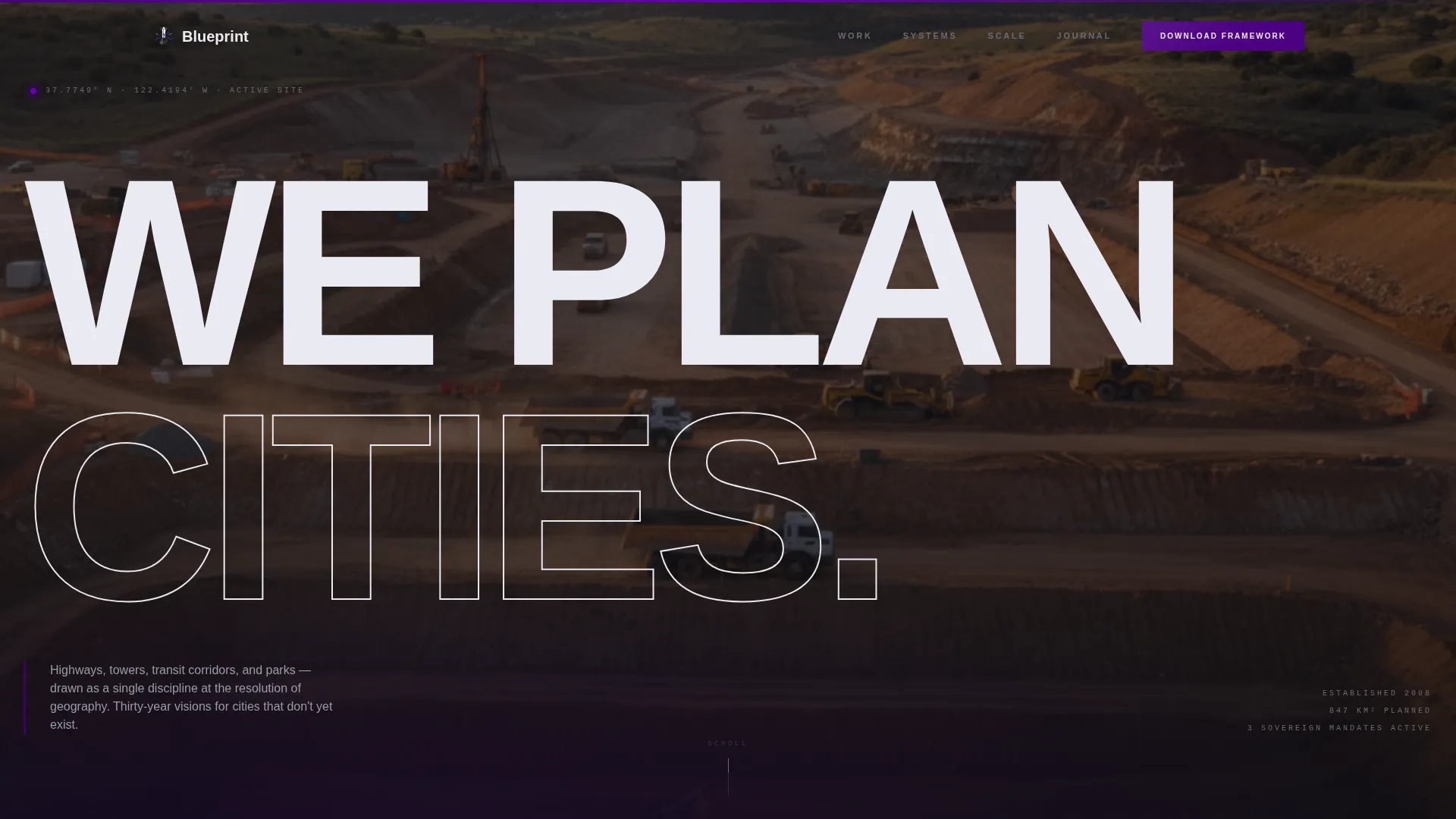
The hero section fills the entire screen with a raw aerial photograph of graded terrain. Over it, "WE PLAN CITIES." renders at 20vw in a condensed heavy-weight sans-serif, tracking tight and clipping past the viewport edges. There is no button or subhead, just land and language at full force.
Immersive Scroll Case Environments
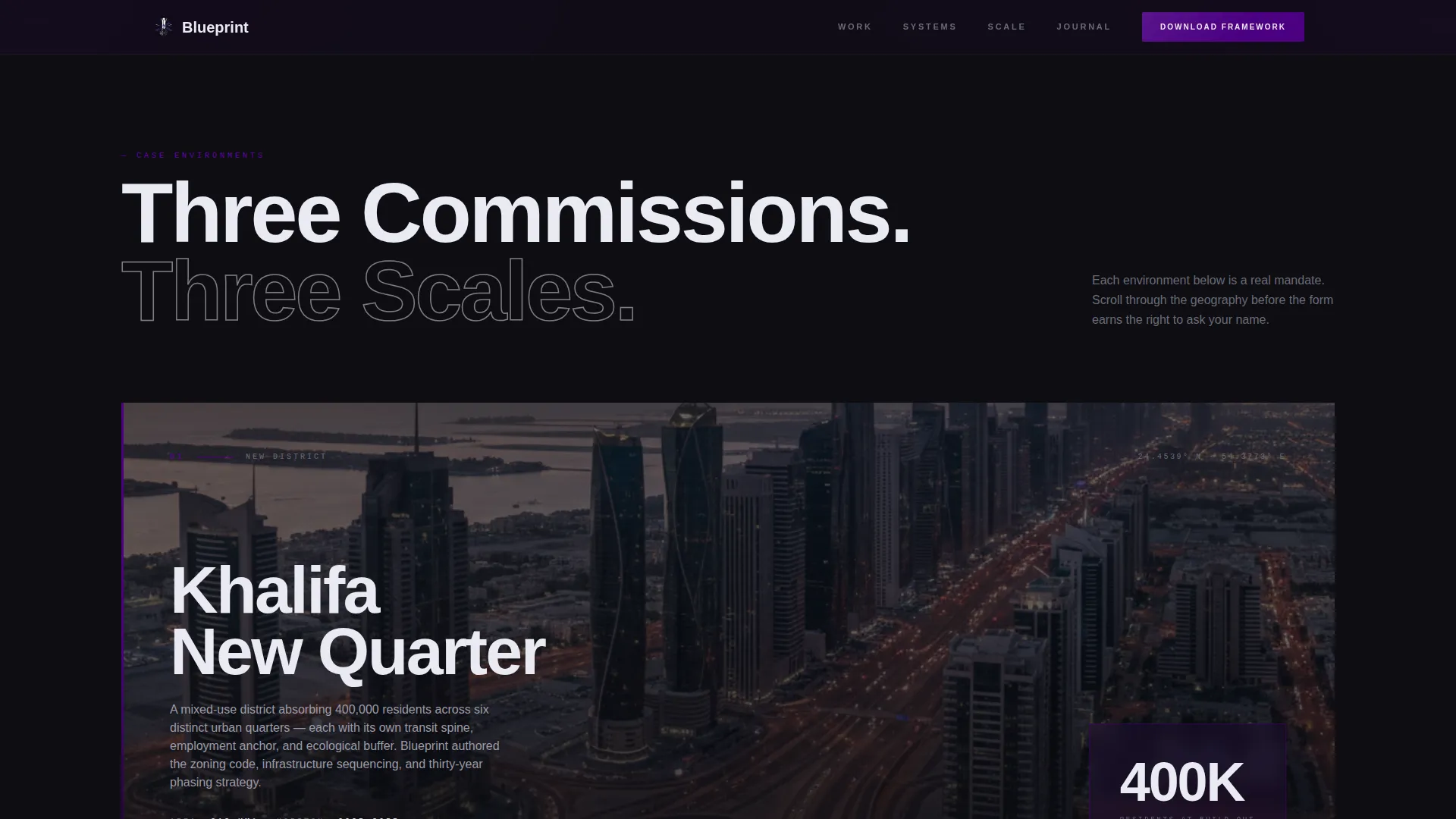
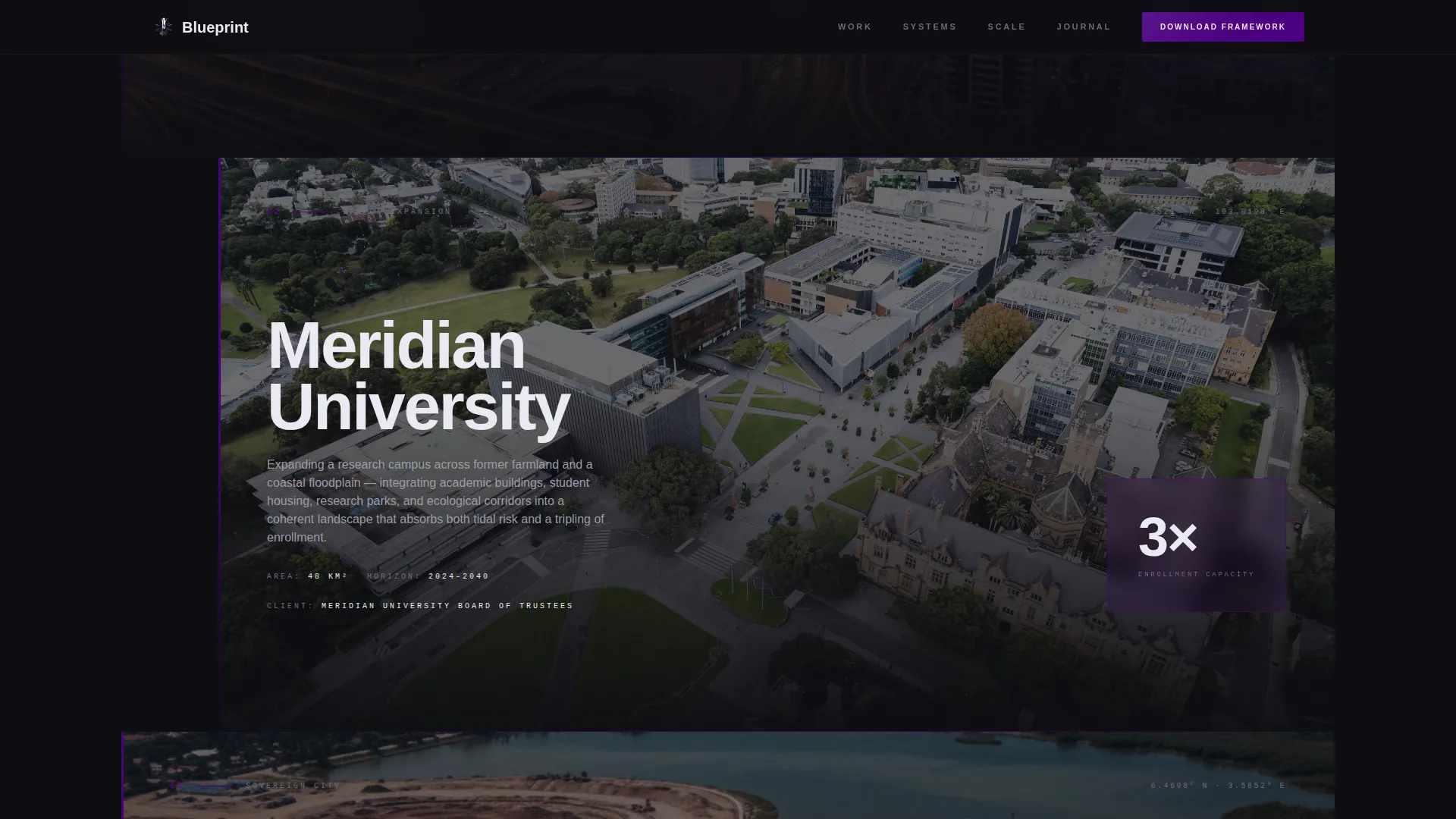
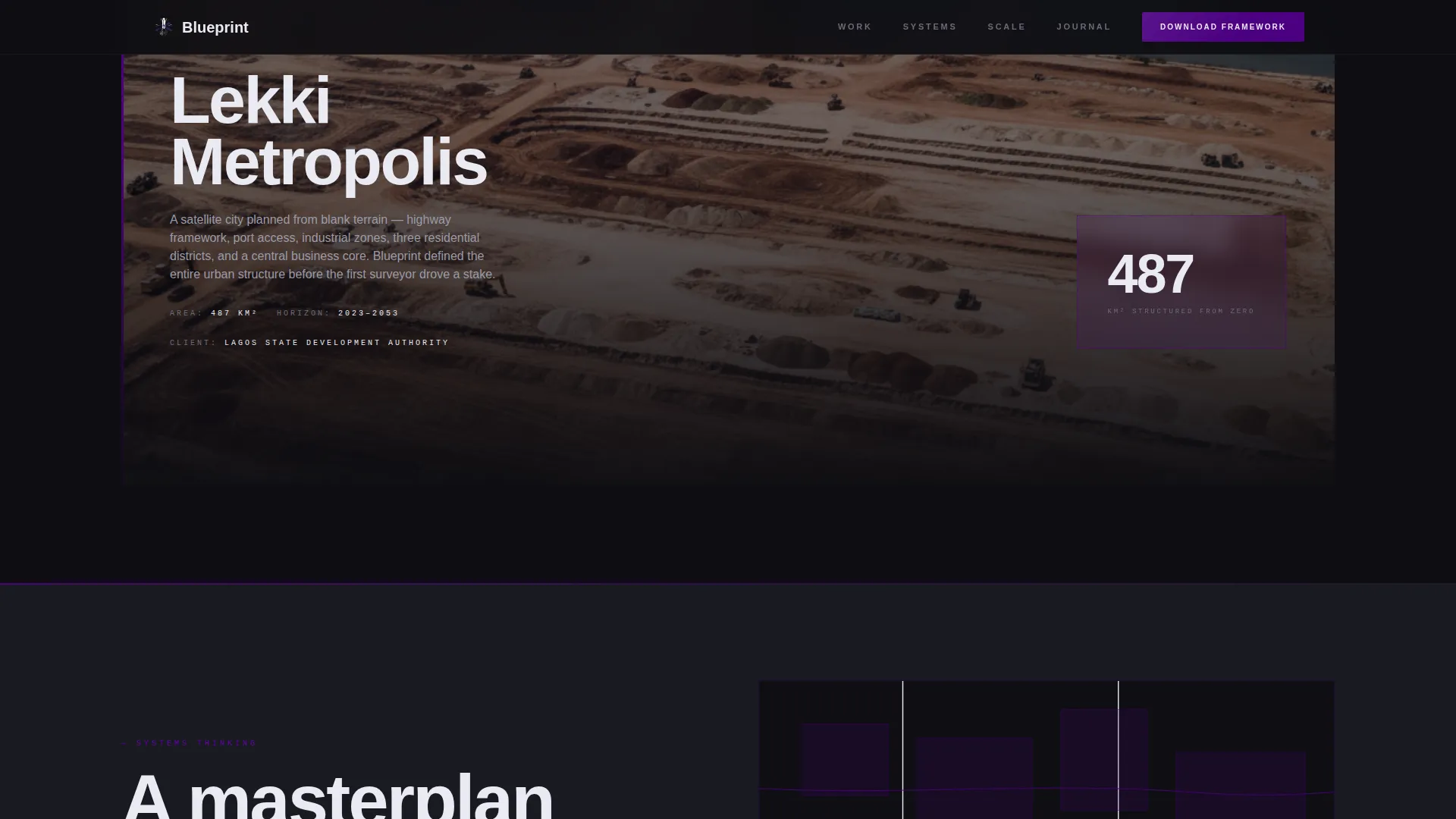
Three sequential full-viewport sections function as case environments. Each one pins horizontally as the visitor scrolls, creating the sensation of falling into the project rather than passing it. The three environments cover a new district, a campus expansion, and a satellite city mandate.
Animated Infrastructure Diagram
A dedicated section animates a layered systems diagram in real time. Transit lines draw first, then road networks, then utility corridors, then zoning blocks. The sequence mirrors how a real masterplan is assembled, communicating process as much as outcome.
Scroll-Depth Gated Form
The framework download form only becomes accessible after the visitor has scrolled through all three case environments. Fields are intentionally minimal: name, organization, and a single dropdown asking "What are you planning?" with options including New District, Campus Expansion, Transit-Oriented Development, and Sovereign City.
Bento Stat Card Section
A credibility section presents key metrics in a bento-grid card layout. Stats such as total area planned in square kilometers and sovereign mandate count are displayed with high contrast, giving institutional clients an immediate sense of practice scale.
Ungated Journal Path
A secondary conversion path offers ungated access to a curated journal of published planning essays. Visitors who are not ready to download the framework can stay inside the ecosystem, reading published thinking rather than leaving the page.
Page sections overview
| Section | Purpose |
|---|---|
| Hero: Aerial Type | Set monumental scale and firm identity instantly |
| Case Environment One | Immerse visitors in a new district project |
| Case Environment Two | Showcase a campus expansion mandate |
| Case Environment Three | Present a sovereign satellite city project |
| Systems Diagram | Animate infrastructure layering as a discipline proof |
| Scale and Credibility | Display stat cards and sovereign client authority |
| Framework Download | Gate the methodology PDF behind scroll-depth |
| Journal Access | Keep uncommitted visitors inside the ecosystem |
| Footer | Minimal single-row close with essential links |
Design & branding system
The visual identity follows a Bold Brutalist theme built on an Electric Indigo color system. Deep bitumen black dominates every background. High-voltage indigo activates section dividers, hover states, and progress indicators. Raw concrete gray holds secondary text and captions. Plan-line white cuts through for headlines and diagram strokes. The result feels like a freshly poured concrete core wall lit by construction ultraviolet light.
- Display typography uses Manrope ExtraBold for all headlines; body copy uses DM Sans for clarity and readability
- Color palette: #0D0D12 black for backgrounds, #4B0082 indigo for accent and interaction, #6B6B78 gray for captions, #EAEAF2 white for primary type
- Animations include GSAP ScrollTrigger-driven line reveals, clip-path transitions, horizontal scroll pinning, marquee elements, and image parallax
Mobile & speed optimization
The template is designed desktop-first, reflecting how municipal authorities and sovereign wealth fund teams typically review long-format planning presentations on large screens. The layout remains fully responsive for smaller viewports.
- Heavy animation components use client-side rendering; static structural sections use server-side rendering for faster initial load
- Scroll-pinned horizontal case environments adapt gracefully to narrower screens without breaking the section flow
- Typography scales proportionally so the brutalist headline hierarchy reads clearly at every viewport width
How this template helps you convert
The conversion strategy is built into the scroll sequence itself. Visitors do not encounter a form until the page has already demonstrated the depth and scale of the practice across three immersive environments.
- The gated framework download form appears only after scroll depth through three case environments, meaning every form view represents a genuinely engaged prospect.
- The "What are you planning?" dropdown qualifies lead intent at the point of submission, giving the practice immediate context about each inquirer's project type.
- The ungated journal path retains visitors who are not ready to convert, keeping them reading published planning essays rather than navigating away.
Other information about this template
This template is part of a broader collection of full-width immersive landing page templates designed for professional services firms in architecture and urban design. A few additional notes for teams evaluating it:
- The template is coded with Next.js, using server components for static sections and client components for all GSAP-driven interactions
- The footer follows a minimal single-row pattern suited to institutional and developer-facing contexts
- The social proof layer includes sovereign mandate count, total planned area in square kilometers, and published essay count as credibility signals
- The page is scoped as a single landing page, not a multi-page website, and works as a standalone front door for the practice or as a campaign-specific destination
- The design system and component library are structured to support straightforward customization of colors, typographic scale, and copy without rebuilding the animation logic
Theme
Bold Brutalist
Creative direction
Immersive Visual
Color system
Electric Indigo
Style
Full-Width Immersive
Direction
Content/Resource
Page Sections
Viewport-scale Brutalist Hero
Immersive Scroll Case Environments
Animated Infrastructure Layering
Scroll-depth Gated Framework Form
Bento Stat Card Credibility Block
Ungated Journal Secondary Path
Related questions
Who is this landing page template designed for?
Can I change the gated form fields?
Do I need advanced development skills to use this template?
What makes this different from a standard architecture portfolio template?
Can I use this template for a single campaign rather than a full practice site?