Nursery & Plant Farm Appointment Booking Website Template
Cultivar is a hero-dominant landing page template built for specimen-grade bonsai nurseries. It pairs a half-page shallow-depth-of-field hero photograph with a quiet serif headline, then walks visitors through four scroll-linked seasonal sections, spring, summer, autumn, and winter, each earning trust before routing collectors, hobbyists, and interior designers toward a guided "Find Your First Tree" lead form or a nursery visit booking.
by Rocket studio
Quick summary
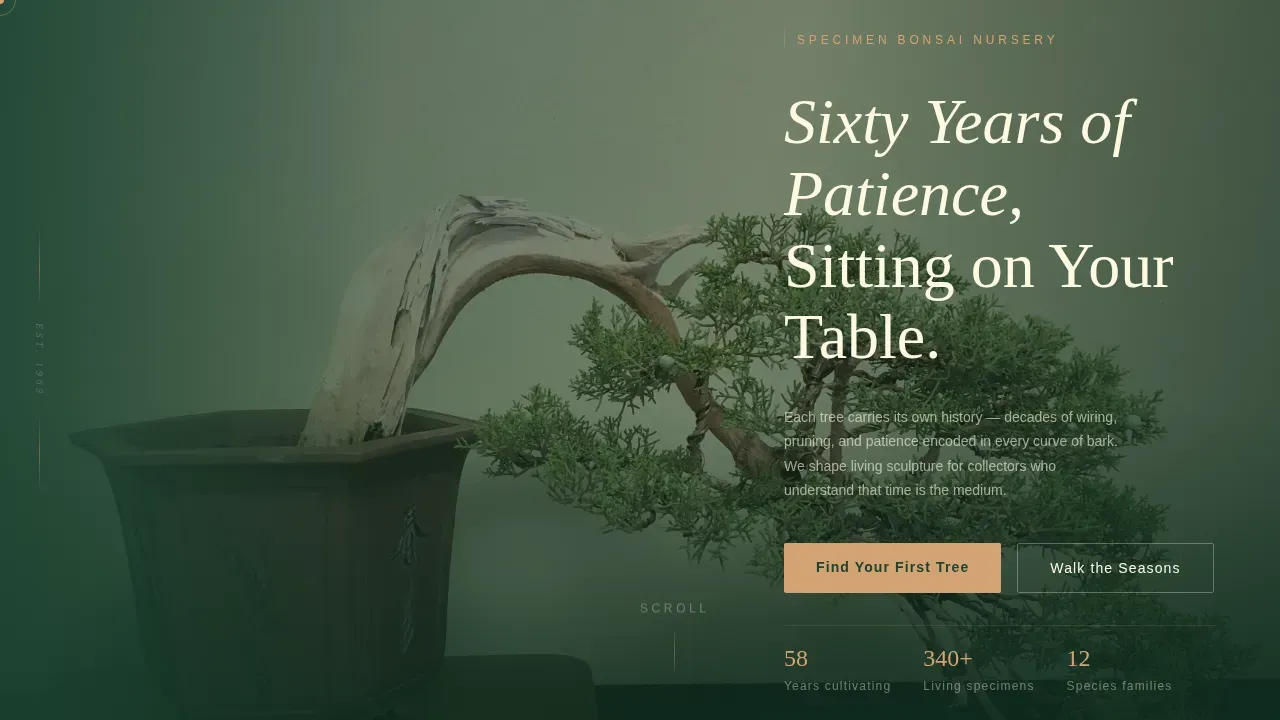
Cultivar is a single-page, hero-dominant landing page template crafted for artisan bonsai nurseries selling specimen-grade trees. The layout opens with a cinematic half-page photograph of a sixty-year-old Japanese black pine, moves through four seasonal scroll sections, and closes with two clear conversion paths: a guided lead form and a nursery visit date picker. Every design decision serves one idea, that bonsai is about time, and this nursery understands it.
Who this template is for
This template was built for a specific kind of seller: one whose trees carry histories, not just price tags. The page speaks to three distinct audiences without diluting its voice.
- Collectors hunting for specimen-grade bonsai trees they have only seen in Japanese exhibition catalogs, with budgets starting at five hundred dollars and climbing into the thousands.
- Hobbyists who lost their first bonsai plant and want real mentorship from a bonsai artist who thinks in decades, not seasons.
- Interior designers sourcing statement pieces for lobbies, waiting rooms, or commercial spaces where something living and sculptural changes the atmosphere entirely.
What problem this template solves
Most nursery pages look like garden center catalogs. They list stock, show a price, and expect the visitor to imagine the rest. A bonsai nursery selling trees shaped over thirty or sixty years cannot afford that approach. The buyer needs to feel the weight of time before they trust you with a decision of this size.
- Trust gap at high price points: Collectors spending thousands of dollars on a single bonsai tree need proof of craft, history, and care philosophy before they submit any form. A flat product grid cannot carry that weight.
- Audience fragmentation: Beginners, serious collectors, and commercial buyers all arrive with different questions. The seasonal scroll structure earns each group's trust at its own pace before presenting a single, well-timed call to action.
- Missed lead capture: Many nursery sites offer only a contact email. This template replaces that with a multi-step guided form that qualifies visitors by experience level, preferred species, placement preference, and budget, making every lead more useful.
What you get with this template
You get a fully structured, single-page layout that guides visitors from first impression to form submission without a single wasted scroll. The template is visual-first, content-aware, and conversion-ready.
- Five distinct content sections covering hero, spring repotting, summer display, autumn emotional peak, and winter structure, each section a complete visual statement.
- Two conversion paths built into the page: the "Find Your First Tree" multi-step guided form and a "Book a Nursery Visit" date picker, both placed at natural scroll-depth decision points.
- A complete Rainforest color system and paired typography stack using deep canopy green, wet moss, sun-through-leaves gold, and exposed-root cream alongside Fraunces serif display type and DM Sans body text.
Feature list
This template includes the following built-in capabilities, all derived directly from the design brief.
Seasonal Scroll Architecture
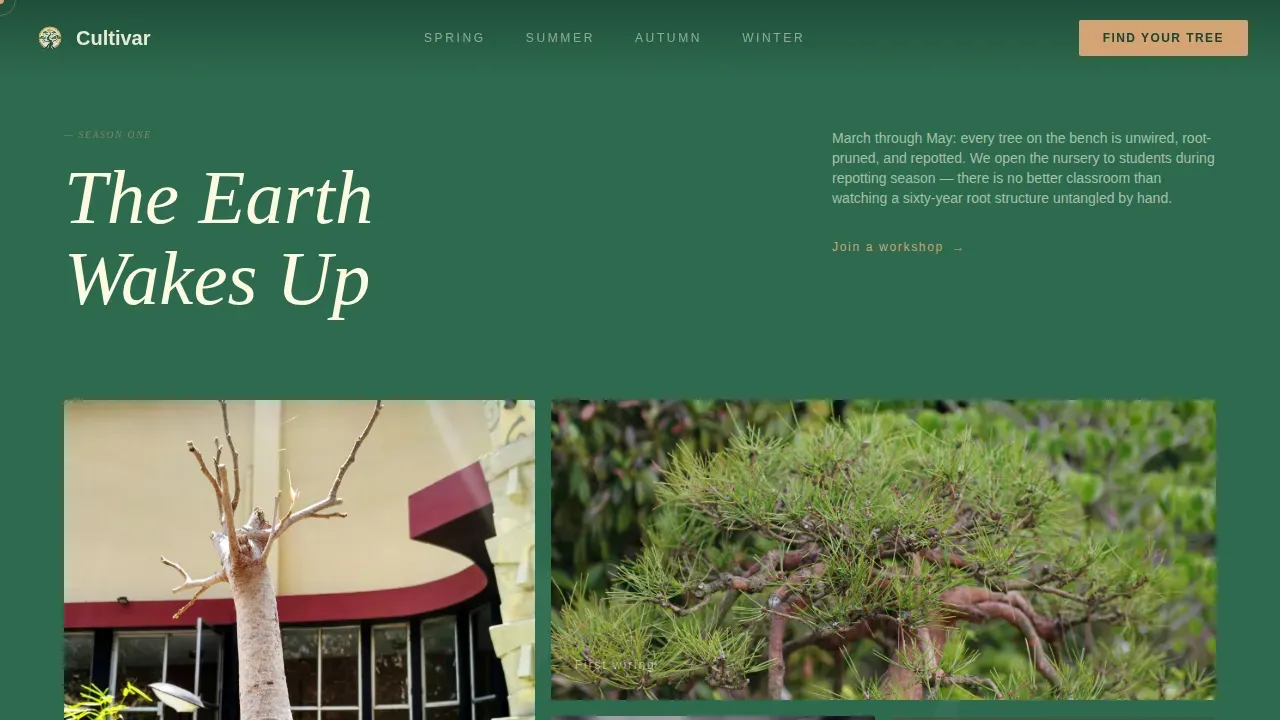
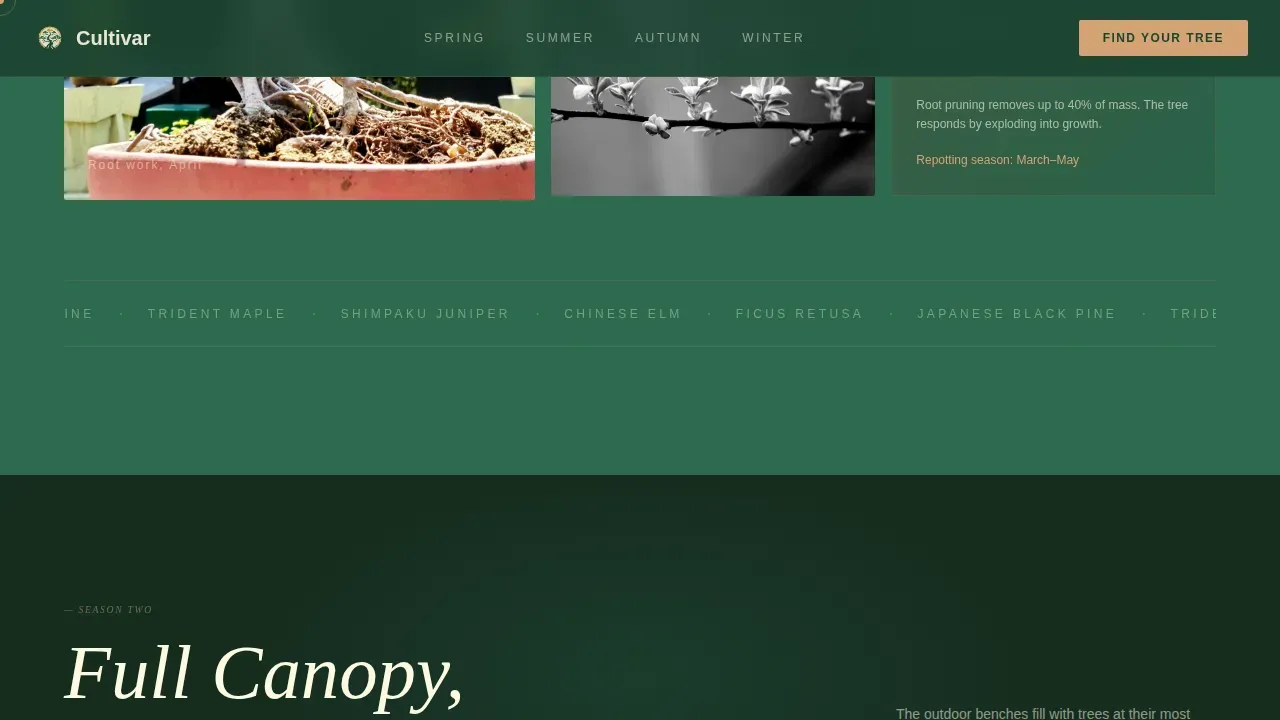
The page is structured as four seasons in sequence. Spring shows repotting and new buds alongside close-up wire demonstrations. Summer opens to outdoor display benches under dappled light. Autumn shifts the palette toward gold as trident maples take center stage. Winter strips everything back to silhouette, bark texture, and exposed deadwood. Each season is its own scroll section, and GSAP scroll-linked transitions carry the visitor through the full calendar arc. The effect is deliberate: visitors feel time passing, which is precisely what bonsai is about.
Hero Half-Page Photograph Layout
The hero section occupies the full viewport on first load. The left two-thirds hold a shallow-depth-of-field photograph of a sixty-year-old Japanese black pine set in a hand-thrown ceramic pot, morning light catching the deadwood jin along the first branch, the soil surface carpeted in miniature moss. The right third carries a vertical headline in quiet Fraunces serif: "Sixty Years of Patience, Sitting on Your Table." Navigation remains hidden until the visitor scrolls, keeping attention undivided on the opening image and headline.
Multi-Step Guided Lead Form
The "Find Your First Tree" form is embedded in the autumn section at the emotional peak of the scroll journey. It is a short, multi-step form that asks four questions: experience level (beginner, intermediate, or collector), preferred species family (conifer, deciduous, or tropical), indoor or outdoor placement, and budget range. This structure qualifies every lead before submission and gives the nursery useful information to match a visitor with the right tree from the very first conversation.
Nursery Visit Booking Path
A secondary conversion path lives in the winter section. The "Book a Nursery Visit" call to action presents a simple date picker that lets interested visitors schedule time at the nursery directly from the page. This path serves collectors and hobbyists who want to see specimen trees in person before committing, as well as interior designers who need to assess scale and character against a real space.
GSAP Animation and Parallax Layers
The template is built with high-animation intent. GSAP scroll-linked transitions handle the seasonal palette shifts and staggered section reveals. Parallax layers add depth to branch and foliage imagery. A cursor follower and image hover depth effects reinforce the tactile, handcrafted character of the nursery throughout the scroll experience. Subtle animation enhances the feeling of tranquility that a bonsai nursery's visual identity depends on.
Rainforest Color System and Typography
The visual identity is anchored by four colors: deep canopy green (#1B4332) for backgrounds, wet moss (#2D6A4F) for secondary panels, sun-through-leaves gold (#D4A373) for calls to action and price highlights, and exposed-root cream (#FEFAE0) for text breathing room. Fraunces handles all display and headline type. DM Sans carries body copy and form interface text. The palette shifts with the seasonal sections, gold overtakes green as the page reaches autumn, so the design itself embodies the passage of time.
Page sections overview
| Section | Purpose |
|---|---|
| Hero: Black Pine | Open with a cinematic half-page photograph and quiet serif headline; hide navigation to hold undivided attention |
| Spring: Repotting & Buds | Show wire demonstrations and new growth close-ups to prove seasonal craft knowledge |
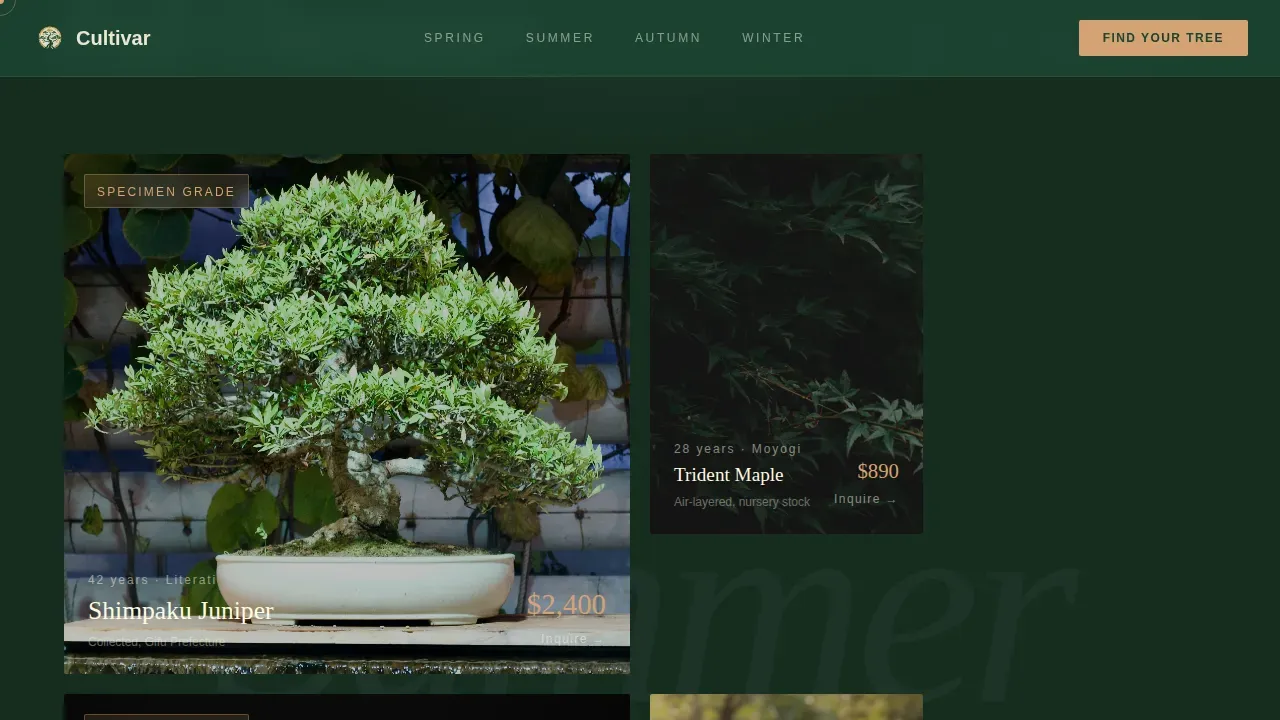
| Summer: Canopy Display | Showcase outdoor specimen benches in dappled light with pricing visible |
| Autumn: Fiery Maples | Shift palette to gold, reach emotional peak, present the "Find Your First Tree" lead form |
| Winter: Bark & Silhouette | Strip to structure and deadwood, present the "Book a Nursery Visit" date picker |
| Footer: Minimal Flow | Deliver minimal cream-on-dark-green horizontal footer with essential links |
Design & branding system
The visual language of this template is best described as organic brutalism meeting Japanese wabi-sabi. Raw textures sit alongside quiet, restrained typography. Nothing competes with the trees. The design earns trust through restraint, a minimalist layout with ample breathing room signals luxury and patience before a single word is read.
- Color: Canopy green (#1B4332) anchors all primary backgrounds. Moss (#2D6A4F) carries secondary panels. Gold (#D4A373) highlights every call to action, price tag, and seasonal accent. Cream (#FEFAE0) opens space for text and prevents visual fatigue across long scroll depth.
- Typography: Fraunces serif handles display headlines and section titles, giving each season its own quiet authority. DM Sans handles body paragraphs, form labels, and user interface elements with clean legibility at all sizes.
- Texture and imagery: High-definition shots of signature ancient trees are placed prominently across sections. Close-up imagery highlights aged bark, exposed roots, and root spread, "living art" visual language that communicates uniqueness and craftsmanship at a glance.
Mobile & speed optimization
The template was designed desktop-first, reflecting how serious collectors and interior designers typically browse and complete inquiry forms on larger screens. However, the layout is fully responsive and adapts cleanly to smaller viewports without sacrificing the seasonal atmosphere or conversion flow.
- Priority hero load: The hero image is prioritized for early loading so the first impression lands immediately, with remaining seasonal sections loading progressively as the visitor scrolls.
- CSS smooth scroll and lazy sections: Each seasonal section below the hero uses lazy loading, and CSS scroll-behavior smooth ensures transitions feel deliberate rather than abrupt across all devices.
- Mobile responsive conversion paths: Both the multi-step guided form and the date picker are accessible and functional on mobile, ensuring no lead is lost when a visitor switches devices between browsing and booking.
How this template helps you convert
This template converts by earning trust first and asking for action second. The seasonal scroll is not decorative, it is a structured persuasion journey designed to move three very different buyer types toward a single qualified submission.
- The scroll journey qualifies intent before the form appears. By the time a visitor reaches the autumn section and the "Find Your First Tree" form, they have passed through spring craft demonstrations, summer specimen pricing, and an emotional autumn color shift. Only visitors who are genuinely interested scroll that far, making the lead pool smaller and more valuable.
- Two paths serve two buyer mindsets. Some visitors are ready to describe what they want; the guided form serves them. Others need to see and touch a tree before deciding; the nursery visit booking serves them. Offering both paths on the same page means the template captures leads at different stages of the buying decision without requiring a second page.
- Clear, specific calls to action reduce hesitation. "Find Your First Tree" is concrete and personal. "Book a Nursery Visit" is low-commitment. Both are placed at scroll-depth points where visitor trust is highest, after the page has already proved that this nursery thinks in decades.
Other information about this template
This section covers additional context that collectors, hobbyists, and designers will find useful when deciding whether this template matches their nursery's needs and the trees they are trying to place.
Bonsai is an art form that originated in China and was refined and developed by the Japanese over centuries. The term literally means "tree in a pot," and the practice aims to recreate the appearance of a full-grown, aged tree in a shallow container. In the 13th century, Japanese practitioners began collecting wild trees that had been dwarfed naturally, these were among the earliest bonsai. The art of bonsai is closely linked to Japanese aesthetics, valuing simplicity and the beauty found in nature.
Bonsai trees are designed to appear aged and graceful, with compact rounded crowns and horizontal or drooping branches. A bonsai artist shapes the tree toward a chosen style, using wire, pruning, and careful repotting to guide growth over years. Bonsai can be classified into roughly ten recognized bonsai styles: formal upright, informal upright, slanting, cascade, semi-cascade, broom, literati, forest, raft, and others. Each style reflects a different moment in nature.
The formal upright style features a straight, tapered trunk with the main trunk line rising vertically. The bottom branch is the longest and extends farthest from the trunk. The formal upright is often considered approachable for new bonsai growers. The informal upright style is very common in both nature and in bonsai, it depicts a tree shaped by the elements, with a gently curved, non-linear trunk line. The slanting style shows a tree that slants to one side, often as a result of wind or water flowing in one dominant direction. Tree slants in this style carry the movement of the environment into the silhouette of the trunk.
The cascade style represents a tree growing on a steep cliff face, with the trunk bending downward past the rim of the bonsai pot. In cascade style bonsai, a tall container is typically used so the cascading foliage has room to fall below the base of the pot. The semi-cascade style is related: the trunk grows upright briefly and then bends downward just beyond the rim of the container.
Many species work well for bonsai projects. Certain species of both maple and elm trees respond well to bonsai culture and develop small leaves that are in proportion to the miniature scale. Among the plants with small leaves and fine needles suited to bonsai are spruce, pine, zelkova, and pomegranate. Japanese zelkova (zelkova serrata) is particularly valued for its fine branching and the way its canopy develops with age. A Japanese black pine specimen is prized for dramatic trunk movement, textured bark, and strong needle growth.
Deciduous trees like trident maples and Japanese zelkova are favorites in collector circles because their seasonal changes, spring buds, summer foliage, autumn color, and winter silhouette, mirror the page's own seasonal structure. Deciduous trees lose their leaves each winter, exposing the branch structure and trunk base in a way that shows decades of careful work. Smaller trees with compact foliage and proportional small leaves tend to display better in a shallow container at tabletop height.
A training pot serves an important function early in a tree's development. While a tree grows in a training pot, the bonsai artist has more soil volume to work with, which supports active growth and root development before the tree is transferred to a final, more refined bonsai container. The root ball is carefully managed during repotting: old soil is removed, roots are trimmed, and fresh soil is packed around the remaining root mass to support new growth.
Repotting bonsai trees at the right time of year is critical. Repotting during the growing season, when the tree is pushing active growth, stresses the tree unnecessarily. Most practitioners repot in early spring, just before new buds break. Regular watering and fertilization year round, adjusted by season, are essential to maintain health and vitality. During active growth periods, fertilization is particularly important. Pruning shapes the tree and maintains its desired size and form. Wiring bends branches into desired positions, and the wire must be monitored so it does not cut into the bark as the tree grows.
Indoor bonsai species require different light conditions than outdoor specimens. Species suited to indoor placement, such as dwarf jade (portulacaria afra) and elephant bush, tolerate lower light and stable indoor temperatures. Portulacaria afra is often recommended as an accessible first tree for new bonsai growers. It is easy to care for, adapts to most environments, and can be grown in most every style of bonsai, including upright and cascade style bonsai. Its thick, succulent stems hold moisture well and respond forgivingly to pruning.
For visitors considering their first tree, the template's guided form addresses placement preference directly, indoor or outdoor, which helps the nursery match the right species and bonsai pot to the buyer's situation. A willow tree style bonsai, for example, needs full sun and outdoor exposure to thrive, while a compact indoor bonsai may suit a lobby or office environment better.
Bonsai workshops and classes are a natural extension of a nursery's offer. Workshops give participants hands-on personal experience trimming and repotting their own bonsai trees under the guidance of a knowledgeable bonsai artist. Participants choose from a variety of trees and pots, work directly with wire and pruning tools, and leave with care instructions and a new bonsai they shaped themselves. Follow-up care information helps buyers maintain their trees with confidence after the workshop ends. Bonsai workshops are engaging for both beginners exploring a new hobby and experienced growers working on new bonsai projects.
Storytelling is central to selling ancient trees. The "History Card" approach gives each specimen a documented record of estimated age, origin, and the bonsai artists who shaped it over the decades, details that transform a tree from a product into a provenance piece. Dynamic CMS collections can showcase different cultivars of bonsai in a categorized layout, making it easier for collectors to navigate by species, bonsai styles, or rarity. The cultivar ancient living sculpture bonsai nursery landing page template supports this kind of storytelling by giving each seasonal section room to introduce individual specimens with their own character and history.
Trust signals matter at high price points. Showcasing the nursery's expertise, training, and care support builds the confidence a collector needs to act. Customer testimonials, particularly those with photographs of trees upon delivery, reinforce credibility. Care guides included with each purchase give buyers the support information they need to maintain their new bonsai with a strict schedule appropriate to the species and the season. The Aura Build - Bonsai E-commerce Landing Page Template is a related template in this niche, focusing on e-commerce functionality with a serenity-led minimalist design.
- The page's specimen showcase in the summer section can display bonsai containers, price tags, and species notes side by side for easy collector comparison.
- The asymmetrical balance of the hero layout, photograph dominant on the left, text quiet on the right, reflects the natural form and compositional principles common to Japanese garden design.
- Each seasonal section supports different shapes in the specimen display, from the upright tree silhouettes of formal specimens to the hanging lines of cascade style pieces.
- A bonsai nursery can use the footer's minimal horizontal flow pattern to include links to care guides, workshop schedules, and collector inquiry forms without cluttering the main scroll experience.
Theme
Nature-Inspired
Creative direction
Seasonal/Moment
Color system
Rainforest
Style
Hero-Dominant (90/10)
Direction
Lead Generation
Page Sections
Seasonal Scroll Architecture
Hero Half-page Photograph Layout
Multi-step Guided Lead Form
Nursery Visit Booking Path
Rainforest Color System and Type Stack
Specimen Display and Social Proof Sections
Related questions
Who is this landing page template designed for?
What conversion paths does this template include?
Can this template showcase different bonsai styles and species across the specimen sections?
Does the template include animations and interactive effects?
Is this template suitable for a nursery that also runs workshops?