Expert Regional & Specialty Restaurant Portfolio & Case Study Website Template
Kudla is a Mangalorean coastal restaurant landing page template built for experiential dining and event bookings. It features a masonry gallery layout, a cinematic overhead hero, and a slide-in reservation form. The Sunset Gradient color system and Organic Flow theme bring monsoon coastal warmth to every scroll, making it ideal for expat communities, food enthusiasts, and corporate event planners.
by Rocket studio
Quick summary
Kudla is a single-page event registration landing page template designed for a Mangalorean coastal restaurant. It guides visitors through a masonry gallery journey, from raw market ingredients to finished feast plates, before inviting them to reserve a table. The Organic Flow theme, warm Sunset Gradient palette, and slide-in booking form make it a strong fit for experiential dining events.
Who this template is for
This template speaks directly to people who want a landing page that does more than list a menu. It is built for restaurant owners, event hosts, and planners who want to present food as a cultural experience worth booking a seat for.
- Mangalorean restaurant owners and coastal dining venues who want to engage both local communities and diaspora guests with an immersive, story-driven page.
- Private event planners and corporate teams who need a polished reservation interface that can handle family gatherings, festival celebrations, and corporate dinners without a complicated booking process.
- Regional food enthusiasts and culinary event organizers who want a presentation that honors the history and science of traditional coastal cooking, and who hope to attract participants who value authenticity over generic dining.
What problem this template solves
Most food and beverage landing pages look like digital menus. They list dishes, show a few photos, and add a phone number. That approach fails when the product you are selling is not just a meal but an entire cultural environment. Visitors who land on a flat, generic page do not feel the pull of recheado paste hitting a hot tawa. They do not understand what makes this dining event different from any other. They leave without booking.
This template solves that problem by making the scroll itself the story. Every section draws visitors deeper into the coastal kitchen, building desire before the reservation form ever appears.
- It replaces static menu lists with three sequential masonry gallery clusters that each serve a distinct narrative purpose: raw ingredients, cooking process, and finished plates.
- It provides a floating "Reserve Your Feast" call-to-action button that stays in view after the first scroll, so guests never have to hunt for the booking path.
What you get with this template
This template gives you a fully structured single-page layout ready to be populated with your food photography, event details, and brand copy. Every section is purposefully arranged to carry visitors from first impression to confirmed reservation.
- A cinematic overhead hero section with a headline fade-in, three sequential masonry gallery clusters with story-line separators in italic laterite red, and a floating call-to-action button that persists throughout the scroll.
- A slide-in reservation form panel with event type selection, a party size stepper, a preferred date picker, and a free-text field so guests can describe exactly how they want their table to feel.
- A split-layout footer with logo and tagline on the left and navigation links on the right, plus a scrolling marquee section that functions as an authenticity signal between the hero and the first gallery cluster.
Feature list
This template is built around a tight set of purpose-driven features. Each one is directly tied to the experience of selling a high-value dining event to guests who need to feel the atmosphere before they commit to a booking.
Cinematic Overhead Hero with Fade-In Headline
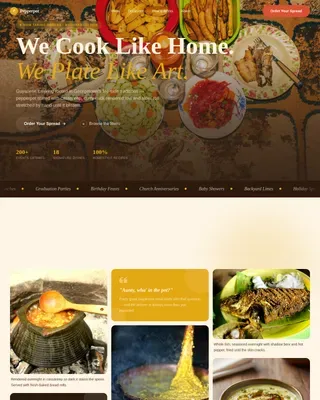
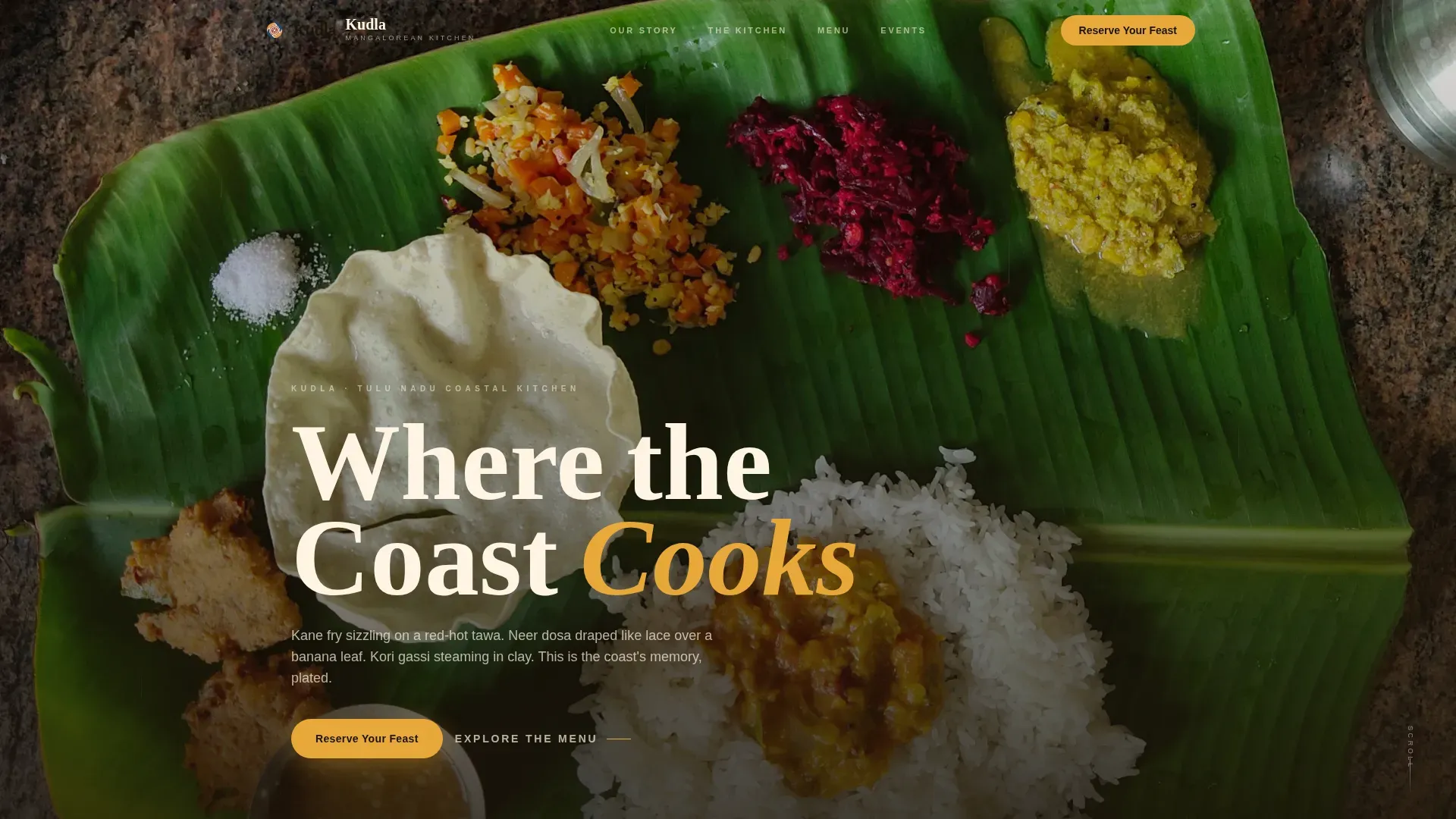
The hero presents a wide overhead lifestyle shot of a full Mangalorean spread on a weathered teak table. The composition includes red rice, neer dosa, a clay pot of kori rotti gassi, fried bangude mackerel, and human hands actively tearing, dipping, and serving. Golden-hour light streams in from the left. The headline "Where the Coast Cooks" fades in over the scene in coconut cream type, giving first-time visitors an immediate sense of the world they are entering. Essential event details should be visible at or near this hero section so participants do not have to scroll to understand the offer.
Three-Cluster Masonry Gallery Layout
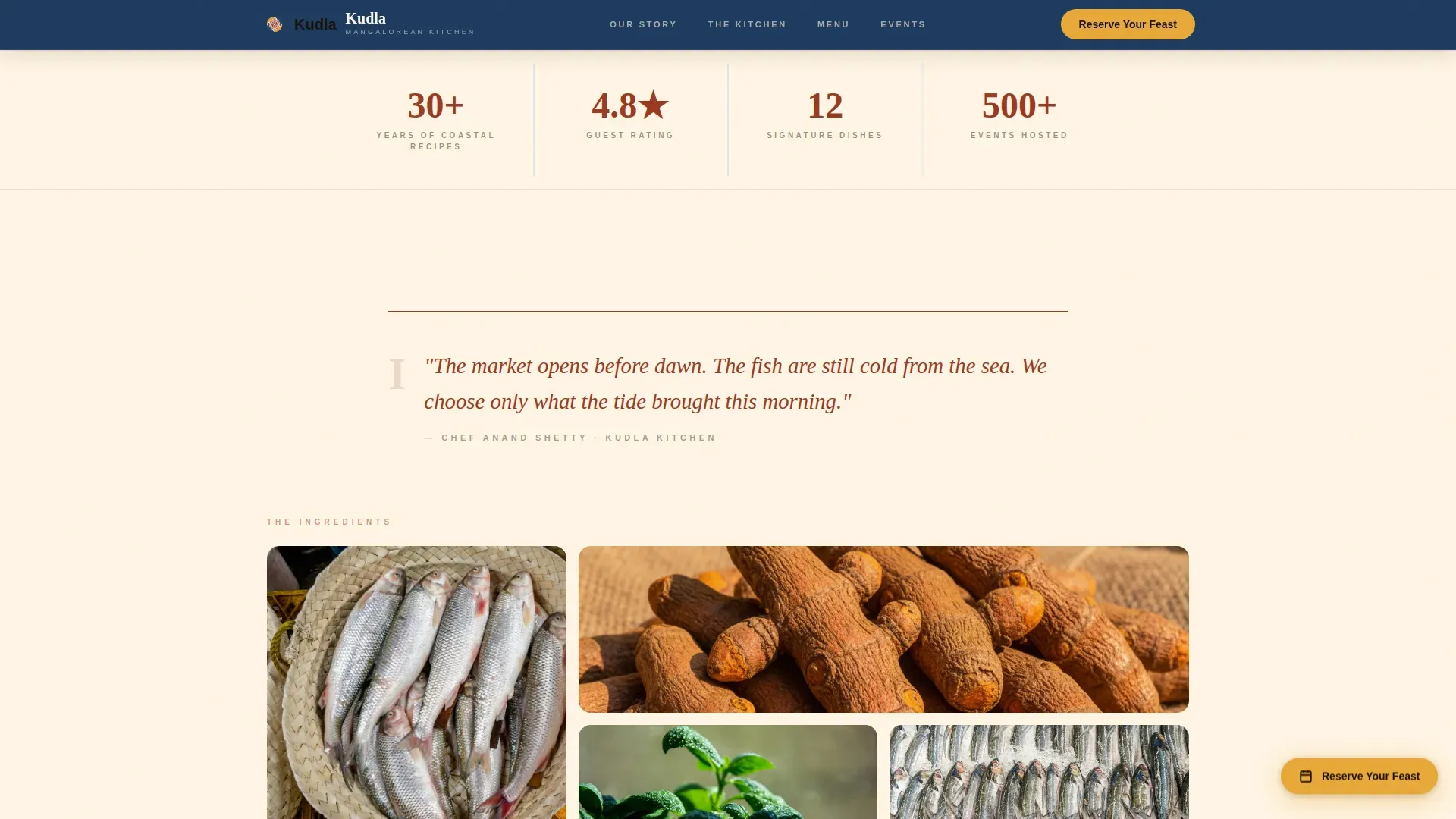
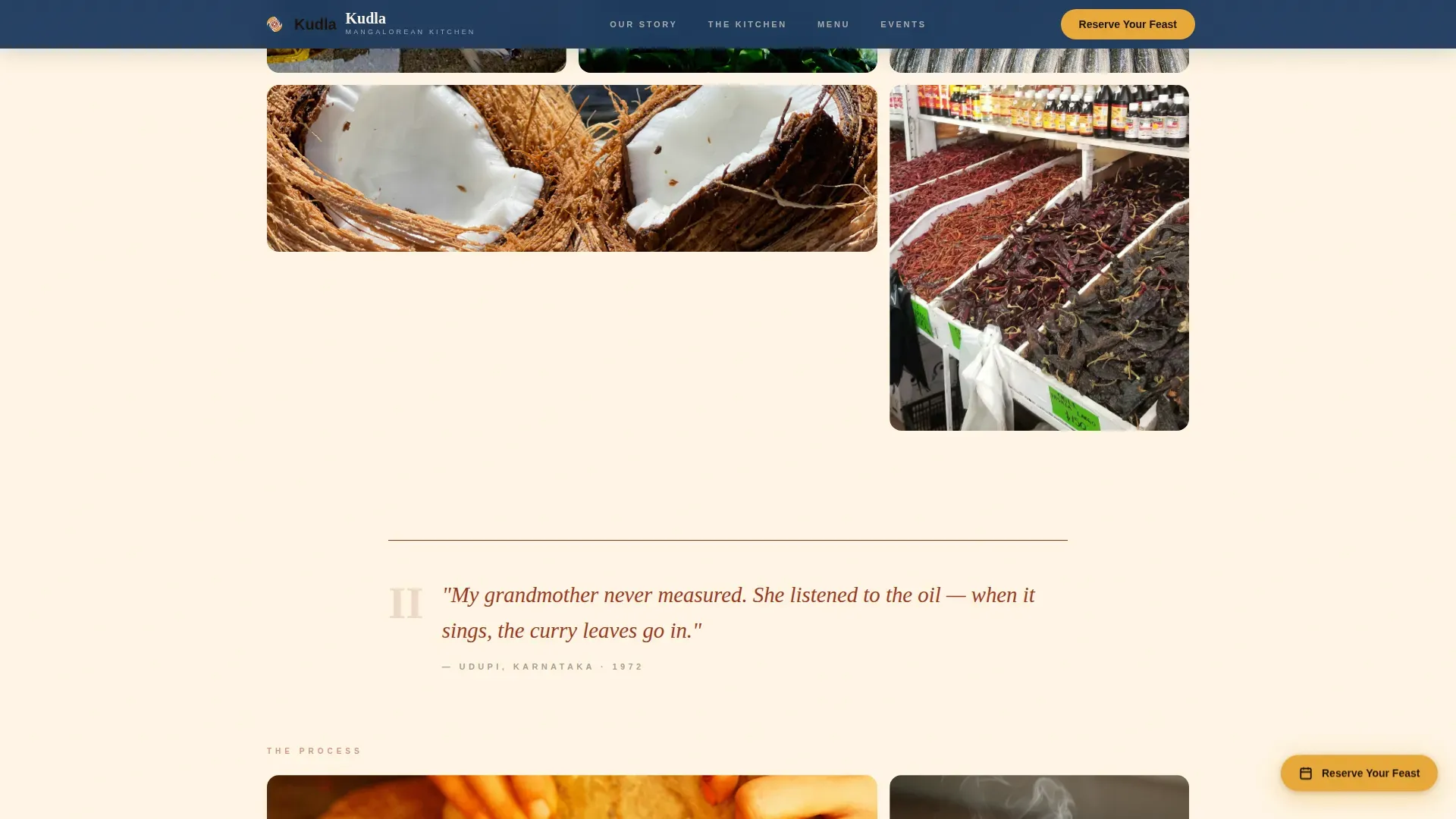
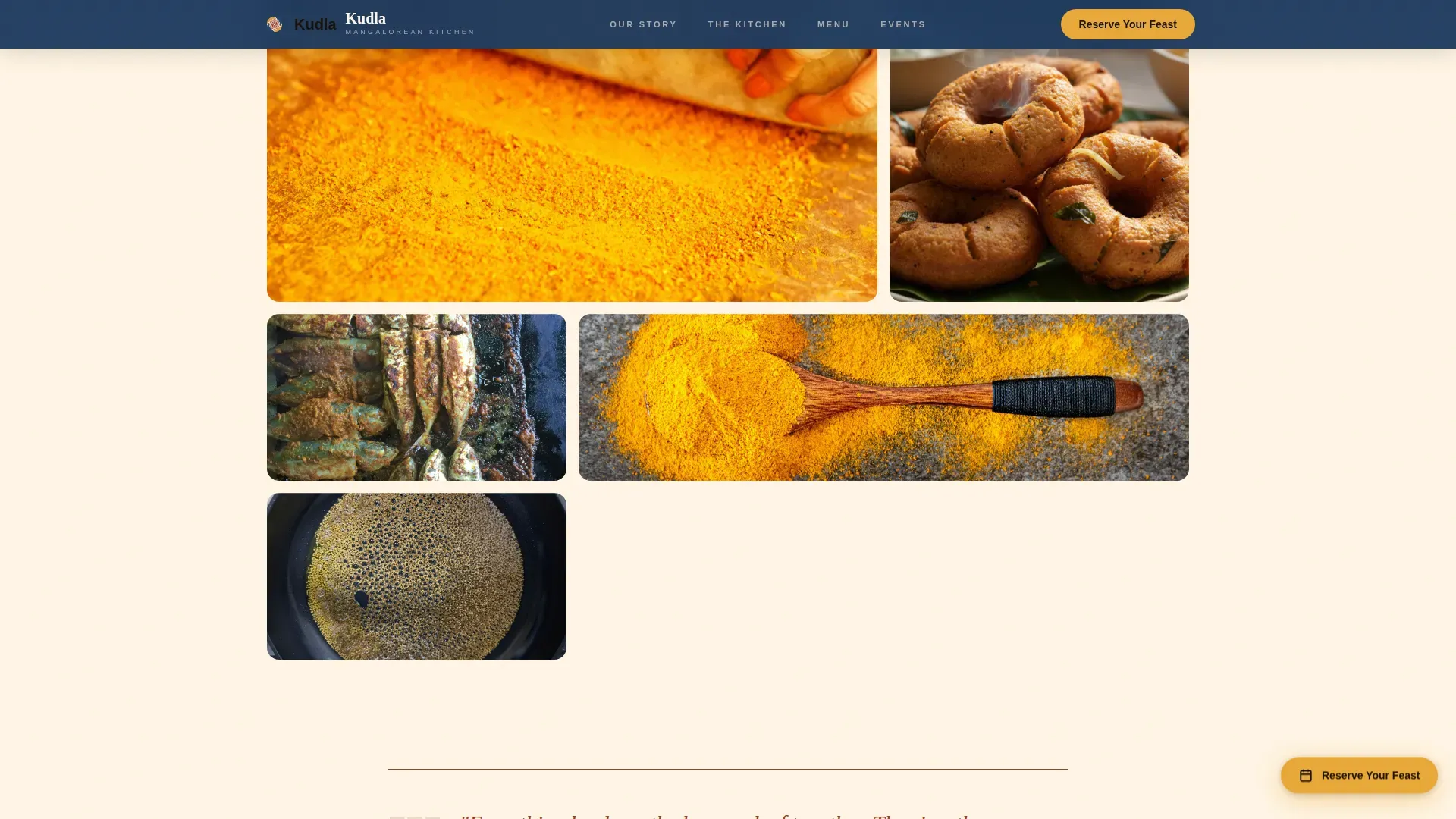
The template structures its visual content as three distinct masonry clusters separated by single-line story beats in laterite red italic. The first cluster presents raw market ingredients, gleaming kane fish, stacked kokum rinds, fresh curry leaves. The second cluster shows the process, hands grinding masala on a stone slab, batter spreading across a hot tawa. The third cluster presents finished plates in portrait and landscape tiles with asymmetric rhythm. Each cluster deepens the sense of being inside someone's coastal kitchen memory, making the presentation feel closer to a gallery walk than a restaurant website.
Floating "Reserve Your Feast" Call-to-Action
A persistent floating button in jackfruit amber (#E8A838) pins itself in the viewport after the first scroll. This ensures the path to reservation remains available throughout the entire gallery journey. Visitors who are ready to book at any point in the scroll do not need to search for the booking trigger. The floating button is one of the most direct tools the template uses to convert browsers into registered participants.
Slide-In Reservation Form Panel
Clicking the floating button triggers a slide-in form panel. The form collects event type (family gathering, corporate dinner, festival celebration, or private tasting), party size via a stepper input, a preferred date using a date picker, and a single textarea labeled "Tell us what your table should feel like." This frictionless registration process focuses on minimal input to keep the experience smooth, so guests can prepare their booking without friction. The form is designed to collect data clearly and efficiently without overwhelming guests with unnecessary fields.
Scrolling Marquee Authenticity Signal
Between the hero and the first gallery cluster, a marquee section scrolls ingredient names, place names, and culinary terms across the screen. This acts as an authenticity signal that orients the visitor culturally before the gallery begins. It functions like a research poster pinned at the entrance of a culinary exhibition, giving context without requiring a visitor to read long paragraphs.
Arc-Split Footer with Tagline
The footer follows an Arc Browser Split pattern: logo and tagline sit on the left, navigation links on the right. This layout keeps the footer clean and readable even on smaller screens. The footer uses Arabian Sea blue (#1E3A5F) as its background, grounding the page after the warm-toned gallery scroll and giving the layout a clear visual close.
Page sections overview
| Section | Purpose |
|---|---|
| Hero Lifestyle Shot | Cinematic overhead spread image with "Where the Coast Cooks" fade-in headline |
| Marquee Origin Signal | Scrolling ingredient and place names as an authenticity and cultural context marker |
| Gallery Cluster One | Masonry grid of raw market ingredients: fish, kokum, curry leaves |
| Story Line Break | Single italic sentence from chef or village name, separating cluster one from cluster two |
| Gallery Cluster Two | Masonry grid of cooking process: stone grinding, tawa spreading, hands at work |
| Story Line Break | Single italic sentence acting as a memory-bridge between process and plated dishes |
| Gallery Cluster Three | Asymmetric portrait and landscape plate tiles, final finished dish presentation |
| Reservation Form Section | Slide-in panel with event type, party size stepper, date picker, and open textarea |
| Arc Split Footer | Logo and tagline left, navigation links right, in Arabian Sea blue |
Design & branding system
The visual identity is built on an Organic Flow theme using a Sunset Gradient color system. The palette references the specific sensory world of Panambur Beach at dusk: warm gold bleeding through burnt clay into deep ocean blue. Typography pairs Fraunces, a serif headline face, with DM Sans for body text. The result is warm and legible without feeling heavy.
- Color roles are clearly defined: coconut cream (#FFF5E4) is the dominant background and lets food photography breathe; laterite red (#9B3922) anchors headlines and hover states; jackfruit amber (#E8A838) warms calls to action and price callouts; Arabian Sea blue (#1E3A5F) grounds the navigation and footer.
- Typography and layout work together to maintain a consistent coastal theme throughout the scroll, ensuring visual coherence from the hero image down to the footer without relying on decorative flourishes that distract from the food photography.
Mobile & speed optimization
The template is built mobile-first, with food photography and masonry grids designed to perform well on smaller screens. The masonry clusters are specifically structured to remain visually engaging on mobile viewports, where tall portrait tiles and wide landscape tiles naturally reflow into a readable stacked rhythm. High-quality hero imagery is used to capture the event atmosphere, and images should be optimized to support fast load performance so visitors on any connection can engage with the page without waiting.
- The floating call-to-action button is positioned and sized for comfortable thumb-reach on mobile, so participants can trigger the reservation form without zooming or searching.
- Animation layers including clip-path reveals, GSAP scroll effects, parallax, and the slide-in form panel are managed via client-side components, while static structural elements use server components to keep initial load lean and responsive.
How this template helps you convert
This template treats conversion as a journey, not a single button. It guides visitors through the atmosphere of the dining event before asking them to commit. By the time a guest reaches the reservation form, they have already walked through the market, watched the masala grind, and seen the finished plates. The desire is built. The ask is natural.
- The floating "Reserve Your Feast" button in jackfruit amber stays persistent throughout the full gallery scroll, meaning participants can choose to book at any moment without losing their place in the story. The clear call-to-action and minimal form fields reduce hesitation and prepare guests to confirm their seat in one smooth motion.
- The inline "Explore the Menu" secondary text link gives browsers a lower-commitment path. It scrolls them toward the gallery clusters so they can spend more time with the visual content, develop a deeper understanding of the dining experience, and arrive at the reservation form already convinced. This dual-path approach helps the template serve both ready-to-book guests and those who need more time to engage with the atmosphere before they decide.
Other information about this template
This template is purpose-built to present the Kudla Coastal Feast event registration landing page template context to a wide range of guests. The event it models is grounded in real coastal culinary history and community tradition. Understanding how this template fits into a broader event management ecosystem helps you use it more effectively.
- The Kudla Samskrutika Prathishtana organizes the Kudla Coastal Feast, which runs from January 15 to January 19, 2025, across 250 stalls on Mahatma Gandhi Road, Kulur Ferry Road, and Mannagudda Road in Mangaluru city. The event aims to promote local street food and culinary traditions of the coastal region across a wide society of food lovers.
- The template is designed to present essential details like the event name, date, time, and location immediately without requiring visitors to scroll. Embedding a Google Maps link for the venue address helps participants who are attending for the first time find the location without confusion. Information about parking or public transport can be added within the footer or a dedicated detail row.
- Event registration templates like this one can streamline the process of signing up for food festivals. Templates for event registration help manage attendee information efficiently and can enhance the user experience for all participants. Digital tools can streamline event management, making it easier to coordinate logistics and communication across a large team.
- Digital ticketing can streamline entry on the day of the event. Automating the delivery of a unique QR code upon registration can facilitate on-site check-in and reduce queues, helping the team serve guests faster and more efficiently from the very beginning of the event.
- Event management software and email marketing strategies work well alongside this template. Email marketing is an effective strategy for keeping attendees informed and engaged before, during, and after an event. Analytics tools can provide insights into attendee behavior and preferences, helping to develop and improve future events.
- The template supports a range of social proof elements. Including testimonials from past events, chef story quotes, village names, and grandmother's instructions as section separators builds trust across diverse communities and encourages hesitant guests to participate. Using phrases that foster urgency, such as "Only 50 seats left" or "Exclusive table for 20," can be placed within the hero or near the floating call-to-action.
- A countdown timer can be added near the reservation section to create urgency around early bird pricing or limited seating windows. Displaying real-time registration numbers or past attendee testimonials promotes urgency in a way that feels organic rather than pushy.
- The Kudla Coastal Feast is the kind of event that brings together friends, families, and food researchers from across the world. It draws young men and women from the coastal city and diaspora communities in florida and other regions who hope to reconnect with the history and science of traditional Mangalorean cooking. Each annual meeting of this culinary society draws a larger group of participants than the last, and the template is built to support that growing scale.
- The template layout is suitable for groups ranging from small private tastings to large corporate conference dinners. Whether guests plan to spend a single evening or attend across multiple trips during the festival's january run, the reservation form can be adapted to collect data relevant to any event type.
- This template can support workshop-style dining experiences, where participants engage with cooking techniques in a structured class offered alongside the main feast. Workshop formats are popular in university campus settings and with graduate student groups who want to develop their understanding of regional culinary science and history. Faculty advisors and program coordinators at institutions like Brown University have used similar event formats to engage students across disciplines, from art history to social science, and to discuss diversity and social justice through the lens of food culture.
- The masonry gallery format serves as a visual research poster for the restaurant's culinary identity. Researchers and journal contributors who document regional food traditions will find the layout's gallery-walk structure familiar and intuitive. The template's presentation style is comparable to how academic communities present data and findings at a conference or annual meeting, where the goal is to advance understanding through well-organized visual and textual evidence.
- The African American community and other diasporic communities share similar dynamics with Mangalorean expat groups: a deep need to reconnect with food culture that carries the weight of home. The template's design philosophy acknowledges this aspect of the experience. It is built to engage those communities with warmth and specificity rather than generic multicultural messaging.
- Communities that participate in culinary festivals often develop a deeper sense of local identity and pride. This template helps those local communities present their culinary heritage to the world in a way that is both visually compelling and functionally effective for event registration. The layout can be adapted for an academic year calendar of events, allowing organizers to plan a series of seasonal dinners from summer through fall, with each course of the annual program building on the last.
- The template's development was guided by a focus on authentic visual storytelling. Progress on the design was driven by the idea that food is not just sustenance but a living lab of cultural memory. Every dedicated section of the page, from the marquee to the footer, serves the broader goal of helping communities meet around a shared table, whether they are booking a school group outing, a campus workshop, or a private feast for friends.
- Published food event templates rarely go this deep into atmosphere and cultural specificity. This template is a dedicated tool for restaurateurs and event organizers who want their page to feel like a place, not a form. It is designed to advance the presentation of coastal Indian culinary culture in a way that is honest, warm, and purposeful.
Theme
Organic Flow
Creative direction
Gallery Walk
Color system
Sunset Gradient
Style
Masonry/Pinterest
Direction
Event Registration
Page Sections
Cinematic Overhead Hero with Fade-in Headline
Three-cluster Masonry Gallery Layout
Persistent Floating Reservation Button
Slide-in Reservation Form Panel
Scrolling Marquee Authenticity Signal
Arc-split Footer with Navigation
Related questions
What event types does the reservation form support?
Can I adapt this template for a recurring annual event series?
How does the masonry gallery handle different image orientations?
Is the floating call-to-action visible throughout the full page scroll?
How do I present venue location details for guests?