Smoky Namibian Restaurant Landing Page Template
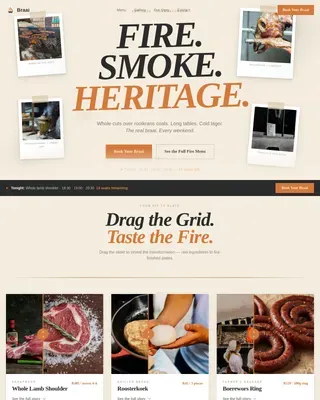
Braai is a single-column Namibian restaurant landing page template built around a scroll-driven origin story. It moves visitors through landscape, journey, and menu in one cinematic flow, then converts them with a reservation form and a home-delivery Braai Box option. The design pairs ink-and-watercolor illustration with Neo-Retro typography for a taste of Windhoek that is impossible to forget.
by Rocket studio
Quick summary
Braai is a single-column flow landing page template for a Namibian restaurant. It tells the origin story of kapana, potjiekos, and ancient cooking traditions through scroll-driven chapters, then drives table reservations and Braai Box home-delivery orders. The visual identity blends travel-poster illustration with Japanese Zen restraint, making every section feel like a hand-thrown ceramic plate: deliberate, warm, and impossible to rush.
Who this template is for
This template speaks directly to restaurant owners and food entrepreneurs who want their online presence to carry as much story as their kitchen does. It is built for operators who believe the meal begins long before the first bite, and that a visitor who understands where the food comes from is a visitor who will book a table.
- Namibian and southern Africa-rooted restaurant owners who want to introduce authentic dishes to a new city audience and convert curious first-timers into loyal regulars.
- Adventurous dining concepts in any diverse country whose cuisine deserves a cinematic introduction rather than a static menu page.
- Food-forward entrepreneurs ready to offer a secondary product, such as a home-delivery kit, alongside their dine-in experience.
What problem this template solves
Most restaurant landing pages treat the menu as the opening act. They list dishes, post a phone number, and hope visitors make the connection between food and feeling on their own. That approach fails cuisines with a deep cultural context, where the cooking methods are centuries old and the story behind every sauce and side dish is half the reason to eat there.
- It closes the gap between a curious visitor and a confident booker by leading with narrative before the menu, so the reservation feels earned rather than transactional.
- It replaces generic restaurant web layouts with a culturally specific design system, one that communicates the heat of the fire, the weight of tradition, and the taste of a country most visitors have never experienced.
- It solves the conversion problem for multi-revenue restaurants by giving equal visual weight to both the dine-in reservation path and the home-delivery Braai Box, so no income stream is buried.
What you get with this template
The template delivers a full single-column landing page with six purpose-built sections, a rich illustration-led header, scroll-triggered chapter reveals, and two distinct conversion paths. Every detail is sourced from the restaurant's origin story rather than generic food-industry patterns.
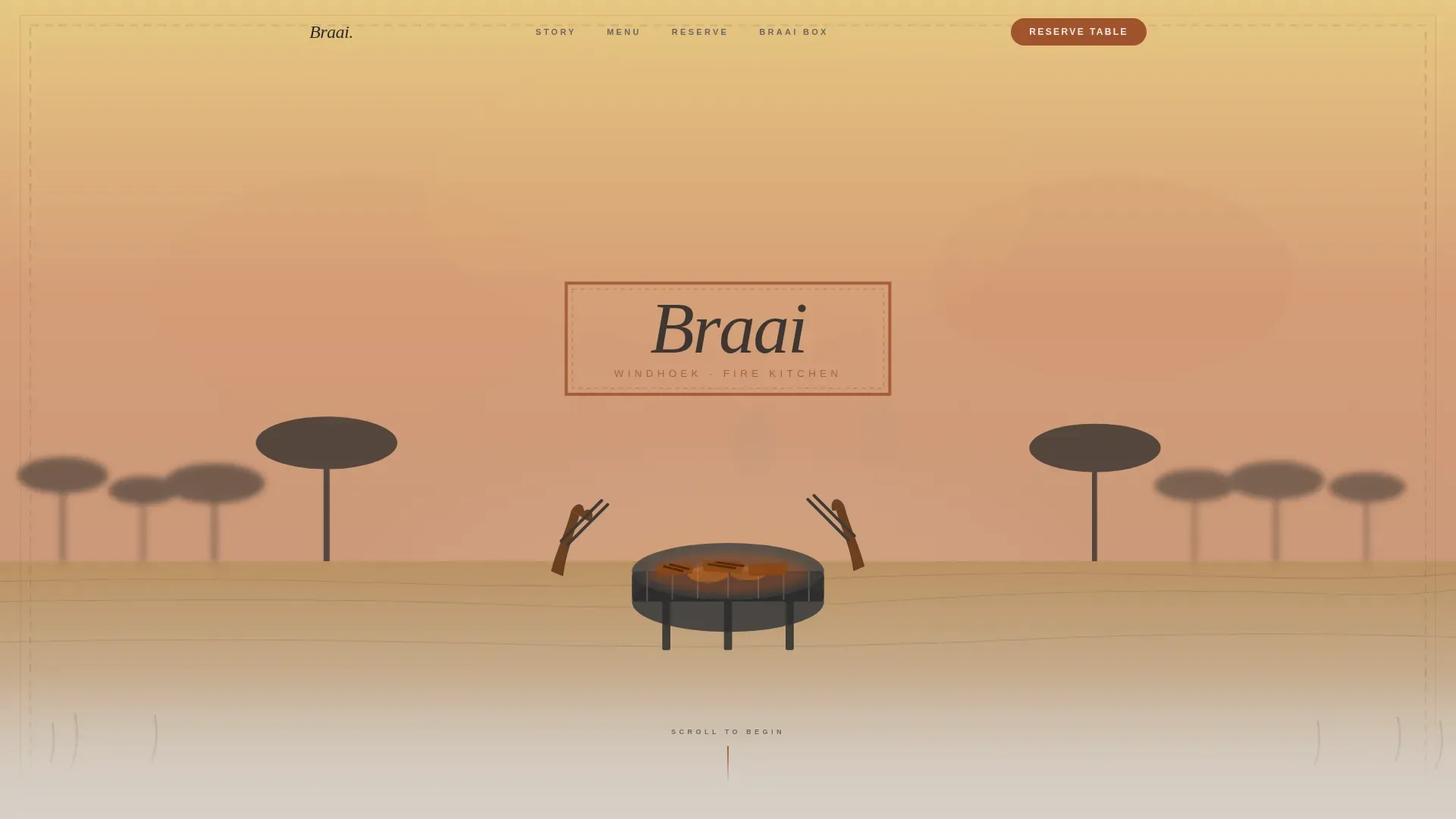
- A hand-crafted ink-and-watercolor hero panorama in retro travel-poster style, featuring a Namibian braai scene with loose line work, deliberate color bleeds, and a hand-lettered restaurant name that reads like a stamp on a vintage postcard.
- A scroll-driven narrative arc across Origin Landscape, The Journey, and Signature Menu sections, each revealed in sequence so the visitor experiences the story as a progression rather than a static page.
- A dual-path conversion system: a primary "Reserve Your Table" form with date picker, party size selector, and a First Visit versus Welcome Back toggle, plus a secondary "Order the Braai Box" option for home delivery of biltong, droëwors, and chakalaka with illustrated instructions.
Feature list
The Braai template is engineered around one idea: earn the sale through story before you ask for the booking. Every feature below serves that purpose.
Illustrated SVG Hero Panorama
The header is not a photograph. It is a wide ink-and-watercolor panorama rendered in a retro travel-poster style, showing hands turning kapana on a steel drum grill, smoke curling into a vast ochre sky, and silhouettes of flat-topped acacias on the horizon. The line work is deliberately loose and human, color washes bleed outside their borders, and the restaurant name sits inside the composition like a hand-lettered stamp. This single illustration sets a tonal register that no stock image could match and immediately signals that this restaurant has a world worth entering.
Scroll-Driven Origin Story Chapters
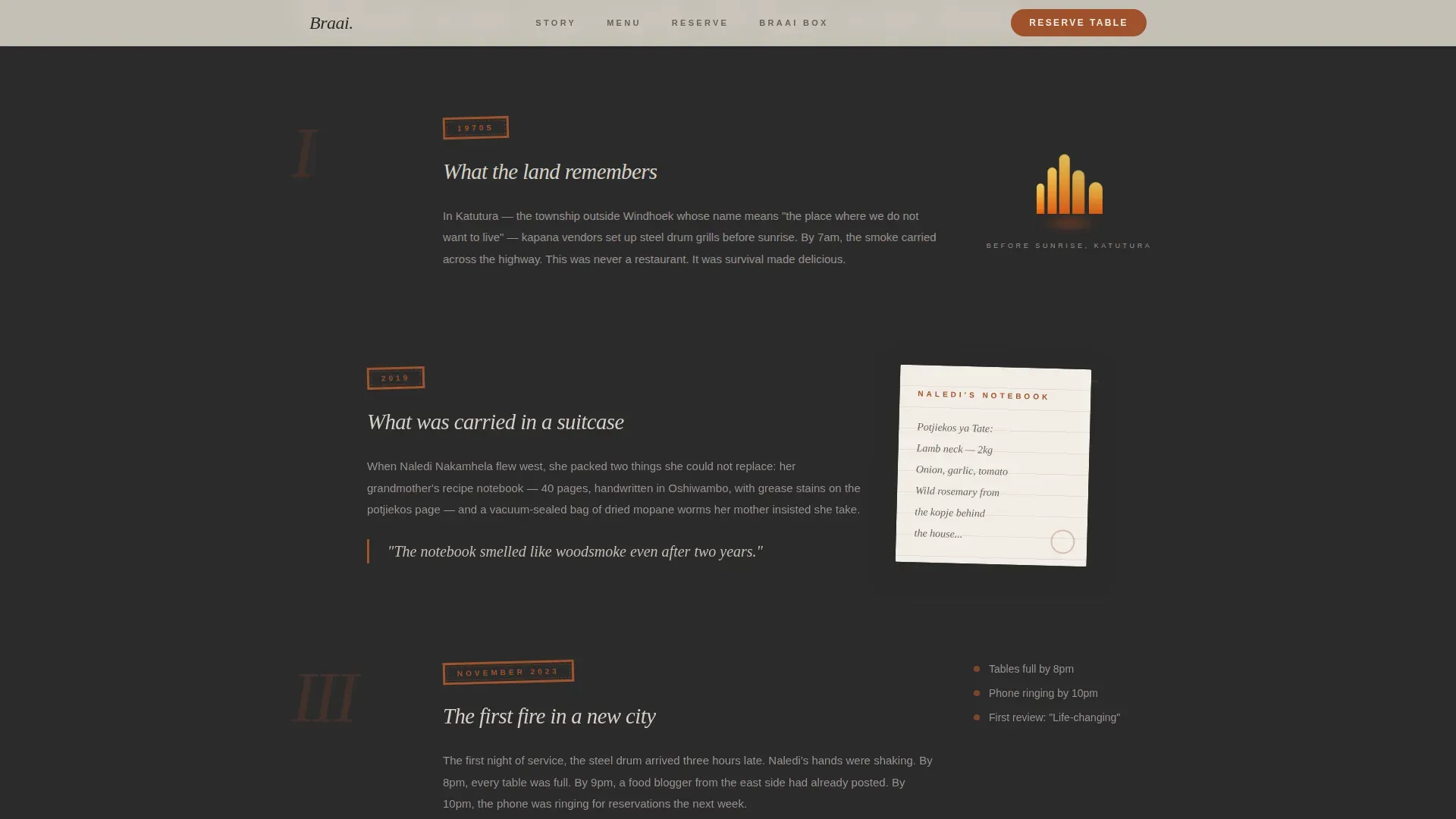
The template uses GSAP ScrollTrigger to reveal narrative chapters as the visitor scrolls. The story begins in the Namibian landscape, moves through ingredient sourcing and ancient cooking traditions, then follows the journey of the recipes themselves: who carried them, what was preserved, and the moment the first cast-iron pot was set on a new stove in a new country. Each chapter uses clip-path reveals, parallax layers, and staggered text animations. The emotional architecture is intentional. By the time the visitor reaches the Signature Menu, they are not just reading a dish list; they are participating in a living culinary record.
Signature Menu with Story Context
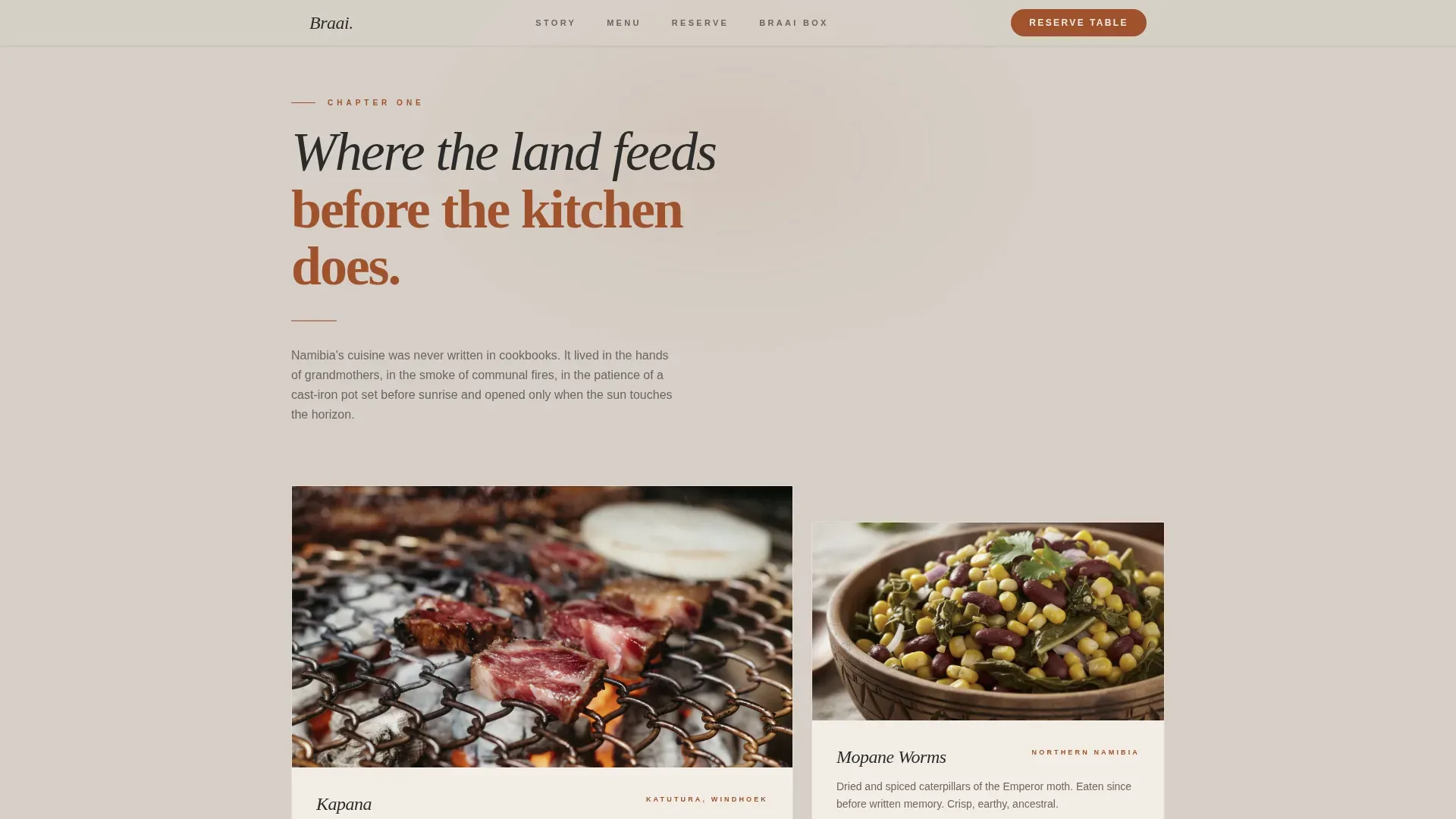
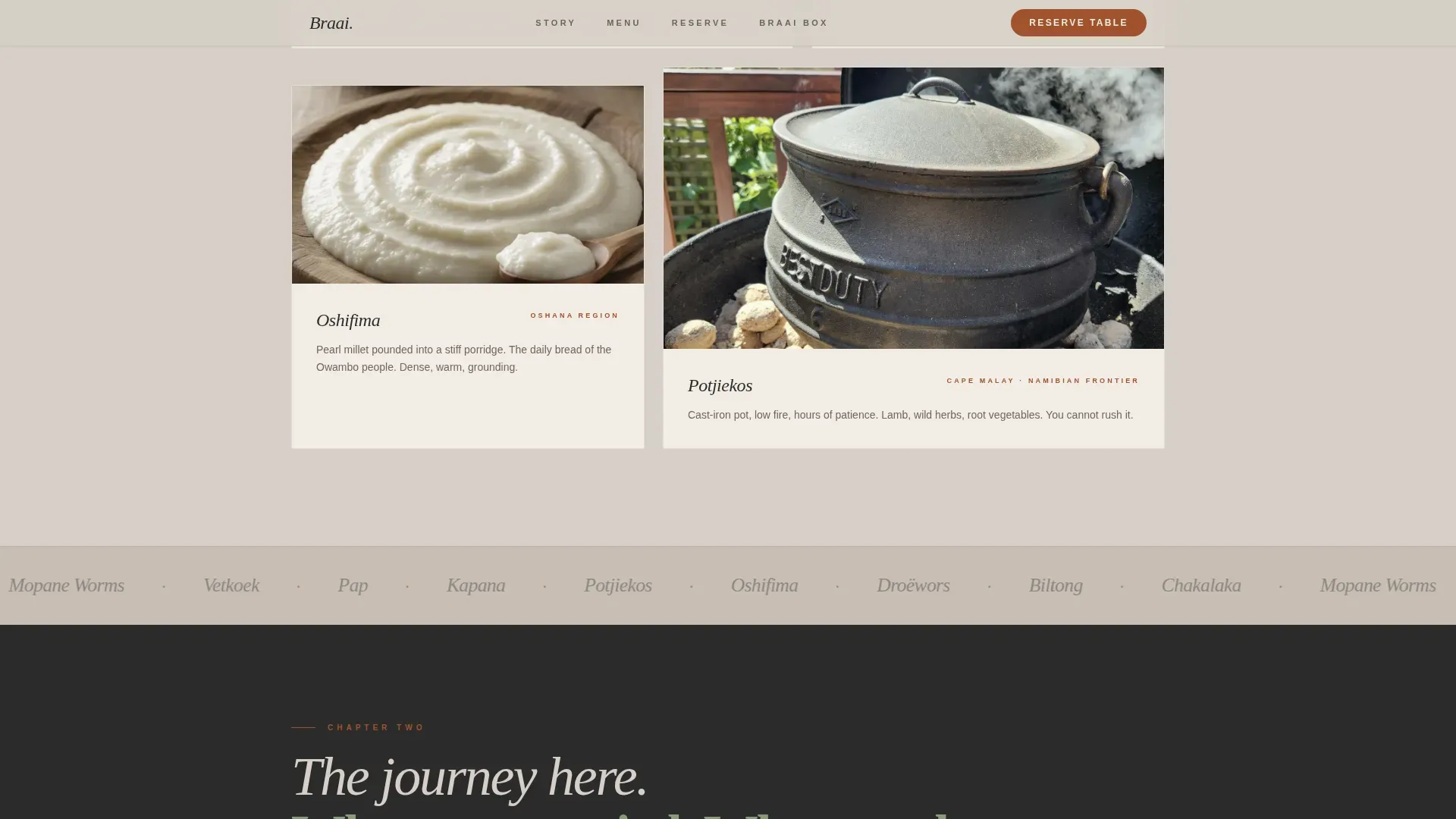
The Signature Menu section presents dish cards in a bento-style grid with tab filters for navigation. Each card carries story context alongside the dish name, so a guest can understand not just what they are ordering but why that particular recipe matters. Dishes like oshifima, mopane worms, and potjiekos are presented with the cultural weight they deserve, not as novelties but as anchors of a cuisine that has traveled far from Windhoek and arrived whole.
Dual-Path Conversion System
The "Reserve Your Table" call-to-action bar appears as a warm clay-colored strip after the origin story crests. It includes a date picker, a party size selector, and a toggle between First Visit and Welcome Back, so the restaurant can treat new guests and returning regulars differently from the very first interaction. A secondary path, the Braai Box home-delivery option, sits alongside food blogger testimonials and gives visitors who are not ready to dine in a meaningful way to engage with the food today.
Food Blogger Testimonials and Social Proof
The Braai Box section pairs the home-delivery offering with curated food blogger quotes. Social proof in this context is not generic star ratings. It is specific, story-rich testimony from people who write about food for a living, which speaks directly to the template's primary audience of adventurous couples and food-curious visitors who trust a well-told recommendation over an aggregate score.
Neo-Retro Typography System
Headlines use Instrument Serif in italic stamp style. Body text uses Plus Jakarta Sans for clean, readable contrast. The pairing creates a tension between the ancient and the contemporary that mirrors the restaurant's own identity: deeply rooted in tradition, served with precision. Every word on the page feels like it was set by hand, even though the layout is fully responsive and production-ready.
Page sections overview
| Section | Purpose |
|---|---|
| Hero Illustration Header | Opens with ink-and-watercolor Namibian braai panorama and hand-lettered restaurant name |
| Origin Landscape Chapter | Introduces the Namibian landscape, wild ingredients, and ancient cooking traditions through scroll reveals |
| The Journey Chapter | Follows the recipe migration story with emotional narrative and recipe notebook visual |
| Signature Menu Grid | Presents dish cards with story context in a bento-style, tab-filtered layout |
| Reserve Your Table | Primary conversion: date picker, party size, First Visit / Welcome Back toggle |
| Braai Box and Testimonials | Secondary conversion: home-delivery kit with food blogger social proof |
| Arc Split Footer | Logo and tagline left, navigation links right |
Design & branding system
The visual identity is a Neo-Retro system filtered through Japanese Zen restraint. Every color decision carries a role, every typeface choice carries a weight, and nothing is decorative without also being purposeful. The result is a palette that feels like a hand-thrown ceramic bowl holding ash: tactile, reverent, and completely at rest.
- Four-color palette: washed sand (#D6CFC7) dominates the background like sun-bleached earth; charcoal ember (#2B2B2B) carries all type with the authority of a woodblock print; dry clay (#A0522D) warms section dividers, pull quotes, and all calls to action; muted sage (#8A9A7B) appears only on hover states and live interactive elements, reserved for what is alive and clickable.
- Typography pairing: Instrument Serif in large italic stamp headlines evokes vintage travel-poster lettering, while Plus Jakarta Sans handles body copy with clean modern readability, keeping long narrative sections easy to follow without losing the period aesthetic.
- Illustration language: retro travel-poster style with loose ink line work, deliberate watercolor bleeds, and hand-lettered label compositions that feel printed rather than rendered, reinforcing the idea that this restaurant carries genuine history rather than manufactured atmosphere.
Mobile & speed optimization
The template is designed desktop-first because the scroll-driven story arc is most powerful on a wider viewport, where each chapter has room to breathe. However, every section reflows cleanly for mobile, and the narrative experience remains fully intact on smaller screens.
- Server Components handle all static sections, including the hero, origin chapters, and menu cards, keeping the initial page load lean while Client Components manage the reservation form, tab filters, and scroll-triggered animations.
- GSAP ScrollTrigger animations, parallax layers, and clip-path reveals are implemented as Client Components, so they activate only when needed and do not block the rendering of content for visitors on slower connections.
- The reservation form and Braai Box call-to-action sections are fully touch-friendly, with a date picker, party size selector, and delivery toggle that are easy to operate on a phone screen without pinching or mis-tapping.
How this template helps you convert
The Braai template is built on a single conversion principle: emotional investment precedes transactional action. A visitor who has traveled through the Namibian landscape, followed the recipe migration story, and arrived at a dish list full of names they are curious about is not the same visitor who landed on the homepage. They are warmer, more trusting, and far more ready to commit.
- The scroll-driven origin story builds emotional debt across three chapters before any menu or booking option appears, so by the time the "Reserve Your Table" bar slides into view, clicking it feels like a natural continuation of the story rather than a response to a sales prompt.
- The dual-path system ensures that visitors who are not ready to dine in still have a meaningful conversion available. The Braai Box home-delivery option, supported by food blogger testimonials, captures intent from visitors at every stage of readiness, giving the restaurant a second revenue stream that the landing page actively sells.
Other information about this template
The Braai template draws on a layered cultural context that is worth understanding before you customize it. Namibian cuisine is influenced by indigenous peoples and colonial settlers alike, making it one of the richest and least-documented food traditions in southern Africa. The word "braai" comes from the Afrikaans word braaivleis, meaning "grilled meat," and the practice itself traces back to indigenous Khoisan methods of cooking meat over open fires, blended with 17th-century Dutch settler traditions. Authentic braais strictly use wood or charcoal, never gas, with dense local hardwoods like Kameeldoring defining the distinct smoky flavor that no electric heat source can replicate. The smoky braai is a fundamental cultural institution in Namibia and across southern Africa, one that centers on gathering around a wood fire to roast high-quality meat over many hours. It is not fast food. Waiting for the coals is as important as the meal itself.
The template's narrative touches on this social dimension directly. A braai is a social exchange, a vital gathering where friends and family contribute, where conversation is as central as the food. Dining experiences built around large, central braai pits embody the "bring-and-braai" culture where everyone contributes something. Historically, braaing has been the preserve of men, with one designated Braai Master managing the fire while others bring the sides. That dynamic is part of the story the template tells through its origin chapters, and it gives the restaurant's social proof sections a specific, credible cultural grounding.
Understanding the full range of South African and Namibian braai dishes also helps operators and designers make better menu card choices. A typical South African braai includes beef, pork, chicken, and lamb, often served with salads, bread, and braaibroodjies, which are grilled sandwiches filled with chutney, tomato, onion, and cheese. Side dishes like white rice and traditional accompaniments such as chakalaka, a spiced relish prepared with onion, tomato, and bay leaves, are common. Beyond the braai itself, Namibian cuisine includes fish from the Atlantic coast, seafood dishes, and game meat that would surprise visitors expecting only red meat. Biltong, a popular dish in its own right, is made from beef or game and seasoned with salt, coriander, and vinegar before drying. Droëwors, a dried sausage, shares similar seasoning traditions.
The template's Braai Box concept draws from this broader pantry. A well-curated home-delivery kit can include biltong alongside droëwors, chakalaka, and illustrated recipe cards that show customers how to recreate the taste of the restaurant at home. This is where the template can support a themed dining experience at home, transporting customers to a different culture through food, packaging design, and illustrated instructions. Pairing the Braai Box contents with appropriate drink suggestions enhances the at-home experience and gives the restaurant another touchpoint beyond the table.
For builders and designers using this template, the scroll-driven narrative system is built on GSAP ScrollTrigger with a marquee element, staggered reveals, and parallax layers. The Arc Split footer pattern places the logo and tagline on the left with navigation links on the right, keeping the page exit clean and branded. The illustrated header uses an SVG panorama that is production-ready and customizable for the operator's specific visual identity. Designers can adapt the illustrated style to reflect a different locale or a different point in the restaurant's story without breaking the underlying layout system.
Regarding the broader cultural context: Namibia is a diverse country whose food traditions sit at the intersection of multiple histories. Travelers who have crossed southern Africa, much like the adventurer Mohamed Salki who cycled 24,000 kilometers across Africa from Morocco to South Africa and passed through Namibia, often describe the generosity of the people they meet as inseparable from the food they share. That spirit of hospitality is exactly what the Braai template is designed to communicate: that sitting down at this table is not just eating dinner, it is joining a story that has been building for a very long time.
This template is categorized under Food and Beverage, specifically Namibian Cuisine, and the braai smoky origin story Namibian restaurant landing page template is optimized for direct sales conversion in the single-column flow format. Operators in Cape Town, Johannesburg, London, or any city with a significant South African or Namibian diaspora community will find the cultural framing directly applicable. Cape Town in particular has a long and celebrated braai culture, and a restaurant positioning itself as a Windhoek original in a Cape Town market or similar urban dining scene would find this template's narrative arc a strong competitive differentiator. The South African dining audience is sophisticated and story-hungry, and the template's emotional architecture is calibrated for exactly that reader.
- The template supports USD pricing by default but can be adapted for any currency.
- Namibian cultural terminology, including kapana, potjiekos, oshifima, droëwors, chakalaka, biltong, and mopane worms, is preserved throughout the placeholder copy and section labels.
- The footer uses Arc Split Pattern 7: logo and tagline left, navigation links right.
- Device priority is desktop-first, but the layout is fully responsive with excellent mobile reflow.
- The reservation form toggle between First Visit and Welcome Back allows operators to personalize the guest experience from the very first digital touchpoint.
- The template can support recipe notebook visual assets, illustrated instruction cards, and pull-quote typography blocks as part of the Journey chapter and Braai Box sections.
- Social proof is designed for food blogger testimonials rather than generic star reviews, reflecting the template's primary audience of story-driven, experience-seeking diners.
Theme
Neo-Retro
Creative direction
Origin Story
Color system
Japanese Zen
Style
Single Column Flow
Direction
Direct Sales
Page Sections
Illustrated SVG Hero Panorama
Scroll-driven Origin Story Chapters
Signature Menu with Story Context Cards
Dual-path Conversion System
Food Blogger Testimonials Block
Neo-retro Typography and Color System
Related questions
What sections does this landing page template include?
Can I adapt this template for a different restaurant cuisine?
Does the reservation form support both new and returning guests?
What is the Braai Box and how is it presented on the page?
What animation and interaction features are built into this template?