Specialist Arborist FAQ & Common Questions Website Template
Canopy is a split-screen arborist frequently asked question and resource landing page template built for certified tree care professionals. It pairs hard-hitting stats with evidence-led frequently asked question blocks, a downloadable risk checklist, and a focused three-field lead generation form. The Cloud Canvas color system and real fieldwork photography create immediate trust with homeowners, property managers, and real estate agents who need expert answers fast.
by Rocket studio
Quick summary
Canopy is a Stats-First Impact landing page template designed for arborist businesses. It opens with three credibility-driving numbers, alternates between plain-language tree questions and visual evidence, and closes with a short lead form. Every section is built to turn a worried homeowner into a booked assessment.
Who this template is for
This template is a strong fit for certified tree care professionals who serve residential and commercial clients. It works especially well when the business wants to lead with expertise before asking for a booking.
- Certified arborist firms serving suburban homeowners worried about storm damage or unknown tree risk
- Property managers who maintain mature trees across multiple sites and carry liability concerns
- Real estate agents and inspectors who need a trusted arborist resource before a closing assessment
What problem this template solves
Homeowners searching at midnight for answers about a cracked limb or a leaning trunk rarely find a page that feels authoritative and calm at the same time. Most arborist pages jump straight to pricing without earning trust first.
- Visitors leave before converting because they cannot find clear, credible answers to their tree health questions
- Arborist businesses struggle to stand out when every competitor page looks the same
- Leads go cold because the path from question to booking is unclear or too long
What you get with this template
This template gives you a fully structured, single-page layout with every section already planned and placed. You get the visual framework, content rhythm, and form logic ready to fill in with your own details.
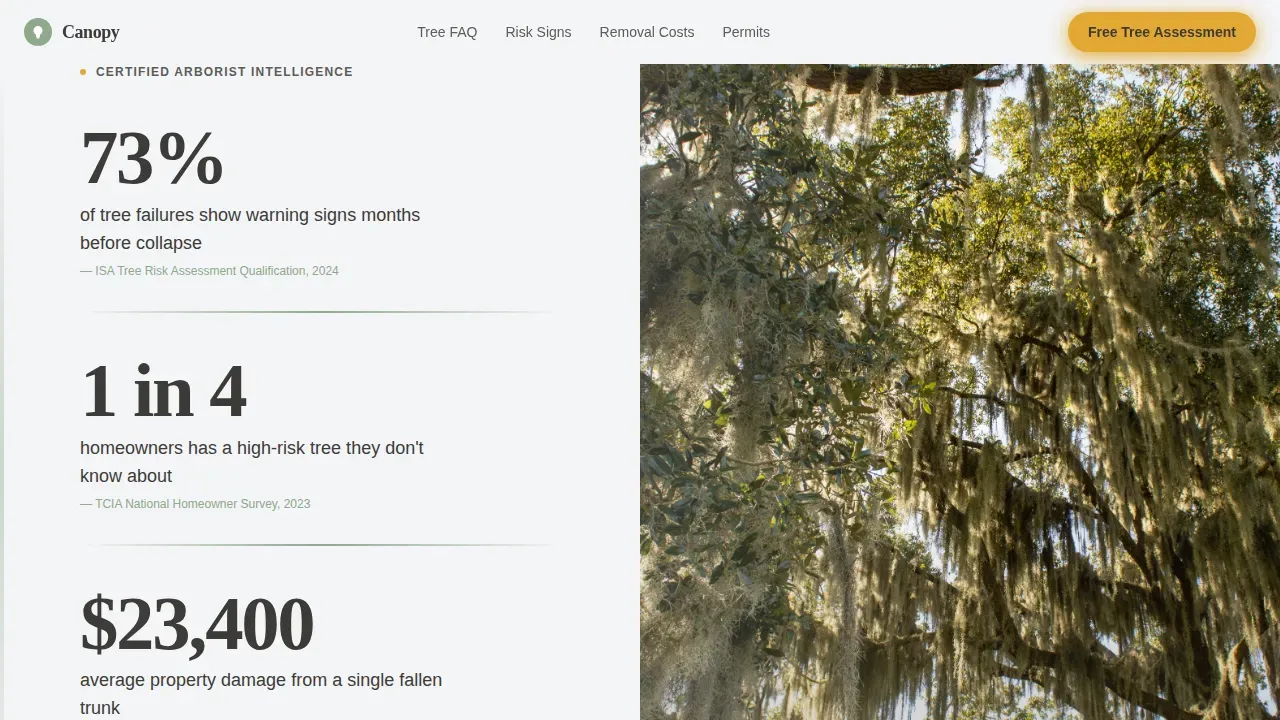
- Stats-first hero section with a 50/50 split screen, three impact numbers, and a cinematic fieldwork photograph
- Alternating frequently asked question evidence blocks with space for diagrams, before-and-after photos, and regional price references
- A risk checklist section, a credentials and trust strip, a three-field lead generation form, and a PDF download gate
Feature list
This template includes the following built-in capabilities, all derived directly from the design brief.
Stats-First Split Screen Hero
The hero opens with three massive data points on the left and a vertical arborist photograph on the right. Numbers render at display scale in bark charcoal, with source citations in small sage type beneath each stat. This layout signals credibility in the first three seconds.
Alternating frequently asked question Evidence Blocks
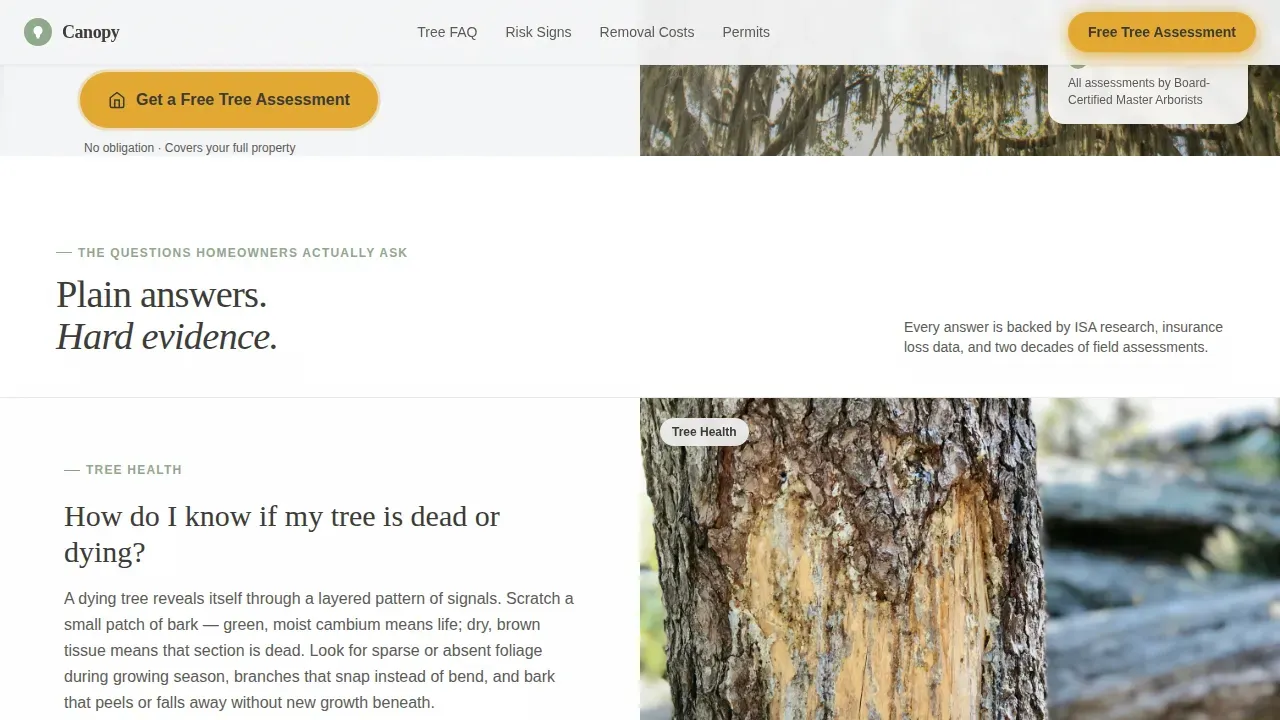
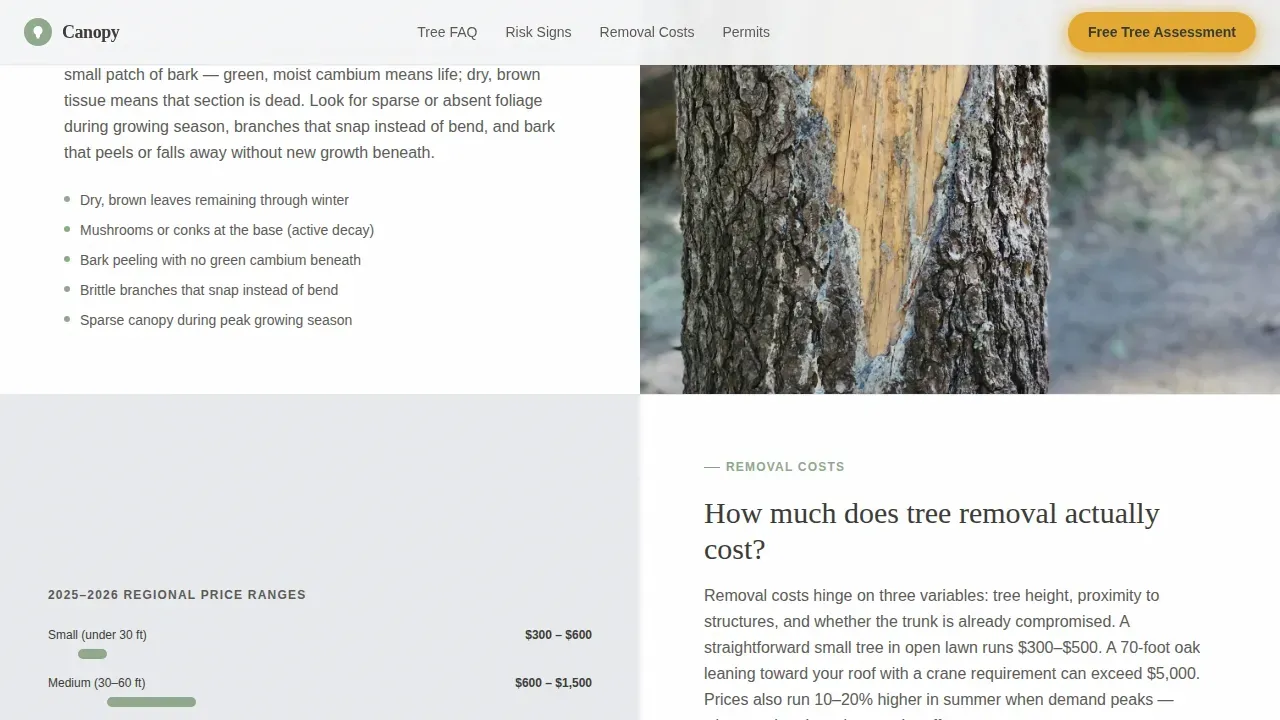
Each frequently asked question block pairs a plain-language question on one side with a visual answer on the other. Evidence can take the form of a labeled cross-section diagram, a before-and-after photo of a diagnosed tree, or a regional price-range chart. The rhythm of question then evidence keeps visitors reading deeper.
Bento-Style Risk Checklist Section
A bento-style grid of risk indicator cards displays visual severity levels that help visitors self-assess their trees. A downloadable "Homeowner's Tree Risk Checklist" PDF is gated behind an email field, creating a secondary lead capture path for visitors not ready to book.
Three-Field Lead Generation Form
The lead form asks only three things: the property address, the visitor's primary concern selected from a dropdown, and their preferred contact method. Keeping the form short reduces friction and increases completion rates.
Floating Amber Call to Action
The primary "Get a Free Tree Assessment" button is styled in amber and pinned as a floating button on mobile. It repeats after every third frequently asked question block on desktop, ensuring the path to booking is always visible without interrupting the reading flow.
Credentials and Trust Strip
A dedicated social proof section displays certification badges, assessment completion stats, regional coverage details, and testimonial pull-quotes. This strip is designed to carry ISA credentials and insurance information prominently.
Page sections overview
| Section | Purpose |
|---|---|
| Stats-First Hero | Open with three impact data points and a real fieldwork photo |
| frequently asked question Evidence Blocks | Alternate question-and-evidence pairs to prove expertise |
| Risk Checklist Cards | Show tree risk severity and gate a downloadable PDF |
| Credentials Trust Strip | Display certifications, stats, coverage, and testimonials |
| Lead Generation Form | Capture address, concern type, and contact preference |
| Footer Linear Row | Single-row footer with essential links and contact info |
Design & branding system
The visual identity follows a Service Utility theme using the Cloud Canvas color system. The overall feeling is an overcast morning in a mature yard, with diffused light filtering through leaf cover.
- Background stays in soft overcast white (#F4F5F7), with text anchored in bark charcoal (#3B3A36) and section dividers and icons marked in lichen sage (#8FA98C)
- High-visibility amber (#E2A832) is reserved exclusively for calls to action and critical stat callouts, so the eye lands exactly where you need it
- Typography pairs Fraunces serif display headings with DM Sans body text for a balance of character and clarity
Mobile & speed optimization
This template is designed desktop-first to match midnight research behavior, while delivering a complete mobile experience. Since 79% of users visit arborist websites on mobile devices, the layout adapts fully to smaller screens.
- The floating amber call-to-action button is pinned at the bottom of the screen on mobile for easy one-thumb access
- Server Components handle static content sections to keep JavaScript minimal and page load lean
- Scroll-reveal animations and staggered frequently asked question block entrances are set to medium intensity, keeping motion purposeful without slowing the experience
How this template helps you convert
The template is built around a Lead Generation direction, where every design decision reduces the distance between a worried visitor and a submitted form.
- The stats-first hero establishes immediate authority, so visitors trust the content before they read a single frequently asked question answer
- The question-evidence rhythm gradually proves expertise across multiple scroll depths, so visitors self-qualify and arrive at the form already convinced
- The dual conversion paths, one for ready-to-book visitors and one for PDF downloaders, ensure that no visitor leaves without leaving something behind
Other information about this template
This template is well suited to arborist businesses that want to address the full range of homeowner concerns in one place. The content structure can support education across many topics relevant to tree care clients.
- Tree permit rules vary by city. In many jurisdictions, a permit is required for tree removal on residential property, and protected trees require permit approval before any regulated work can begin. Construction and site improvements near protected trees often trigger permit requirements, and exceptions are typically limited to emergencies such as storm damage.
- Pruning regulations also vary. Some cities require a tree permit when pruning a protected tree involves removing more than a set percentage of the canopy. Topping and over-thinning of protected trees is prohibited in many communities. Pruning less than 25% of the canopy is often permitted without a permit, but always consult your local city rules in advance.
- A certified arborist from the International Society of Arboriculture (ISA) has completed a professional assessment process and must continue their education to maintain their credential. ISA certified arborists follow maintenance standards covering tree biology, disease diagnosis, proper pruning, cabling, and bracing techniques.
- Pruning young trees helps them mature into healthy, structurally sound assets on your property. Most trees can be pruned year-round, but species like oaks, elms, and ash should be pruned during the dormant season, typically in winter, to mitigate disease spread. Never remove more than 30% of the canopy in a single session.
- Before tree work begins, remove yard art, bird feeders, and clear the area around the site. Tree removal during winter is a good option when lawn impact is a concern, since frozen ground reduces scuffing. Inform your tree service of any changes to the work order in advance.
- The canopy expert arborist faq and resource landing page template also supports local service area targeting, making it straightforward to customize content around street tree regulations, sidewalk encroachment rules, lot grading concerns, and neighborhood-specific canopy coverage.
- This template can support online portal links, such as city permit submission pages, where visitors can submit applications or discuss their case with local officials before work begins. An online portal reference helps property owners understand the approval process for protected trees.
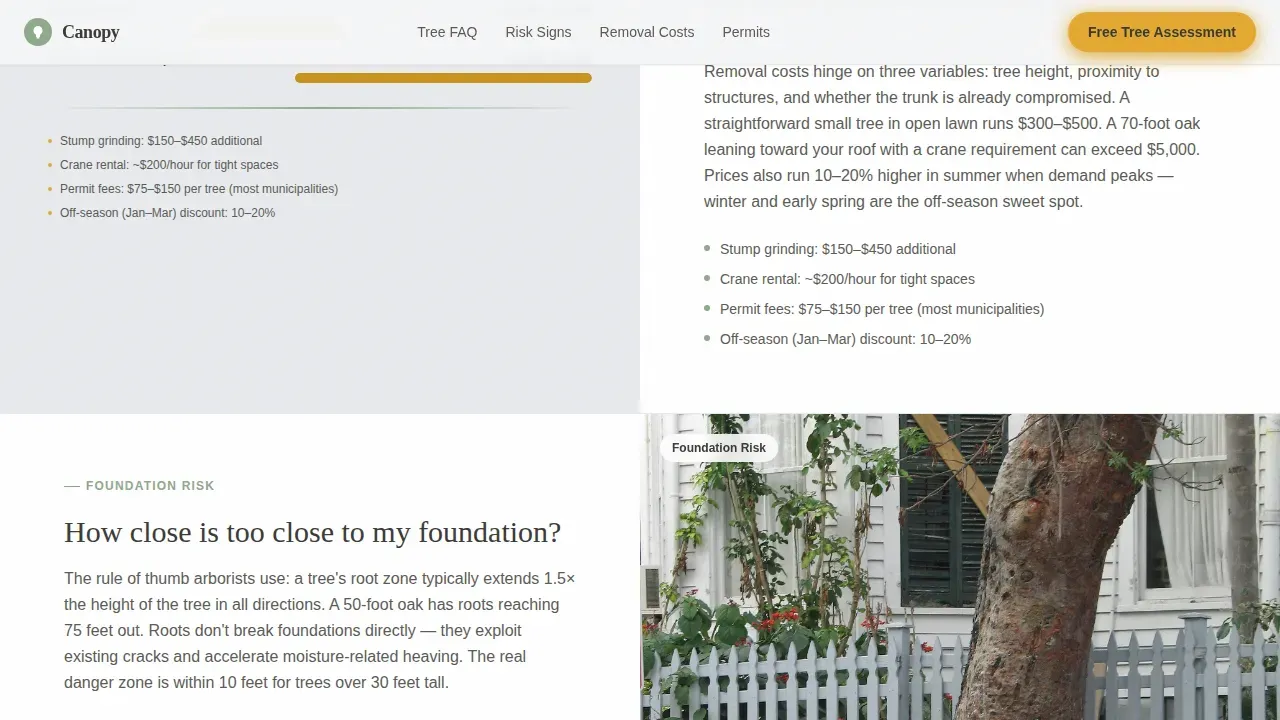
- Trees planted too close to a foundation or a sidewalk can cause root encroachment issues. The diameter of the trunk at a designated measurement height is often used to determine whether a street tree is protected under local ordinances. A city council may designate certain species as protected based on diameter, age, or ecological value.
Theme
Service Utility
Creative direction
Stats-First Impact
Color system
Cloud Canvas
Style
Split Screen (50/50)
Direction
Lead Generation
Page Sections
Stats-first Split Screen Hero
Alternating Frequently Asked Question Evidence Blocks
Risk Checklist and PDF Gate
Three-field Lead Generation Form
Floating Amber Call to Action
Credentials and Trust Strip
Related questions
Do I need a permit to prune or remove a tree on my property?
What makes a tree a risk worth acting on?
How should I prepare my yard before tree work begins?
What is an ISA certified arborist and why does it matter?
Can a sick tree be saved, or does it need to be removed?