CPAP Equipment Comparison Landing Page Template
The Breathe template is a single-page CPAP and sleep apnea supply landing page built for lead generation. It combines plain-language education, side-by-side CPAP machine comparison tables, real patient testimonials, and a three-step progressive form. Visitors learn what their diagnosis means, compare machines by need, and check insurance coverage before submitting a single detail.
by Rocket studio
Quick summary
Breathe is a conversion-focused landing page template for CPAP and sleep apnea supply stores. It leads with education, earns trust through a patient testimonial mosaic, and closes with an insurance-check form. The design feels calm and clinical at once: arctic white backgrounds, teal call-to-action buttons, and real before-and-after AHI numbers woven into every comparison section.
Who this template is for
This template is built for sleep health retailers, CPAP equipment suppliers, and medical supply businesses that sell or recommend CPAP therapy to patients. It works equally well for clinics that handle their own resupply and for independent online storefronts.
- Newly diagnosed sleep apnea patients who need a plain-language guide before they can choose the right CPAP machine
- Existing CPAP users looking to upgrade equipment, replace worn cushions, or switch machine type
- Sleep medicine clinics and supply businesses that want to capture leads through insurance verification
What problem this template solves
Most CPAP product pages dump specs without context. A patient holding a fresh prescription has no idea what pressure settings mean, what the difference between auto cpap and standard cpap is, or whether their insurance covers anything. That confusion costs businesses leads every day.
- Visitors arrive confused and leave without converting because no page teaches them enough to feel confident
- Comparison pages that list machines without explaining breathing patterns, pressure level differences, or machine type distinctions fail to move buyers forward
- Untreated sleep apnea carries real cardiac and accident risks, yet most pages never address the stakes that would motivate action
What you get with this template
You get a fully structured, single-page lead generation layout designed specifically for CPAP equipment retail. Every section moves the visitor from confusion to confidence to contact. The layout is educational first, commercial second, and that sequence is exactly what builds trust with a health-anxious audience.
- A split hero section, an AHI explainer, filterable comparison tables with testimonial mosaic rows, a stakes section, a three-step progressive lead form, and a linear single-row footer
- An Arctic White design system with teal call-to-action highlights, sleep-blue dividers, and typographic choices suited to a medical-educational tone
- A secondary email capture path for visitors who want the free equipment guide before committing to a call
Feature list
Split Hero with Sticky Mobile Call to Action
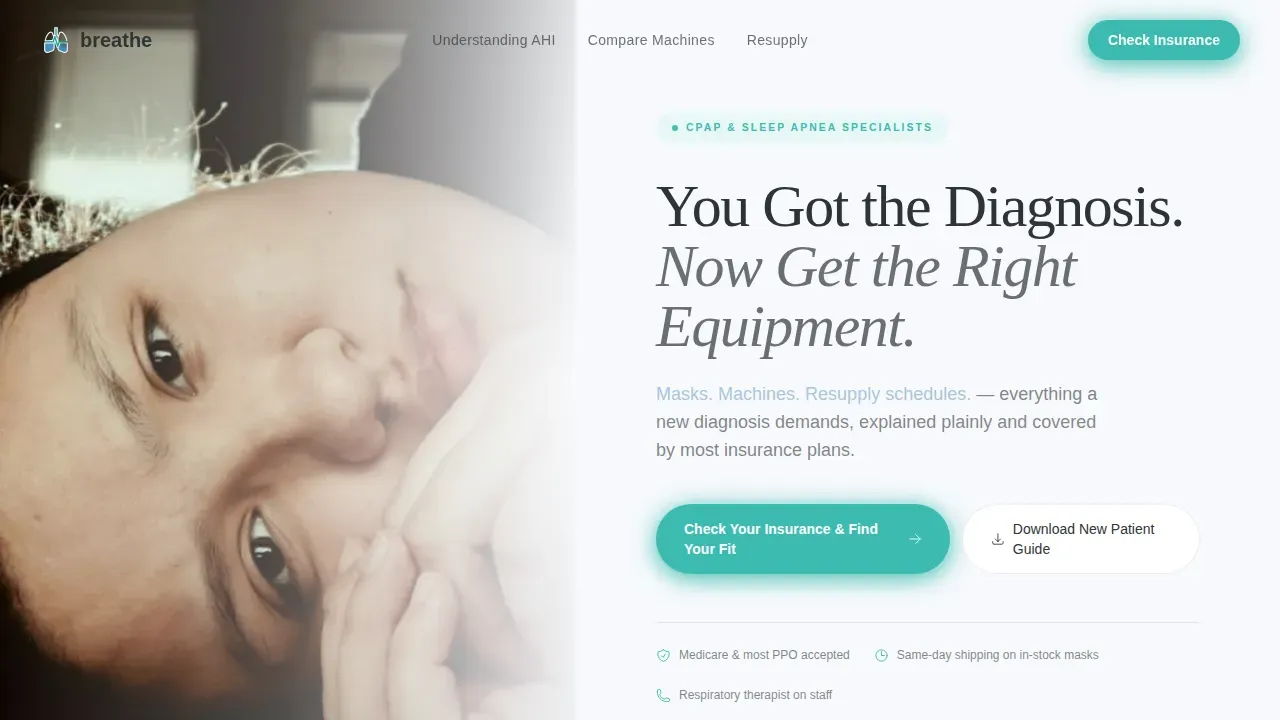
The hero divides the screen: a cinematic close-up photograph on the left, a charcoal headline and sleep-blue subtext on the right. The primary call to action anchors in the header and reappears as a sticky bar at the bottom of every mobile screen, keeping the conversion path visible as visitors scroll through long comparison content.
Plain-Language AHI Explainer Section
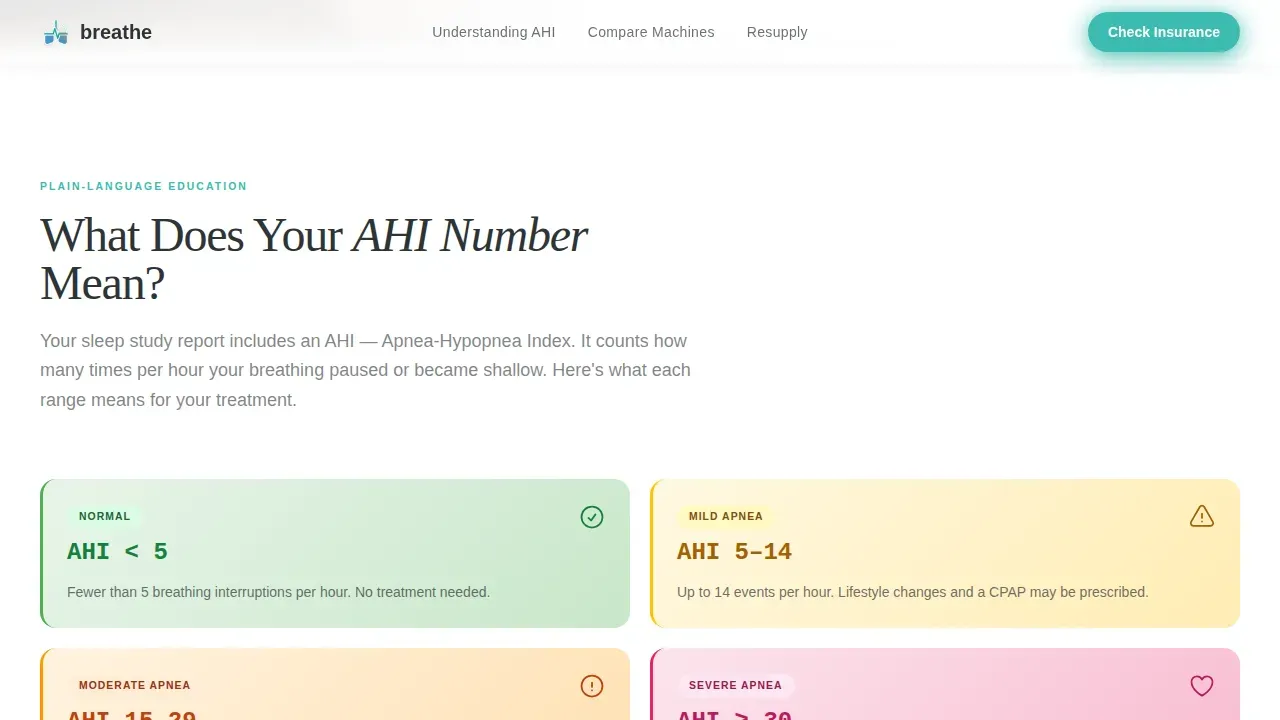
Before any product comparison appears, the page teaches visitors what their Apnea-Hypopnea Index number actually means. Severity bands are displayed clearly so a newly diagnosed patient can understand where their sleep apnea falls on the scale. This section earns trust by giving real information before asking for anything in return. A visitor who understands their diagnosis is far more ready to choose the right cpap machine.
Filterable CPAP Machine Comparison Tables
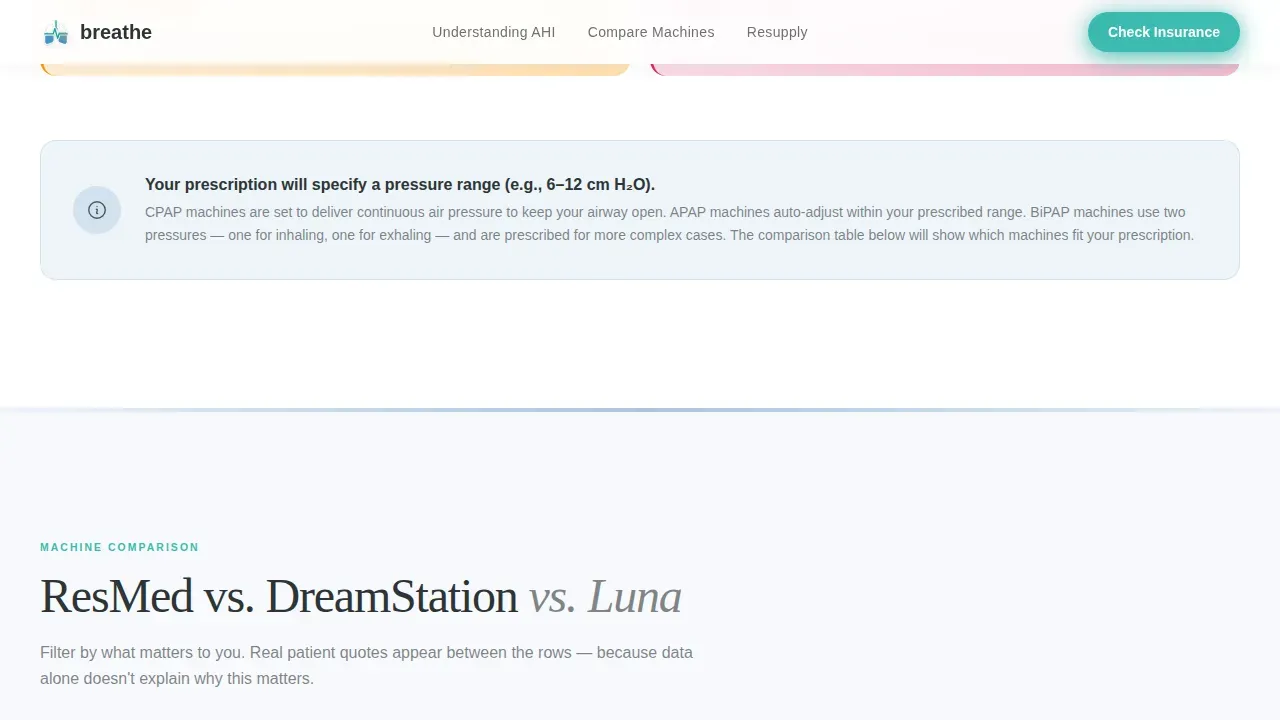
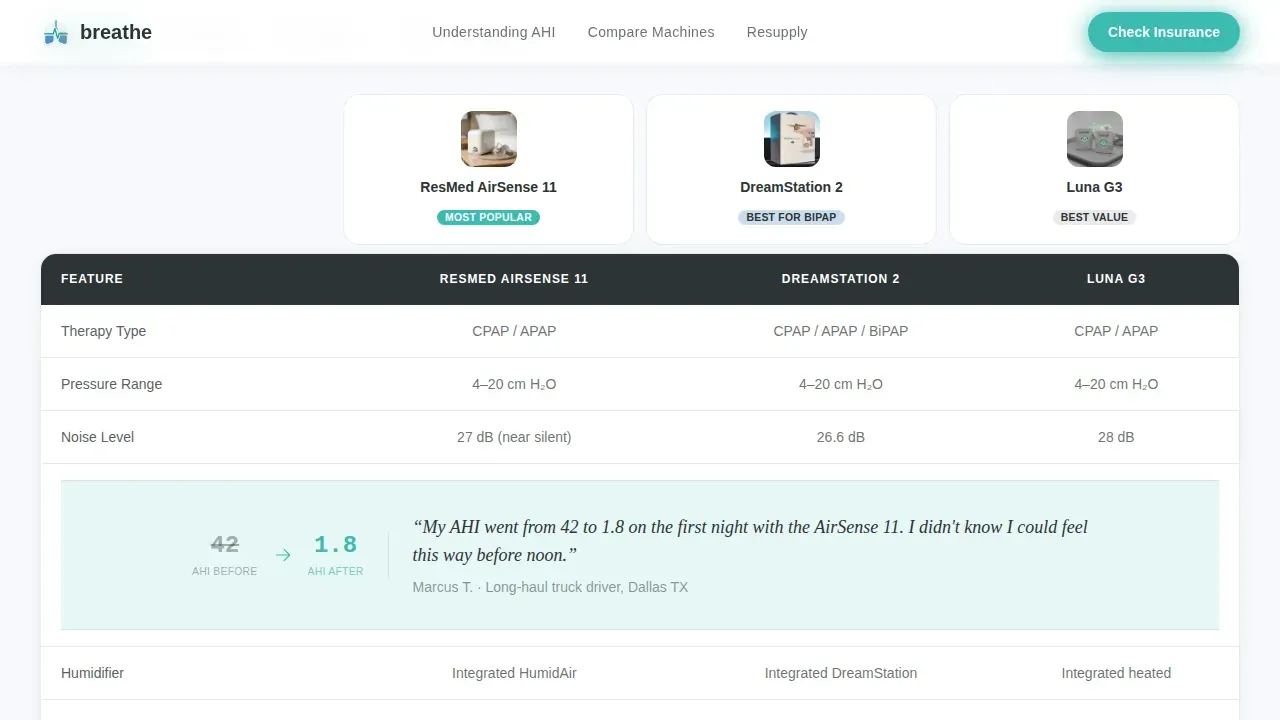
The core of the page is a set of side-by-side comparison tables. Visitors can filter by sleep position, pressure settings range, and insurance compatibility. The tables clarify the types of cpap machines available, including standard cpap machines that deliver fixed pressure, automatic cpap machines that use auto-adjusting pressure based on breathing patterns, and bipap machines that provide two pressure settings for inhale and exhale. Each table row is built to help visitors identify the best cpap machine for their specific diagnosis and personal preferences.
Testimonial Mosaic Between Table Rows
Real patient quotes appear as tiled cards between every comparison row. Each testimonial includes a before-and-after AHI number, making the social proof concrete rather than generic. A truck driver, a mother, and a retiree each tell a short outcome story. This mosaic keeps the emotional stakes present while the visitor works through technical comparisons.
Three-Step Progressive Lead Form with Insurance Check
The lead form uses progressive disclosure to reduce friction. Step one asks for diagnosis status and insurance provider. Step two captures mask preference, including nasal pillow masks, full face options, and nasal cradle styles, or the visitor can select "help me choose." Step three collects name, phone, and preferred contact time. A secondary path lets email-only leads download the New Patient Equipment Guide without completing the full form.
Stakes Section with Risk Education
Before the form appears, the page presents the real consequences of untreated sleep apnea: cardiac risk, daytime accident statistics, and lifespan impact. This section raises urgency without being alarmist. It reframes cpap therapy not as a burden but as the thing standing between the visitor and serious health consequences, then immediately offers the solution comparison again with the insurance-check tool embedded inline.
Page sections overview
| Section | Purpose |
|---|---|
| Hero Split | Headline, subtext, and primary call to action |
| AHI Explainer | Plain-language severity education |
| Comparison Tables | Filterable side-by-side machine comparison |
| Testimonial Mosaic | Patient outcome quotes with AHI numbers |
| Stakes Section | Cardiac and accident risk education |
| Insurance Form | Three-step progressive lead capture |
| Equipment Guide | Secondary email-only download path |
| Footer Row | Linear single-row navigation and contact |
Design & branding system
The visual identity follows an Educational Guide theme. The palette feels like a freshly made bed in a cool, quiet room: clinical without being cold, reassuring without being soft. Every color choice has a job. White signals medical clarity. Teal signals action. Blue signals information.
- Arctic white (#F7F9FC) dominates all open background areas; soft sleep-blue (#A8C6DF) appears on section dividers and informational callouts; charcoal (#2D3436) carries all body text; calm teal (#3CBBB1) is reserved for buttons and interactive highlights only
- DM Sans handles headings for clean modern legibility; IBM Plex Mono displays AHI numbers with precision; Fraunces renders testimonial pull quotes with warmth and editorial weight
- Scroll-reveal animations guide attention through the page; form step transitions keep the three-step flow smooth; comparison table filter interactions use a fade effect to avoid jarring jumps
Mobile & speed optimization
The template is built mobile-first. A large portion of sleep apnea patients research CPAP therapy from their phones, often after a recent diagnosis or a late-night moment of frustration. The sticky call-to-action bar on mobile ensures the primary conversion path is never more than a thumb-tap away.
- The sticky bottom bar keeps "Check Your Insurance & Find Your Fit" visible at all times on mobile screens throughout the full scroll
- The comparison tables are responsive and readable on small screens, with "Best for" category labels helping visitors filter cpap machine options without horizontal scrolling
- Interactive components including the progressive form and filterable tables are built as client-side components only, keeping the static base of the page lightweight
How this template helps you convert
The page is engineered around a simple insight: a visitor who understands their diagnosis and sees their situation reflected in real patient stories is far more likely to submit a lead form than one who lands on a cold product grid.
- The AHI explainer and stakes section do the educational heavy lifting first, so by the time the visitor reaches the form, they already know they need a cpap machine and understand why continuous positive airway pressure therapy matters
- The testimonial mosaic creates personal identification. When a visitor reads about a truck driver whose breathing interruptions were affecting his livelihood, or a mother who would fall asleep at her child's soccer game, the stakes become emotionally real, not just clinical
- The progressive three-step form and the secondary email-only guide path offer two entry points, capturing both high-intent callers and early-stage researchers in the same scroll
Other information about this template
This template is specifically designed for the CPAP and sleep apnea supply niche in the United States. All localization details reflect USA conventions: USD pricing, MM/DD/YYYY date formatting, and insurance terminology covering Medicare, BCBS, and Aetna in the insurance dropdown.
- The ResMed AirSense 11 is one of the machines featured in the comparison tables; it offers auto-titration, advanced event detection, an integrated heated humidifier, and Bluetooth connectivity for sleep data tracking
- The ResMed AirSense range is represented across comparison rows; the earlier ResMed AirSense model remains a popular mid-range reference point for users comparing reliable performance at different price levels
- The ResMed AirMini is relevant to the travel cpap section of the comparison; travel cpap machines are smaller and more portable than standard cpap machines, and most travel cpap machines support both cpap and automatic positive airway pressure therapy
- Travel cpap machines are often FAA-approved for in-flight use; they are designed to maintain effective sleep apnea therapy while minimizing bulk, though they carry a higher price tag and may not be covered by insurance
- Many travel cpap machines require proprietary accessories and are not intended to fully replace a full-size machine for long-term nightly use; when choosing a travel cpap machine, weight, size, and power options all matter
- Most cpap machines are covered by health insurance when prescribed for sleep apnea treatment; the template's insurance-check tool is designed to surface this information early in the buyer journey
- CPAP machines can last approximately 5 to 7 years with proper care; most come with a manufacturer warranty covering defects in materials and workmanship
- Automatic cpap machines use auto-adjusting pressure to respond to changing breathing patterns through the night; standard cpap therapy delivers a constant pressure at a fixed level set by a sleep specialist or healthcare provider
- BiPAP machines offer two pressure settings, providing higher pressure on inhale and a lower pressure setting on exhale, and are often recommended for complex sleep-related breathing disorders
- APAP machines, also called apap machines, automatically adjust air pressure in real time and are often more comfortable for restless sleepers; auto cpap is generally preferred when breathing patterns vary significantly night to night
- The page references nasal pillow masks, a nasal mask option, and full face mask styles in the form step, reflecting the range of mask types a patient may need to consider alongside their cpap device choice
- Dry air during cpap therapy can cause a sore throat; modern cpap machines address this with built-in humidifiers that pass pressurized air over warm water before delivery, and heated tubing further reduces condensation and dry air discomfort
- Mask leaks reduce the effectiveness of any cpap device; the template's mask preference step in the lead form helps match visitors to compatible options before they speak to a specialist
- The page can be adapted for stores that also stock products available through online retailers, and the template's comparison architecture supports adding or adjusting machine models as inventory changes
- This template is the Breathe trusted CPAP equipment comparison landing page template, purpose-built for the intersection of sleep medicine education and medical supply retail
Theme
Educational Guide
Creative direction
Testimonial Mosaic
Color system
Arctic White
Style
Comparison Table
Direction
Lead Generation
Page Sections
Filterable CPAP Machine Comparison Tables
Plain-language AHI Explainer
Testimonial Mosaic with AHI Proof
Three-step Progressive Lead Form
Stakes Section with Risk Context
Split Hero with Sticky Mobile Bar
Related questions
What types of CPAP machines does the comparison table cover?
Can I customize the machine models shown in the comparison table?
How does the lead form work for visitors who aren't ready to call?
Is the template suitable for both new patients and existing CPAP users?
Does the template support mobile users effectively?