Mediation & Alternative Dispute Booking Website Template
The Accord trusted community mediation center landing page template is built for mediation centers that need to earn trust fast. A zigzag testimonial mosaic, a Charcoal and Amber color system, and a five-step guided assessment work together to move distressed visitors from a state of conflict to a scheduled intake call, without pressure and without jargon.
by Rocket studio
Quick summary
Accord is a single-page landing page template designed for community mediation centers. It combines a testimonial mosaic layout with a personalized quiz assessment to help convert distressed visitors into booked intake calls. The design draws on an Institutional Authority visual theme, using deep charcoal, warm amber, and parchment cream to communicate that resolution is both serious and possible.
Who this template is for
This template is intended for mediation professionals and organizations that serve individuals caught in active conflict. It works equally well for established nonprofit centers and newer practices looking to grow referral-based intake numbers.
- Community mediation centers serving neighbors, families, and HOA boards
- Legal-adjacent organizations handling business disputes, LLC separations, and workplace conflict
- Family court referral programs and attorneys who need a trustworthy landing page to send clients to
What problem this template solves
Visitors arriving at a mediation center page are rarely calm. They are often in the middle of a dispute with a landlord, a co-parent, or a business partner. Most landing pages for legal-adjacent services feel cold and transactional, which is exactly the wrong tone for individuals who need to feel safe before they share sensitive information. Creating an effective landing page for a community mediation center requires a focus on trust-building, as visitors are likely in a high-stress, emotional state.
This template solves that problem by leading with real voices. The testimonial mosaic creates cumulative social proof across dispute types. The quiz replaces the standard contact form with a structured intake experience that makes visitors feel understood, not processed.
- Generic legal pages create friction at the moment of first contact, causing potential clients to leave without acting
- Visitors in conflict need reassurance around neutrality and confidentiality before they will share any personal information
- Standard forms do not help a distressed party understand which type of mediation session fits their situation
What you get with this template
You get a complete, ready-to-customize single-page layout that covers every stage of the visitor journey, from first impression to scheduled intake call. Each section is composed to serve a specific function in the conversion flow, and the visual system is consistent throughout. The goal of a community mediation center's landing page is to move visitors from a state of conflict to a place of feeling safe and understood, and every design decision in this template supports that goal.
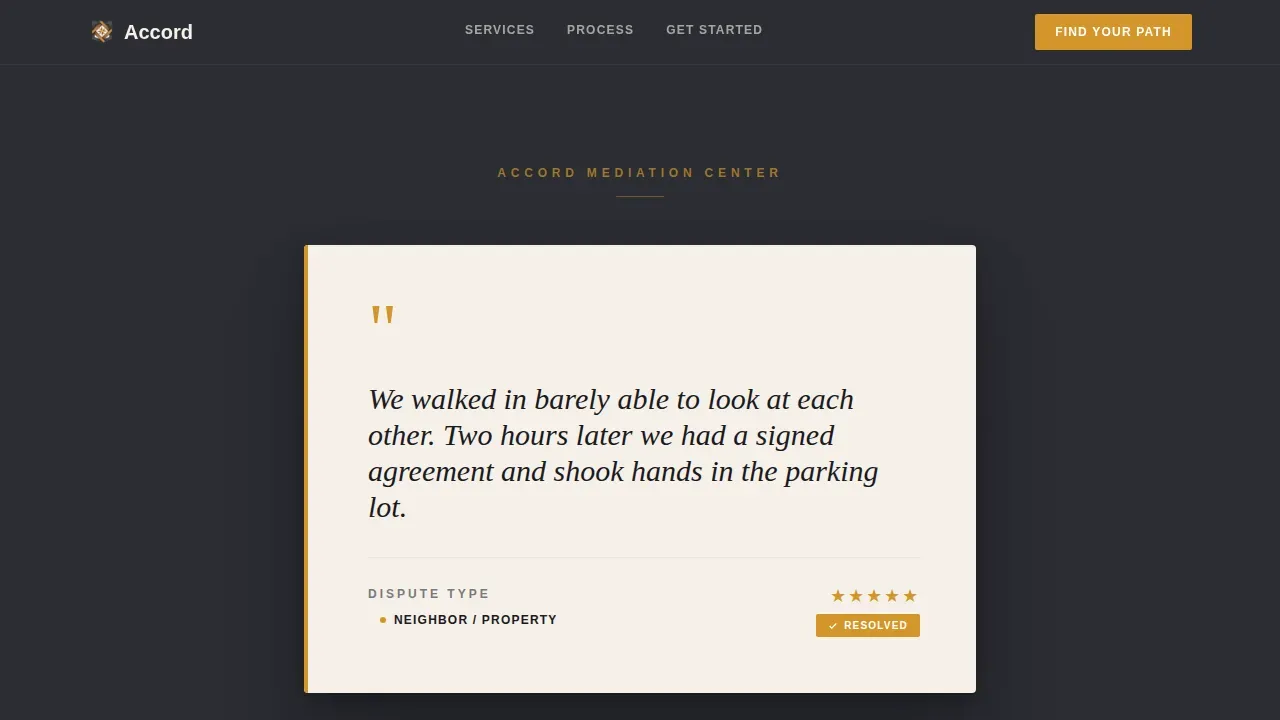
- A hero section built around an oversized testimonial card on a deep charcoal field, with an amber left-border stripe and a large serif quote
- Four zigzag content sections covering family, housing and neighbor, and workplace and business dispute types, each pairing testimonial card clusters with explanatory copy
- A five-step guided quiz assessment with a live amber progress bar and a personalized session recommendation on completion
Feature list
This section covers the core capabilities built into this template based on the source design brief.
Zigzag Testimonial Mosaic Layout
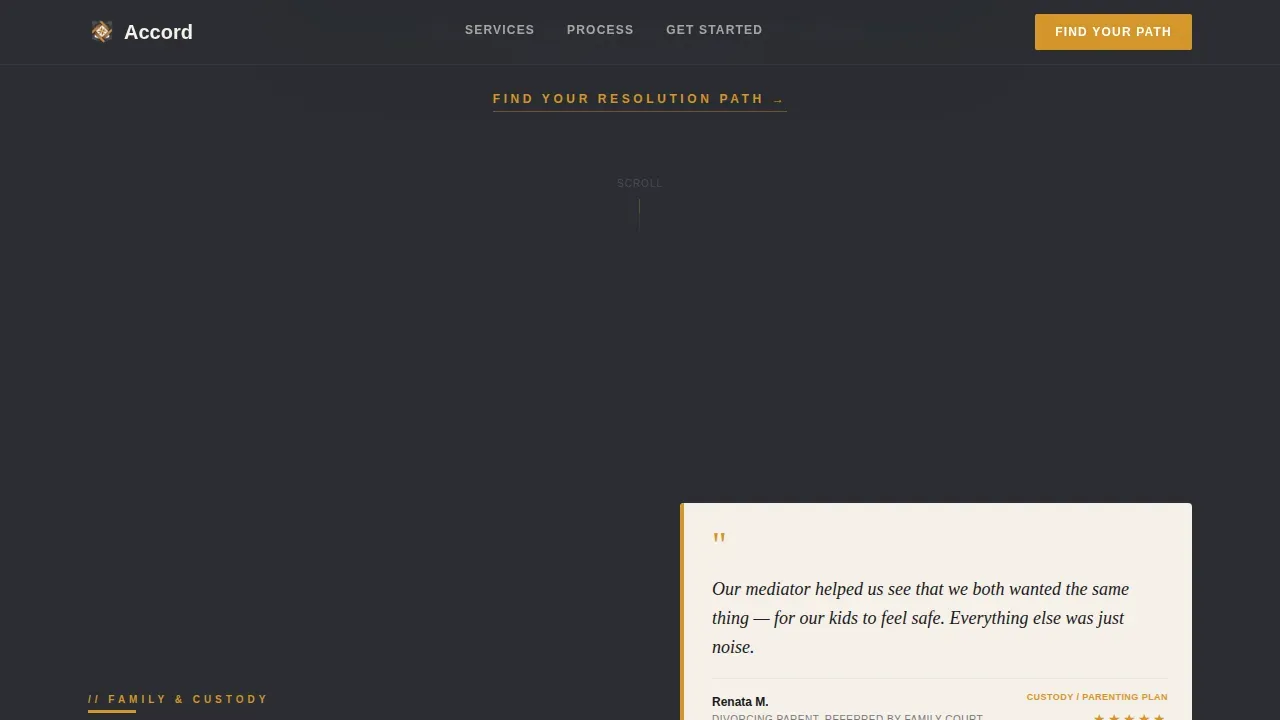
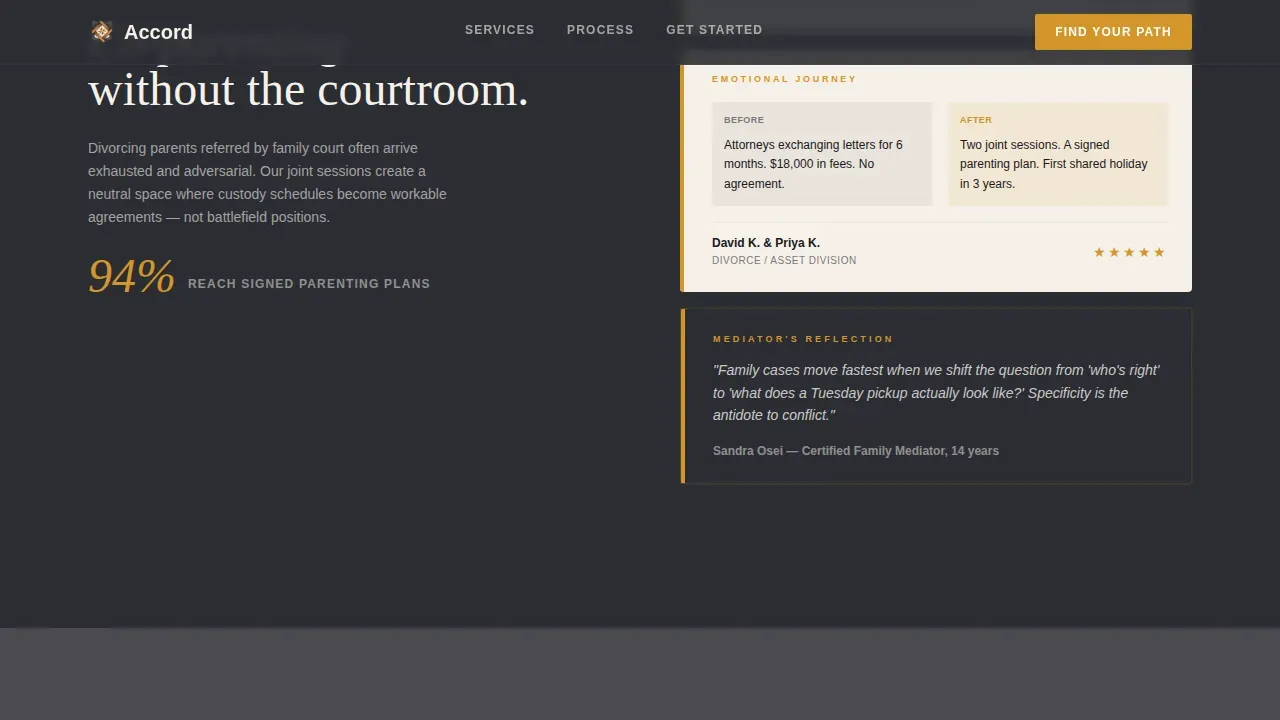
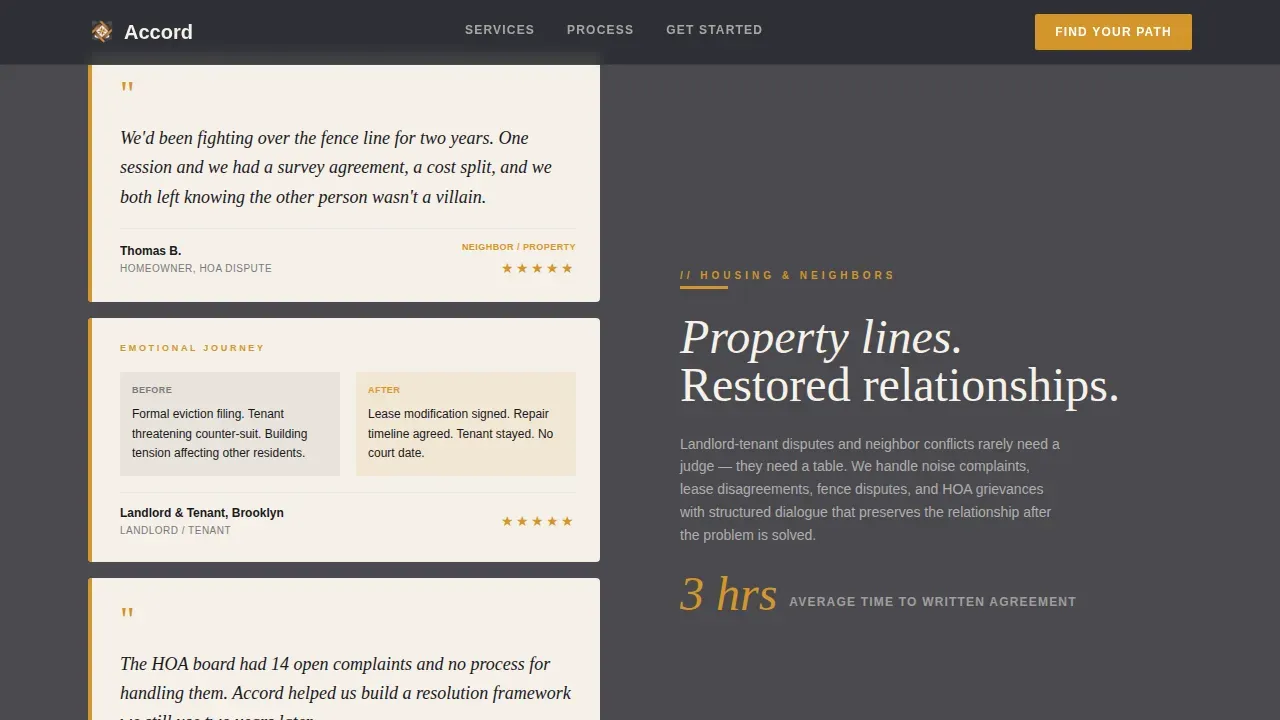
The page is organized as an alternating zigzag scroll. Each section pairs a cluster of three to four testimonial cards on one side with explanatory content on the other. The mosaic groups cards by dispute type, family, housing, workplace, and community, so visitors can notice the category that matches their own situation. As the visitor scrolls, card formats vary between short quotes, before-and-after emotional snapshots, and mediator reflections. This variety keeps the eye engaged and helps the page feel like a living record of real resolution rather than a marketing brochure.
Five-Step Guided Quiz Assessment
The primary call-to-action in this template leads into a five-question intake assessment titled "Find Your Resolution Path." Each question is specific and practical: dispute type selected from a dropdown, the visitor's relationship to the other party, whether communication has broken down completely, whether a court or attorney has already been involved, and preferred first-session timing. Each answer moves an amber progress bar forward. On completion, the visitor receives a personalized recommendation, shuttle mediation, joint session, or facilitated dialogue, along with a "Schedule Your Intake Call" button. The quiz earns the click by making each party feel diagnosed, not sold to.
Testimonial Card Hero Header
The page opens with a single oversized testimonial card centered on a charcoal field. The card uses a parchment cream surface, an amber left-border stripe, and a large serif quote in DM Serif Display. Below the quote, a small dispute-type tag and a five-star resolution badge provide immediate social proof. There is no stock photography and no illustration. The words carry the full weight of the first impression, which is appropriate for visitors who are making a serious decision about their conflict.
Institutional Authority Color and Typography System
The visual identity is built around deep charcoal at hex code 2B2D33 for primary backgrounds, warm graphite at 4A4A4F for alternating sections, courthouse amber at D4952A for accent lines, buttons, and pull-quote marks, and parchment cream at F5F0E8 for text panels and card surfaces. Typography pairs DM Serif Display for headlines and quotes with Plus Jakarta Sans for body copy. The combination reads like a leather portfolio opened under brass desk lamps: serious enough to trust with a custody agreement, warm enough to believe that resolution is possible.
GSAP Scroll Animations and Staggered Card Entries
The template includes medium-intensity GSAP scroll reveal animations. Testimonial cards enter with staggered timing as the visitor scrolls into each mosaic section. Amber accent lines animate between sections to create the visual sense of a thread connecting the stories. These animations add life to the mosaic without overwhelming a visitor who is already processing a difficult situation.
Linear Single-Row Footer
The footer follows a Pattern 1 linear single-row layout. It is clean and uncluttered, keeping the focus on the primary conversion action rather than scattering attention across multiple navigation links or secondary calls-to-action.
Page sections overview
| Section | Purpose |
|---|---|
| Hero Testimonial Card | Opens with oversized serif quote on charcoal, amber border, five-star badge |
| Family Disputes Mosaic | Zigzag cluster of family conflict testimonials paired with explanatory copy |
| Housing and Neighbor Mosaic | HOA and landlord-tenant testimonial cluster with process explanation |
| Workplace and Business Mosaic | Business and LLC dispute cards paired with mediator reflection content |
| Quiz Assessment | Five-step "Find Your Resolution Path" intake assessment with amber progress bar |
| Linear Footer | Single-row footer keeping focus on the primary conversion action |
Design & branding system
The design language for this template is Institutional Authority. The palette and typography choices are intentional: they communicate that this organization takes conflict seriously and that resolution is within reach. Displaying testimonials from past clients or endorsements can establish credibility on a mediation center's landing page, and the mosaic layout is built specifically around that principle.
- Charcoal at 2B2D33 for primary backgrounds, warm graphite at 4A4A4F for alternating section backgrounds, courthouse amber at D4952A for all accent elements including buttons and pull-quote marks, and parchment cream at F5F0E8 for card surfaces and text panels
- DM Serif Display for all headlines and large quote text, Plus Jakarta Sans for all body copy and form labels, creating a clear typographic hierarchy that supports readability across the full page
- Amber accent lines animate between mosaic sections, visually connecting dispute-type clusters and reinforcing the thread-of-resolution narrative without adding visual clutter
Mobile & speed optimization
The template is built desktop-first with full mobile responsiveness. A clean and professional layout is important for a mediation services landing page to convey reliability, and that standard holds at every screen size. Mobile responsiveness is crucial for mediation services landing pages to ensure accessibility for all users, and the zigzag mosaic reflows cleanly on smaller viewports.
- The zigzag alternating layout reflows to a single-column stack on mobile, with testimonial card clusters appearing above their paired explanatory content in each section
- The five-step quiz assessment is built as a client-side component, keeping it interactive and fast regardless of the device the visitor is using
- Static page sections are built as server components, separating the heavier interactive quiz logic from the lighter static mosaic and header content
How this template helps you convert
The entire page is engineered around one outcome: helping a distressed visitor take the first step toward a scheduled intake call. Every section earns the next scroll. The value proposition on a mediation center's landing page should communicate the benefits clearly and succinctly, and this template does that through evidence rather than claims.
- The hero testimonial card creates an immediate emotional anchor. A real quote from a real dispute resolution experience sets the tone before any service description appears. The visitor sees that other individuals in similar situations have already trusted this room and walked out with a signed agreement.
- The mosaic scroll builds cumulative acceptance. As the visitor moves through dispute-type sections, the sheer number of voices and categories creates a sense that this organization has handled situations like theirs many times before. Each card format, short quote, before-and-after snapshot, mediator reflection, adds a different dimension of trust.
- The quiz converts interest into action by giving the visitor something to do that feels useful. Rather than filling out a generic form, they answer five specific questions and receive a personalized recommendation. That moment of receiving a recommendation, shuttle mediation, joint session, or facilitated dialogue, is the moment the abstract idea of mediation becomes a concrete next step they are prepared to take.
Other information about this template
This template is categorized under Legal and Compliance, in the Mediation and Alternative Dispute subcategory, with a niche focus on Community Mediation Centers. It is well-suited for organizations that operate in a referral ecosystem alongside attorneys, family courts, and HOA management bodies. The accord trusted community mediation center landing page template is designed to serve that ecosystem from a single, focused page.
A few additional points worth noting for buyers evaluating this template:
- The template is composed for English-language audiences in the United States, with no currency fields or localization layers required
- Accord Project templates, as a reference point for legal-technology practitioners, tie legal text to computer code using three components: text, model, and logic. This template's quiz structure follows a similar philosophy: each question maps to a defined outcome type, making the recommendation feel logical and grounded rather than arbitrary. The template text is written in natural language, and TemplateMark-style variable thinking informs how each quiz answer feeds the final recommendation
- The Accord Project uses Cicero as its implementation layer, allowing users to create, validate, and execute software templates; this landing page template applies a parallel approach by using a structured five-step flow with defined terms and branching output, so every party who completes the quiz receives a specific, actionable recommendation based on their answers
- Community mediation centers like ACCORD, a local nonprofit Community Dispute Resolution Center (CDRC) that has served Broome and Tioga Counties since 1982, represent the real-world organizations this template is built to support. ACCORD has assisted thousands of individuals, families, and organizations to discover agreeable and enduring solutions to conflict, and this template reflects that same mission in its structure and tone
- An independent, fair, and impartial approach is indispensable to the justice system, and mediation provides a complementary path. The Code of Judicial Conduct establishes standards for ethical conduct, and judges are encouraged to participate in activities that promote public understanding of and confidence in the justice system. Community mediation centers often receive court referrals precisely because judges recognize mediation as a credible, structured alternative for parties who have obligations to resolve their dispute without further litigation
- The template is intended for organizations that want to build long-term trust with their community, not just capture leads. The writing throughout is plain and clear, accessible at a reading level that does not exclude individuals who are unfamiliar with legal terms
- Buyers can consult the template's built-in section structure as a reference for best practices in mediation landing page design, including guidance on notifying visitors of confidentiality, presenting dispute types clearly, and using non-threatening language throughout the intake flow
- Other resources on mediation center design consistently note that a short, user-friendly lead capture should only request essential information. This template's quiz is built on that principle: five focused questions, no unnecessary fields, and a clear statement of what the visitor will receive in return for their time
Theme
Institutional Authority
Creative direction
Testimonial Mosaic
Color system
Charcoal & Amber
Style
Zigzag/Alternating
Direction
Quiz/Assessment
Page Sections
Zigzag Testimonial Mosaic Layout
Five-step Guided Quiz Assessment
Testimonial Card Hero Header
Institutional Authority Branding System
GSAP Scroll Animations and Stagger Effects
Linear Single-row Footer
Related questions
What dispute types does this template cover?
Can I customize the quiz questions for my organization's intake process?
Is the testimonial mosaic easy to update with real client quotes?
Who is the primary audience this template is built to reach?
Does this template support multiple conversion paths or a single call to action?