Specialist Embassy & Consulate Privacy Policy & Terms Website Template
Accord is a split-screen landing page template built for treaty organizations that need to project institutional authority from the first scroll. It guides foreign ministry attachés, international law academics, and NGO policy directors through a question-driven layout that surfaces treaty status, depositary notifications, and observer accreditation paths with procedural precision and restrained elegance.
by Rocket studio
Quick summary
Accord is a single-page, FAQ-driven landing page template designed for multilateral treaty organizations. It pairs a half-page institutional photograph with authoritative serif typography, then unfolds a call-and-response scroll that answers the precise procedural questions specialists arrive with. Every design choice, from glacial white backgrounds to ratification blue calls to action, reinforces the gravity and legitimacy that such organizations must project.
Who this template is for
This template is built for organizations whose work lives inside binding international instruments. If your visitors arrive already knowing what they need and simply require the fastest, most credible path to find it, this template was designed with them in mind.
- Foreign ministry attachés preparing ratification briefs and verifying treaty status for their sending state
- International law professors and research institutions tracking active agreements, depositary notifications, and amendment procedures
- NGO policy directors seeking observer accreditation and clarity on the procedural obligations that apply to their organizations
What problem this template solves
Institutional portals for treaty organizations often fail the exact people they are meant to serve. The layout is either too generic to inspire confidence or too buried in navigation to deliver quick answers. Visitors representing a government, an academic institution, or a civil society body arrive with specific, time-sensitive questions. A portal that cannot answer those questions clearly and immediately loses credibility before a single document is opened.
Accord solves this by structuring the entire page as a deliberate, question-led sequence. The scroll mirrors the way specialists actually think when they land on a treaty portal.
- Ratification status questions are addressed before the visitor has to search for a menu item
- Observer accreditation paths and depositary notification access are surfaced within the natural reading flow
- The primary call to action resurfaces contextually, so the click to the treaty database always feels earned rather than forced
What you get with this template
Accord delivers a complete, ready-to-adapt single-page layout. Every section is purposefully sequenced to carry institutional weight while moving the visitor steadily toward the treaty database or the accreditation request path. The template ships with defined typography, a precise color system, and structured interactivity that respects the professional context of its users.
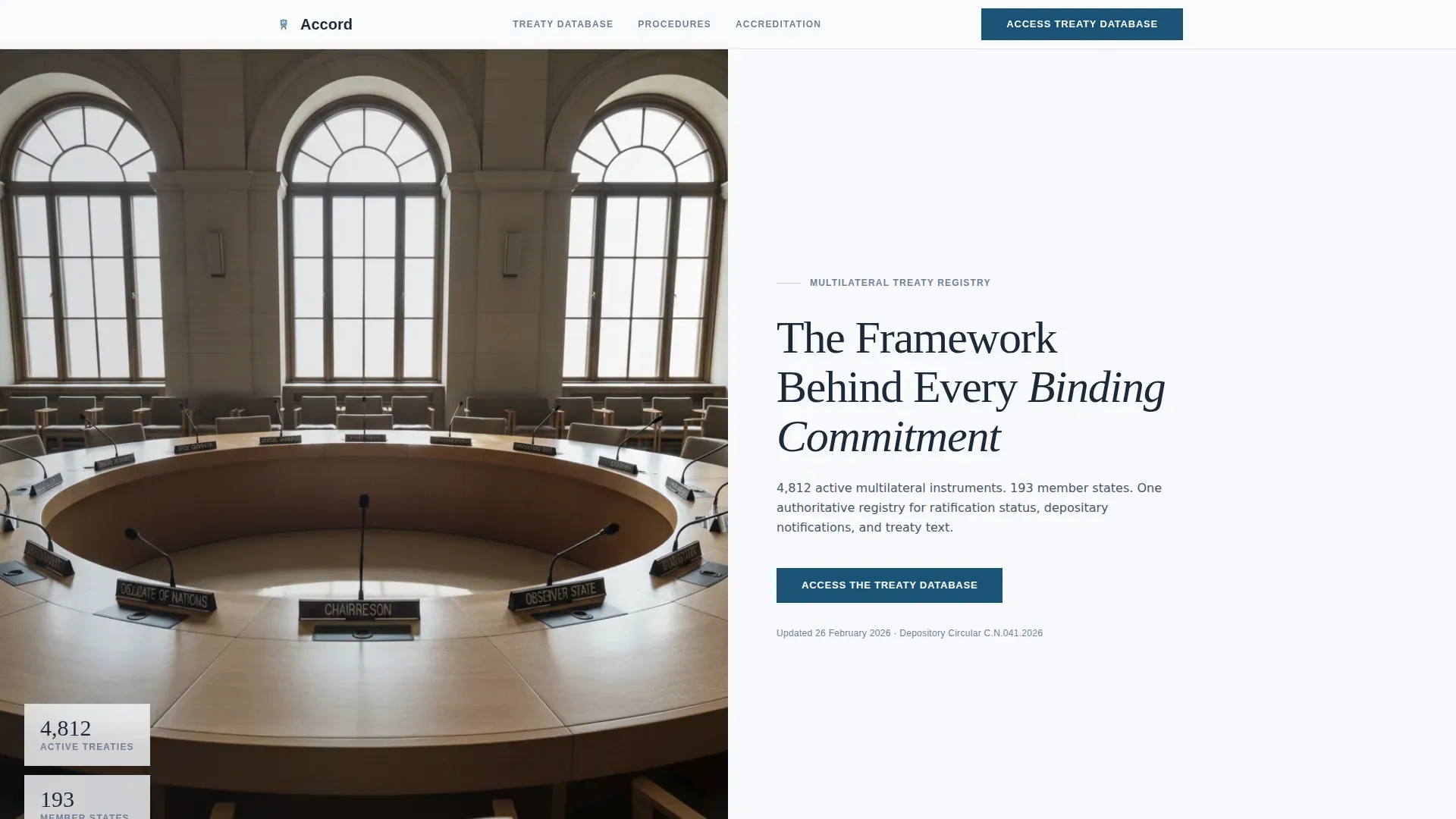
- A 50/50 split-screen hero with an institutional photograph on the left and a restrained serif headline on the right, plus a contextual subhead citing active treaty count and member states
- A marquee stats ticker that keeps live treaty statistics in persistent view as the visitor scrolls
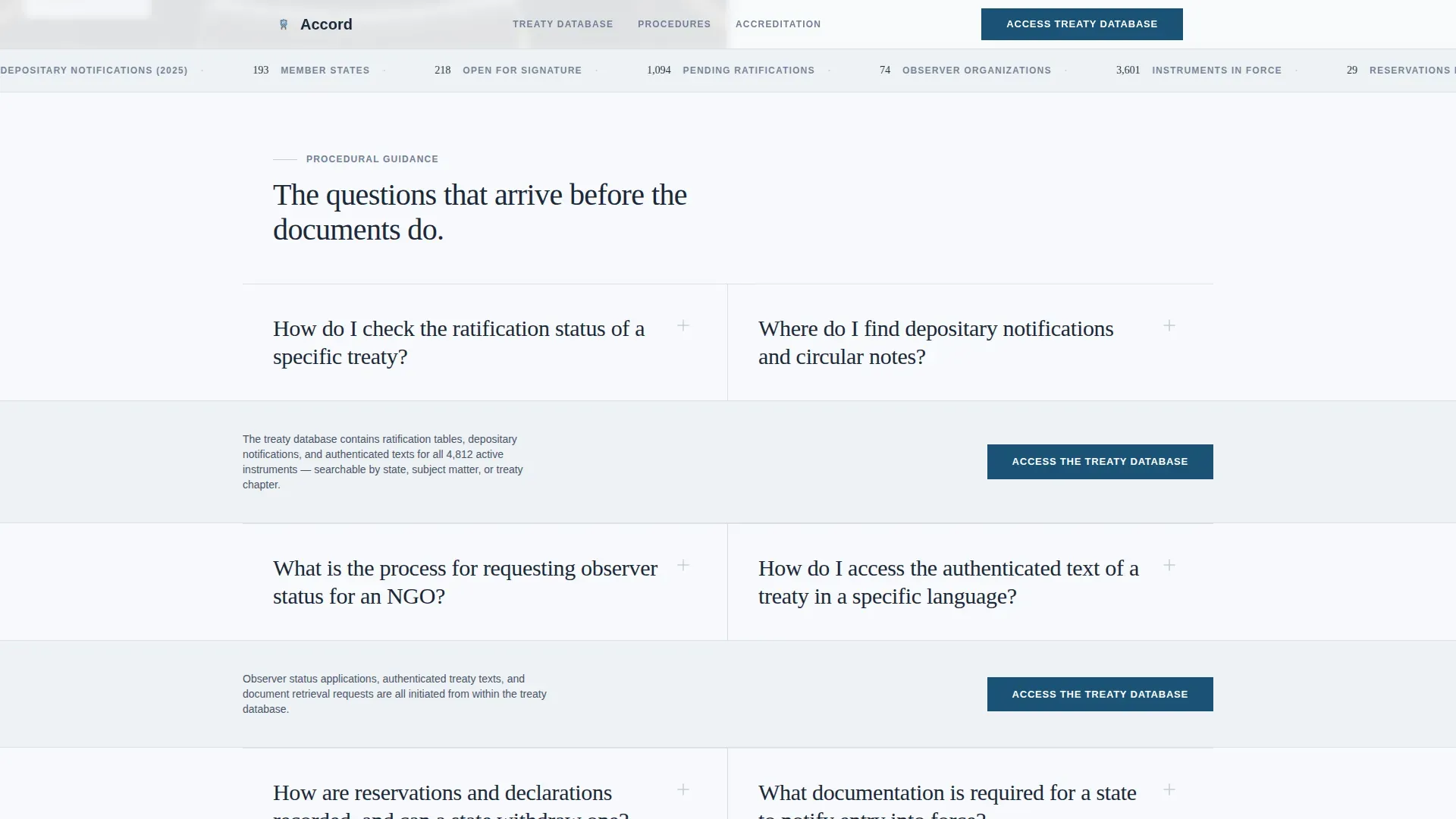
- Three FAQ pair sections, each built as a left-panel question in large serif type answered by concise procedural language on the right, with accordion expansions for deeper legal detail
- A primary call to action, "Access the Treaty Database," placed at the header and resurfaced after every third FAQ pair with a shifting contextual prompt
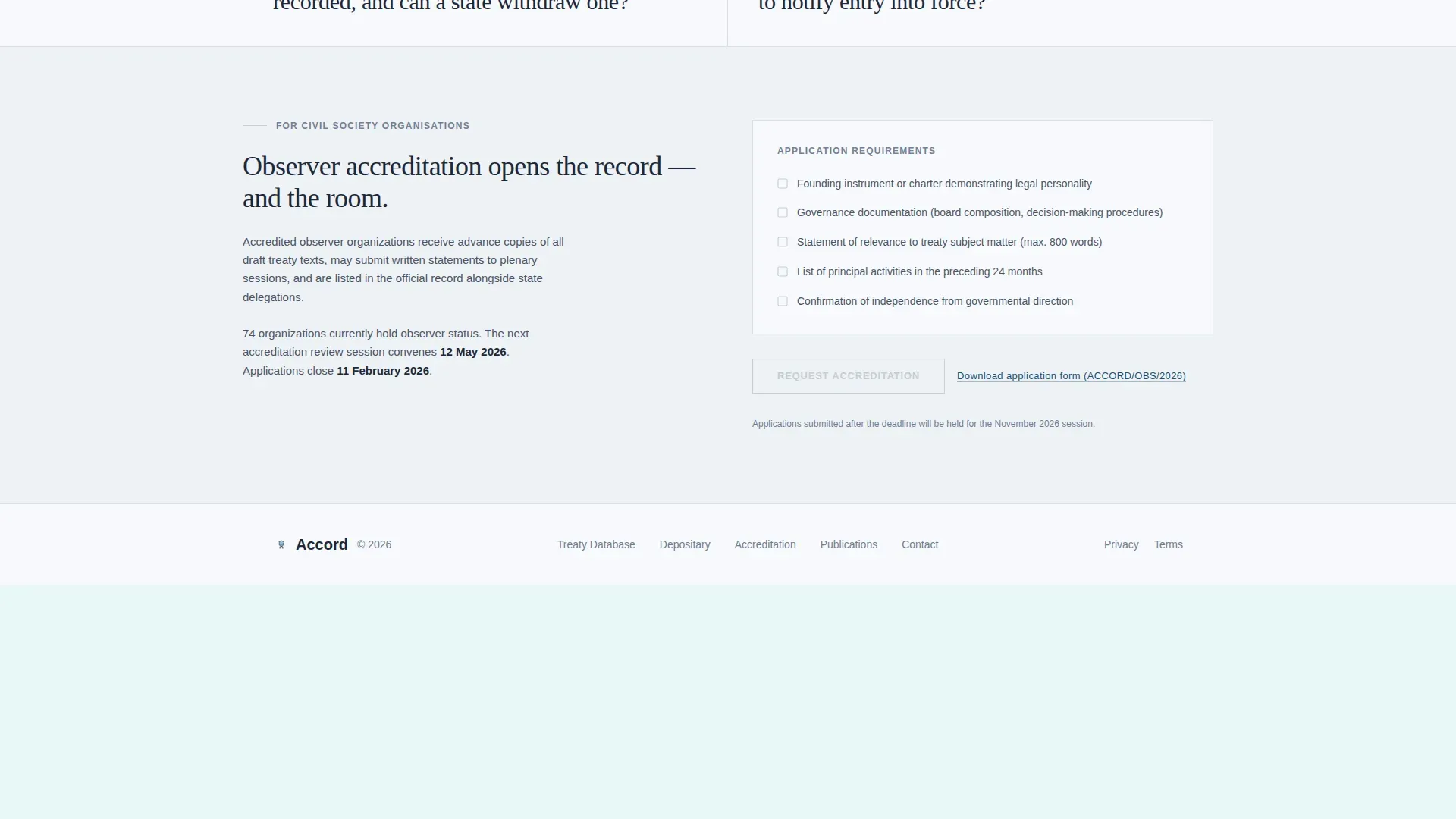
- A secondary accreditation path, "Request Accreditation," styled in protocol silver and flaring to ratification blue on hover, positioned once near the footer for NGO visitors
- A linear single-row footer that closes the page cleanly without adding visual noise
Feature list
Accord ships with a tightly scoped set of purposeful features. Each one is drawn directly from the needs of the organizations and visitors this template serves.
Split-Screen Hero with Institutional Photography
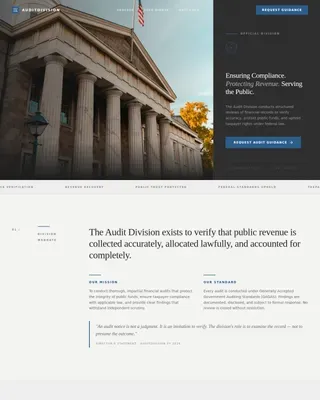
The hero section divides the viewport equally. The left panel holds a wide-angle photograph of an empty round negotiating table, shot from slightly above, with nameplates visible and microphones at rest. Natural light enters through tall institutional windows. The right panel carries a single headline in diplomatic charcoal set in a restrained serif face, followed by a two-line subhead. The composition communicates authority before a single word is read.
FAQ-Driven Scroll Layout
The core of the page is a vertical sequence of question-and-answer pairs. Each question sits in large serif type on the left panel. The right panel responds with concise procedural language, embedded document links, and accordion expansions for deeper legal content. The rhythm builds from general treaty status queries through to specialized subjects like amendments, reservations, and the accreditation path. Visitors feel that the organization anticipated their exact need.
Contextual Call-to-Action Resurfacing
The primary call to action does not simply repeat. It reappears after every third FAQ pair with a single-line contextual prompt that shifts based on the questions immediately preceding it. This keeps the invitation to access the treaty database relevant at every point in the scroll, rather than feeling like a static banner the visitor has learned to ignore.
Marquee Stats Ticker
Immediately below the hero, a horizontal marquee continuously displays live treaty statistics: active treaty count, member state count, and depositary notifications metric. The ticker keeps key social-proof figures visible as the visitor reads, reinforcing the scale and reach of the organization without interrupting the FAQ flow.
Accordion Expansion for Legal Detail
Each FAQ pair includes a subtle accordion mechanism. Visitors who need surface-level procedural guidance get it immediately. Those who need the full legal depth, including references to specific provisions, applicable regulations, or the scope of obligations under a given instrument, can expand the panel without leaving the page. The interaction is low-friction and respects the professional context of the user.
Secondary Accreditation Path with Hover State
A secondary call to action, "Request Accreditation," appears once near the bottom of the page. It is styled in protocol silver at rest and transitions to ratification blue on hover. This single hover interaction signals the distinction between the primary database path and the accreditation request route, guiding NGO visitors without requiring additional explanatory copy.
Page sections overview
| Section | Purpose |
|---|---|
| Hero Split Screen | Institutional photo left, headline and primary call to action right |
| Stats Ticker Marquee | Persistent display of active treaty, member state, and notification counts |
| FAQ Pair One | Ratification status and depositary notifications with first call-to-action resurfacing |
| FAQ Pair Two | Observer status procedures and treaty text access |
| FAQ Pair Three | Amendments, reservations, accreditation path and secondary call to action |
| Footer Linear Row | Clean single-row close with minimal navigation |
Design & branding system
The visual identity of Accord is built around an Arctic White color system that feels like a freshly printed official communiqué. Every color choice carries a functional meaning, and the typographic pairing reinforces the institutional register of the content.
- Color palette: glacial white (#F7F9FC) for open backgrounds, diplomatic charcoal (#1B2838) for body text and section dividers, protocol silver (#C5CED6) for inactive interface elements, and ratification blue (#1A5276) reserved strictly for active states, links, and the primary call to action
- Typography: Fraunces is used as the serif display face for headlines and FAQ question panels; Manrope handles all body copy and interface labels, keeping the reading experience clean and authoritative
- Visual tone: the overall impression is a marble-floored assembly hall at rest, crisp bond paper, embossed letterhead, and ink still drying on a signature line
Mobile & speed optimization
Accord is built desktop-first, reflecting the professional workstation context of its primary audience. Foreign ministry staff and international law research teams typically access institutional portals on large screens where the 50/50 split layout and FAQ panel structure read at full effect. The template is structured to keep the page light and responsive.
- Server Components handle all static content sections, keeping JavaScript to a minimum and ensuring the page loads without unnecessary overhead
- The accordion FAQ panels use minimal scripting so that legal detail expansions remain fast and reliable
- The marquee ticker and scroll-reveal animations are kept at a low-to-medium intensity level, preserving the institutional gravity of the design without introducing distracting motion
How this template helps you convert
A landing page for treaty management requires a balance of formality, trust, and clear, action-oriented information. Accord earns the click by proving, question by question, that the database and the organization behind it hold exactly the document the visitor came to find. Conversion here is not a purchase; it is a qualified click from a professional who now trusts the source enough to act.
- The FAQ-driven structure builds progressive confidence. Each answered question increases the visitor's certainty that the organization understands their specific procedural needs, making the call to action feel like the logical next step rather than an interruption.
- Contextual call-to-action placement removes friction at the moment of highest relevance. Because the "Access the Treaty Database" prompt shifts its single-line context based on the preceding questions, the visitor never sees a generic button. They see an invitation that speaks directly to what they just read.
- The secondary accreditation path is deliberately restrained. By styling "Request Accreditation" in protocol silver and revealing ratification blue only on hover, the template directs NGO visitors toward the correct path without cluttering the primary conversion flow for attachés and academics.
Other information about this template
Accord is a purposefully scoped template. Its authority derives from restraint. The design does not attempt to serve all government or intergovernmental use cases; it is built specifically for the treaty organization niche, where the obligations of contracting parties, the status of a sending state's ratification, and the procedures governing the exchange of depositary notifications are the subjects that define every visit.
The template draws on established principles in how treaty instruments are structured. International agreements typically open with a preamble that outlines purpose and objectives, followed by a main body containing the substantive provisions that define the rights and obligations of the parties involved. Articles within these instruments specify procedures for amendments and modifications, and final provisions address entry into force, duration, and termination. The Accord template reflects this logical structure in its FAQ sequence, moving from foundational questions about treaty status through to specialized subjects like reservations, subsidiary bodies, and the scope of special arrangements applicable to particular signatories.
Institutional authority in treaty organizations carries specific meaning. Such authority is grounded in a founding instrument that grants the entity legal personality under international law. It is exercised through defined bodies, including a secretariat, executive boards, and member state assemblies. Formal recognition of who can sign or bind a state to a treaty is a key function of institutional authority, often requiring documentation of full powers from competent authorities. An institution's authority is considered legitimate when its decisions are accepted as binding obligations by its members. Authority may be legislative, executive, or judicial in nature, and most treaty organizations have bounded domains defined in their founding documents.
The template's contextual depth is also well suited to organizations operating in the climate action space. Modern climate instruments like the Paris Agreement, which came into force on 04 November 2016, demonstrate the full range of treaty architecture that Accord can support. Such agreements address all aspects of a given problem, establishing temperature goals and greenhouse gas emissions frameworks, incorporating provisions on financial support for developing parties, and relying on transparency to hold contracting parties accountable for their commitments. The Paris Agreement establishes a framework for Nationally Determined Contributions to reduce greenhouse gas emissions, and its ambition mechanism is intended to increase the level of climate action over time. Other climate accords, such as the CANIE Accord, require signatories to commit to at least five climate actions spanning three or more areas, and signatories receive a digital badge and media kit to promote their commitment to climate action. Signatories to such accords must have the authority to sign on behalf of their organization, and the process typically involves completing an online form.
The treaty portal context also covers instruments that govern the movement and treatment of persons across borders. Such instruments commonly address the personal effects of diplomatic personnel, the extent to which a sending state retains jurisdiction over such persons, and the degree to which applicable local laws and regulations remain subject to bilateral or multilateral carve-outs. Where two contracting parties agree on special arrangements, or where one contracting party invokes provisions under article ii, article iii, article iv, or article viii of a governing instrument, the portal must surface those provisions clearly. Customs duties, compensation arrangements, and the liability of a sending state for acts carried out by its personnel are all subjects that such persons may need to research quickly. The template's accordion expansion design supports this level of procedural granularity without requiring the visitor to navigate away from the page.
Reliance agreements, which document the respective authorities and responsibilities between institutions involved in research or treaty commitments, represent another area where this template's structure applies naturally. Such arrangements can cover a special agreement covering a single study or a broad framework applicable to all subjects of research conducted under a Federal-wide Assurance. The CANIE Accord is applicable to the whole of the international education sector, including higher education institutions and membership associations. Organizations in research and education that engage with treaty obligations or accreditation processes will find the template's procedural, question-led layout equally suited to their communication needs.
- The template is localized for an international institutional audience: English language throughout, ISO date format (DD Month YYYY), no currency references
- English and french languages are both common in multilateral treaty instruments; the layout supports bilingual label adaptation with minimal structural change
- The footer follows a linear single-row pattern to close the page cleanly without adding navigational complexity
- No form is included on this page; both calls to action route outward to the full searchable database or the accreditation request flow
- The accordion FAQ expansion design ensures that visitors who need only surface-level procedural answers are not slowed down by legal depth that does not apply to them

Theme
Institutional Authority
Creative direction
FAQ-Driven
Color system
Arctic White
Style
Split Screen (50/50)
Direction
Click-Through
Page Sections
Split-screen Hero with Negotiating Table Photo
Faq-driven Question-and-answer Scroll
Contextual Call-to-action Resurfacing
Live Stats Marquee Ticker
Accordion FAQ Expansion Panels
Silver-to-blue Secondary Accreditation Path
Related questions
Who is this template designed for?
Does this template include a contact form or sign-up form?
Can I adapt the FAQ pairs to cover different treaty subjects?
Is the 50/50 split layout responsive on smaller screens?
Can this template support organizations working on climate action or environmental agreements?