Ink & Paper Content Writer Portfolio Landing Page
Byline is a bento grid writing portfolio landing page built for content writers who win clients through evidence, not adjectives. It pairs an editorial Ink and Paper visual identity with an iridescent color system to create a portfolio page that feels like a freshly printed magazine. Case study tiles, a sticky brief form, and a gated rate card work together to turn serious visitors into partnership inquiries.
by Rocket studio
Quick summary
Byline is an editorial bento grid portfolio landing page for professional content writers targeting marketing directors, startup founders, and agency creative leads. It presents published work as case study evidence inside asymmetric tiles, pairs a deep Ink and Paper visual identity with iridescent hover states, and drives B2B partnership inquiries through a sticky brief form and gated rate card download.
Who this template is for
This portfolio landing page is built for writers who sell on proof, not promises. Whether you are a seasoned copywriter with a roster of big brands or a new writer building your first freelance writing portfolio, the layout adapts to your level of published work. The template is especially well matched to writers targeting business clients rather than one-off gigs.
- Freelance writers and independent content writers seeking retainer or long-term partnership agreements with marketing teams
- Startup-focused writers who need to present brand narrative work and blog articles to founders preparing for funding rounds
- Agency copywriters and senior copywriters looking to subcontract long-form work or attract a creative director as a direct client
What problem this template solves
Most writing portfolio examples fall into two failure modes: a static list of links that clients ignore, or a generic portfolio website that looks identical to every other writer's online portfolio. Neither approach communicates reliability, range, or results. Potential clients visiting a portfolio page want to feel confident quickly, and a wall of text links does not build that confidence.
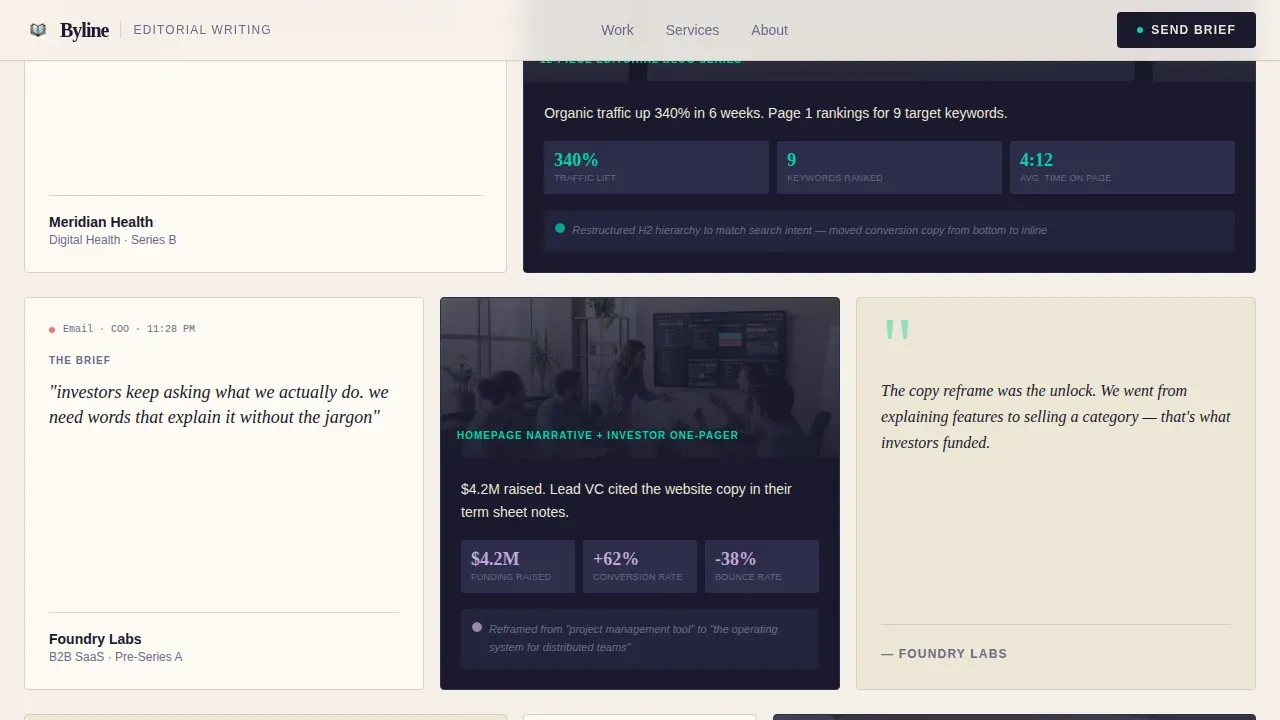
Byline solves this by structuring your portfolio around case study evidence. Each tile pairs the original brief with the published result and real performance metrics, so visitors understand what you researched, drafted, optimized, and increased for past clients. The design does the persuading before a single word is read.
- Eliminates the "show me your work" back-and-forth by presenting writing samples alongside their measurable outcomes in a single view
- Removes the credibility gap that affects a new writer or anyone without a polished online writing portfolio by using structured proof tiles instead of raw links
- Provides a clear conversion path so potential clients never have to search for a way to get in touch
What you get with this template
You get a fully structured, single-page bento grid portfolio landing page with every section planned and every interaction defined. The template brings all the work together in one place, from hero mosaic to footer, so you are not assembling sections from scratch or guessing at layout logic.
- A Photo Grid Mosaic hero with an editorial headline overlay, asymmetric case study bento tiles, a credibility strip, a services section, and a contact section with a sticky brief form
- A dual conversion system: a primary "Send Me Your Brief" sticky bar form and a secondary "Download My Rate Card" gated PDF capture that qualifies serious buyers
- The full Ink and Paper color palette, Fraunces display serif and DM Sans body typography, scroll-reveal animations, hover iridescence, and mosaic parallax interactions
Feature list
This template delivers six purpose-built features that work together to turn a writing portfolio into a B2B sales asset.
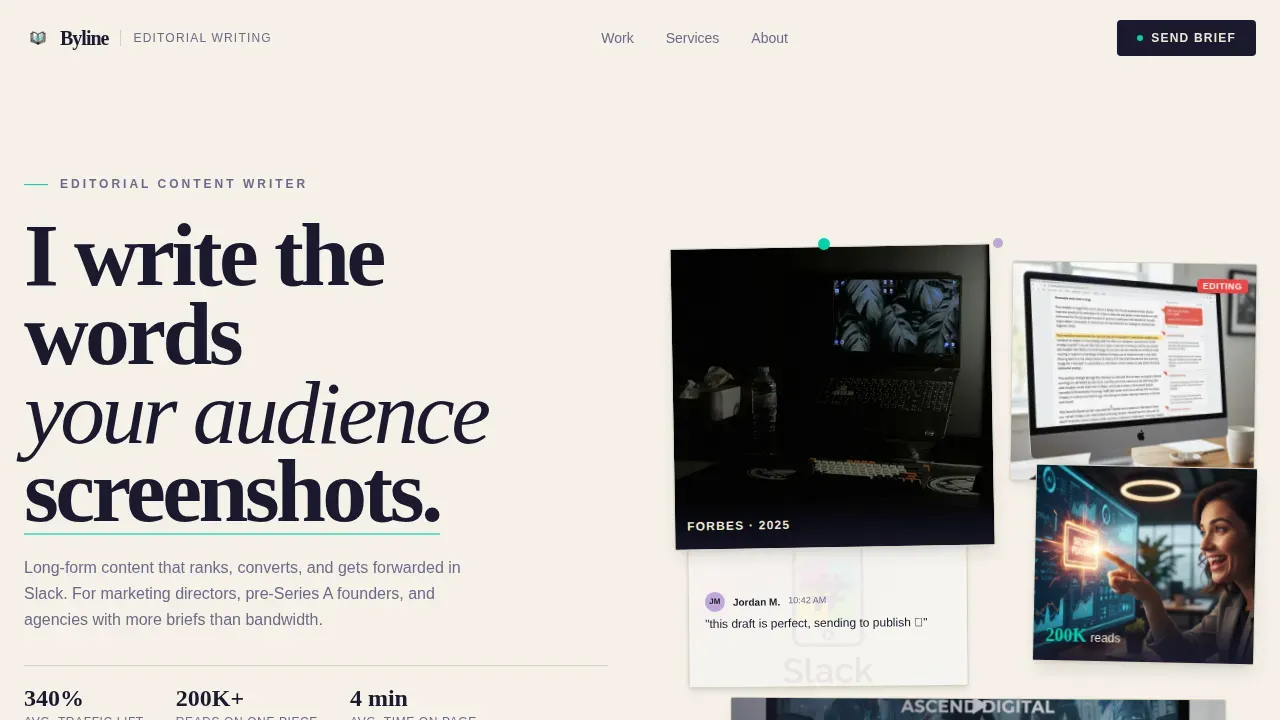
Photo Grid Mosaic Hero
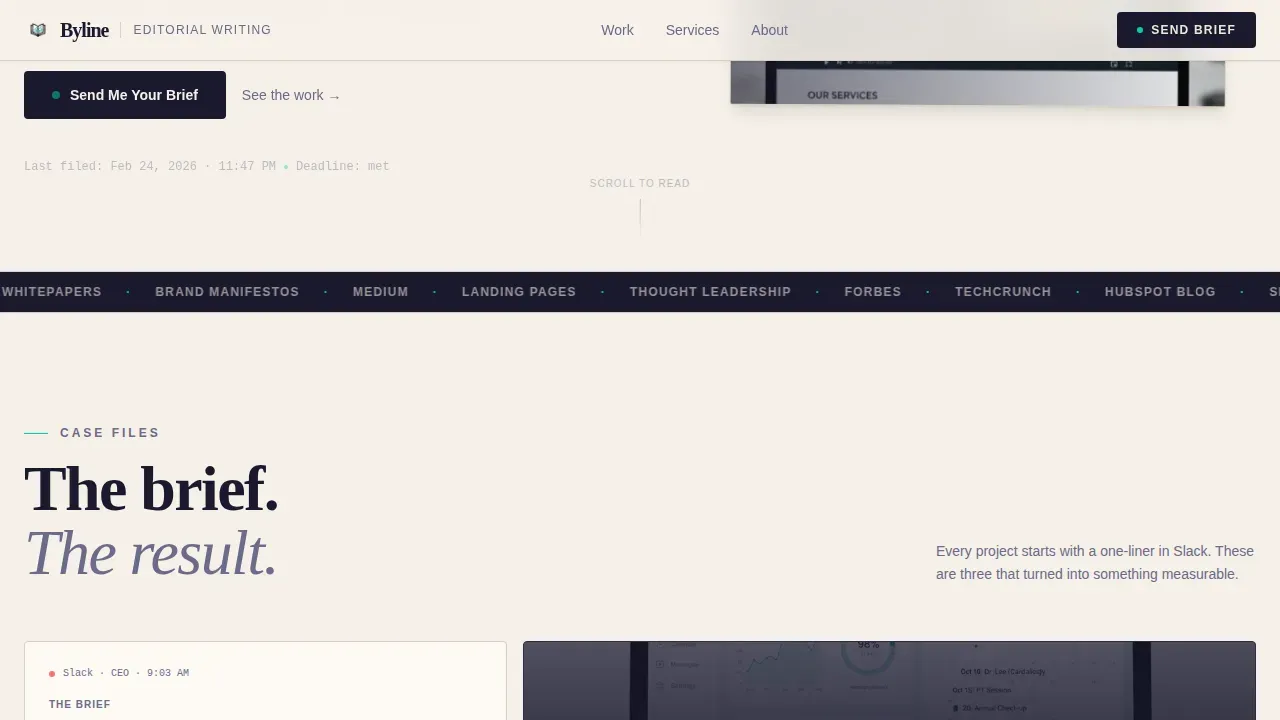
The hero section uses a tight, asymmetric collage of cropped screenshots to communicate volume and range before a visitor reads a single sentence. A published byline, a mid-revision document with comment threads visible, a Slack message of approval, a stats dashboard, and a live client page all layer together. An editorial serif headline sits across the center of the mosaic, anchoring the visual proof with a single confident line of copy.
Asymmetric Case Study Bento Grid
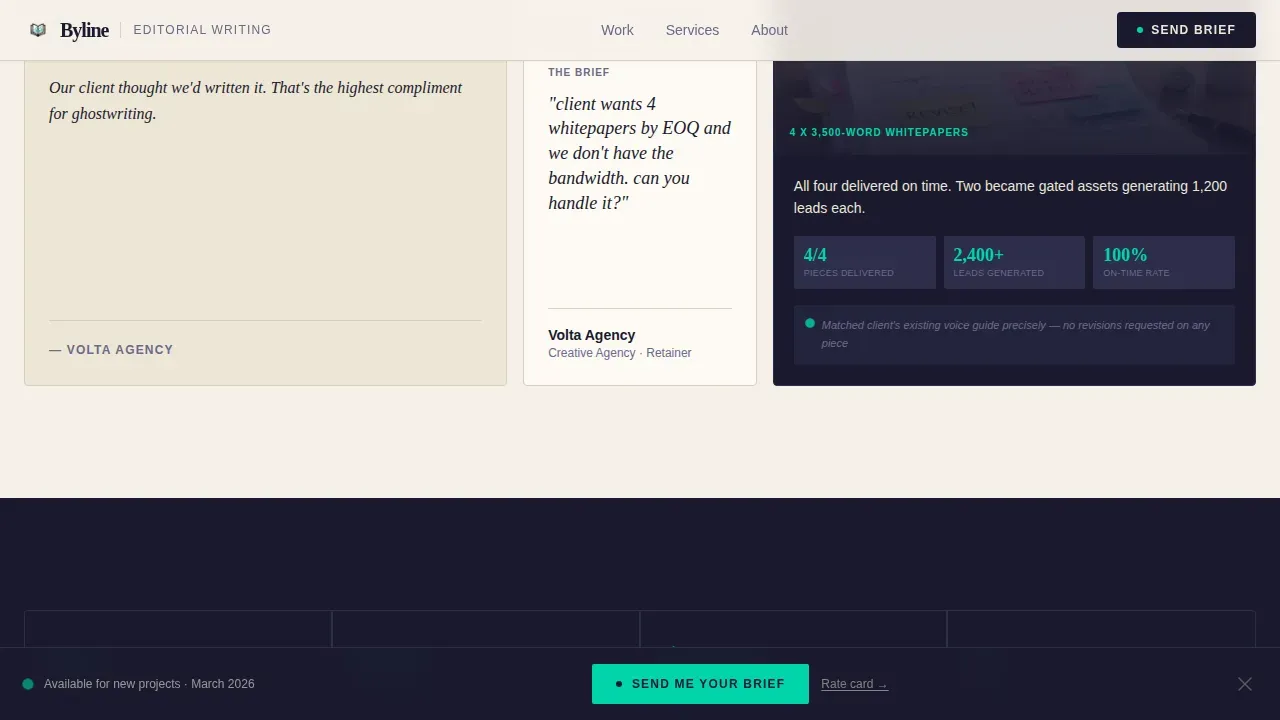
Each case study in the portfolio is split across adjacent tiles: one tile shows the original client brief in raw form, the next shows the published result with traffic lift, time on page, and conversion data. Small tiles hold pull-quotes from editors; large tiles expand into full before-and-after transformations with inline annotations. This layout turns scrolling into reading a writer's case file, building credibility through evidence rather than adjectives.
Sticky Brief Form with Qualifying Fields
A sticky bottom bar appears after the third case study tile and stays anchored as visitors continue to scroll. The form collects company name, content type needed (blog, landing page, email sequence, or whitepaper), monthly volume, and a freeform "Describe your voice in three words" field. This sequence qualifies the lead while giving the writer signal about the client's priorities before the first reply.
Gated Rate Card Download
A secondary conversion path offers a rate card as a downloadable PDF in exchange for a work email address only. This low-friction offer gives undecided visitors an exit that still captures the lead. It separates serious buyers from browsers without requiring a full form fill, making it an effective qualifying layer alongside the primary brief form.
Credibility and Social Proof Section
The credibility section combines named editor pull-quotes, specific traffic metrics, client messages, and a metrics strip into a dedicated band of proof. Each piece of social proof is presented as a self-contained tile, maintaining the case study narrative logic throughout the page. This section reinforces the writer's expertise and makes client testimonials feel like editorial evidence rather than marketing copy.
Services Tile Layout
The services section uses an asymmetric tile layout organized by content type rather than by date. Blog posts, long-form articles, landing page copy, email sequences, whitepapers, and sales copy each occupy their own tile with enough context for a visitor to understand scope and output. Grouping portfolio items by category rather than chronologically helps potential clients find relevant pieces quickly.
Page sections overview
| Section | Purpose |
|---|---|
| Hero Mosaic | Establishes range and published volume through a collage of real work screenshots and an editorial headline |
| Case Study Grid | Presents each project as a brief-to-result evidence pair with metrics inside asymmetric bento tiles |
| Credibility Strip | Consolidates pull-quotes, editor testimonials, and traffic metrics into a focused proof band |
| Services Tiles | Organizes portfolio items by content type so visitors can locate relevant pieces by format |
| Contact and Form | Houses the sticky brief form and rate card download gate as dual conversion paths |
| Footer | Closes the page with a horizontal flow pattern and secondary navigation links |
Design & branding system
The visual identity follows an Ink and Paper theme disrupted by a single iridescent shimmer. Cream dominates the background the way unbleached stock paper fills a printed page. Manuscript black carries all body text with the weight of typeset ink. Iridescent accents appear only on interaction, proving the portfolio is alive, not archived. The result is a portfolio site that evokes traditional craftsmanship, professionalism, and timeless storytelling without feeling static.
- Color palette: soft vellum cream (#F5F0E8) for backgrounds, deep manuscript black (#1A1A2E) for body text, electric teal (#00D4AA) for links and active indicators, holographic lilac (#C3A6D8) reserved for hover states
- Typography: Fraunces display serif for headlines to mimic traditional typesetting, paired with DM Sans for body text to keep reading comfortable and clear; the pairing gives headings the weight of a printed byline while keeping paragraphs easy to scan
- Decorative details: the template uses textured paper background references, ink-stroke graphic elements, and significant negative space around text blocks to give the writing room to breathe
Mobile & speed optimization
The template is designed desktop-first to serve B2B buyers who evaluate writers during the workday, while maintaining a fully responsive fallback for mobile and tablet viewing. The navigation bar stays simple and easy to understand across all screen sizes. The mobile layout preserves the bento grid logic in a single-column stack, keeping readability high without clutter.
- Static sections use server-rendered components for fast initial load; interactive tiles, the sticky brief form, and hover transformations are handled client-side to keep the experience smooth
- Images in the mosaic hero and case study tiles are structured to load efficiently so the site remains fast even with multiple screenshots visible at once
- The mobile layout removes visual noise while keeping all portfolio items, links, and conversion paths accessible without horizontal scrolling
How this template helps you convert
This landing page is engineered around a single business goal: turning a portfolio visit into a partnership inquiry. Every section builds toward that outcome in a deliberate sequence.
- The hero mosaic creates immediate credibility by showing published work volume at a glance, so visitors arrive at the case study grid already primed to trust the writer's expertise and writing style
- The case study bento grid deepens that trust with before-and-after proof, real metrics, and inline annotations, addressing the unspoken question every client asks before they reach out: "Can this writer actually deliver results for my business?"
- The sticky brief form appears precisely when trust peaks, after the third case study tile, giving qualified visitors a frictionless path to start a conversation while the gated rate card captures leads who are not yet ready to commit
Other information about this template
This section covers practical details that help writers decide whether Byline fits their current career stage and workflow.
The Byline ink and paper content writer portfolio landing page template is built for writers at any career stage. A new writer can use the case study tile structure to present even a small number of portfolio items with the same authority that an experienced senior copywriter brings to a full roster of published work. The template works equally well for someone doing freelance writing part time and for a full-time content writer managing multiple retainer clients.
The layout supports a wide range of writing disciplines. Blog writing, long-form articles, news articles, whitepapers, email sequences, sales copy, landing page copy, ux writing, and copywriting services all fit naturally into the services tile section. Writers who cover different topics across industries can use the category-based tile organization to present a focused slice of their work without appearing unfocused.
The portfolio page supports publication logos and client brand marks in the credibility section to establish authority quickly. Each portfolio item can include the publication name, date, a brief summary, and key metrics so visitors have full context for every piece. Relevant pieces should be kept fresh by regularly removing outdated portfolio items and replacing them with newer published work.
The author bio area in the template supports a short introduction that highlights niche, writing style, and experience. Writers can link their own blog, guest posts from online publications, and work samples stored in external documents or drives as supporting evidence. The navigation bar is intentionally minimal so clients can reach any section in a few clicks.
Other writers who rely on freelance portfolios or a standard online portfolio page will find that this template's case study approach creates a stronger impression with potential clients than a flat gallery of links. Clients prefer to hire writers with a streamlined focus, and the bento grid format naturally encourages that clarity. A well-curated selection of 5 to 10 of your best portfolio pieces, prioritizing bylined work from reputable sources, is enough to fill the template effectively.
Practical advice for getting the most from this template: use active verbs when describing each portfolio piece in the annotation tiles, keep all byline links tested and working, and update the metrics strip whenever new performance data is available. Regularly assess which portfolio examples are driving the most engagement and replace weaker sample pieces with stronger published work over time. This keeps your online writing portfolio aligned with your current writing skills and the clients you want to attract.
The template is one of several customizable templates available on the platform. Writers building their first freelance writing portfolio or refreshing an existing writer portfolio will find the pre-structured layout reduces the decision-making burden significantly. Every portfolio page element is editable, from headline copy to tile content, so you can make own writing samples feel at home inside the design without forcing them into a rigid format.
- The template supports social media link placement in the footer and contact section for writers who maintain an active presence on those platforms
- Small businesses and startup clients who visit the portfolio will find the brief form format familiar, as it mirrors standard project intake flows used across the industry
- Writers who have published work on online publications, contributed guest posts, or built an own blog can reference all of that work inside the portfolio without restructuring the layout
Theme
Ink & Paper
Creative direction
Case Study Narrative
Color system
AI Iridescent
Style
Bento Grid
Direction
Partnership/B2B
Page Sections
Photo Grid Mosaic Hero with Editorial Overlay
Case Study Bento Grid with Proof Tiles
Sticky Brief Form for B2B Inquiries
Gated Rate Card PDF Download
Credibility Strip with Social Proof Tiles
Services Section Organized by Content Type
Related questions
Can a new writer use this template without a large body of published work?
Does the template support different writing formats like blog posts, whitepapers, and sales copy?
How does the sticky brief form qualify leads before the writer responds?
Is the portfolio easy to update as new work gets published?
Who is this landing page designed to attract?