Science Writer Landing Page Template for Academic Clients
Byline is a split-screen landing page template built for a solo science writing practice. It leads with hard manuscript placement data, stacks client testimonials against real publication outcomes, and closes with a focused inquiry form. The result is a page that earns institutional trust before a single word of self-promotion is spoken.
by Rocket studio
Quick summary
Byline is a single-page, split-screen template designed for an authoritative science writing service. It opens with a metrics wall of manuscript placements and acceptance rates, then builds credibility through sequenced client testimonials paired with tangible outcomes. Two clear calls to action qualify serious institutional and academic leads before any conversation begins.
Who this template is for
This template is purpose-built for a one-person editorial operation serving the research and academic publishing world. It speaks directly to clients who need expert translation of scientific findings into publication-ready prose.
- Postdoctoral researchers and early-career scientists preparing journal manuscripts under tenure pressure
- Biotech startups and university communications offices commissioning white papers, grant narratives, or press materials
- Science writers offering B2B editorial services who need a page that earns institutional trust on arrival
What problem this template solves
Most professional service pages lead with the provider's credentials. That approach stalls the decision for academic and institutional buyers who need evidence, not biography. This template flips the structure entirely.
- Researchers and institutional clients often cannot tell whether a science writer can handle their specific discipline or deadline
- A generic portfolio page fails to communicate the real stakes: acceptance rates, named journals, and funded outcomes
- Visitors leave without acting because no clear next step matches their specific project type
What you get with this template
You get a fully structured, split-screen landing page that replaces abstract claims with stacked, attributed proof. Every section is ready to populate with your own client outcomes and inquiry fields.
- A stats wall header displaying three oversized figures alongside a named five-star testimonial
- Sequenced testimonial-and-outcome pairs that escalate from early-career researchers to institutional partners
- Two conversion paths: a direct manuscript inquiry form and a gated portfolio PDF download
Feature list
This template is built around a small set of high-conviction layout decisions. Each one serves the specific trust-building logic of an academic and institutional audience.
Split-Screen Stats Header
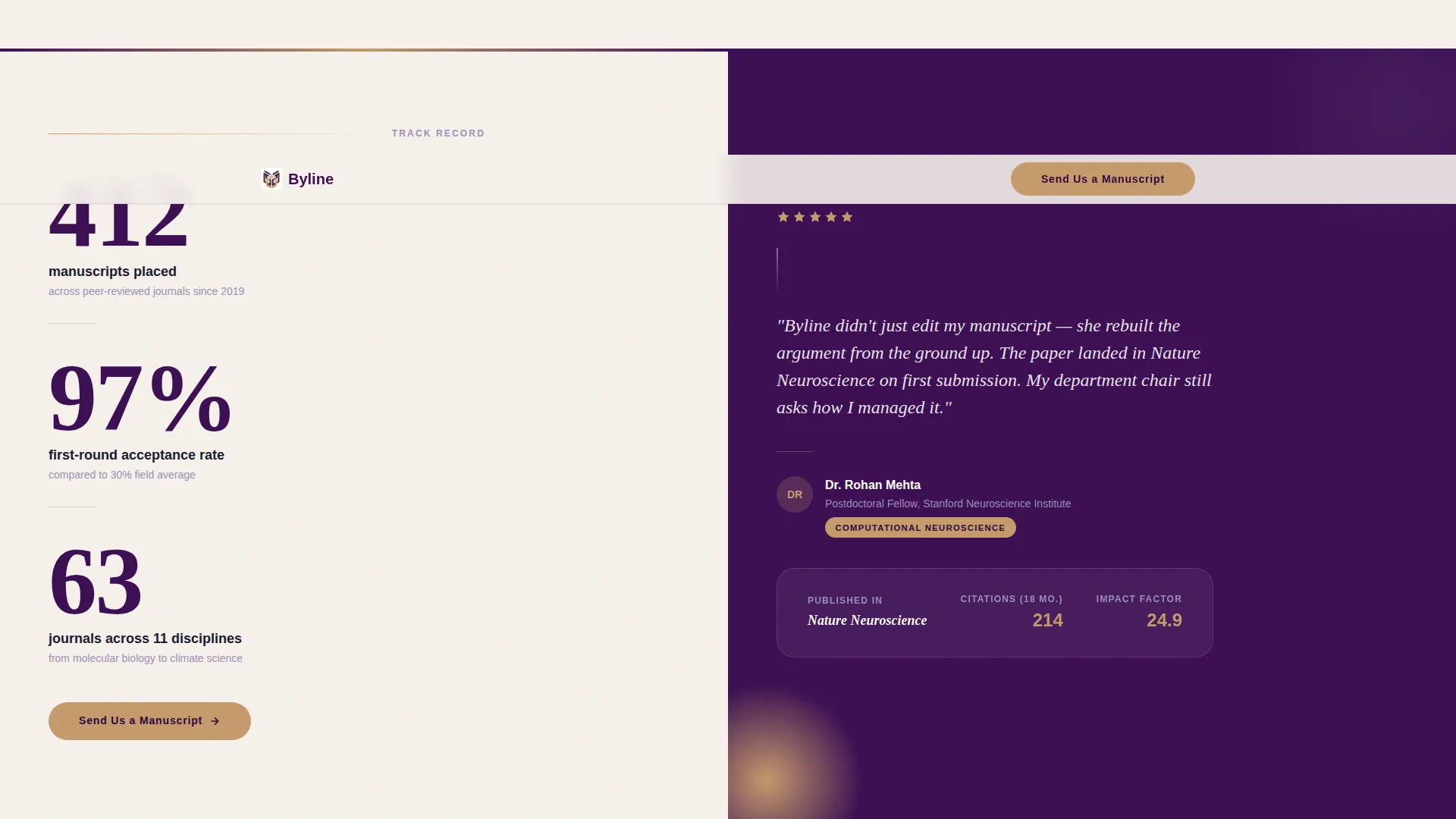
The header divides into two equal panels. The left panel holds three oversized metrics in deep plum typography: manuscripts placed, first-round acceptance rate, and journals covered across disciplines. The right panel shows a single attributed five-star quote with full name, institution, and journal title set on warm parchment. No imagery is needed because the numbers and the named person carry the entire first impression.
Escalating Testimonial Layout
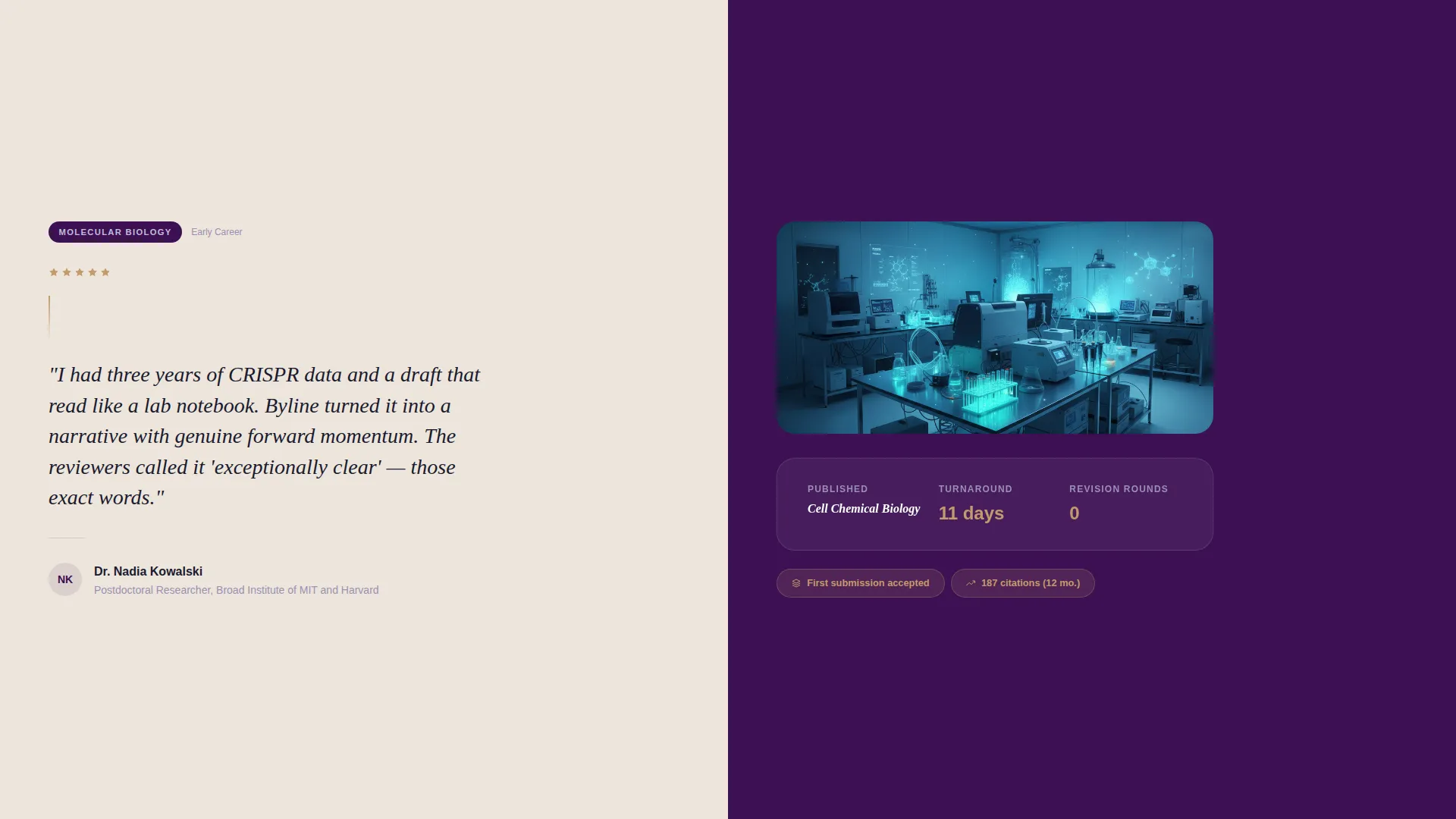
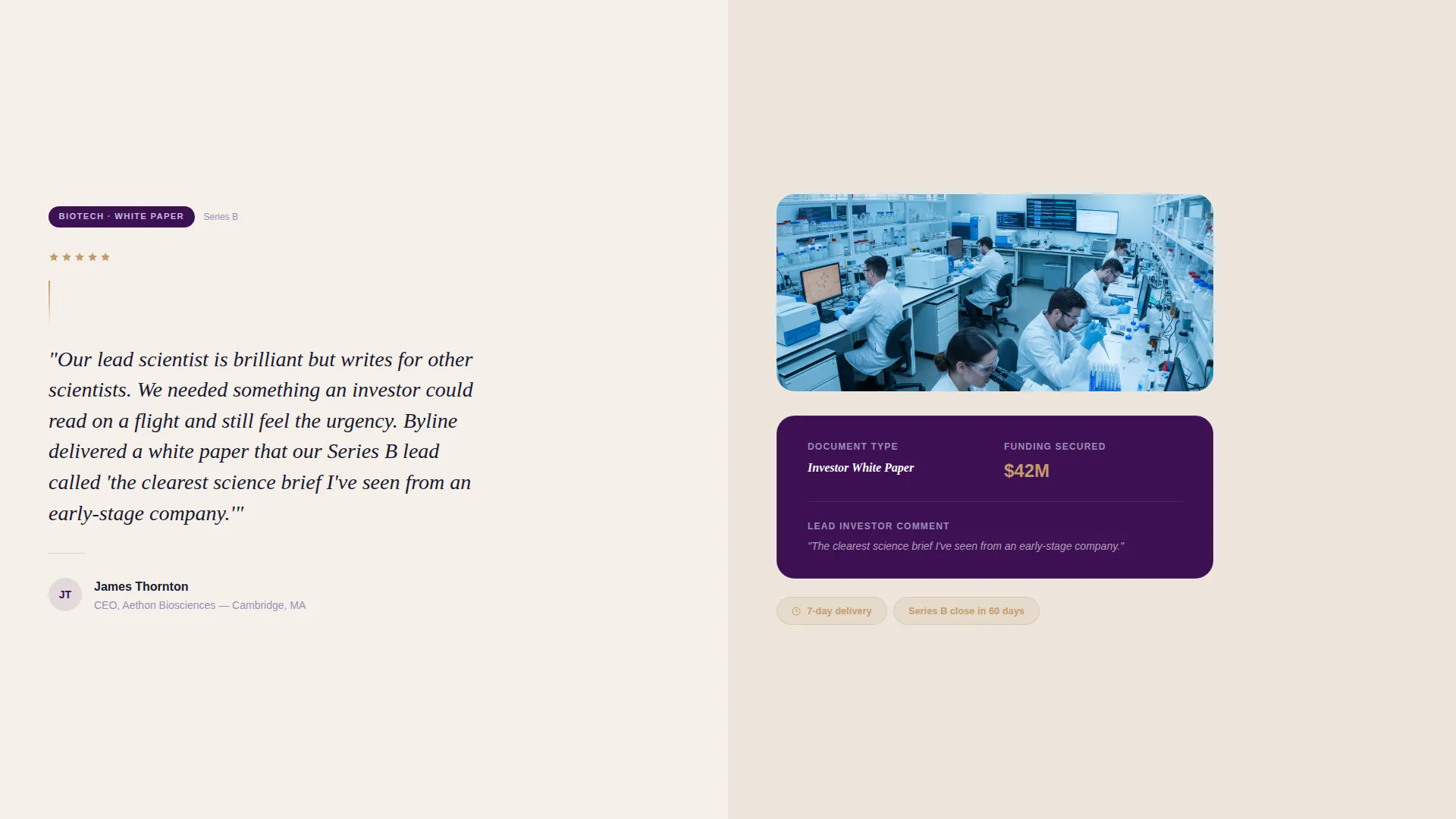
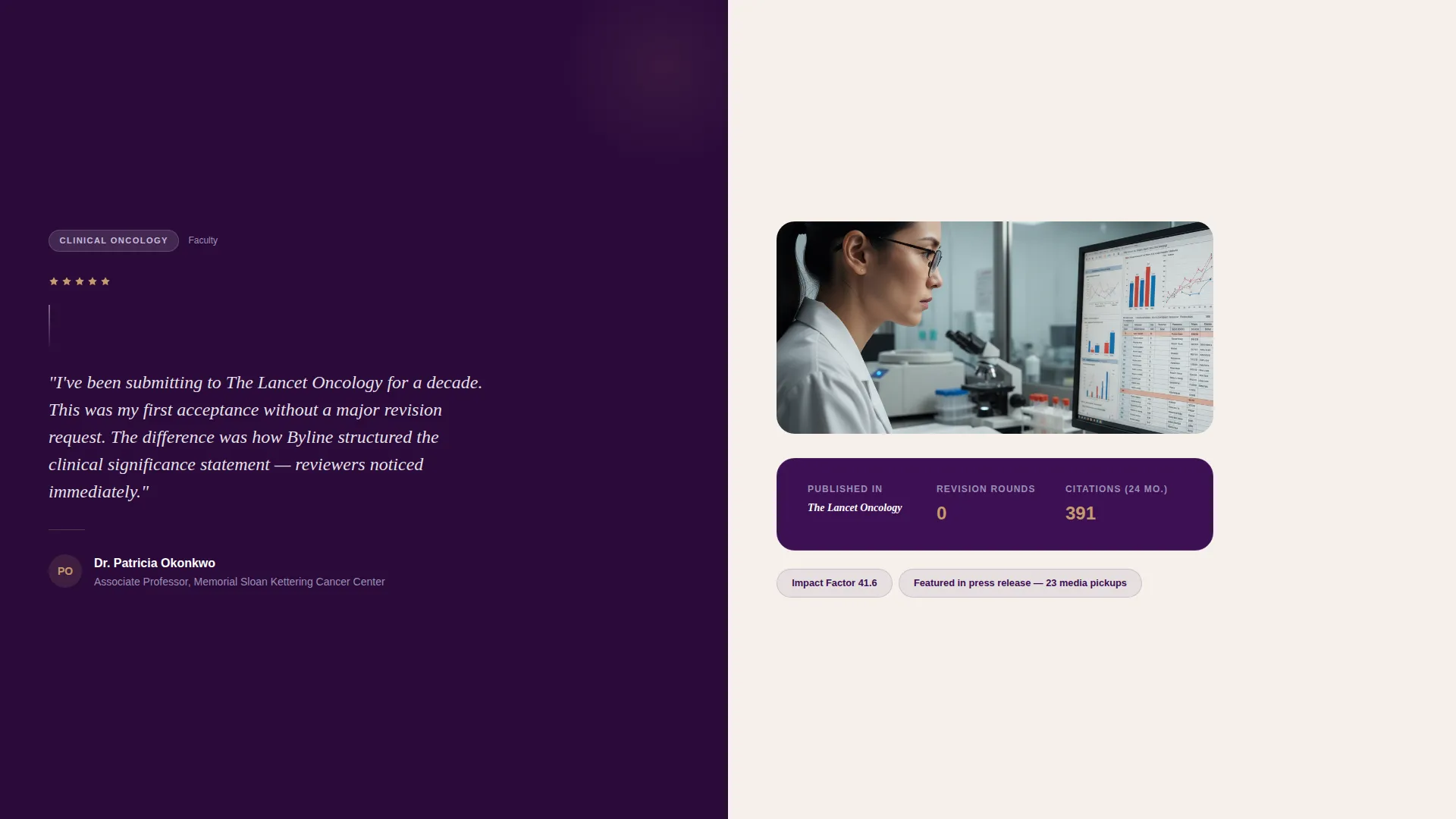
Each scroll section pairs a pull-quote testimonial on the left with a tangible outcome on the right. Outcomes include journal covers, citation counts, and funding amounts secured. The sequence moves from early-career researchers to department heads to institutional partners, building a compounding case through other people's verified wins.
Dual Conversion Path Design
The primary call to action, "Send Us a Manuscript," appears after the third testimonial pair and again in the footer. A secondary path, "Download the Client Portfolio," gates a PDF case-study deck behind a work email field. The two paths serve different buyer readiness levels without competing with each other.
Structured Manuscript Inquiry Form
The inquiry form collects institution name, discipline, project type, and a free-text deadline field. Project type options cover journal articles, white papers, grant narratives, and press materials. This structure qualifies leads by context before any call is scheduled.
Service Utility Visual Identity
The color system uses deep plum, warm parchment, muted silver-lavender, and ink-black for body text. Oxidized gold handles accent calls to action. The palette reads as academically serious without feeling cold or institutional in a negative sense.
Discipline Tag Attribution System
Every testimonial block includes a discipline tag alongside the client's full name and institution. This detail signals range across scientific fields and helps each visitor quickly find a comparable case. It turns a testimonial wall into a searchable evidence base.
Page sections overview
| Section | Purpose |
|---|---|
| Stats Metrics Header | Opens with three oversized placement figures and one named five-star quote |
| First Testimonial Pair | Pairs early-career researcher quote with a specific journal placement outcome |
| Second Testimonial Pair | Escalates to mid-career client with citation count and funding detail |
| Third Testimonial Pair | Introduces department-level client with institutional outcome |
| Primary call to action Block | Places "Send Us a Manuscript" form after the third testimonial pair |
| Fourth Testimonial Pair | Continues escalation toward institutional and partner-level evidence |
| Portfolio Download Gate | Offers PDF case-study deck gated behind a work email field |
| Footer call to action Anchor | Repeats the primary manuscript inquiry call to action to close the page |
Design & branding system
The visual identity follows a Service Utility theme built on the Plum Executive color system. The palette draws from leather-bound academic materials rather than clinical or tech-forward references.
- Core colors: deep plum (#3C1053), warm parchment (#F5F0EB), muted silver-lavender (#9B8FB4), and ink-black (#1A1A2E) for body text
- Accent color: oxidized gold (#C49A6C) reserved for call-to-action elements only
- No stock imagery or abstract graphics; typographic weight and named attribution carry all visual authority
Mobile & speed optimization
The split-screen layout adapts to narrower viewports by stacking its two panels vertically. The design keeps the metrics and the testimonial readable at every size without sacrificing the visual hierarchy that makes the page work.
- Oversized plum statistics reflow cleanly as full-width headlines on smaller screens
- Testimonial and outcome pairs stack in reading order so the logic of the sequence is preserved on mobile
How this template helps you convert
The page is structured to move institutional and academic buyers from skepticism to action without relying on a hard sell. Every layout decision serves that trust arc.
- The header metrics create immediate credibility: specific numbers attributed to real placements make the first impression impossible to dismiss, encouraging visitors to keep reading rather than bouncing.
- The escalating testimonial sequence builds a cumulative case across scroll depth, so by the time the primary call to action appears, the visitor has already seen proof matched to their own career stage or project type.
- The dual conversion paths respect different buyer readiness levels: a direct form captures ready-to-commit leads, while the gated portfolio download qualifies researchers and institutional buyers who need one more round of evidence before booking.
Other information about this template
This template is designed around a specific editorial niche: translating complex scientific research into prose that passes peer scrutiny and reaches a wider audience. It is a strong fit for science writing services that publish work in outlets such as Nature, The Lancet, and Scientific American, or that serve clients aiming for those venues.
- The template style follows a Sidebar Companion and split-screen layout approach suited to content-and-resource landing page directions
- The header concept draws from a Stats-First Impact and Giant Headline Left structure, prioritizing data over decoration
- The creative direction is Team and People focused, using the client constellation as the social proof engine rather than the writer's own biography
- This template works equally well for individual science writers, editorial consultancies, and academic communication offices building a credible web presence
Theme
Service Utility
Creative direction
Stats-First Impact
Color system
Plum Executive
Style
Sidebar Companion
Direction
Content/Resource
Page Sections
Split-screen Stats Header
Escalating Testimonial Sequence
Dual Conversion Path Design
Structured Manuscript Inquiry Form
Discipline Tag Attribution System
Plum Executive Color System
Related questions
Can I update the statistics and testimonials with my own client data?
What project types does the inquiry form support?
Does the portfolio download section require a specific file format?
Is this template suitable if I work across multiple scientific disciplines?
How does the dual call-to-action structure work on the page?