Premium Log Home Developer Landing Page Template
Timber is a zigzag landing page template built for luxury log cabin developers. It combines a drone-shot hero with a three-field search bar, a scroll-driven Gallery Walk of completed builds, and a four-step "Reserve a Build Slot" configurator. The Sunset Mesa color system and Executive Suite visual style signal seven-figure craftsmanship from the first scroll.
by Rocket studio
Quick summary
Timber is a single-page landing page template designed for high-end log home developers. It opens with an aerial hero and "Find Your Last Address" headline, then walks visitors through real completed builds before guiding them into a stepped build configurator. Every section earns trust through authentic project details, attributed client quotes, and warm Sunset Mesa tones that feel like a leather-bound property portfolio.
Who this template is for
This template is built for log cabin developers and custom log home builders who serve high-net-worth clients. It suits any construction office or sales team that needs a polished, high-converting landing page for legacy timber building projects.
- Senior executives and retired couples researching a forever log home on private acreage
- Second-generation ranchers and estate buyers with a multi-structure vision and a serious budget
- Log cabin builders and timber frame construction firms ready to document their portfolio publicly
What problem this template solves
Most log home builder pages fail to create the right atmosphere. They show generic stock photography, bury their planning process, and give buyers no clear path to begin a conversation. Timber solves all three problems at once.
- Buyers struggle to visualize the construction quality, log species, and site scale from a bland page
- Builders lose high-intent leads because there is no structured process to move from interest to contract
- The planning and budget range conversations happen too late, after trust has already eroded
What you get with this template
Timber delivers a fully structured landing page with every section mapped to a specific stage of the buyer journey. From the first aerial image to the final deposit form, the layout guides a serious buyer through careful planning steps without friction.
- A hero section with a drone-shot background, three search fields (Region, Bedrooms, Budget Range), and a single search button
- A zigzag Gallery Walk with alternating landscape photographs and detail panels showing log species, county, square footage, and client quotes
- A four-step "Reserve a Build Slot" configurator modal plus a secondary "Download the Lookbook" email-gate path
Feature list
The feature set is drawn directly from the template brief and covers every major interaction a luxury log home buyer would expect.
Aerial Hero with Search Bar
The header places a slow-panning drone shot of a completed log cabin compound at dusk behind a centered, minimal search bar. Three fields (Region, Bedrooms, Budget Range) let buyers filter their vision before they read a single line of copy. The headline "Find Your Last Address" sets the emotional register immediately.
Zigzag Gallery Walk
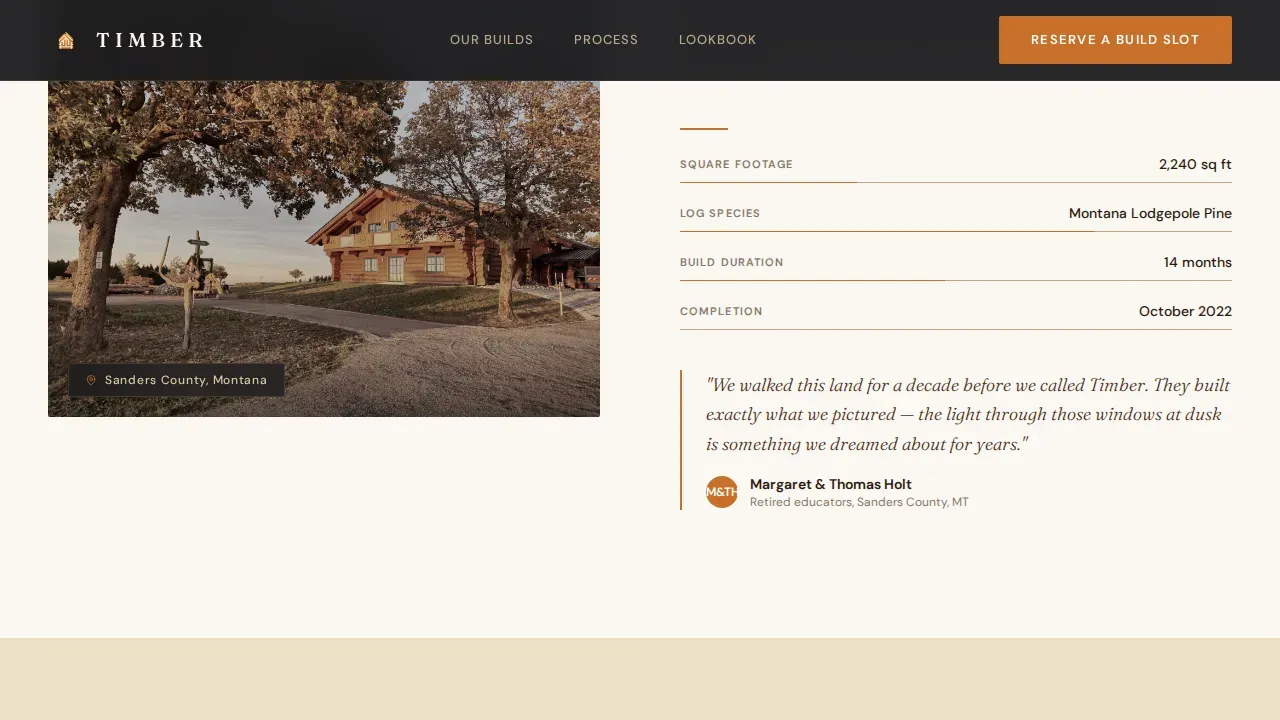
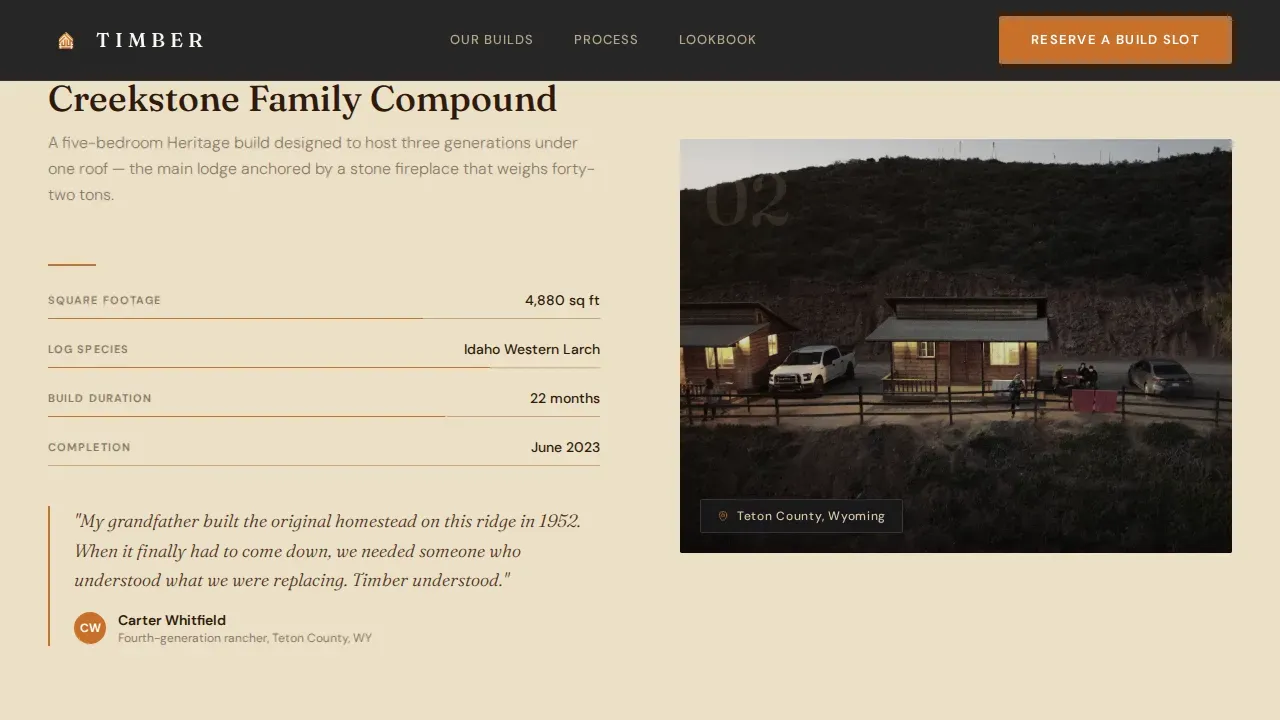
Each alternating section presents one completed log home project as a full case study. A wide landscape photograph sits on one side; a tight detail panel on the other holds the project name, county, square footage, log species, and a single attributed client quote. The scale of projects escalates as the visitor scrolls, from a riverside retreat to a sprawling multi-structure estate with guest cabins and a workshop.
Four-Step Build Configurator
Clicking "Reserve a Build Slot" opens a stepped modal. Step one selects a floor plan family (Classic, Heritage, or Estate). Step two presents visual swatches for log profile and wood species. Step three captures the build site state and parcel size. Step four collects contact details alongside a refundable deposit field processed inline.
Lookbook Email Gate
A secondary call-to-action, "Download the Lookbook," captures email addresses from buyers not yet ready to commit. It gates a sixty-page PDF of completed builds with pricing brackets, creating a nurture path for warm leads who need more time to review their options.
Scroll-Triggered Reveal Animations
Medium-intensity scroll-triggered animations reveal each Gallery Walk panel as the visitor moves down the page. Grayscale-to-color image hovers add a tactile quality to project photography. Parallax depth on the hero reinforces the sense of standing at the edge of a finished deck at golden hour.
Repeating "Reserve a Build Slot" Call to Action
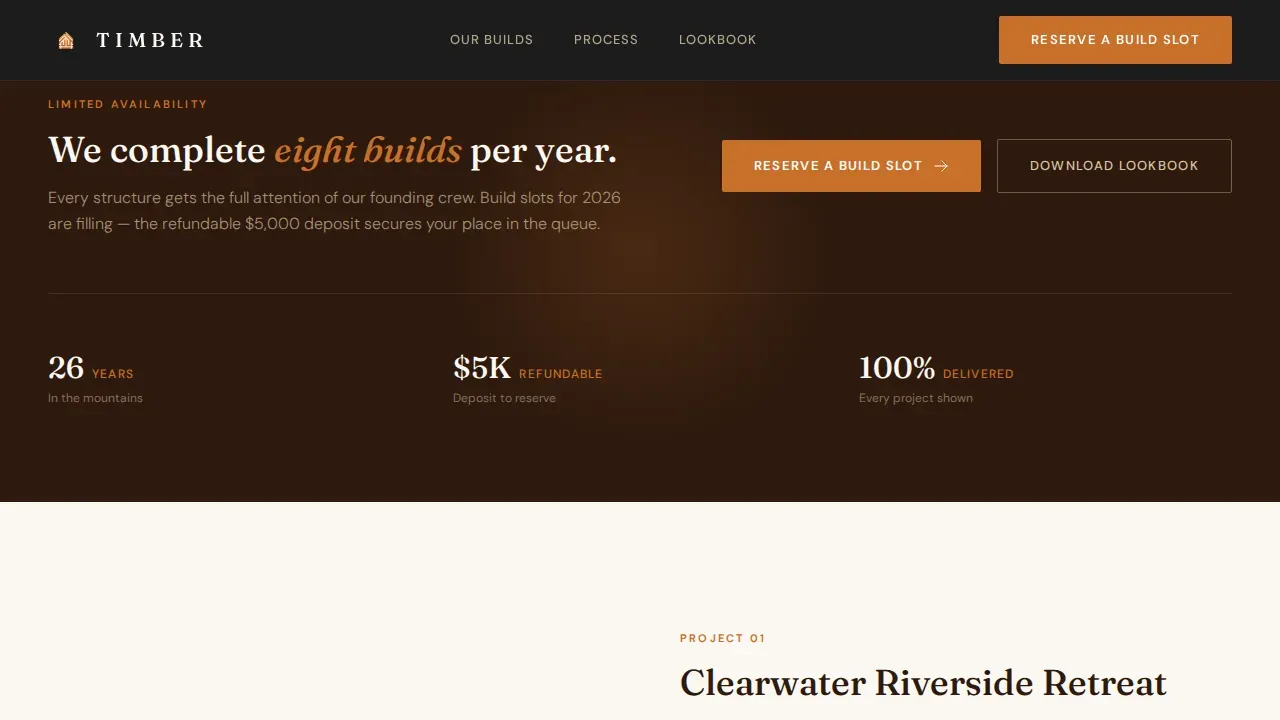
The primary call to action appears first beneath the header search results and repeats after every third project panel. This cadence meets buyers at multiple points in their scroll without overwhelming the editorial rhythm of the Gallery Walk.
Page sections overview
| Section | Purpose |
|---|---|
| Aerial Hero Search | Establish mood and filter buyer intent by region, bedrooms, and budget range |
| Gallery Walk 1 | Showcase a modest riverside log home with attributed client quote and build details |
| Reserve Slot call to action | Trigger the four-step build configurator for high-intent visitors |
| Gallery Walk 2 | Present a mid-scale family compound to escalate perceived project range |
| Gallery Walk 3 | Feature a multi-structure estate with guest cabins to anchor the top of the price range |
| Arc Split Footer | Display logo, tagline, and navigation links in a warm charcoal slab |
Design & branding system
The Sunset Mesa color system signals luxury without shouting. Every tone is drawn from the natural materials found in a hand-scribed log home: scorched amber, deep bark, dusted sandstone, and twilight charcoal. Typography uses Fraunces for display headings and DM Sans for body text, pairing old-world authority with clean readability.
- Primary accent color is scorched amber (#C8702A), used for hover states, buttons, and active sign indicators throughout the page
- Deep lodgepole bark (#2E1A0E) governs all typography and section dividers, while dusted sandstone (#D9C4A1) alternates across background panels
- Twilight charcoal (#1B1B1E) anchors the header and footer slabs, framing the warm interior tones between two solid dark edges
Mobile & speed optimization
The template is designed desktop-first to meet the browsing habits of its senior executive audience, with full mobile support built in. Hero images are priority-loaded, and all below-fold images use lazy loading to keep the initial experience sharp.
- Touch-friendly buttons and a responsive layout ensure the page reads clearly on phones and tablets
- Lazy-loaded project photography and a priority-loaded hero image keep the page responsive on all connections
- The Gallery Walk panels restack cleanly on smaller screens, preserving the alternating rhythm without crowding the detail panels
How this template helps you convert
Timber is engineered around a direct sales funnel that meets buyers at their level of readiness. Every layout decision reduces friction for someone spending serious money on a legacy log home.
- The three-field search bar at the top lets buyers self-qualify by region, bedroom count, and budget range before they scroll, pre-warming them for the configurator call to action that follows
- The escalating Gallery Walk builds credibility through real project details and attributed client quotes, so by the time buyers reach "Reserve a Build Slot," they have already seen proof that this builder delivers completed log homes at the scale they need
- The secondary "Download the Lookbook" path captures emails from buyers still in the research phase, ensuring that a visitor who is not ready to sign today stays within reach for the next conversation
Other information about this template
The Timber template is grounded in how serious timber frame homes and log home projects actually move from vision to completion. The construction process generally begins with a conceptual design meeting to align on project parameters and budget. From there, a schematic design set is created, including floor plans, drawings, and specifications. Construction documents are generated once the design is approved and the contract is signed.
Timber frame construction requires careful planning and skilled execution. The location of a build can affect both the budget and the schedule, and different builds may have different requirements that lead to variations in the construction process. Budgeting for a log home or timber frame house should cover materials, labor, and site preparation. Timber frame home costs can vary considerably depending on design complexity, and the advantages of building with timber include faster construction timelines and lower labor costs compared to traditional block construction.
Proper treatment of exterior wood surfaces is essential for longevity. Managing moisture is one of the most critical factors in protecting a log cabin or timber frame building over its life. High-performance windows and well-sealed doors reduce weather-related risk and help maintain interior comfort across seasons. Timber frame construction is also a sustainable building method that utilizes renewable resources and can lead to lower energy costs through efficient insulation.
- This template supports the visual-first design approach that log home and timber frame homes marketing requires, with large-format image slots ready for real project photography
- The Gallery Walk format is ideal for developers who want to document the history of completed builds with attributed quotes and specific construction details
- Buyers looking to monitor progress across a multi-year build schedule will find the configurator's step-by-step format mirrors the reality of how timber frame construction plans are developed
Theme
Executive Suite
Creative direction
Gallery Walk
Color system
Sunset Mesa
Style
Zigzag/Alternating
Direction
Direct Sales
Page Sections
Aerial Hero with Three-field Search Bar
Zigzag Gallery Walk with Project Case Studies
Four-step Build Configurator Modal
Lookbook Email Gate
Scroll-triggered Reveal Animations
Repeating Primary Call to Action
Related questions
Can I use this template for both log home and timber frame construction projects?
How does the four-step build configurator work for buyers?
What is the Lookbook email gate and who is it for?
Is the template desktop-first or fully responsive?
Does this template include the photography or just the layout?