Marketing Manager Personal Brand Landing Page
Campaignreel is a masonry-style personal brand landing page built for marketing managers who think in campaigns, not job titles. The Lens & Frame visual identity, collage-style header, and case-study card layout make your work the centerpiece. A persistent waitlist bar and dual conversion paths turn visitor curiosity into qualified leads before the page ends.
by Rocket studio
Quick summary
Campaignreel is a single-page personal brand landing page for marketing managers who lead with proof. The masonry card layout presents each campaign as a story. The Monochrome Steel palette keeps focus on the work. A sticky waitlist bar and a downloadable campaign reel give visitors two clear reasons to hand over their email.
Who this template is for
This template is built for senior marketing professionals who want their portfolio to do the talking. It suits anyone whose work speaks louder than a résumé and who needs to attract the right kind of inbound attention.
- Marketing managers and fractional chief marketing officers building a personal brand presence
- Senior strategists open to agency recruitment or conference speaking opportunities
- Campaign-led professionals who want proof-first positioning and a waitlist-ready conversion flow
What problem this template solves
Most personal brand pages read like a LinkedIn profile with a custom domain. They list titles and companies but never show the thinking, the stakes, or the results. Visitors leave without trusting the work.
- No way to show campaign depth, budget scale, or strategic insight in a single scroll
- Generic layouts that flatten a senior strategist's portfolio into a flat list of job entries
- No clear conversion path that lets a founder, recruiter, or event organizer signal intent without a cold email
What you get with this template
You get a fully designed, single-page personal brand landing page that leads with campaign proof and closes with a structured waitlist form. Every section earns the next.
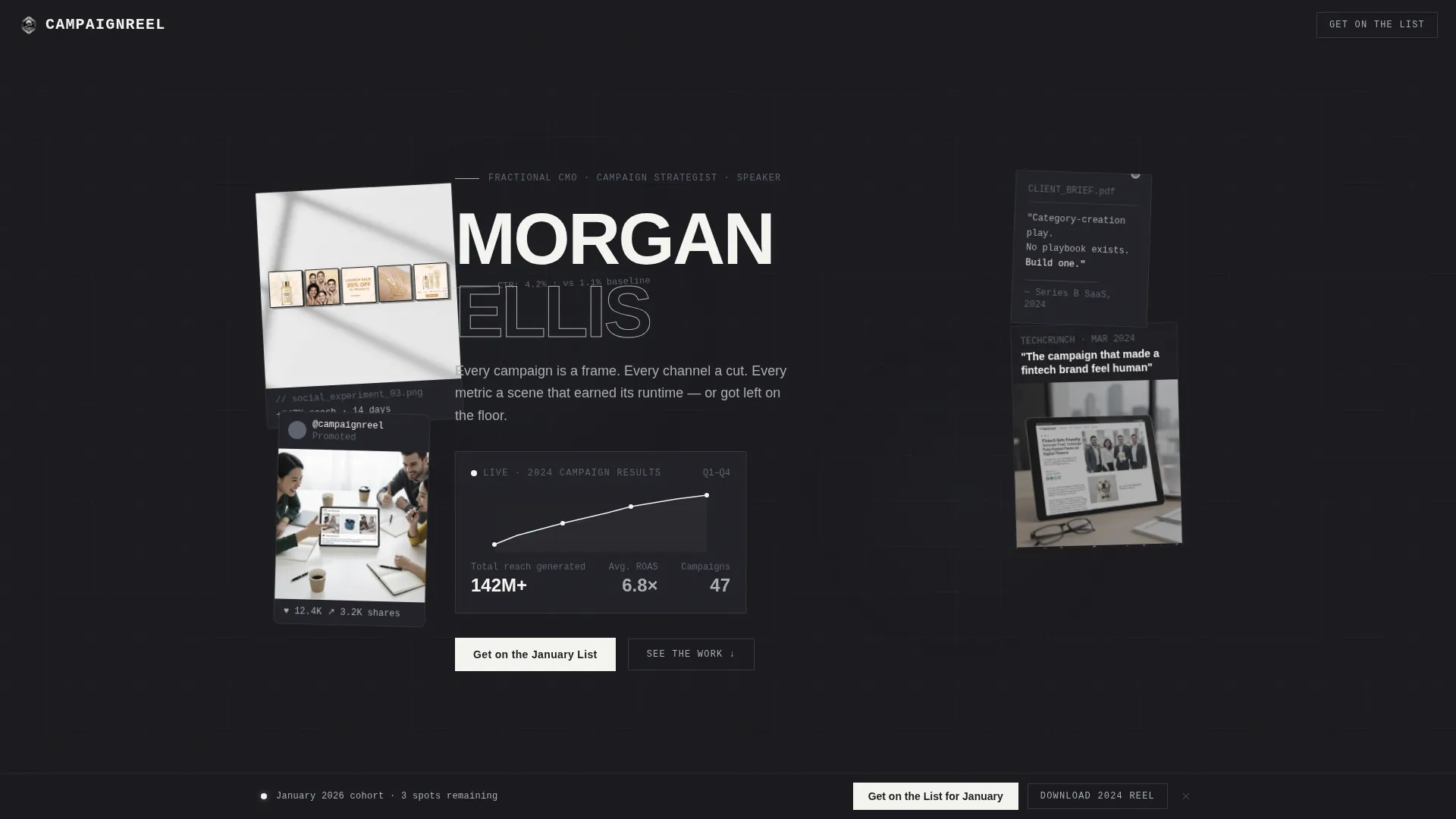
- A collage-style header with overlapping campaign artifacts and a self-drawing metrics graph animation
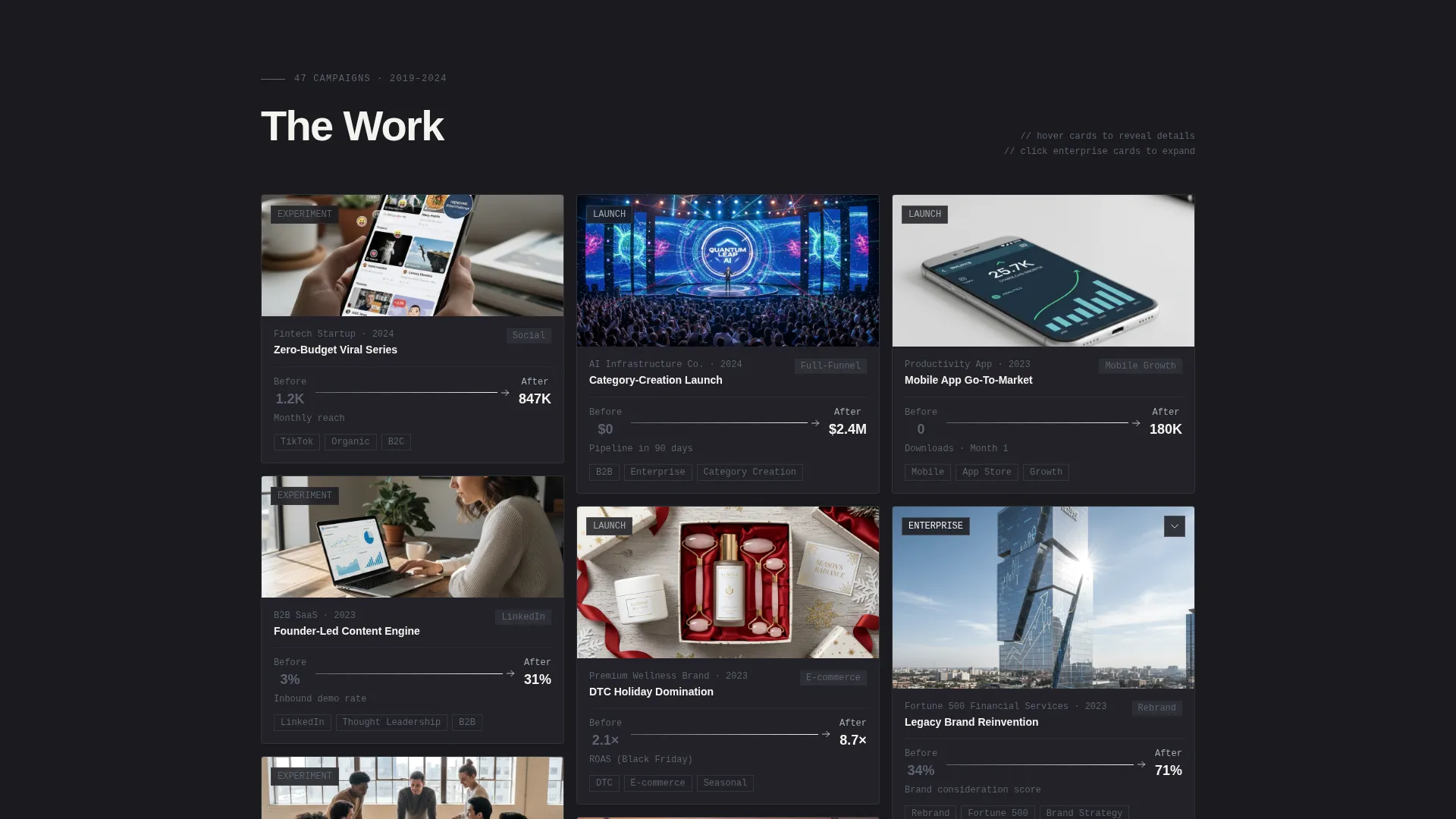
- A masonry card grid where campaigns escalate in complexity from social experiments to enterprise rebrands
- A persistent sticky waitlist bar with an email field and a three-option radio selector for visitor intent
Feature list
This template ships as a cohesive visual and structural system. Every piece below comes directly from the brief.
Collage Header with Live Metrics Animation
The header is composed like a mood board, not a grid. Campaign screenshots, cropped brand logos, hand-scrawled key performance indicator annotations in a monospaced typeface, and a torn brief overlap across the composition. One element moves: a metrics graph that draws its own line in real time, the only animation on the page.
Escalating Masonry Card Grid
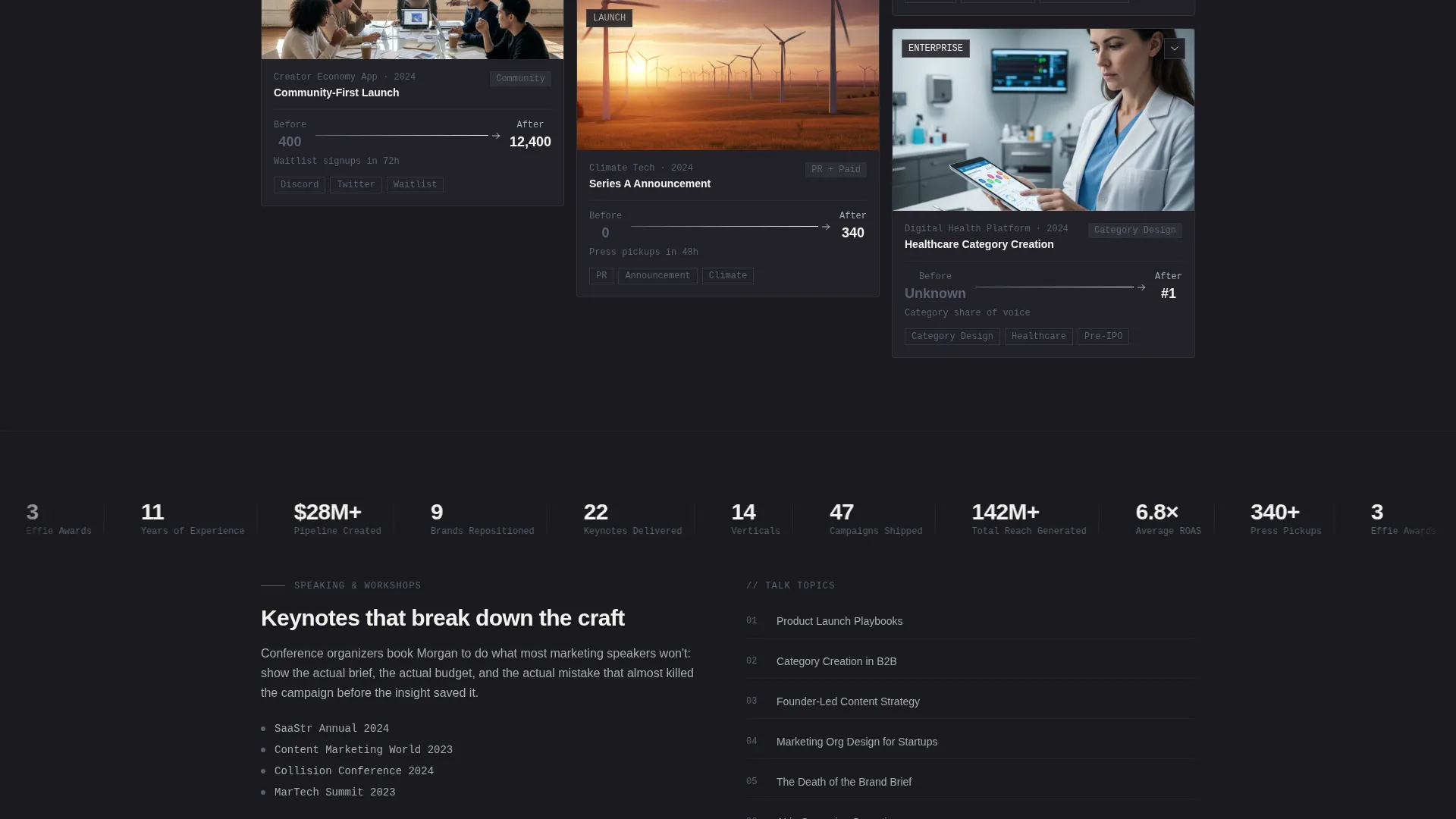
Cards tile in a masonry layout and increase in complexity as the visitor scrolls. Early cards show before-and-after engagement numbers from social experiments. Mid-scroll cards reveal product launch details on hover, including budget, timeline, and channel mix. Bottom-row cards expand into a three-slide mini-deck covering the brief, the insight, and the result.
Persistent Waitlist Bottom Bar
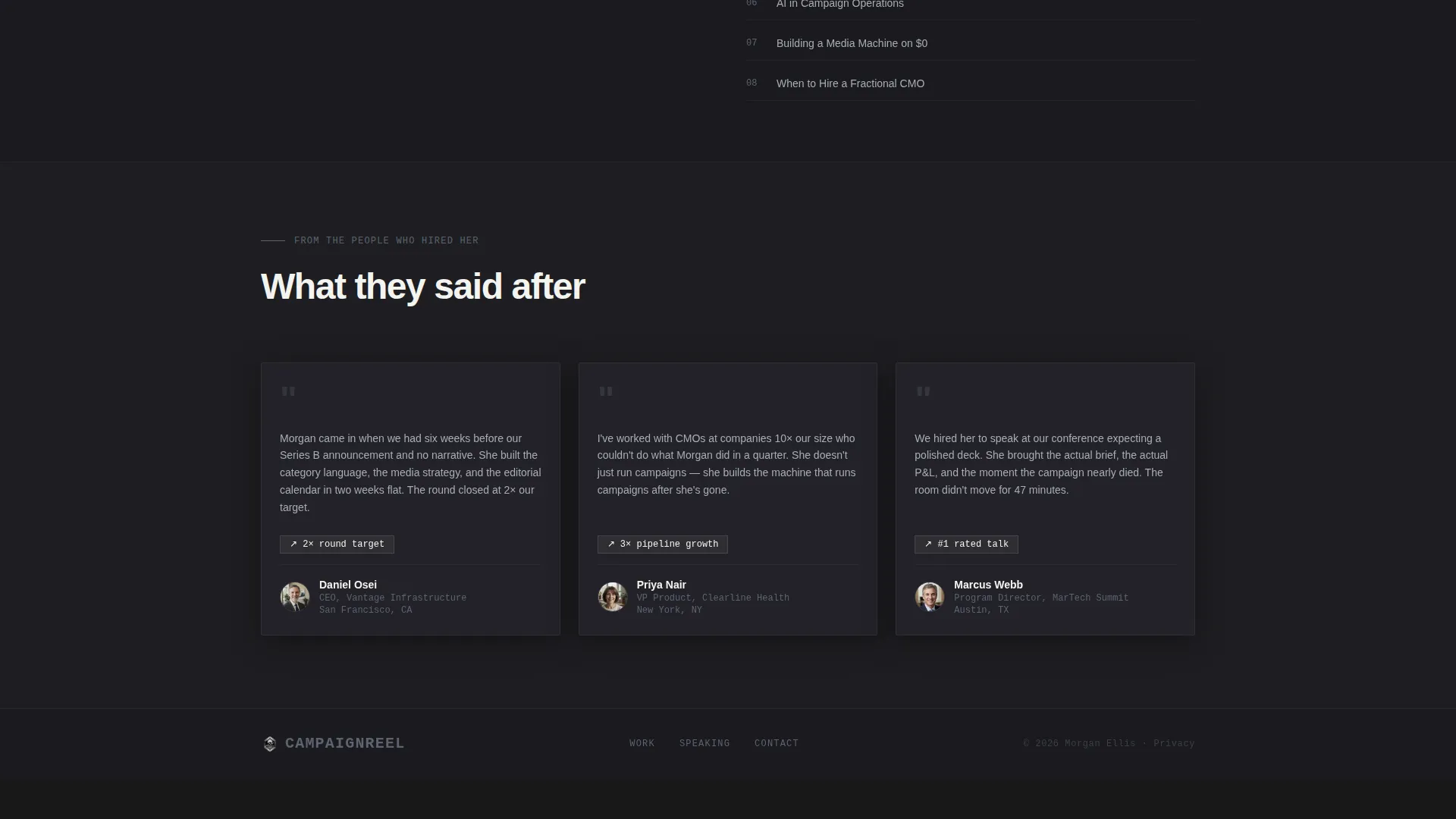
After the third scroll depth, a sticky bottom bar floats into view. It holds a single email input and a radio selector with three choices: "I want to hire," "I want to collaborate," or "I want to book a talk." The bar stays visible without interrupting the portfolio scroll.
Dual Conversion Path Design
Beyond the waitlist bar, a secondary link offers visitors a "Download the 2024 Campaign Reel" option. Both conversions require only an email address. This gives two distinct reasons to sign up without asking for anything more.
Proof-First Content Architecture
The page is structured so visitors see five campaigns before any conversion prompt appears. The sticky bar only surfaces after meaningful scroll depth. This sequencing lets the work establish trust before the ask is made.
Monochrome Steel Visual System
The full palette runs on four values: deep darkroom black, brushed aluminum, matte titanium mid-tone, and projection-white reserved for hover states and active card borders. No color distracts from the campaign work itself.
Page sections overview
| Section | Purpose |
|---|---|
| Collage Header | Establish identity through layered campaign artifacts and animated metrics |
| Campaign Name Display | Place the strategist's name bold, off-center, partially obscured by work |
| Masonry Card Grid | Present campaigns as escalating case study stories |
| Hover Reveal Layer | Surface launch details, budget, timeline, and channel mix on card hover |
| Expandable Card Deck | Show three-slide mini-decks for enterprise and rebrand campaigns |
| Sticky Waitlist Bar | Capture email and visitor intent after scroll depth threshold |
| Campaign Reel Download | Offer a secondary conversion tied to the same email capture |
Design & branding system
The Lens & Frame theme treats the page like a steel contact sheet tray lit by a single overhead bulb. Every design decision strips away color so the campaign work becomes the only visual pigment.
- Four-value Monochrome Steel palette: deep darkroom black (#1A1A1E), brushed aluminum (#A8ADB3), matte titanium mid-tone (#5C6370), and projection-white (#F4F4F0) for hover and active states
- Collage and scrapbook header composition with no grid alignment, overlapping layers, and a monospaced typeface for annotation details
- Masonry card layout styled after a producer's lookbook, with intentional visual tension and escalating content density per row
Mobile & speed optimization
The template is designed with a deliberate, minimal animation footprint. Only one element animates on the page, keeping the visual load focused and intentional.
- Single animation instance: the self-drawing metrics graph in the header keeps motion contained and purposeful
- Masonry layout and card hover interactions are structured to work within a single-page flow without heavy layering
- Sticky bottom bar is designed to remain visible on smaller viewports without obscuring the card grid content
How this template helps you convert
The page builds trust through evidence before it asks for anything. Conversion is a natural outcome of scroll, not a pop-up interruption.
- The escalating card grid keeps visitors scrolling deeper, showing more proof at each row before the waitlist bar appears
- The dual conversion paths let visitors self-select intent, making the email capture feel relevant rather than generic
Other information about this template
This template sits within the Personal and Resume category, specifically designed for the Marketing Manager Profile niche. It is built as a personal brand website landing page targeting inbound from three distinct visitor types.
- Designed for a "Waitlist and Coming Soon" launch direction, making it practical for professionals preparing to announce availability or a new service
- The Case Study Narrative creative direction is a deliberate structural choice, not just a visual style, it shapes how content is sequenced across every card row
- The template works well for fractional chief marketing officers, conference speakers, and senior strategists who want qualified inbound rather than cold outreach
- The Lens and Frame theme and the Masonry and Pinterest template style are matched at the intersection level, meaning both the visual language and layout pattern are designed to work together
Theme
Lens & Frame
Creative direction
Case Study Narrative
Color system
Monochrome Steel
Style
Masonry/Pinterest
Direction
Waitlist/Coming Soon
Page Sections
Collage Header with Animated Metrics Graph
Escalating Masonry Campaign Card Grid
Persistent Sticky Waitlist Bar
Dual Email Conversion Paths
Proof-first Page Architecture
Monochrome Steel Color System
Related questions
Who is this landing page template designed for?
What does the masonry card layout actually do?
How does the waitlist form work?
Can I use this template for a coming-soon launch?
What makes the header different from a standard portfolio header?