Specialist Arborist Appointment Booking Website Template
Canopy is an editorial-style arborist landing page template built for certified tree care professionals. It combines an authoritative magazine aesthetic with practical conversion tools, including a gated resource download, a persistent booking form, and a credential-rich trust section. It suits arborists serving residential clients, commercial property managers, and municipal planners who need a credible, content-led online presence.
by Rocket studio
Quick summary
Canopy is a single-page arborist landing page template designed in an editorial magazine style. It pairs generous white space, editorial serif typography, and a muted old-growth color palette with conversion-focused tools. The result is a page that earns visitor trust through demonstrated expertise before it ever asks for a booking.
Who this template is for
This template is built for tree care professionals who want their online presence to reflect the seriousness and depth of their work. It suits businesses that serve a mix of client types and need a page that speaks clearly to all of them.
- Certified arborists running residential and commercial tree care operations
- Property managers overseeing large multi-tree campuses who need a credible vendor page
- Municipal or utility-adjacent arborist firms that require risk-assessment credibility upfront
What problem this template solves
Most arborist websites look generic. They show a logo, a phone number, and a stock photo of someone in a hard hat. That approach fails high-stakes clients like municipal planners or commercial property managers who need proof of expertise before they make contact.
- Visitors arrive after a storm or liability concern and find nothing that builds confidence
- Credential pages feel scattered, making it hard for clients to trust the crew quickly
- There is no lead capture mechanism that rewards the visitor before asking for their information
What you get with this template
This template delivers a fully structured editorial landing page with every section pre-built and ready to customize. The design system, content hierarchy, and conversion tools are all included as part of the layout.
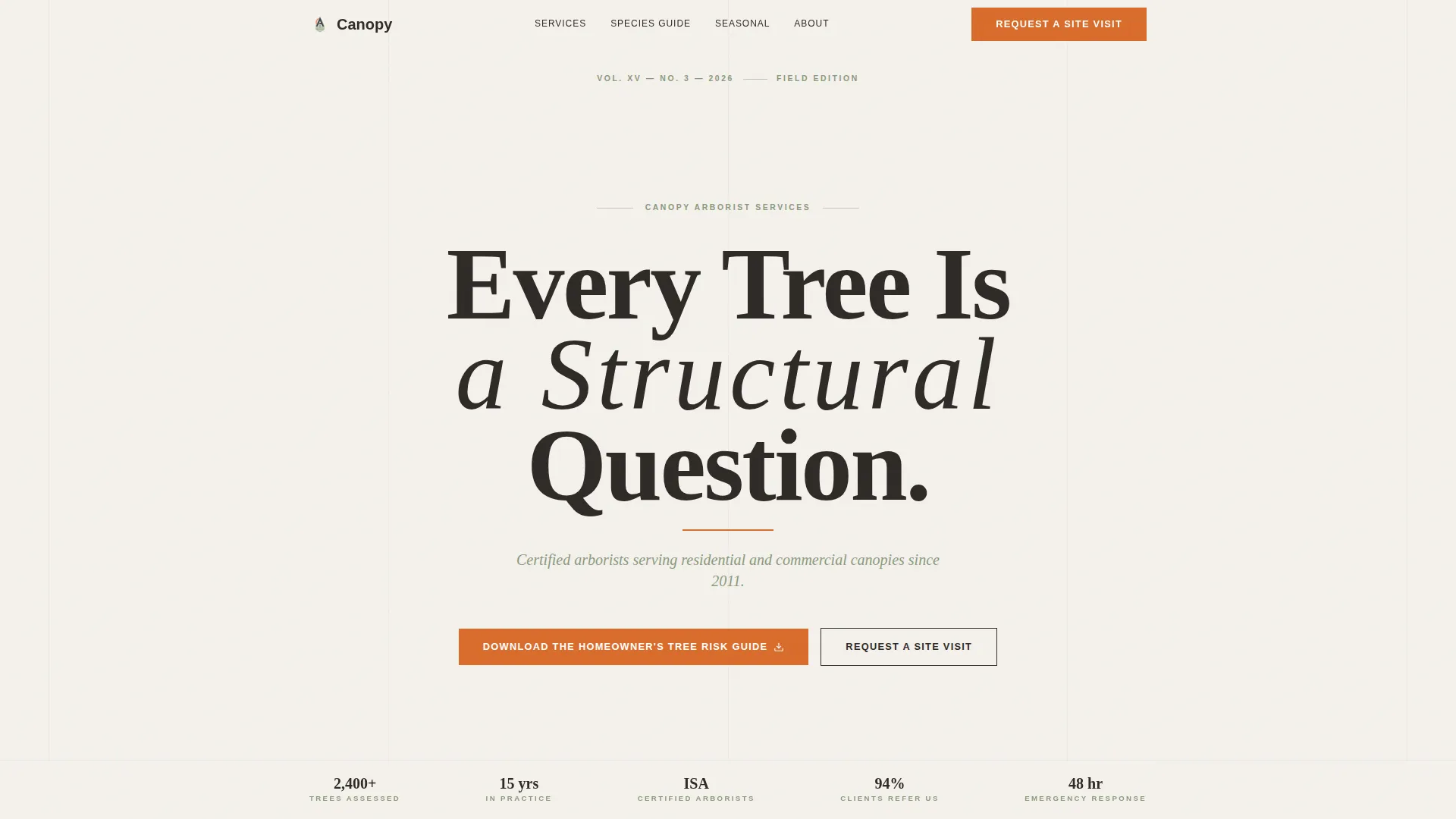
- A giant centered headline section with editorial serif type, an orange rule accent, and an italic sage subhead
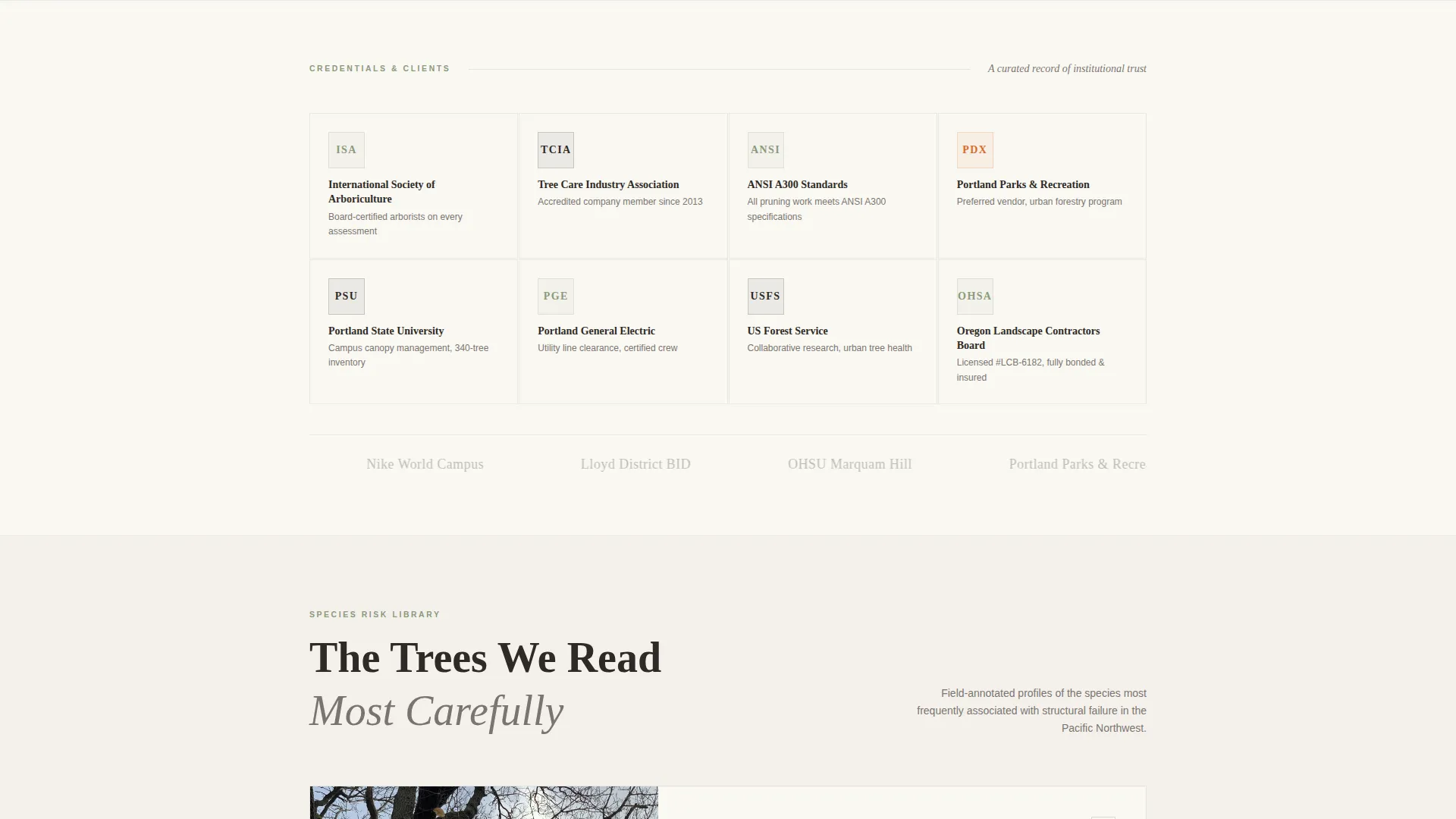
- A curated credential band featuring municipal seals, certification marks, and client badges with individual captions
- A gated resource download form capturing email and zip code, plus a persistent booking nav link to a short site-visit request form
Feature list
This template is built around a specific editorial vision. Each feature below reflects a built-in design or structural decision described in the brief.
Editorial Magazine Typography System
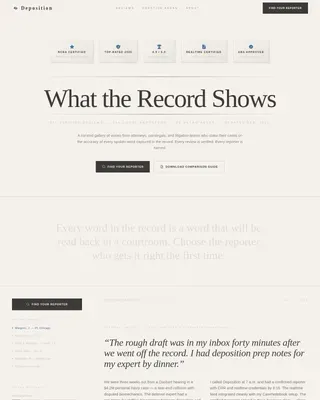
The headline uses enormous serif type tracked wide across a cloud white field. A thin chainsaw-pull orange rule sits beneath it. An italic sage subhead completes the header. No photography competes with the type. The typography is the visual statement.
Cloud Canvas Color System
The palette uses four values: soft overcast white (#F4F1EC) for backgrounds, bark charcoal (#2E2A26) for body text, lichen sage (#8A9A7B) for subheads and supporting labels, and chainsaw-pull orange (#D96C2B) reserved strictly for buttons and pull-quote rules. The restraint of the palette gives every orange element immediate visual weight.
Curated Credential Band
The logo wall is reimagined as an editorial feature. Municipal seals, ISA (International Society of Arboriculture) certification marks, insurance carrier logos, and client badges are laid out in a horizontal band. Each mark carries a small caption explaining the specific relationship. This is not a generic trust bar; it reads like a curated editorial spread.
Long-Form Content Sections
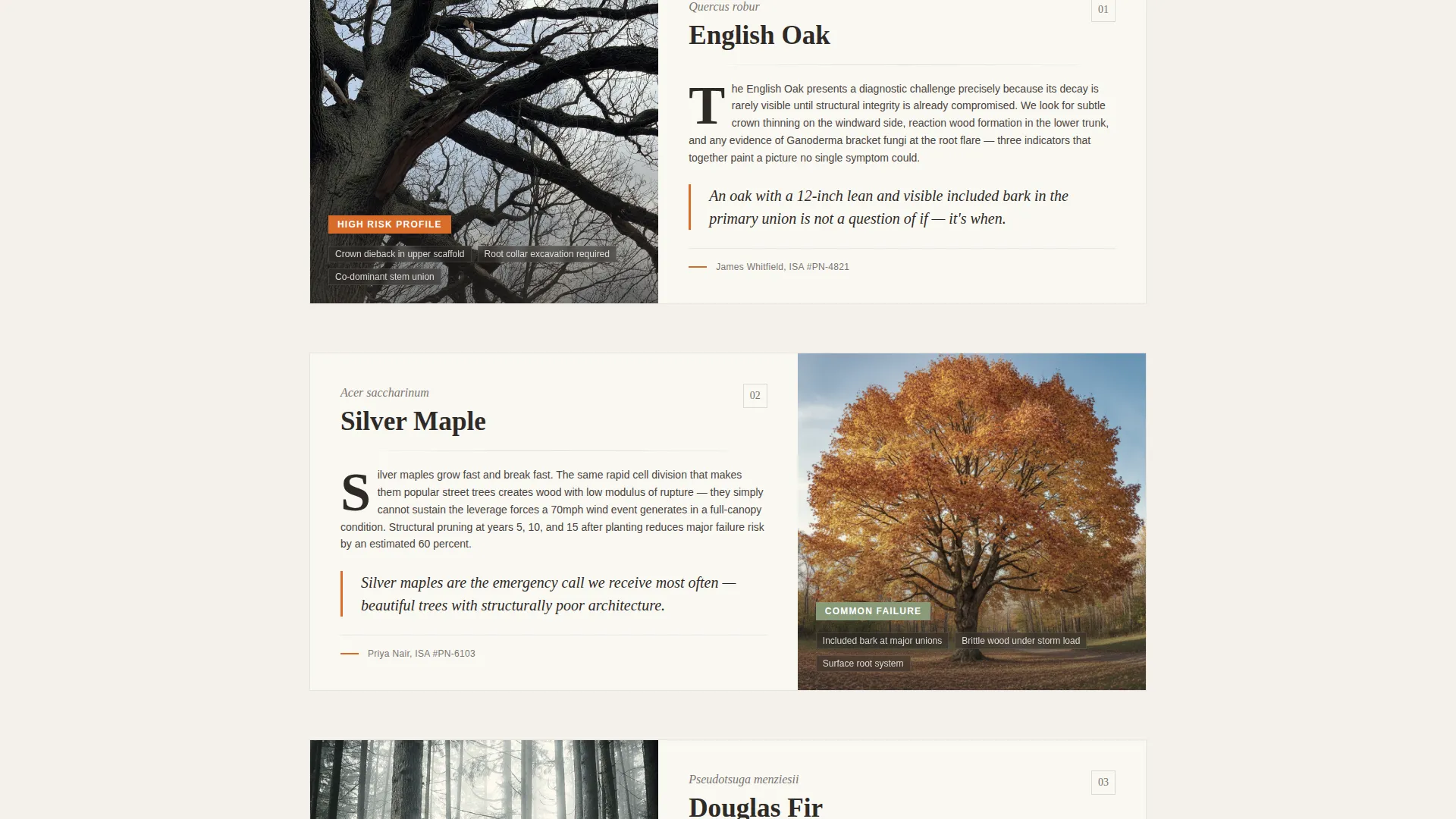
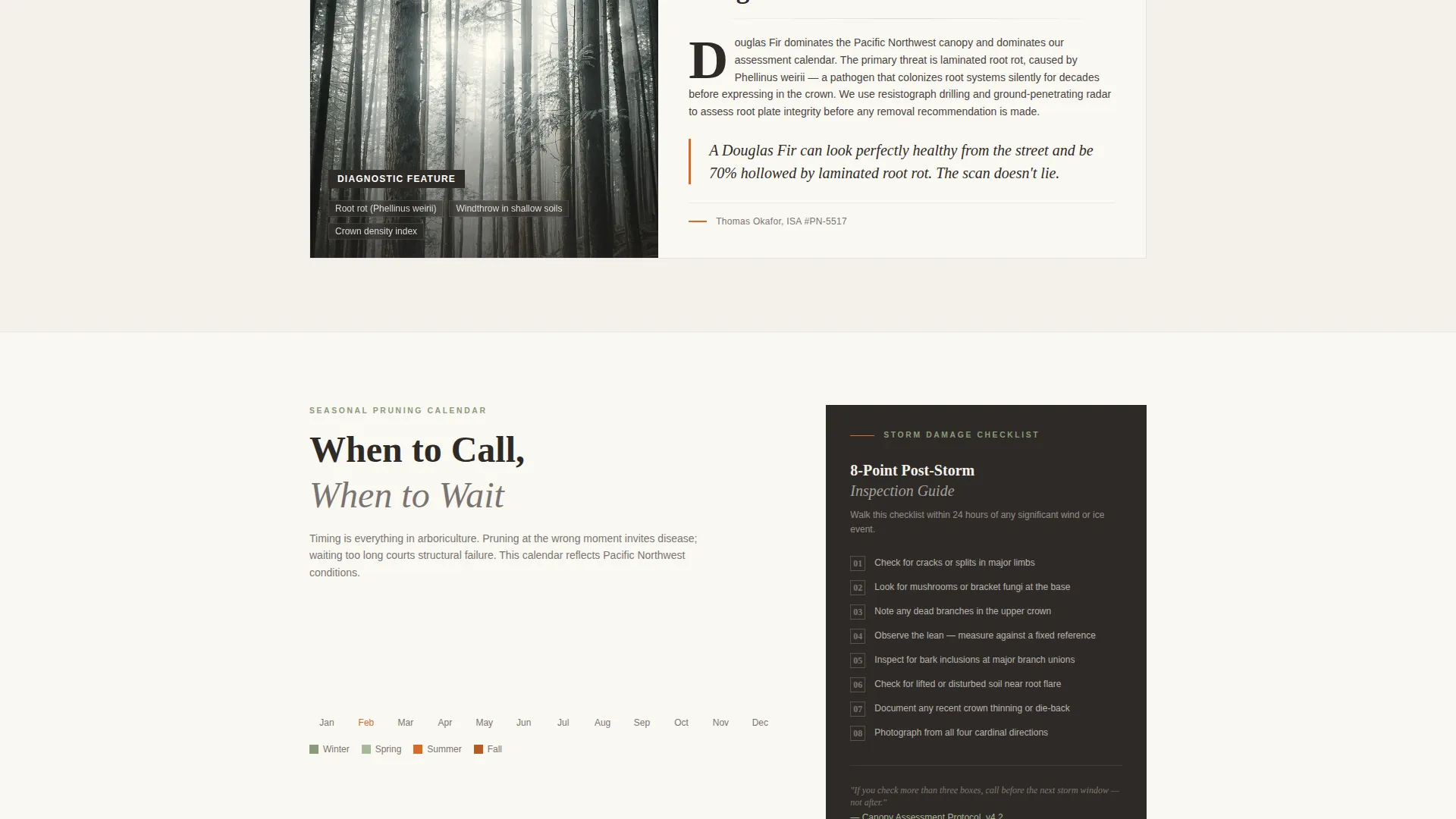
The scroll unfolds like a magazine. It includes species profiles with annotated photography, a seasonal pruning calendar rendered as an infographic, a downloadable storm-damage assessment checklist, and a photo essay of a full tree removal sequence. Each section uses generous margins, drop caps, and pull quotes attributed to certified arborists.
Gated Resource Download
The primary call to action is a form gating the Homeowner's Tree Risk Guide behind an email address and zip code. This positions the arborist business as the regional authority. The form sits within the content flow, not bolted on at the end.
Persistent Booking Navigation
A secondary call to action lives in the navigation bar at all times. It reads "Request a Site Visit" and links to a short booking form. The form asks for a property address, the number of trees of concern, and an urgency level: routine, storm damage, or emergency.
Page sections overview
| Section | Purpose |
|---|---|
| Giant Headline Header | Sets editorial authority and brand voice immediately |
| Italic Sage Subhead | Communicates tenure and service scope concisely |
| Credential and Badge Band | Builds trust through curated certifications and client marks |
| Species Profile Features | Demonstrates diagnostic expertise through long-form content |
| Seasonal Pruning Calendar | Provides genuine seasonal value as an infographic resource |
| Storm Damage Checklist | Offers a downloadable tool for homeowners post-storm |
| Removal Photo Essay | Builds confidence through documentary-style process coverage |
| Gated Resource Form | Captures leads via the Homeowner's Tree Risk Guide offer |
| Site Visit Booking Form | Converts high-intent visitors through a short request form |
Design & branding system
The design language is rooted in the editorial magazine tradition. Every visual decision reinforces a sense of grounded authority, the way a well-produced field guide communicates expertise before you read a single word.
- The Cloud Canvas palette uses four controlled values: overcast white, bark charcoal, lichen sage, and chainsaw-pull orange, with orange used only for action elements
- Typography is the primary visual element, using wide-tracked editorial serif type at headline scale and consistent use of sage for subheads and italics throughout
- Layout relies on generous margins, drop caps, and pull-quote rules to reward careful reading over quick scrolling
Mobile & speed optimization
The editorial layout is structured to translate cleanly across screen sizes. The single-page format keeps the content hierarchy intact on smaller displays without requiring separate mobile versions.
- The centered headline and full-width credential band reflow naturally on narrower viewports
- Long-form content sections with generous margins are spaced to remain readable on mobile without layout collapse
- The persistent navigation booking link stays accessible across all scroll positions on both desktop and mobile
How this template helps you convert
Canopy converts by earning trust before making an ask. The page is structured so that visitors receive genuine expertise first, which dramatically increases the likelihood they will engage with the booking form.
- The gated Homeowner's Tree Risk Guide collects email and zip code from early-funnel visitors who are not yet ready to book, building a local lead list around a genuinely useful resource
- The persistent "Request a Site Visit" link in the navigation keeps the booking path one click away at every point in the scroll, so high-intent visitors can act the moment they are ready
Other information about this template
This template is part of a broader professional services template category focused on trade and specialty service providers. A few additional details worth noting before customizing:
- The template style is classified as Editorial/Magazine and sits within the Arborist Online Presence subcategory under Professional Services
- The header concept is Giant Headline Centered, a format that works especially well for service businesses that rely on authority positioning rather than product imagery
- The creative direction follows a Logo Wall Authority pattern, which is reimagined here with editorial captions rather than a plain row of logos
- The landing page direction is Content/Resource, meaning the primary conversion path is a gated download rather than a direct service booking, with the booking form serving as a secondary conversion
- The template has been designed with a specific niche in mind: arborist booking pages that need to serve both emergency-response clients and long-term commercial relationships from a single page
Theme
Editorial Magazine
Creative direction
Logo Wall Authority
Color system
Cloud Canvas
Style
Editorial/Magazine
Direction
Content/Resource
Page Sections
Editorial Magazine Typography System
Cloud Canvas Color System
Curated Credential Band
Long-form Content and Resource Sections
Gated Resource Download Form
Persistent Site Visit Booking Link
Related questions
Can this template work for a solo arborist, not just a large crew?
What is the gated resource download, and do I need to create the guide myself?
How does the urgency level field work in the booking form?
Can I replace the credential band with my own certifications and client logos?
Is this template suitable for commercial property managers as a primary audience?