Rainforest Policy Institute Landing Page Template
Canopy is a single-column landing page template built for rainforest protection research and policy institutes. It follows an Origin Story creative direction, guiding high-stakes visitors from a founding field expedition through satellite data, legislative outcomes, and a single confident call to action: downloading the annual Policy Impact Brief PDF.
by Rocket studio
Quick summary
Canopy is a civic-institutional landing page template for a rainforest protection research and policy institute. It uses a Forest Trust color system and an Origin Story scroll structure to move congressional staffers, foundation officers, and investigative journalists from a legislator pull-quote header all the way to a fixed bottom bar calling them to read the Policy Impact Brief.
Who this template is for
This template is designed for organizations that turn scientific field data into legislation. It suits institutes that need to earn trust from skeptical, deadline-driven readers before asking for any action.
- Congressional staffers and foundation program officers who vet sources before citing them
- Investigative journalists sourcing peer-reviewed deforestation data on deadline
- Climate philanthropists and academic researchers evaluating where to direct significant funding
What problem this template solves
Most nonprofit landing pages ask visitors to act before they have earned the right to. Canopy solves that credibility gap by building a documented evidence trail first. Each scroll section deepens the stakes before the call to action ever appears.
- High-authority visitors leave when a page feels generic or unverifiable
- A single call to action buried in a wall of text loses click-through momentum
- Disconnected sections fail to show how research actually becomes law
What you get with this template
You get a fully structured single-column flow landing page with five purpose-built sections and a fixed bottom call to action bar. Every design decision reinforces institutional gravity while keeping the reading experience clear and scannable.
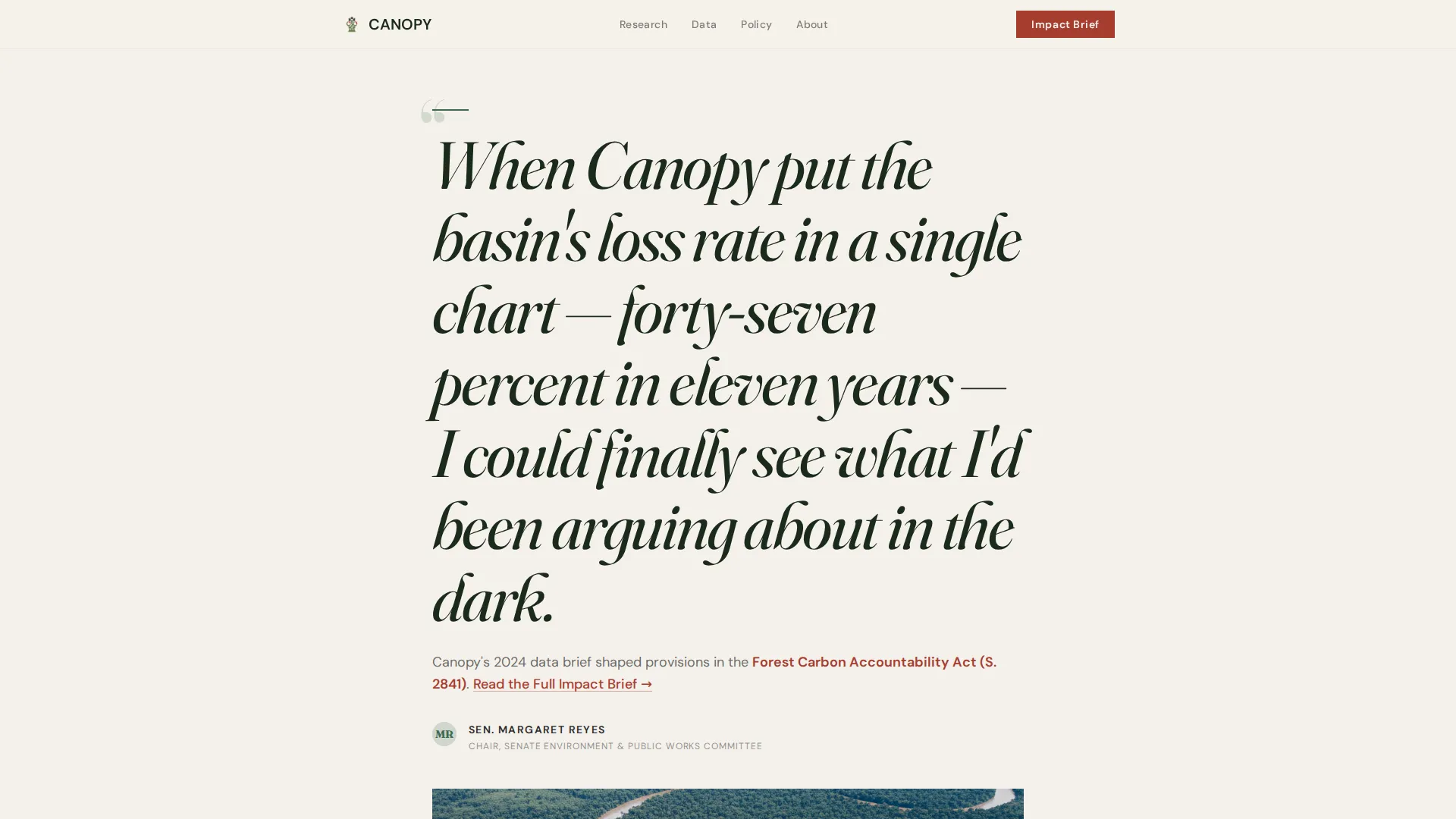
- A testimonial card header with a legislator pull-quote, a named forest photograph, and a subtle inline link to the impact brief
- A scrollable Origin Story arc moving from founding expedition through data cascade to enacted legislation
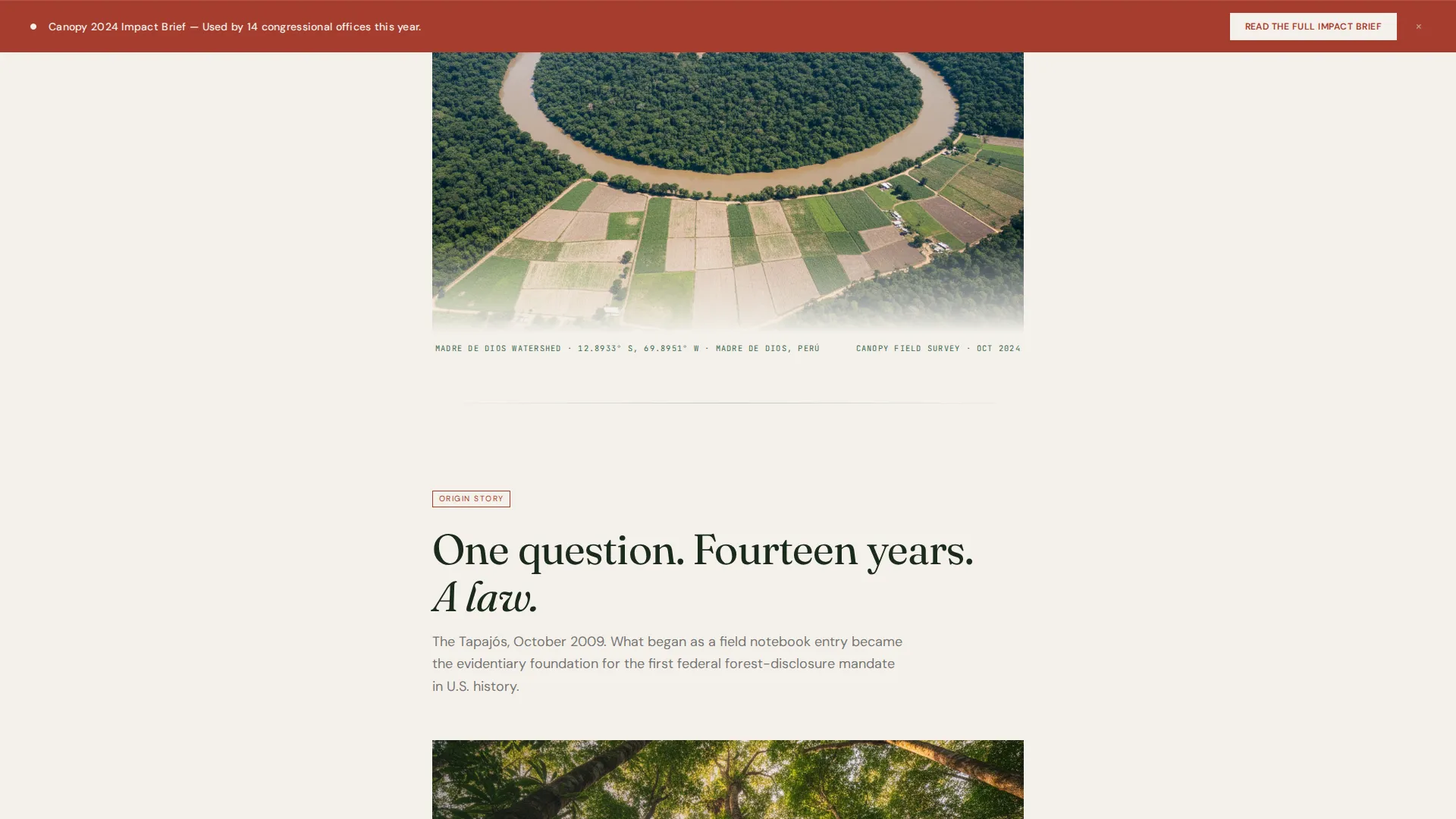
- A policy-red fixed bottom bar that activates once the visitor passes the legislative outcomes section
Feature list
A paragraph introduces the feature set: Canopy packages the visual authority of a classified briefing folder with the narrative clarity of a well-edited research report. Each built-in feature serves the template's single goal of converting high-credibility visitors into impact brief readers.
Testimonial Card Header
The header opens with an oversized serif pull-quote from a sitting legislator or indigenous land defender. Below the attribution sits a named, geolocated forest photograph rather than stock imagery. A thin understory-green rule frames the card on vellum, giving it the weight of sworn testimony entered into a public record.
Origin Story Scroll Arc
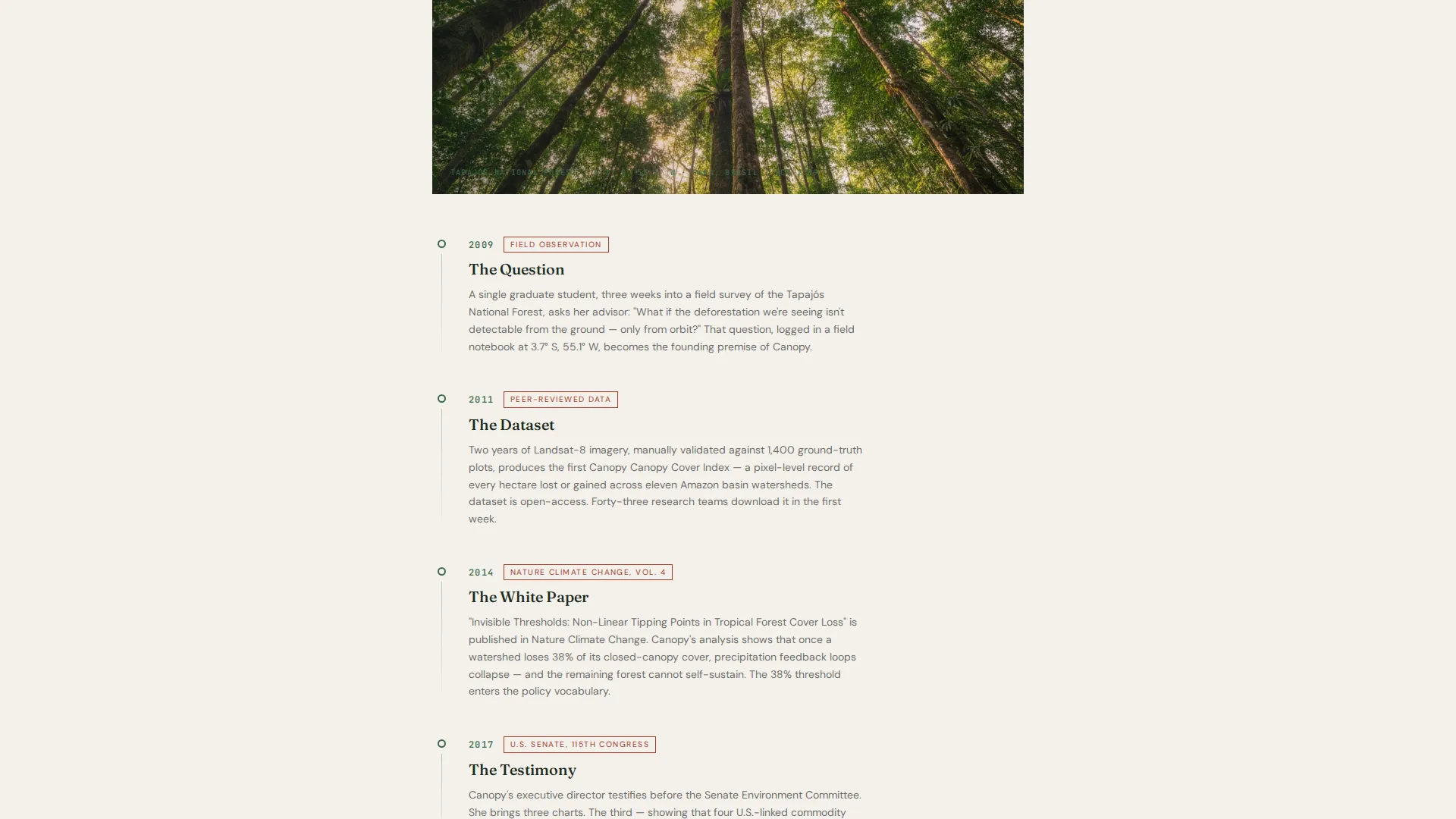
Five thematically linked sections trace one field research question from a 2009 expedition through a dataset, a white paper, congressional testimony, and finally enacted legislative text. Scroll-linked section markers and GSAP ScrollTrigger reveals guide the reader through each stage without losing narrative momentum.
Data Cascade Section
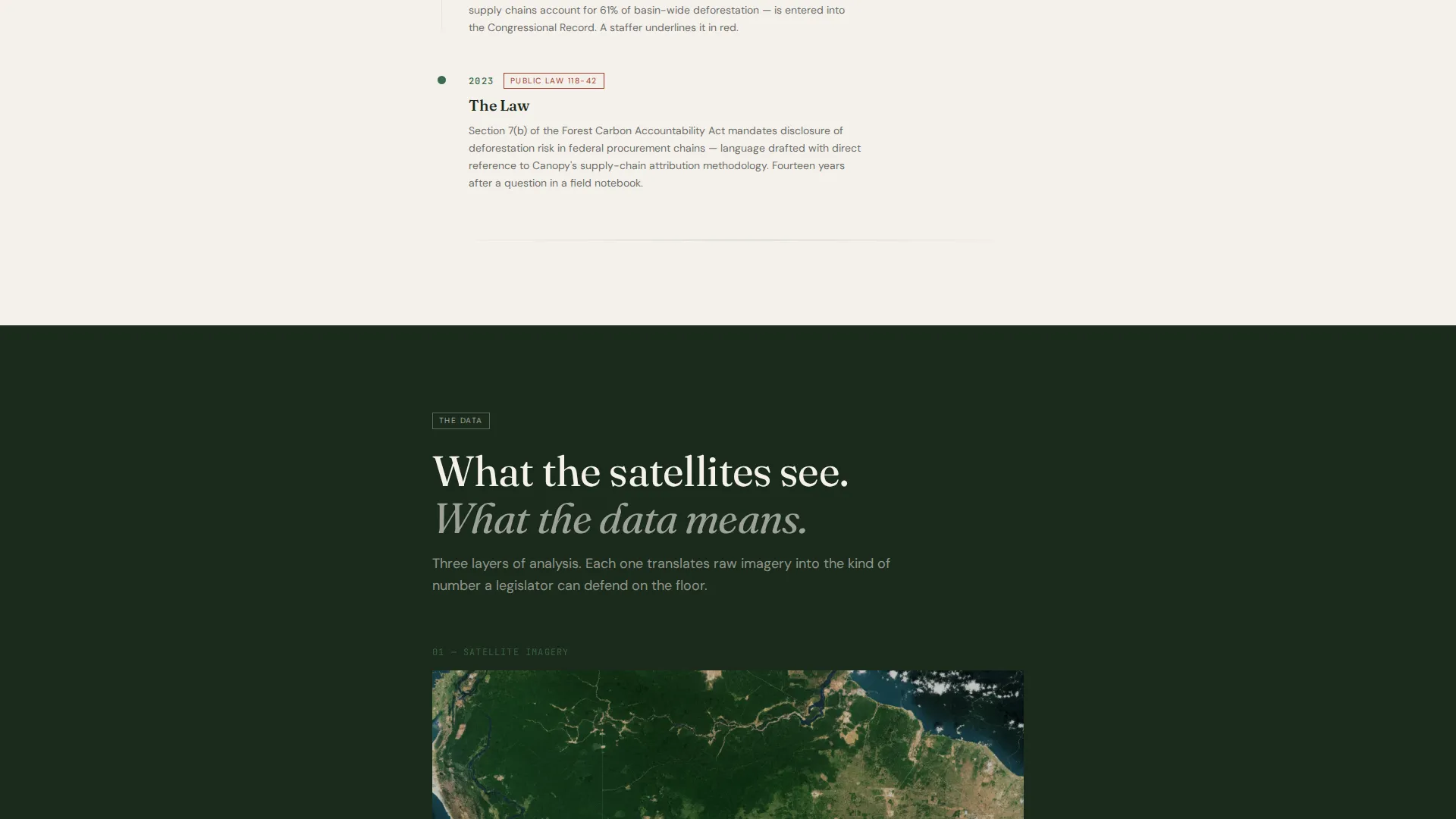
A loam-background section presents satellite imagery, species counts, and community displacement figures in a sticky scroll layout. Each data point deepens the human and ecological stakes before the call to action appears.
Fixed Bottom Call to Action Bar
A policy-red bar anchored to the bottom of the viewport activates once the visitor scrolls past the legislative outcomes section. It reads "Read the Full Impact Brief" and delivers a gated PDF on the next page, removing form friction from the primary conversion moment.
Forest Trust Color and Typography System
Headlines use a Fraunces serif for editorial gravitas. Body copy and captions use DM Sans for legibility. Backgrounds alternate between loam (#1B2A1B) and vellum (#F4F1EB). Policy-red (#A63D2F) is reserved strictly for citations, data callouts, and the primary call to action, so it always signals importance.
Civic Institutional Design Theme
The overall aesthetic reads like a classified briefing folder left open on a mahogany desk. Warm charcoal (#2C2C2C) body text, peer-reviewed citation callouts, hectares-saved metrics, and visible tracked legislative text give the page the authority its audience demands.
Page sections overview
| Section | Purpose |
|---|---|
| Hero Testimonial Card | Opens with a legislator pull-quote and a named forest photograph on vellum |
| Origin Story Expedition | Introduces the 2009 founding field question and begins the evidence arc |
| Data Cascade Display | Presents satellite imagery, species counts, and displacement figures on loam |
| Knowledge to Power | Traces white paper through testimony to tracked legislative text on vellum |
| Impact Brief Call to Action | Full-width policy-red section plus fixed bottom bar driving PDF download |
| Footer Links | Minimal Pattern 8 footer with civic and research navigation links |
Design & branding system
The Forest Trust color system gives Canopy its institutional weight. Every palette choice is intentional and functional, not decorative. Typography reinforces the editorial register throughout.
- Colors: deep loam (#1B2A1B), understory green (#3D6B4F), vellum white (#F4F1EB), policy-red (#A63D2F), and warm charcoal (#2C2C2C) for body text
- Typography: Fraunces serif for headlines carrying sworn-testimony gravitas; DM Sans for body copy and data captions
- Backgrounds alternate between loam and vellum across sections, with policy-red used only for citations, callouts, and the primary call to action button
Mobile & speed optimization
The template is designed desktop-first to serve congressional staffers and journalists working on laptops. It also delivers a solid mobile reading experience for secondary audiences accessing the page on the go.
- GSAP ScrollTrigger animations and staggered text reveals are scoped to medium complexity, keeping client-side JavaScript lean
- Server Components handle static content delivery, reducing unnecessary re-renders
- The fixed bottom call to action bar adapts gracefully across viewport sizes without obscuring content
How this template helps you convert
Canopy earns trust through evidence before it ever asks for a click. The conversion architecture follows the same logic as the research it represents: build the case first, then invite action.
- The inline impact brief link appears early, immediately after the header testimonial, for visitors who are already convinced and ready to act.
- The fixed bottom bar activates only after the visitor has scrolled through the legislative outcomes section, timing the ask to the moment of maximum credibility.
- The gated PDF on the next page captures an email with a single field, reducing friction to one confident action after the Origin Story has already done the persuasion work.
Other information about this template
Canopy is built within the Civic Service theme and the Single Column Flow template style, two structural decisions that keep the reading path linear and the authority signal consistent. It sits within the Community and Nonprofit category, specifically the Rainforest Protection Nonprofit subcategory.
- The template is localized for English (United States) with date formatting in the MM/DD/YYYY format and no currency symbols
- No form fields appear on the landing page itself; the email capture happens on the PDF delivery page, which reduces visible friction
- Hover states and scroll-linked section markers provide interactive feedback without distracting from the editorial content
- The minimal Pattern 8 footer includes civic and research navigation links appropriate for an institutional nonprofit audience
- The Intersection Match Score of 13 reflects a tightly aligned match between the template's design system, creative direction, and target niche
Theme
Civic Service
Creative direction
Origin Story
Color system
Forest Trust
Style
Single Column Flow
Direction
Click-Through
Page Sections
Testimonial Card Header with Named Forest Photo
Five-stage Origin Story Scroll Arc
Sticky Data Cascade Section
Scroll-activated Fixed Bottom Bar
Forest Trust Color and Typography System
Civic Institutional Design Theme
Related questions
Who is the primary audience this template is designed to reach?
Does this template include a form on the landing page?
Can I adapt the Origin Story arc to a different founding year or research question?
What triggers the fixed bottom call to action bar?
Is the policy-red color used throughout the page?