Effective Social Advertising Landing Page Template
Fetch is a Facebook ads comparison landing page built specifically for solo dog walkers and small pet-care teams. It leads with real campaign data, walks visitors through a side-by-side comparison of common mistakes versus proven tactics, layers in named testimonials with specific metrics, and drives every scroll toward one clear action: grabbing the free playbook.
by Rocket studio
Quick summary
Fetch is a single-purpose Facebook ads comparison landing page designed for dog walkers who want to stop guessing and start booking. It opens with animated campaign data, builds trust through a structured comparison table and inline testimonials, and closes with a single click-through call to action. No forms on the page. No distractions. Just proof, then a decision.
Who this template is for
This landing page was built for people who walk dogs for a living and want Facebook ads to actually fill their schedules. It speaks directly to operators at every stage of growth, from solo starters to small teams scaling past thirty clients.
- Solo dog walkers running a handful of routes who want their first real Facebook ads result
- Husband-and-wife pet-care teams who have never spent a dollar on paid advertising and want a proven starting point
- Operators who have tried Facebook ads before, burned budget without results, and need a smarter structure to test
What problem this template solves
Most dog walkers who try Facebook ads run into the same wall. They boost a post, pick a broad audience, and watch their budget disappear without a single qualified lead to show for it. The ad click happens, but the landing page does not do its job. A weak post-click experience is only half the equation when it comes to turning Facebook ads into booked clients.
- Visitors arrive from an ad that made a promise, then land on a page that does not match that promise, killing conversion rates immediately
- Dog walkers waste budget on targeting, ad creative, and ad copy without ever building a page that earns the click
- Without social proof and a clear comparison of what works versus what does not, potential clients leave with no reason to act
What you get with this template
Fetch gives you a complete, ready-to-customize Facebook landing page built around real campaign performance. Every section is purpose-built to move a skeptical visitor from first impression to confident click, using data and testimonials instead of stock photos and vague promises.
- An animated hero section displaying real Facebook ads metrics with a catchy headline that grabs the viewer's attention immediately
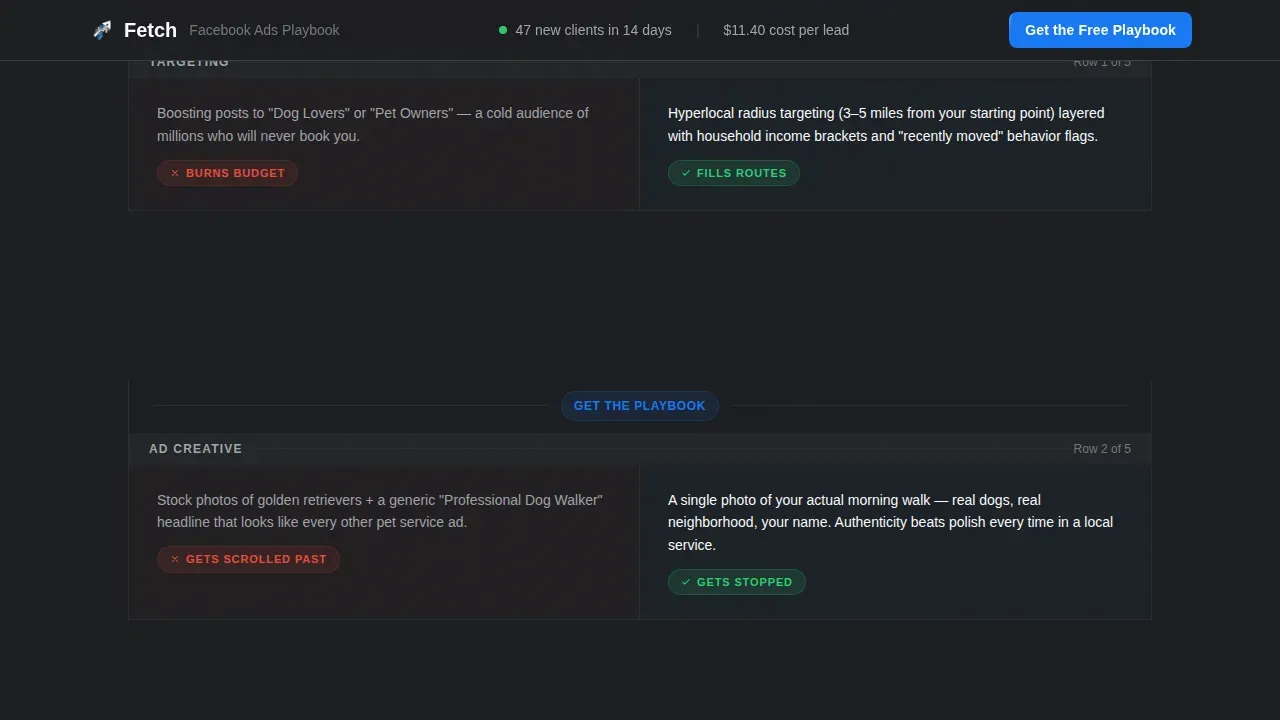
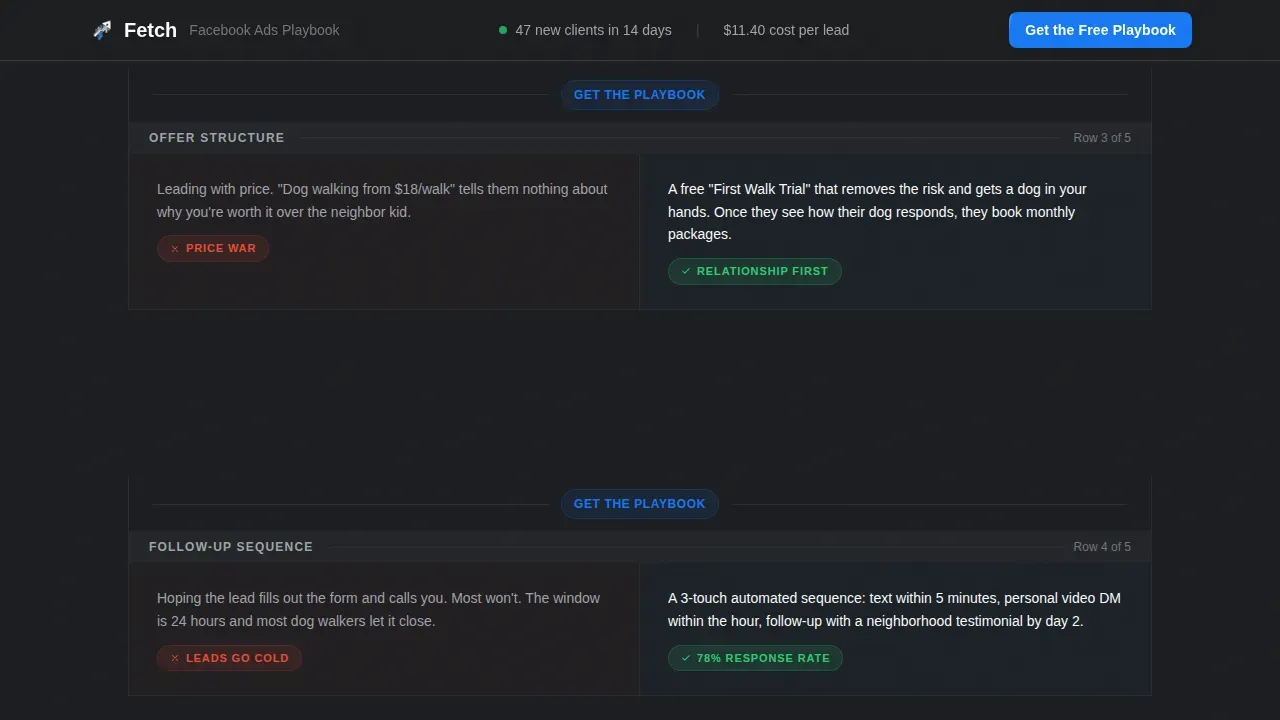
- A five-row comparison table showing exactly what most dog walkers do wrong versus what this guide teaches, with inline testimonial cards after each row
- A bento grid section revealing playbook contents, a floating sticky call to action bar, and a final anchored conversion section that closes with maximum momentum
Feature list
This landing page template is built around a small number of high-impact components. Each one is designed to do specific conversion work at a specific point in the scroll.
Animated Data Hero Section
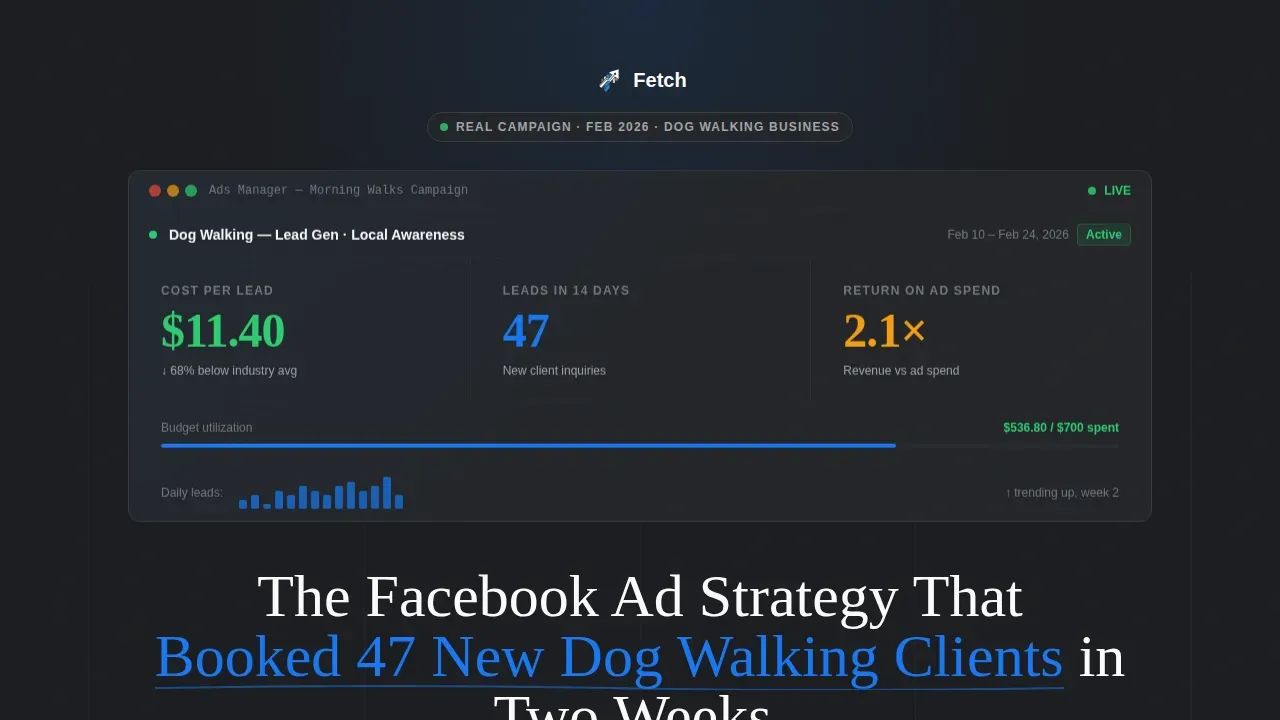
The header opens with a stylized Facebook Ads Manager screenshot showing real campaign numbers: $11.40 cost per lead, 47 leads in 14 days, and a 2.1x return on ad spend. Each number counts up sequentially on load, landing with subtle visual weight. Below the dashboard image, a single headline fades in. The data is the hero image, not a stock photo. This approach captures the viewer's attention in the first seconds of the page experience, which is where campaign performance is won or lost.
Side-by-Side Comparison Table
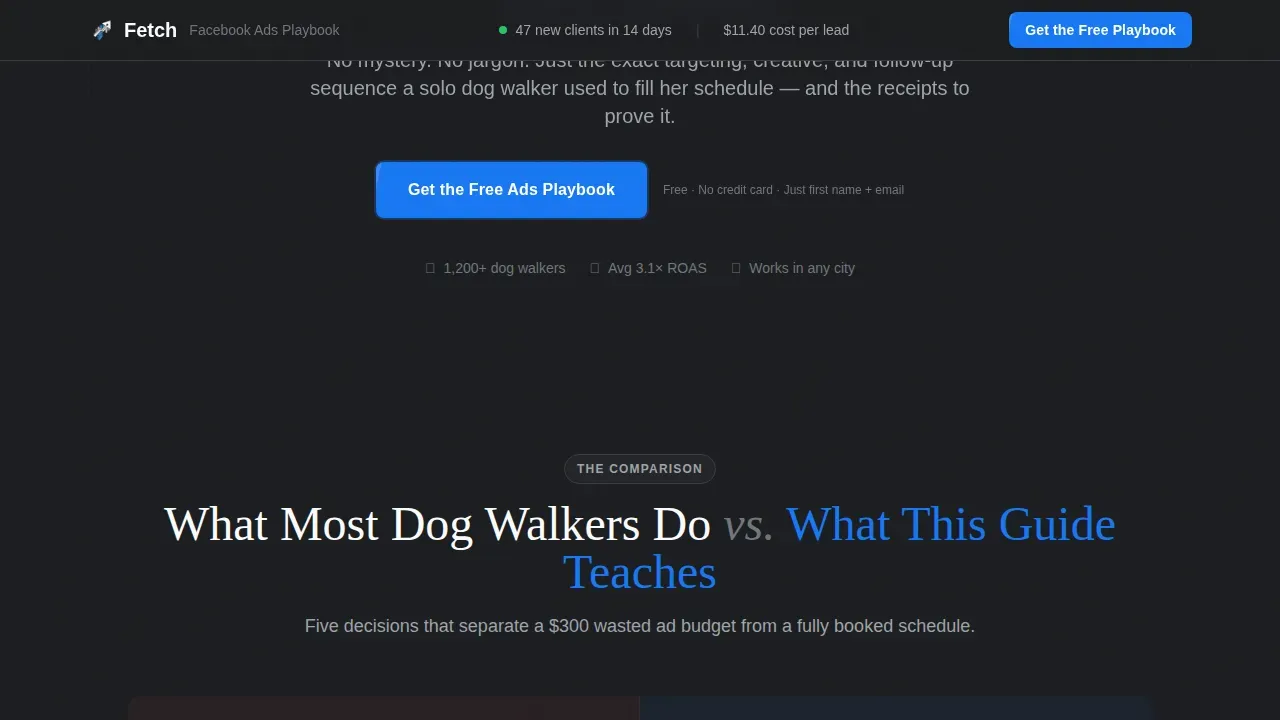
The core of the page is a structured comparison across five rows: targeting, ad creative, offer structure, follow-up sequence, and budget allocation. Each row contrasts what most dog walkers do against what the guide teaches. Using clear visual contrast between approaches lets visitors process the value difference in seconds. A side-by-side comparison landing page is effective for complex services because it reduces cognitive load, and this template applies that principle with precision.
Inline Testimonial Mosaic
Between each comparison row, a real testimonial card appears from a dog walker who used that specific tactic. Each card includes a first name, city, and one concrete metric. This granular social proof structure means trust builds row by row as users scroll down the page. By the time they reach the bottom, the question is not whether it works but how fast they can get started.
Floating Sticky Call to Action Bar
The call to action button reads "Get the Free Ads Playbook" in the electric blue accent color. It appears first beneath the hero data, then pins to the top of the viewport as a floating bar during scroll, then anchors the final section. This gives users three clear moments to act without the page ever feeling pushy or cluttered. A sticky call to action keeps the conversion path visible at every stage of the reading experience.
Bento Grid Playbook Contents Section
A structured bento grid lays out what is inside the free playbook in a clean, scannable format. This section gives visitors a preview of the value before they click, reinforcing the decision without adding friction. Showing benefits clearly and specifically in this format is more persuasive than a simple bullet list of features.
Click-Through Single Action Flow
There is no form on this landing page. Every call to action passes the visitor to a short next-step page that asks only for a first name and email address. This reduces friction at the most critical moment of the conversion process, letting the landing page do the convincing so the next step feels small and safe.
Page sections overview
| Section | Purpose |
|---|---|
| Hero Data Dashboard | Opens with animated campaign metrics and a bold headline to earn immediate attention |
| Comparison Table | Five-row side-by-side layout showing common mistakes versus guide tactics |
| Inline Testimonial Cards | Named social proof placed after each comparison row to build trust progressively |
| Playbook Bento Grid | Visual preview of guide contents to reinforce value before the click |
| Final Anchored Call to Action | Closing conversion section after the last testimonial to capture decision-ready visitors |
| Floating Sticky Bar | Persistent call to action button visible throughout the entire scroll |
| Footer Pattern Linear | Clean footer that closes the page without adding distraction or extra links |
Design & branding system
Fetch uses a Monochrome Steel color system that reads like a polished analytics dashboard. The palette borrows visual authority from the tools dog walkers already use, making the page feel credible from the first frame.
- Deep charcoal (#1C1E21) anchors all primary backgrounds, brushed steel (#71767B) handles secondary text and divider lines, and bright white (#FAFAFA) lifts card surfaces and data callouts so numbers pop with high contrast
- A single electric blue accent (#1877F2) is used exclusively for every clickable element, creating a consistent and immediately recognizable call to action color across all three button placements
- Typography pairs Fraunces as a serif display face for headlines with bold typography presence, and Manrope as a clean sans-serif body font, giving the page a balance of editorial authority and dashboard readability
Mobile & speed optimization
Most Facebook users browse on mobile devices, so this landing page is built mobile-first. The layout adapts cleanly from phone to desktop without sacrificing the comparison table structure or the animated hero section.
- The floating sticky call to action bar is designed to remain usable on small screens, keeping the conversion path accessible without covering critical content
- The comparison table reflows responsively so the side-by-side format stays readable on narrower viewports, preserving the visual clarity that makes the page convert
- Static content is handled through server components while animations and interactive elements use client rendering, balancing page responsiveness with the sequential number-counting effects in the hero
How this template helps you convert
Successful Facebook ads generate profitable conversions through strategic alignment of targeting, ad creative, and post-click experience. A landing page that mirrors the promise of the ad removes friction and increases conversion rates. Fetch is built around that principle at every level.
- The page earns trust before it asks for anything. Real campaign numbers, a clear comparison table, and named testimonials with specific metrics build credibility row by row. By the time users reach the call to action, they have already seen the evidence. This is how the page turns an ad click into a qualified lead without a hard sell.
- The single call to action is visible at all times. The floating sticky bar means that whenever a visitor decides they are ready to act, the path to immediate action is right in front of them. There is no hunting for a button. There is no second-guessing the next step. The page is structured so the moment a visitor is convinced, the click is effortless.
- Message match is built into the template architecture. The headline, the comparison table, the testimonials, and the call to action all reinforce the same core promise. A relevant landing page that aligns with the ad that brought the visitor here strengthens message consistency and improves your ad's relevance score, which can lower your cost per click over time.
Other information about this template
Fetch is one of the more focused facebook landing page templates available for the pet-care industry. It was designed specifically for dog walker marketing, which means it does not require heavy customization to feel relevant to the audience. The template style is Comparison Table, the creative direction is Testimonial Mosaic, and the header concept is Data Storytelling. These three components work together to create a facebook landing page experience that feels more like a conversation than a sales page.
The fetch proven facebook ads comparison landing page template is available as a fully coded starting point. You can swap in your own campaign numbers, replace the placeholder testimonials with real client results, update the photos in the bento grid, and adjust the brand color if needed. The electric blue accent is pulled directly from the Facebook brand palette, so it looks familiar to anyone who has spent time inside their ads account.
For context on the broader landscape of facebook landing page templates, tools like Leadpages offer libraries of professionally designed pages that can be customized for specific facebook campaigns and sorted by historical conversion rate. The fetch template occupies a different niche: it is narrowly tailored to dog walker advertising rather than being a general-purpose landing page builder option. This specificity is its advantage. Customizing landing page templates to match a specific audience eliminates the message inconsistency that kills conversion rates on generic pages.
When running facebook ads alongside other paid channels like google ads, a dedicated landing page for each campaign ensures the messaging stays highly relevant and allows for meaningful testing across audience segments. Dog walkers who later want to explore carousel ads, video ads, or carousel format variations for retargeting will find the template structure easy to adapt. Video ads, for example, follow a four-part structure: a hook, a demonstration, proof, and a call to action. That four-part rhythm maps naturally onto the scroll flow this template already uses.
The facebook ad library is a useful research tool when writing ad copy to pair with this landing page. Studying facebook ad examples from similar service businesses helps clarify what ad creative resonates with the same audience. Strong ad copy reinforces visual concepts with one clear message, and the best facebook ad examples match the landing page tone so closely that the transition from ad to page feels seamless.
For advertisers running limited time offers, the template's clear call to action structure makes it straightforward to add urgency without cluttering the layout. Pricing options can be surfaced in the bento grid section if the offer includes a paid tier alongside the free playbook. The page is also a good example of how to handle conversion data transparently: showing real performance data upfront sets visitor expectations honestly and builds the kind of credibility that lower-performing pages never establish.
Younger audiences who engage with facebook campaigns on mobile expect pages that load fast and make the value obvious within the first scroll. This template is designed to meet that expectation by leading with numbers, not with paragraphs. The comparison architecture also works well for marketers outside pet care who want to adapt the structure for other service-based businesses where before-and-after framing is relevant. Before running messy facebook campaigns with high cost per acquisition, users face unclear structure and wasted spend. After implementing the guide this page promotes, they can work toward organized campaigns and lower acquisition costs.
- The template includes no navigation menus or external links, keeping all focus on the single conversion action
- The comparison table uses visual contrast so that differences between approaches are processed instantly, without writing heavy explanatory text
- Named testimonials with city and metric data add specific, verifiable credibility that generic review quotes cannot match
- The page is built to let users click through to a short next-step page, so the on-page experience never asks for personal information before delivering value
- Templates designed for specific industries, like this one, help create effective facebook landing pages more quickly than starting from a blank canvas
- Regularly refreshing the campaign numbers and testimonials based on new performance data keeps the page relevant over time and maintains conversion rates as the audience grows
Theme
Educational Guide
Creative direction
Testimonial Mosaic
Color system
Monochrome Steel
Style
Comparison Table
Direction
Click-Through
Page Sections
Animated Data Hero Section
Five-row Comparison Table
Inline Testimonial Mosaic
Floating Sticky Call to Action Bar
Bento Grid Playbook Preview
Click-through Single Action Flow
Related questions
Does this template include the opt-in form?
Can I use this template if I have never run Facebook ads before?
How do I update the campaign numbers shown in the hero section?
Is this template suitable for pet-care businesses beyond dog walking?
Does the floating call to action bar work on mobile devices?