Teal Nature-Inspired Healthcare Access Landing Page
Catalyst is a nature-inspired healthcare access landing page built for social enterprises that bring care directly to underserved communities. It pairs a hand-drawn illustrated landscape with a teal, moss, and coral color system to create a page that feels alive with purpose. The design guides funders, public health directors, and community organizers from emotional story to Summit registration in one focused scroll.
by Rocket studio
Quick summary
Catalyst is a single-column landing page template designed for healthcare access social enterprises. It opens with a full-viewport custom illustration, moves through human-centered storytelling and program showcases, and closes with a Summit registration form. Every section is built to earn trust and convert visitors who carry real decision-making weight. The template speaks directly to people who fund, deliver, and organize care.
Who this template is for
This template is built for organizations and individuals who are actively working to close the gap between patients and the care they need. It speaks the language of direct service, data-backed impact, and urgent community need. If your audience makes funding decisions, manages field programs, or sits inside the communities most affected, this page is designed with them in mind.
- Foundation program officers and corporate social responsibility leads who need a funding-ready presentation that connects dollars to real-world patient outcomes
- Public health directors, community organizers, and field practitioners who want a page that reflects the work they do and the populations they serve
- Social enterprise teams developing an event-driven campaign where registration, relationship-building, and mission communication all need to happen on one page
What problem this template solves
Healthcare access organizations often have a profound mission but a presentation that fails to match its weight. A generic page cannot carry the emotional and structural complexity of a project that serves rural parishes, food deserts, and communities medicine has historically overlooked. Visitors who arrive with budget authority or partnership interest need to feel conviction before they commit.
- Funders reviewing dozens of grant requests need a page that separates real impact from noise, with specific data, a clear program focus, and a direct path to engagement
- Community leaders and practitioners need a design environment that reflects their world, not a sterile clinic brochure aesthetic that feels distant from the ground truth
- Organizations developing an annual Summit presence need a page that handles both event registration and longer-term network-building in one seamless flow
What you get with this template
This template delivers a complete single-column landing page built around a Vision and Mission creative direction. Every section is designed to pull visitors deeper into the story while always keeping the conversion goal visible. The illustrated world from the header persists through each scroll section, growing more populated as the narrative builds.
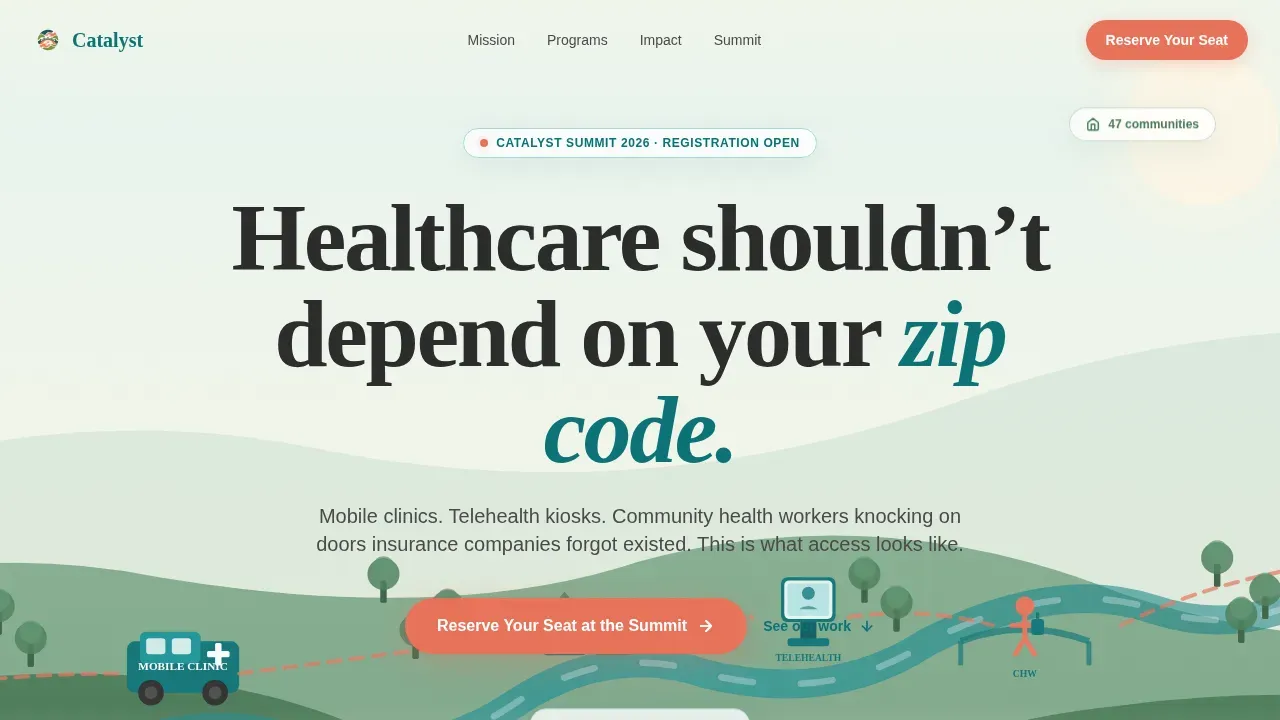
- A full-viewport hero with a hand-drawn SVG illustrated landscape, floating data badges, and a primary call to action in catalyst coral
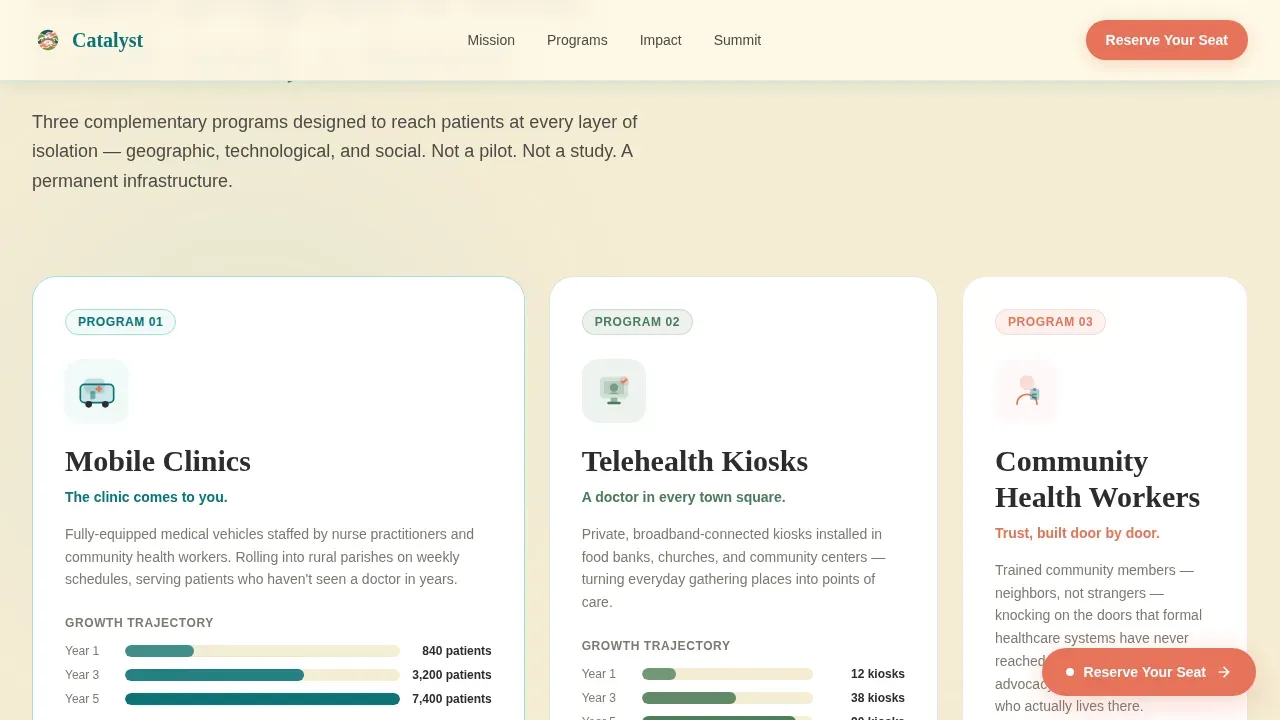
- Three program sections presented as asymmetric cards covering mobile clinics, telehealth kiosks, and community health workers, each introduced as a seed of sustained community impact
- A Summit registration block with a full validated form, a role dropdown, an open-field qualifier question, and a secondary Field Network email capture path for visitors who cannot attend
Feature list
This template packages several purpose-built components. Each one is grounded in the source brief and designed to serve the specific audience this page attracts.
Full-Viewport Illustrated Hero
The hero spans the entire screen with a hand-drawn SVG landscape connecting community clusters to healthcare symbols. A mobile clinic sits between illustrated hills. A telehealth screen glows in a town square. A community health worker crosses a river bridge. The headline emerges from the landscape in a clean serif: "Healthcare shouldn't depend on your zip code." Floating data badges animate in on scroll, giving the scene immediate credibility and scale.
Human-Story Problem Section
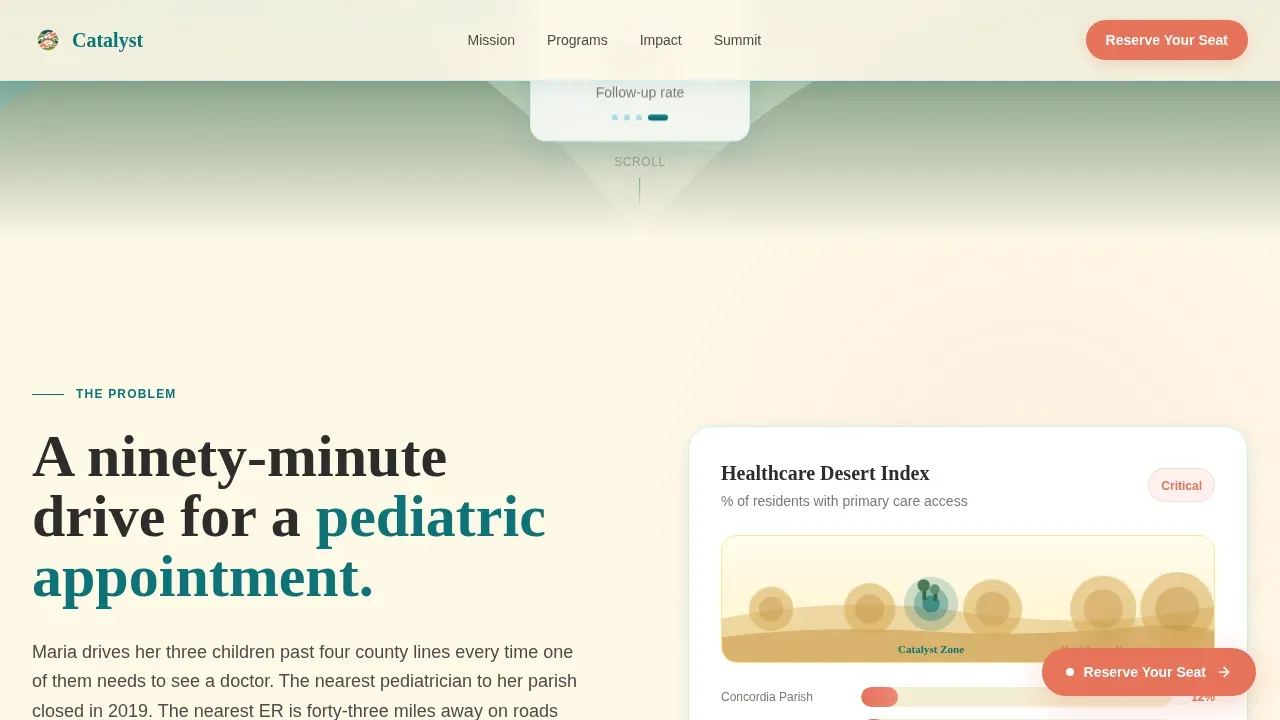
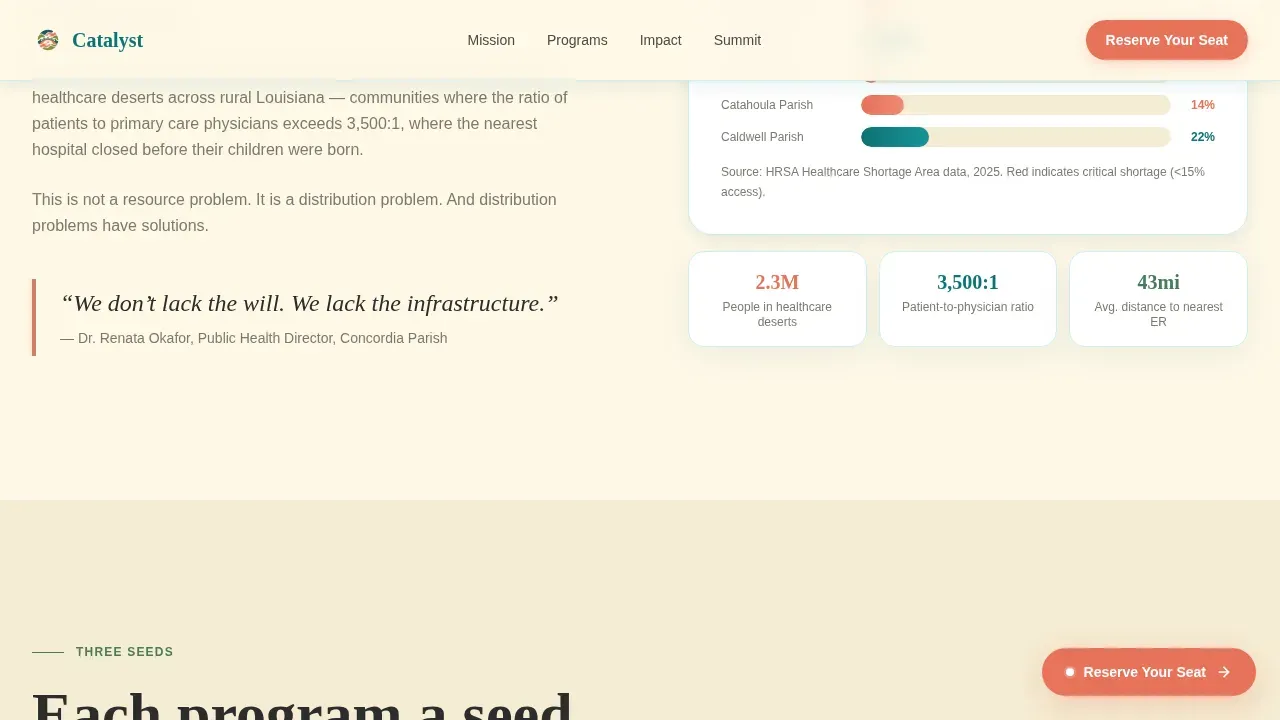
The problem section opens with a single mother driving ninety minutes for a pediatric appointment. That one image carries more weight than a paragraph of analysis. The section then pulls back to reveal a data visualization of healthcare deserts rendered as barren patches in the same illustrated landscape from the hero. This contrast between the personal and the systemic is what stops a program director mid-scroll and makes them feel the mission.
Three-Program Asymmetric Cards
Each program is presented as a distinct card: mobile clinics rolling into rural parishes, telehealth kiosks planted in food deserts, and community health workers who reach the patients insurance systems forgot. The cards use an asymmetric layout to create visual rhythm and avoid the flat row-of-boxes pattern that makes nonprofit pages feel interchangeable. Illustrated growth stages accompany each card, showing projected community impact at one, three, and five years.
Animated Impact Proof Section
The impact section uses GSAP-powered counter animations on patient and community numbers. Named testimonial cards sit beside the counters, each containing a specific quote rather than a generic phrase. This section gives the working group of funders and practitioners the social proof they need to feel confident in the organization before they fill out the registration form. Data without human voice is analysis; this section delivers both.
Summit Registration Form with Lead Qualifier
The registration block captures full name, organization, role via dropdown, and a single open-field question: "What healthcare gap keeps you up at night?" That question does two things at once. It qualifies the lead by surfacing the visitor's specific focus area. It also creates emotional investment by asking them to articulate their own sense of urgency. Below the primary form, a secondary path captures email addresses from visitors who cannot attend, ensuring every session with the page leads to a connection.
Floating Coral Call-to-Action Button
After the mission section, a coral-colored "Reserve Your Seat at the Summit" button pins to the viewport on scroll. This floating element means the conversion path is always visible without interrupting the reading experience. It is the most direct implementation of the principle that a good landing page never makes a ready visitor hunt for the next step. The coral color is reserved exclusively for this and other urgent data points, making every appearance feel intentional.
Page sections overview
| Section | Purpose |
|---|---|
| Illustrated Hero | Introduce mission and anchor visual identity |
| Problem Story | Humanize the healthcare gap with narrative and data |
| Program Cards | Describe all three direct-service programs |
| Impact Proof | Report patient numbers and named testimonials |
| Summit Registration | Capture attendee data and Field Network emails |
| Page Footer | Provide navigation and secondary contact paths |
Design & branding system
The visual language is rooted in a nature-inspired philosophy: the page should feel like a medicinal garden at golden hour, quiet and alive at the same time. Every color has a specific role, and the discipline of that system is what makes the design feel considered rather than assembled. The illustrated style, somewhere between editorial illustration and folk art, ensures no stock photography appears anywhere on the page.
- Color system: deep canopy teal (#0D7377) anchors the primary structure, living moss (#4A7C59) carries secondary sections and proof points, sunlit cream (#FFF8E7) breathes as the dominant background, and catalyst coral (#E8725A) appears only on calls to action and urgent data points; charcoal loam (#2C2C2C) keeps text grounded and readable
- Typography: Fraunces is used for all display serif headlines, giving the page warmth and editorial authority; DM Sans handles body copy with clean legibility that never competes with the organic palette around it
- Illustration system: the hand-drawn SVG landscape from the hero reappears through each scroll section, growing more populated and alive as the page progresses, creating a continuous illustrated environment that rewards the reader who stays
Mobile & speed optimization
The template is built desktop-first, reflecting the reality that funders, faculty members, and health directors reviewing program materials typically do so on a full-screen browser. That said, the layout is fully responsive and adapts cleanly to mobile viewports, ensuring no visitor is excluded regardless of device.
- GSAP scroll reveal animations and counter animations are implemented as client-side components, keeping static sections lean and fast to render without sacrificing the high-animation experience the design calls for
- The floating coral call-to-action button is positioned and sized for both desktop and mobile interaction, maintaining its conversion function across all screen sizes without covering essential content
How this template helps you convert
This page is designed around a single conversion goal: Summit registration. Every structural and visual decision supports that goal. The page does not scatter attention across multiple competing actions. It leads the visitor through a story arc that makes registering feel like the natural next step.
- The hero and problem sections build emotional investment before asking for anything, so by the time the registration form appears, the visitor already understands why the Summit matters and what kind of people will be in the room
- The role dropdown and open-field question in the registration form qualify each lead at the moment of conversion, giving the organization useful data about who registered and what specific focus area brought them to the page
- The Field Network secondary path below the form ensures that visitors who cannot attend the Summit still leave with a thread of connection, turning a page bounce into a future relationship
Other information about this template
This template is part of a broader ecosystem of mission-driven design resources developed for nonprofit and social enterprise organizations. The following notes are useful for teams assessing fit, developing their implementation plan, or exploring customization options.
The catalyst teal nature inspired healthcare access landing page template is designed for organizations at the intersection of public health, direct service, and community trust. It is particularly relevant for teams where a working group of funders, practitioners, and community stakeholders needs to align around a shared mission event like an annual Summit.
Several aspects of the template deserve attention during setup. The illustrated SVG landscape in the hero is the visual spine of the entire page. Teams developing their customization plan should treat that illustration as the primary design asset and build outward from it. The color system is intentional: resist the temptation to introduce new materials or off-palette colors that would dilute the teal-to-coral narrative the design depends on.
The project aims to reduce friction between a visitor's emotional response and their decision to register. Careful planning of the form field order and the Summit details block is important: place the event date, location, and speaker highlights above the form so that visitors have full context before they commit. This is a foundational principle of effective event registration pages.
From a content perspective, teams are encouraged to populate the impact counters with real patient and community numbers as early as possible. Abstract data placeholders undermine the credibility the design works hard to establish. Named testimonials with specific quotes are more valuable than paraphrased endorsements; the template is structured to display them as such.
The page supports discussions between funding organizations and delivery organizations by giving both audiences a clear perspective of the work and a direct path to involvement. Program officers focused on funding decisions and field practitioners focused on patient care can each find their entry point without the page feeling split in two directions.
For teams interested in developing the Field Network as an ongoing engagement channel, the email capture below the registration form is the starting point. That list represents visitors who are interested in the mission but not yet ready to commit to the Summit. Treating them as a working group in progress, rather than a failed conversion, is the right long-term frame.
Digital solutions like this template enable organizations to streamline patient-facing and funder-facing communication on one page. Research consistently shows that landing pages connecting patients and funders to healthcare services perform better when they lead with human stories and follow with data. This template follows that sequence deliberately.
No-code platforms that support this template reduce the time and cost involved in developing a polished, high-animation healthcare landing page. Teams without dedicated development resources can still achieve a publication-ready result. Templates like this one enable non-technical users to implement a complex illustrated layout without building from scratch.
Nature-inspired design systems have been shown to create a calming effect that is especially valuable in healthcare contexts, where users may arrive carrying stress or urgency. The organic palette and illustrated environment in this template are chosen with that psychological effect in mind. Using colors and patterns drawn from the natural world positively influences the emotional response of visitors, making them more receptive to the message and the call to action.
The following points summarize additional context useful for teams evaluating or implementing this template:
- The page is localized for English-language audiences in the United States, with USD formatting and rural geography references that reflect a Louisiana and broader Southeast context
- The frequently asked question accordion component within the Summit section enables visitors to get answers to common event questions without leaving the page, supporting the conversion goal
- Researchers and faculty members working in public health, oncology, and community medicine fields will find the framing of this page familiar and credible
- The template can be adapted for annual report launches, grant announcement pages, or community health campaign introductions with modest structural changes
- Student researchers and emerging practitioners involved in community health programs are also a natural secondary audience for the Field Network email capture
- The illustrated system, high-animation implementation, and coral call-to-action structure represent a specific design vocabulary that can be maintained across future campaign pages for brand consistency
- Organizations assessing this template for a working group presentation or board-level review will find the visual materials and section structure clear enough to stand on their own without additional slides
- The ability to capture both high-intent Summit registrants and lower-intent Field Network subscribers on one page gives the organization two data streams from a single campaign effort
- Teams developing sustainability messaging around long-term community health impact will find the growth-stage illustrations in the program cards an effective visual framework for that narrative
Theme
Nature-Inspired
Creative direction
Vision & Mission
Color system
Teal Catalyst
Style
Single Column Flow
Direction
Event Registration
Page Sections
Full-viewport Illustrated Hero with Floating Data Badges
Human-story Problem Section with Healthcare Desert Visualization
Three-program Asymmetric Card Layout
Animated Impact Counters with Named Testimonials
Summit Registration Form with Role Dropdown and Lead Qualifier
Floating Coral Call-to-action Button on Scroll
Related questions
Who is the primary audience this landing page is designed to reach?
Can this template be used for purposes other than Summit registration?
What makes the registration form effective for lead qualification?
How does the illustrated design system work across the full page?
Does the page address visitors who cannot attend the Summit?