Sedation Dentist FAQ Website Template
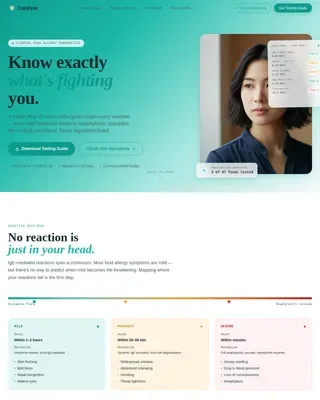
Catalyst is a single-page sedation dentistry landing page built around FAQ-driven comparison tables. It helps patients, office managers, and parents of special-needs children decode insurance coverage, CDT and CPT billing codes, and pre-authorization workflows for IV sedation, oral conscious sedation, and nitrous oxide procedures. The design feels authoritative and reassuring from the first scroll.
by Rocket studio
Quick summary
Catalyst turns one of dentistry's most confusing topics into a calm, scannable resource. The landing page walks visitors through sedation insurance coverage, code lookups, and benefit verification using structured comparison tables and a scroll-based FAQ narrative. Every section answers a real question before asking the visitor to act.
Who this template is for
This template serves a specific and underserved audience: people who need accurate sedation billing information fast, not generic dental content. Whether the visitor is at home at 11 p.m. or at a desk between patient calls, the page meets them with clarity.
- Anxious patients searching whether IV sedation, oral conscious sedation, or nitrous oxide is covered by their plan
- Dental office managers at referring practices who need to verify sedation benefits for a patient already on the schedule
- Parents of special-needs children navigating behavioral coding distinctions such as D9248 versus D9239 that determine claim approval or denial
What problem this template solves
Sedation dentistry billing is genuinely complex. Patients do not know whether to call their medical insurer or dental plan. Office managers juggle pre-authorization deadlines. Parents of children with special needs worry that a single wrong code will cause a denial. No single resource pulls it all together in one readable place.
- There is no clear, public explanation of which sedation types fall under medical versus dental insurance
- CDT and CPT codes for sedation are rarely explained in plain language, making it hard to prepare before a claim is filed
- Pre-authorization workflows differ by carrier and sedation method, leaving patients and staff guessing
What you get with this template
The template delivers a fully structured, content-forward landing page designed for sedation dentistry insurance and billing education. Each section is purpose-built to reduce confusion and build enough confidence that the visitor is ready to act.
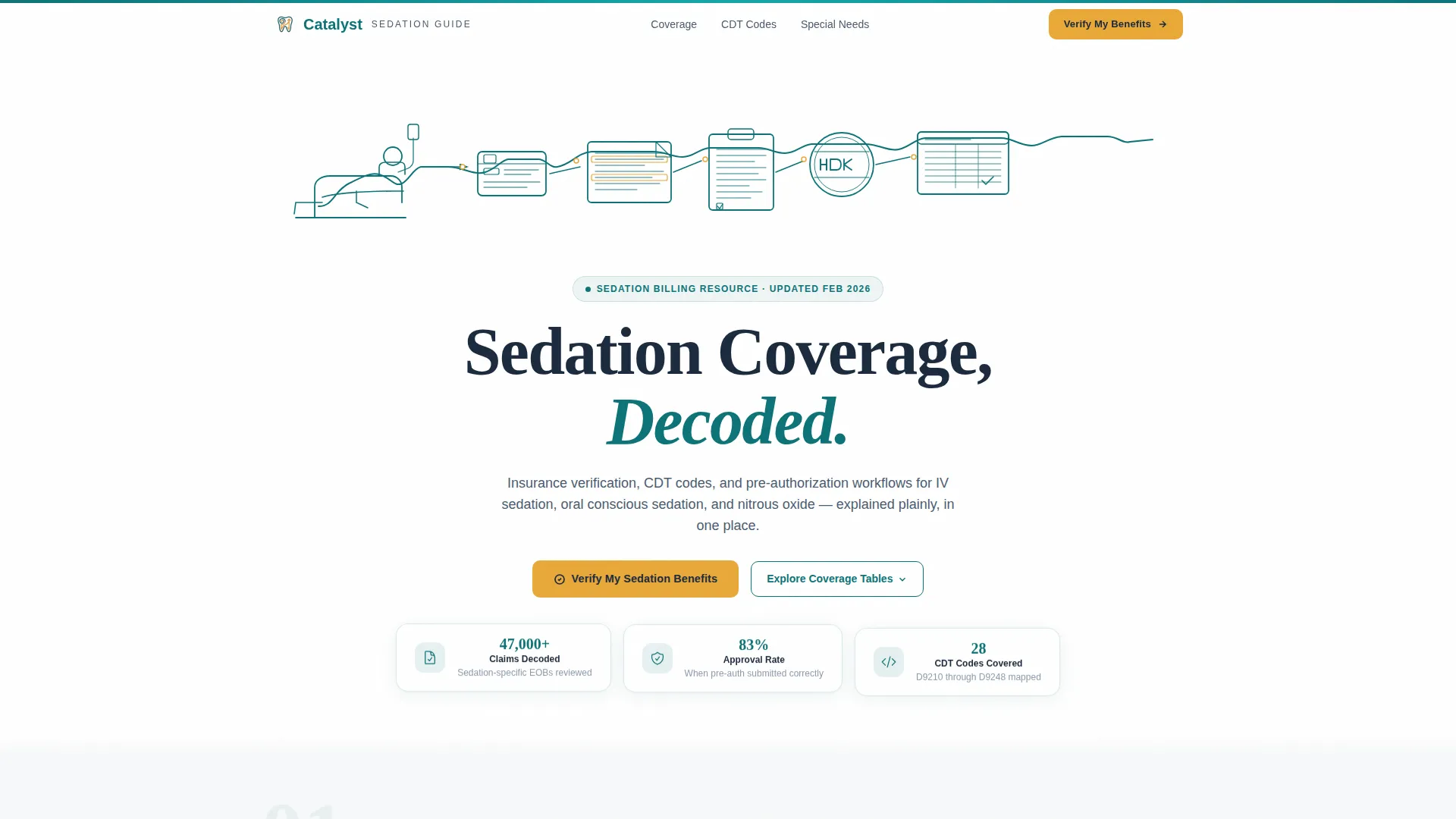
- A hero section with a continuous SVG line art illustration, headline, and floating stat cards showing claims processed, approval rate, and codes covered
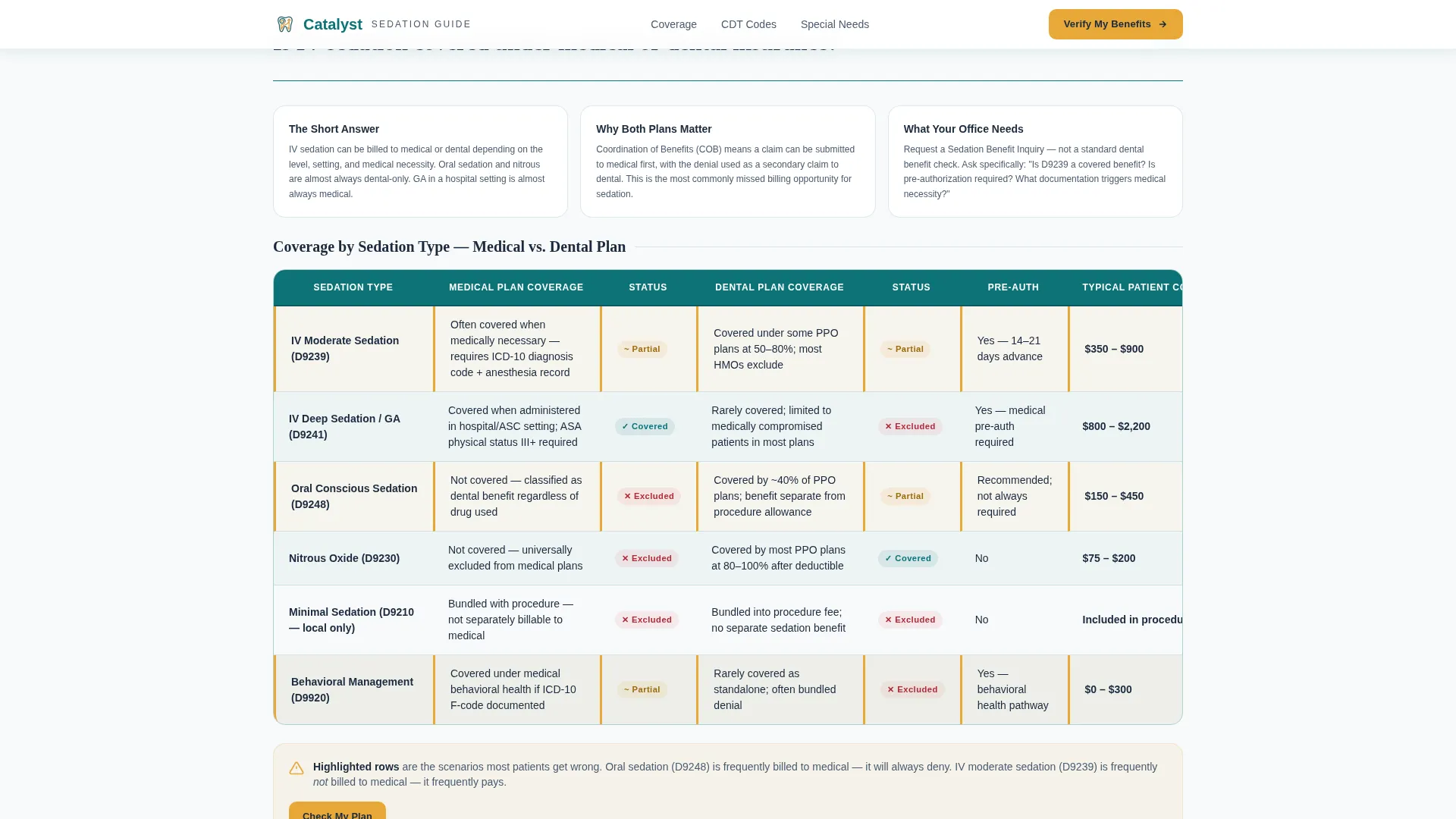
- Two core comparison tables: one mapping medical versus dental coverage by sedation type, and one mapping each sedation method to its corresponding CDT or CPT code and typical reimbursement range
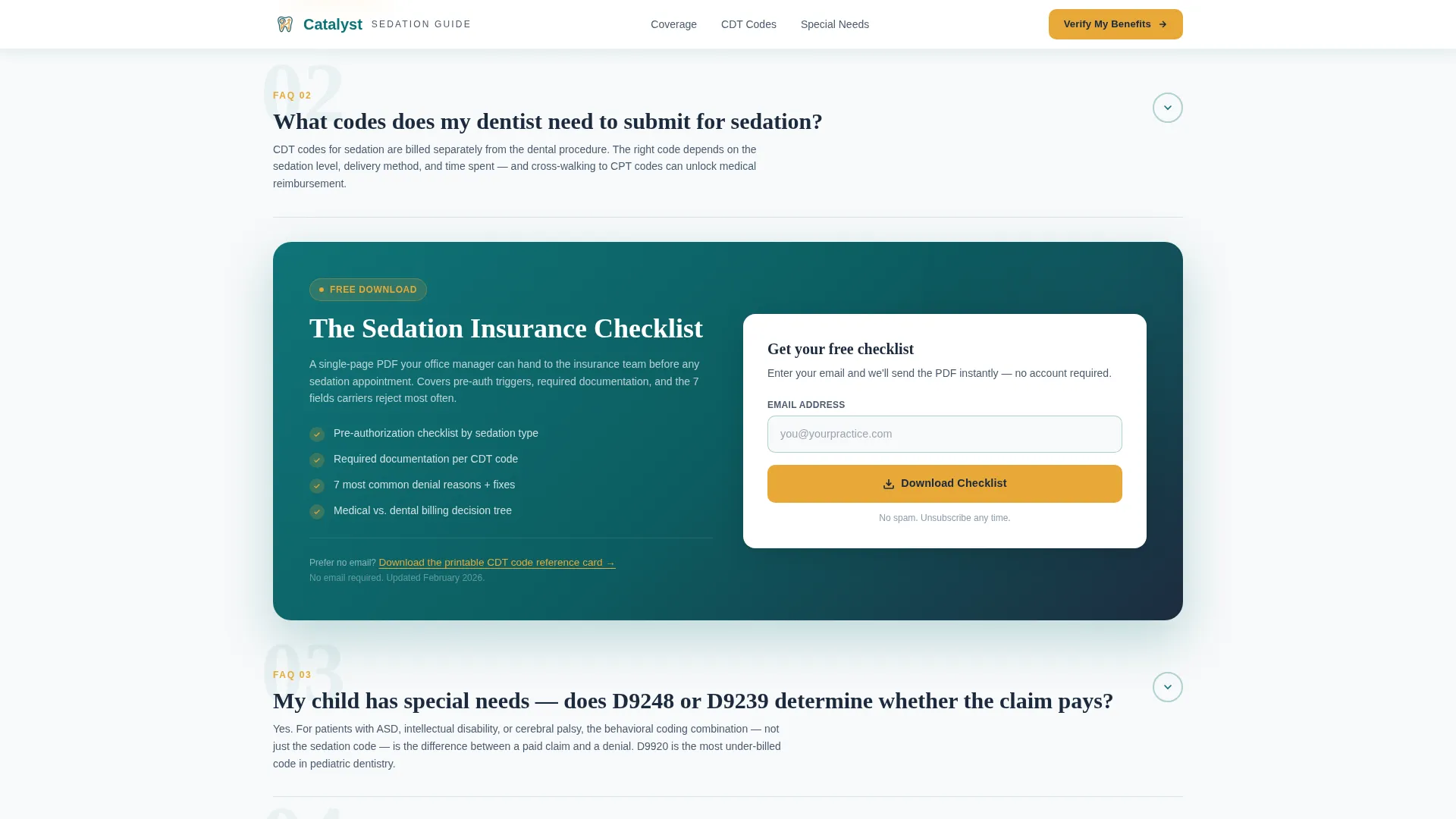
- A gated email capture for the Sedation Insurance Checklist, a printable ungated code reference card, and a short Verify My Sedation Benefits form with insurance carrier, sedation type, and procedure date fields
Feature list
This landing page is built around several purposeful components that each carry their own function in the visitor journey.
FAQ-Driven Scroll Narrative
Each scroll section is framed around a single real question patients and office managers type into search bars. The page does not build urgency. Instead, it dissolves confusion one answered question at a time, so visitors feel informed before they are asked to do anything.
Medical versus. Dental Coverage Comparison Table
The first major table answers the most common coverage question directly. It maps IV sedation, oral conscious sedation, and nitrous oxide against medical plan coverage and dental plan coverage so visitors can find their specific scenario in a single row.
CDT and CPT Code Reference Table
The second table is a three-column reference that pairs each sedation method with its relevant Current Dental Terminology (CDT) or Current Procedural Terminology (CPT) code and a typical reimbursement range. It gives office managers and patients a shared vocabulary before they call the carrier.
Dual Conversion Path Design
The page offers two parallel paths. The primary path gates the Sedation Insurance Checklist behind a single email field, introduced after the third FAQ section. The secondary path provides a printable code reference card with no email required, building trust before the gated ask.
Behavioral Coding Section for Special Needs
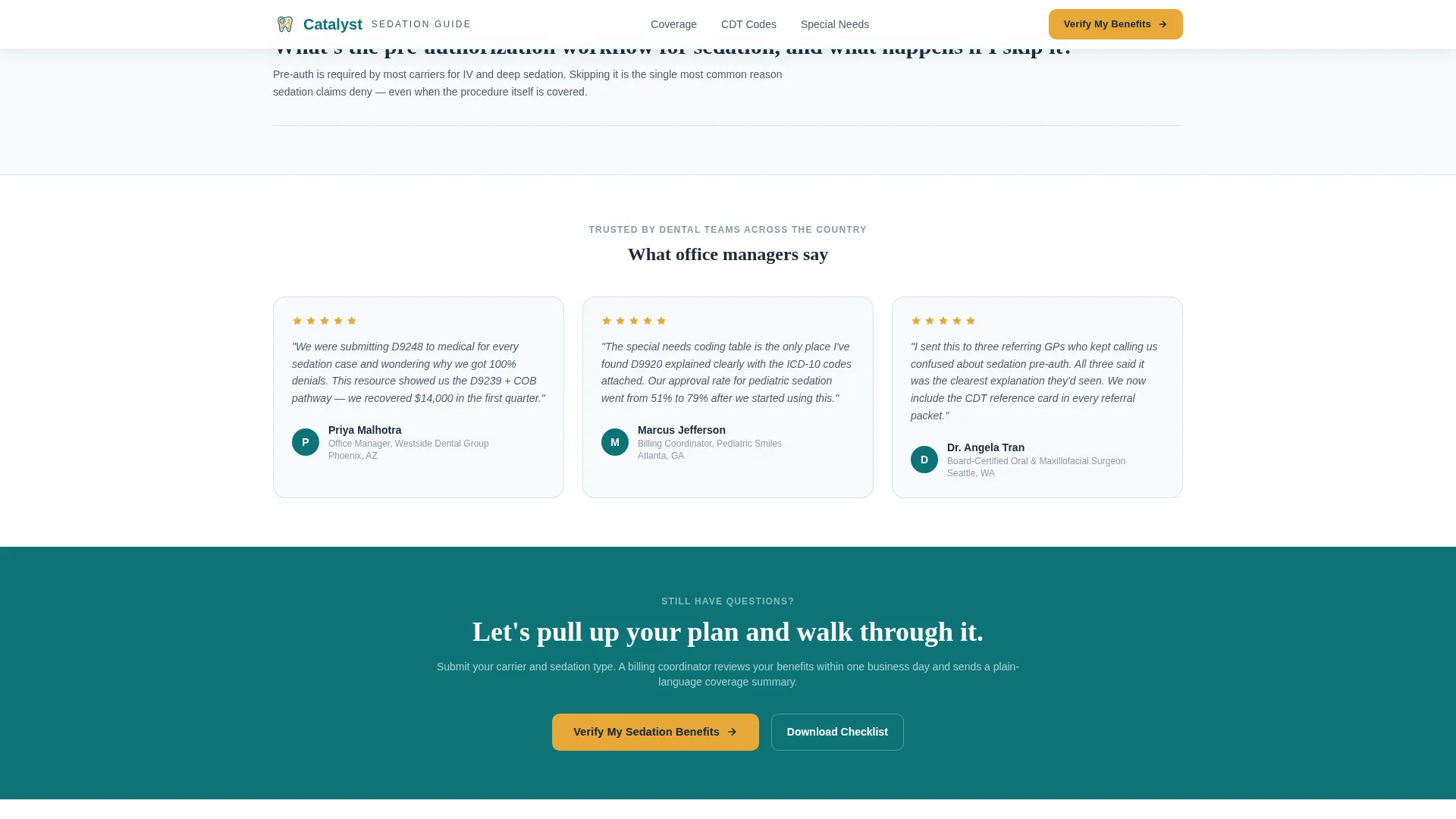
A dedicated section addresses the specific coding distinctions that affect claims for patients with special needs, including D9248 and D9239 behavioral coding. This section is paired with trust builders and a footer pattern that reinforces credibility.
Interactive FAQ Expand and Collapse
Each FAQ block can be expanded or collapsed, keeping the page clean on first load while allowing visitors to go deeper on the questions that match their situation. Table rows include hover states for quick scanning.
Page sections overview
| Section | Purpose |
|---|---|
| Hero with Illustration | Introduce the page concept, display stat cards, and set a calm expert tone |
| Medical versus. Dental Table | Answer whether sedation falls under medical or dental insurance by plan type |
| CDT and CPT Codes Table | Map sedation methods to billing codes and typical reimbursement ranges |
| Email Gate and Form | Deliver the checklist download and open the Verify My Sedation Benefits short form |
| Behavioral Coding and Footer | Cover special needs coding distinctions and reinforce trust before page close |
Design & branding system
The visual identity follows a Corporate Precision theme. The palette is clinical and editorial, designed to feel like a well-designed explanation of benefits document rather than a generic healthcare page.
- Deep clinical teal (#0D7377) anchors headers, table borders, and the SVG line art illustration; midnight charcoal (#1B2A3D) is used for all body text; sterile white (#F7F9FA) appears on alternating table rows
- Warm amber (#E8A838) is reserved exclusively for interactive elements, toggle states, and the primary call to action, creating a clear visual hierarchy between informational content and actionable elements
- Typography pairs Fraunces serif for headlines with DM Sans for body copy and table content, balancing editorial authority with high-readability screen text
Mobile & speed optimization
The page is built mobile-first, reflecting the primary audience behavior: patients searching for sedation coverage information late at night on a phone. The layout and interactions are designed to work cleanly on small screens.
- Scroll-reveal animations and table row stagger effects are set to medium intensity, keeping the experience engaging without overwhelming mobile performance
- The SVG line art illustration uses a line-draw animation that works at any screen width, and the comparison tables reformat cleanly for narrow viewports
- The FAQ expand and collapse interaction and the form modal are built as client-side components, while the comparison tables use server-side rendering for fast initial load
How this template helps you convert
Conversion on this page is not driven by urgency. It is driven by demonstrated competence. The visitor who finds their exact insurance scenario in a table row is already primed to take the next step.
- The two comparison tables act as the primary conversion engine: a visitor who recognizes their situation in a row is much more likely to click "Verify My Sedation Benefits" and complete the short form
- The dual conversion path removes friction by offering real value without an email requirement first, so by the time the gated checklist appears, the visitor already trusts the page
- The progressive FAQ scroll structure means each section earns the next one, so visitors who reach the email gate have already received enough specific value to feel the ask is fair
Other information about this template
This template is a strong fit for sedation dentistry practices that want a dedicated content and resource destination separate from their main practice website. It is purpose-built for the billing and insurance education use case rather than general dental marketing.
- The page targets the United States market, using USD pricing references, MM/DD/YYYY date formatting in the verification form, and CDT and CPT code standards specific to American dental billing
- The inline trust badges and hero stat cards (claims processed, approval rate, codes covered) are included as design components and should be updated with real practice data before publishing
- The Catalyst template is part of the Corporate Precision theme family and uses the Teal Catalyst color system, making it straightforward to align with an existing brand that uses a clinical teal palette
Theme
Corporate Precision
Creative direction
FAQ-Driven
Color system
Teal Catalyst
Style
Comparison Table
Direction
Content/Resource
Page Sections
Faq-driven Scroll Narrative
Medical Versus. Dental Comparison Table
CDT and CPT Code Reference Table
Dual Conversion Path Design
Behavioral Coding Section
Interactive FAQ and Form Components
Related questions
Does this template include real insurance coverage data?
Can I remove the email gate and still use the verification form?
Is this template suited for a practice that only offers one type of sedation?
What does the special needs coding section cover?
What do I need to update before publishing this landing page?